1. Gainsty
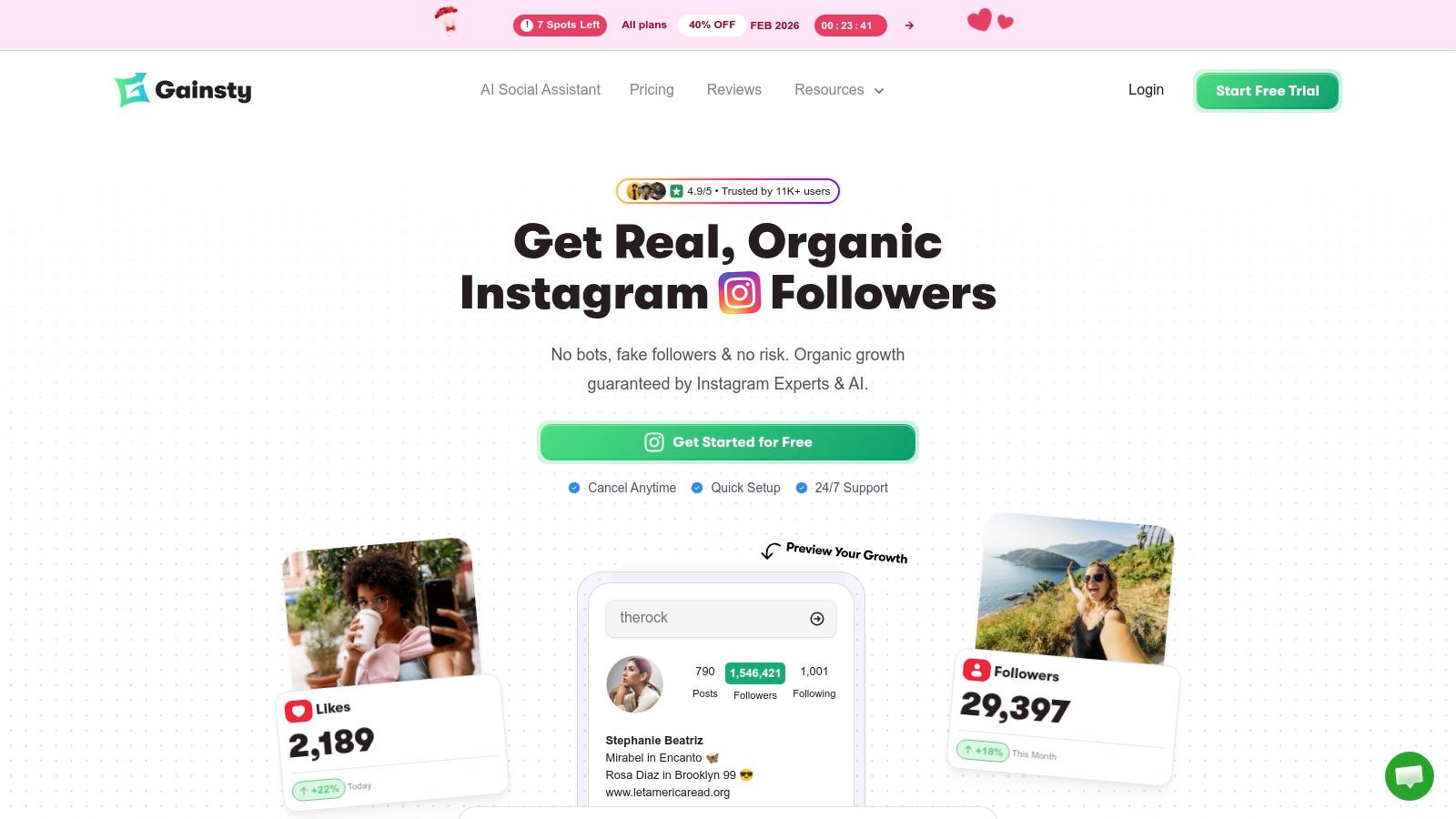
Gainsty secures the top spot as our featured choice for the best social media engagement tools by offering a powerful, done-for-you solution focused exclusively on authentic Instagram growth. It masterfully blends advanced AI with human expertise to generate real followers and tangible engagement, sidestepping the risks associated with bots and fake accounts. This hybrid approach ensures your account's credibility and long-term health remain intact while you see measurable results.
The platform is engineered for users who demand scalable, organic growth without the heavy lifting. Gainsty's team builds and manages targeted campaigns based on your ideal audience, using criteria like competitors, location, age, and language to attract genuinely interested followers. This targeted outreach is a cornerstone of its strategy, designed not just to inflate follower counts but to build a community that actively engages with your content. To deepen your understanding of how this targeted approach fuels genuine interaction, you can learn more about what social media engagement truly means and why it's a vital metric for success.
Key Features & Analysis
Gainsty's feature set is built around a "growth engine" that combines technology with hands-on management. Users get access to a live dashboard to monitor progress in real time, along with in-depth analytics that provide clear insights into audience growth and engagement patterns.
AI + Human Expertise: This dual approach is Gainsty's standout feature. AI identifies potential followers, while human experts refine the strategy, ensuring interactions feel natural and align with Instagram's community guidelines.
Granular Audience Targeting: Go beyond basic demographics. You can target followers of specific competitors, users in certain cities or countries, and even those who speak a particular language, ensuring your new audience is highly relevant.
DM Automations: The platform includes smart DM automation to welcome new followers or initiate conversations, helping to build relationships at scale without manual effort.
Dedicated Support & Management: Higher-tier plans include a dedicated account manager, offering a concierge-level service that helps refine your growth strategy and accelerate virality. All users benefit from 24/7 customer support.
Pricing and Plans
Gainsty offers a transparent pricing model designed for various needs, from individual creators to agencies. A 7-day free trial allows you to test the service risk-free, backed by a money-back policy during the trial period.
Upgrade Plan: Starts at $59/month (or $49/month with annual billing), targeting growth of 200 to 1,000+ followers per month.
Turbo Plan: Starts at $79/month (or $59/month with annual billing), offering accelerated growth of 700 to 1,700+ followers per month and access to more advanced features.
Pros:
Authentic Organic Growth: Explicitly guarantees no bots or fake followers, protecting your account's integrity.
Rapid & Measurable Results: Initial growth is often visible within 24 hours, with a clear dashboard to track progress.
Advanced Targeting: Hyper-specific targeting ensures follower quality and relevance.
Flexible & Risk-Free: A 7-day free trial, cancel-anytime policy, and annual discounts make it accessible.
Strong Support System: 24/7 support and dedicated account managers provide expert guidance.
Cons:
Variable Results: The advertised follower numbers are typical but not guaranteed, as success depends on factors like niche and content quality.
No Official Certifications: Lacks an official Instagram partnership badge, so users should rely on the free trial and user reviews to assess its credibility.
Website: https://www.gainsty.com
2. Sprout Social
Sprout Social is a comprehensive, enterprise-level platform that goes far beyond basic scheduling, positioning itself as one of the best social media engagement tools for teams that need structure and deep insights. Its core strength lies in the Smart Inbox, a unified stream that consolidates all incoming messages, mentions, and comments across profiles. This feature allows teams to tag conversations, apply sentiment analysis, and use collision detection to prevent multiple agents from replying to the same message simultaneously.
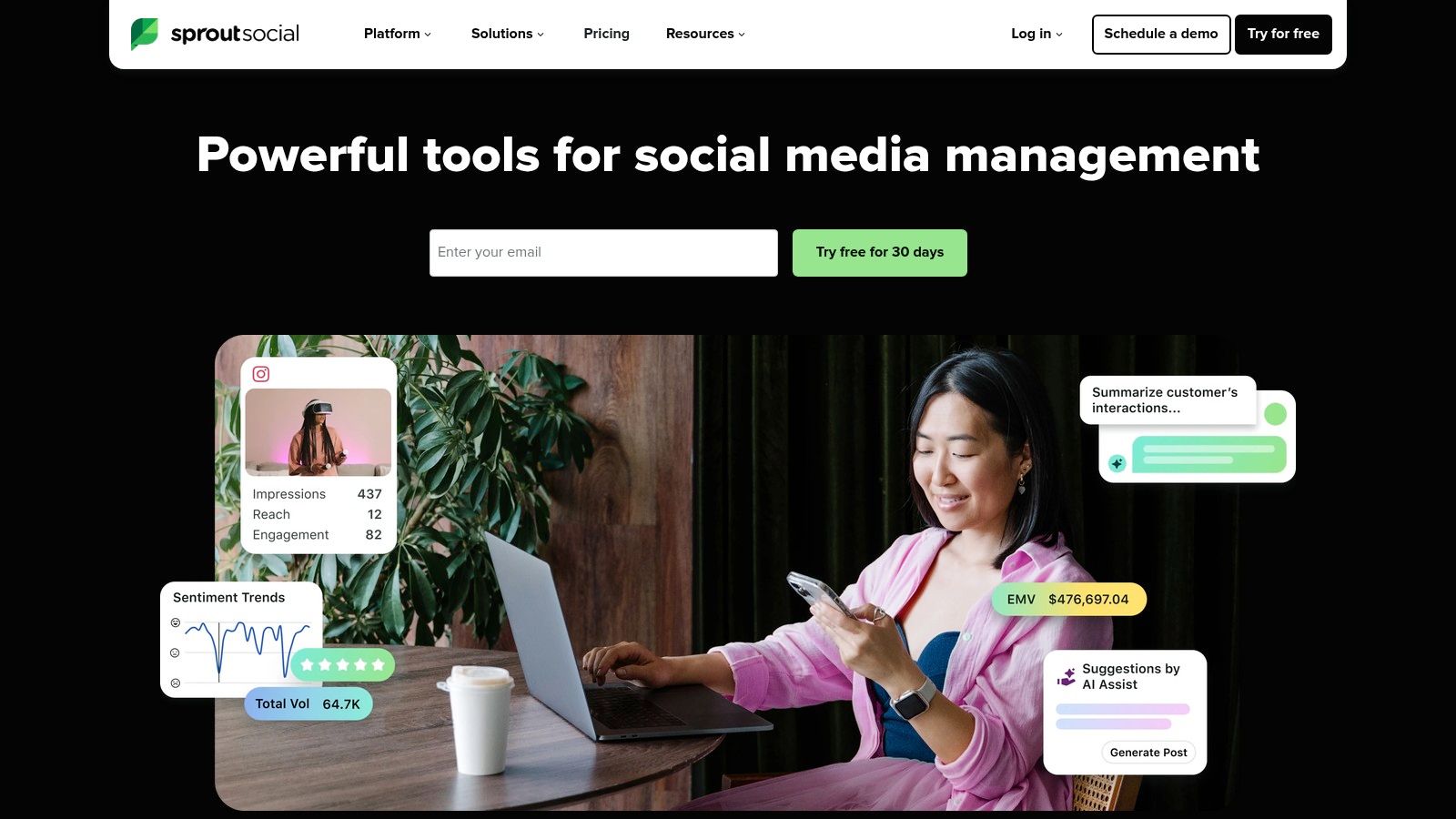
The platform is ideal for agencies and larger businesses that require robust governance and approval workflows. For instance, a marketing manager can set up rules so that all replies drafted by a junior team member must be approved before publishing. Furthermore, its AI Assist feature helps streamline content creation by generating copy, suggesting alt text, and even drafting replies, saving significant time.
Key Details & Use Case
Ideal For: Medium-to-large businesses and marketing agencies needing scalable, team-based engagement and in-depth reporting.
Standout Feature: The Smart Inbox, with its advanced filtering, tagging, and team collaboration capabilities, makes managing high-volume engagement seamless.
Pricing: Plans start at $249 per month for one user, with additional users costing extra. A 30-day free trial is available.
While its reporting is powerful, those focused solely on metrics might want to explore the best social media analytics software for more specialized options.
Pros
Enterprise-grade analytics and governance features: Provides robust reporting, compliance, and oversight capabilities suitable for large organizations and complex operational environments.
Excellent collaboration tools: Includes features such as collision detection and structured approval workflows, which streamline teamwork and reduce publishing errors.
Reliable performance and intuitive user interface: Delivers consistent system stability combined with a user-friendly experience, making day-to-day management efficient.
Cons
Higher per-seat pricing: The cost structure can become expensive for small teams or growing businesses.
Platform complexity: The extensive feature set may feel overwhelming for solo users or those with simple social media management needs.
Website: https://sproutsocial.com
3. Hootsuite
Hootsuite is one of the most established and widely recognized names in social media management, making it a reliable choice among the best social media engagement tools. Its strength lies in its all-in-one approach, providing a centralized dashboard to manage customer interactions across multiple networks. The unified inbox allows teams to view, delegate, and respond to comments and direct messages efficiently, while features like team assignments and internal notes streamline collaboration on community management tasks.
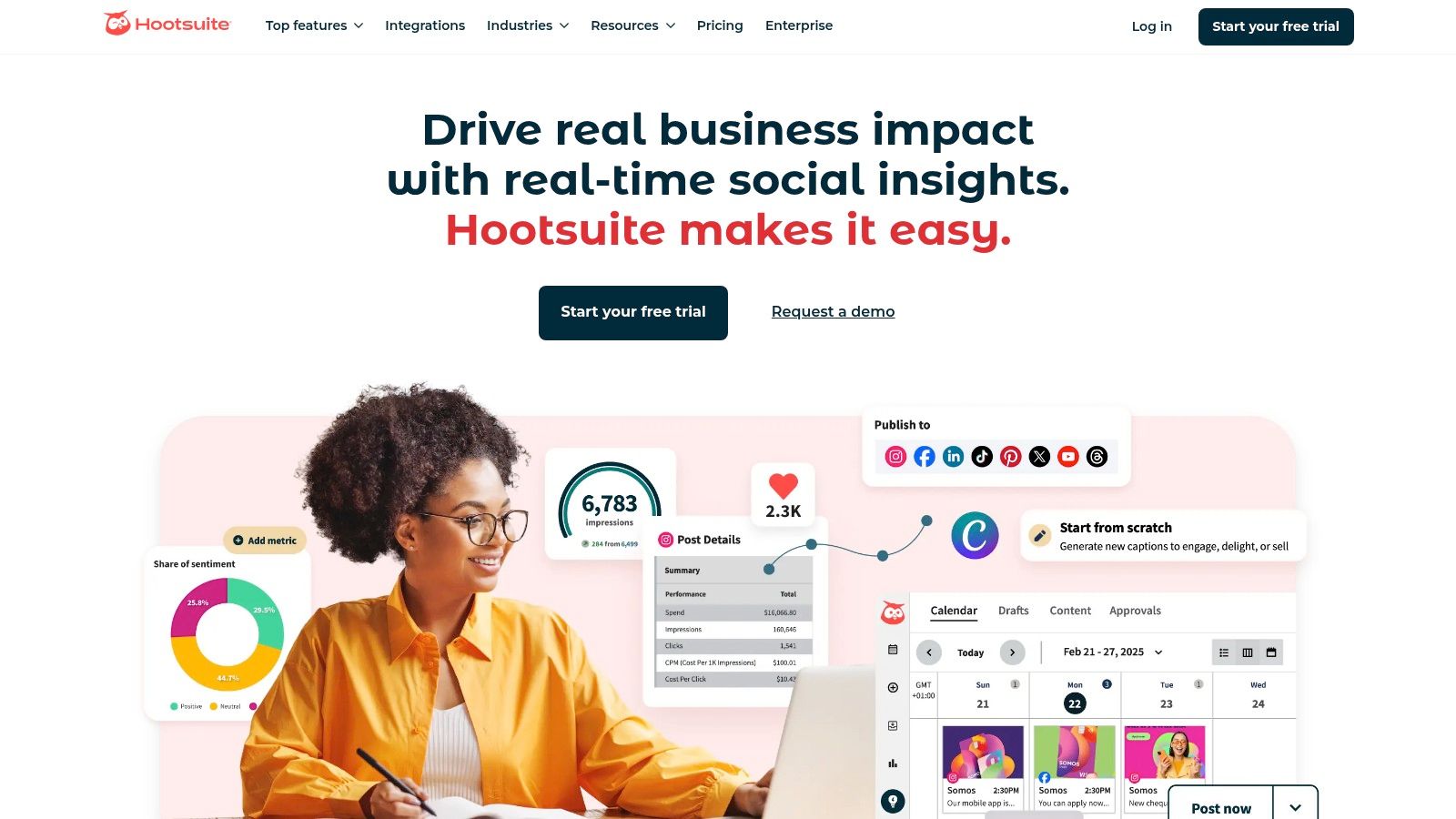
The platform scales effectively from solo entrepreneurs to large enterprises, offering robust workflows and permission settings that grow with your team. Beyond engagement, it provides unlimited scheduling with AI-powered recommendations for the best times to post on Instagram for engagement and other networks. Its extensive app directory and free utility tools, like hashtag and caption generators, add extra value for content creators.
Key Details & Use Case
Ideal For: Teams of all sizes, from solo users to enterprise organizations, who need a centralized platform for scheduling, engagement, and reporting.
Standout Feature: The all-in-one unified inbox combined with extensive scheduling capabilities and a large app directory for added functionality.
Pricing: Plans start at $99 per month for one user and three social profiles. A 30-day free trial is available.
While its feature set is broad, the tiered pricing structure can become costly as you add more users and profiles.
Pros
Highly scalable: Offers flexible plans suitable for individuals, growing teams, and large enterprises, making it adaptable at every stage of business growth.
Strong training resources and mature workflows: Provides comprehensive educational materials and a well-tested operational framework, supporting efficient onboarding and long-term success.
Unlimited post scheduling and AI-powered publish-time suggestions: Enables consistent content distribution while leveraging data-driven recommendations to optimize posting times.
Cons
Non-transparent pricing structure: Costs are not displayed in a single, straightforward grid, and total expenses can increase as additional features or users are added.
Interface design: The platform’s interface may feel somewhat dated compared to newer competitors with more modern visual experiences.
Website: https://www.hootsuite.com
4. Buffer
Buffer is a highly accessible and user-friendly platform that has evolved from a simple scheduler into one of the best social media engagement tools for creators and small businesses. Its primary advantage lies in its simplicity and affordability. The platform offers a dedicated Engagement tab that functions as a community inbox, bringing all unread comments and direct mentions from Instagram and Facebook into a single, clean interface. This feature helps users quickly identify and respond to important interactions without getting lost in noisy feeds.
The platform is designed for streamlined workflows, making it perfect for those who prioritize efficient publishing and straightforward community management. Features like scheduling a first comment, a hashtag manager, and an AI Assistant for repurposing content add significant value without overwhelming the user. With its predictable, per-channel pricing and unlimited team member access on higher tiers, Buffer provides a scalable solution for growing brands that need an effective, no-frills tool.
Key Details & Use Case
Ideal For: Content creators, startups, and small teams focusing on building an organic identity and managing community conversations efficiently.
Standout Feature: The clean, focused Engagement inbox simplifies the process of replying to comments and mentions, ensuring no important interaction is missed.
Pricing: A free plan is available for up to 3 channels. Paid plans start at $6 per month per channel, with team options available.
While excellent for direct engagement, it lacks the deep social listening and advanced workflow controls found in more enterprise-focused suites.
Pros
Simple and intuitive user interface: The platform is easy to learn and navigate, making it especially suitable for beginners and small teams.
Generous free plan with predictable pricing: Offers an accessible free tier and affordable, per-channel pricing that remains transparent and manageable as you scale.
Engagement inbox: Provides a centralized inbox that simplifies community management and streamlines responses to comments and messages.
Cons
Limited enterprise-level workflow controls: Lacks advanced approval systems and complex workflow features required by larger organizations.
Less robust social listening capabilities: Does not offer the same depth of social listening and monitoring features as more advanced competitors.
Website: https://buffer.com/pricing
5. Later
Later has cemented its reputation as one of the best social media engagement tools for creators and brands with a strong visual focus, particularly on Instagram and TikTok. Its core value lies in its highly intuitive, drag-and-drop Visual Planner, which allows users to see exactly how their feed will look before posts go live. This visual-first approach extends to scheduling Reels, Stories, and Carousels, making it a go-to for maintaining a polished aesthetic.
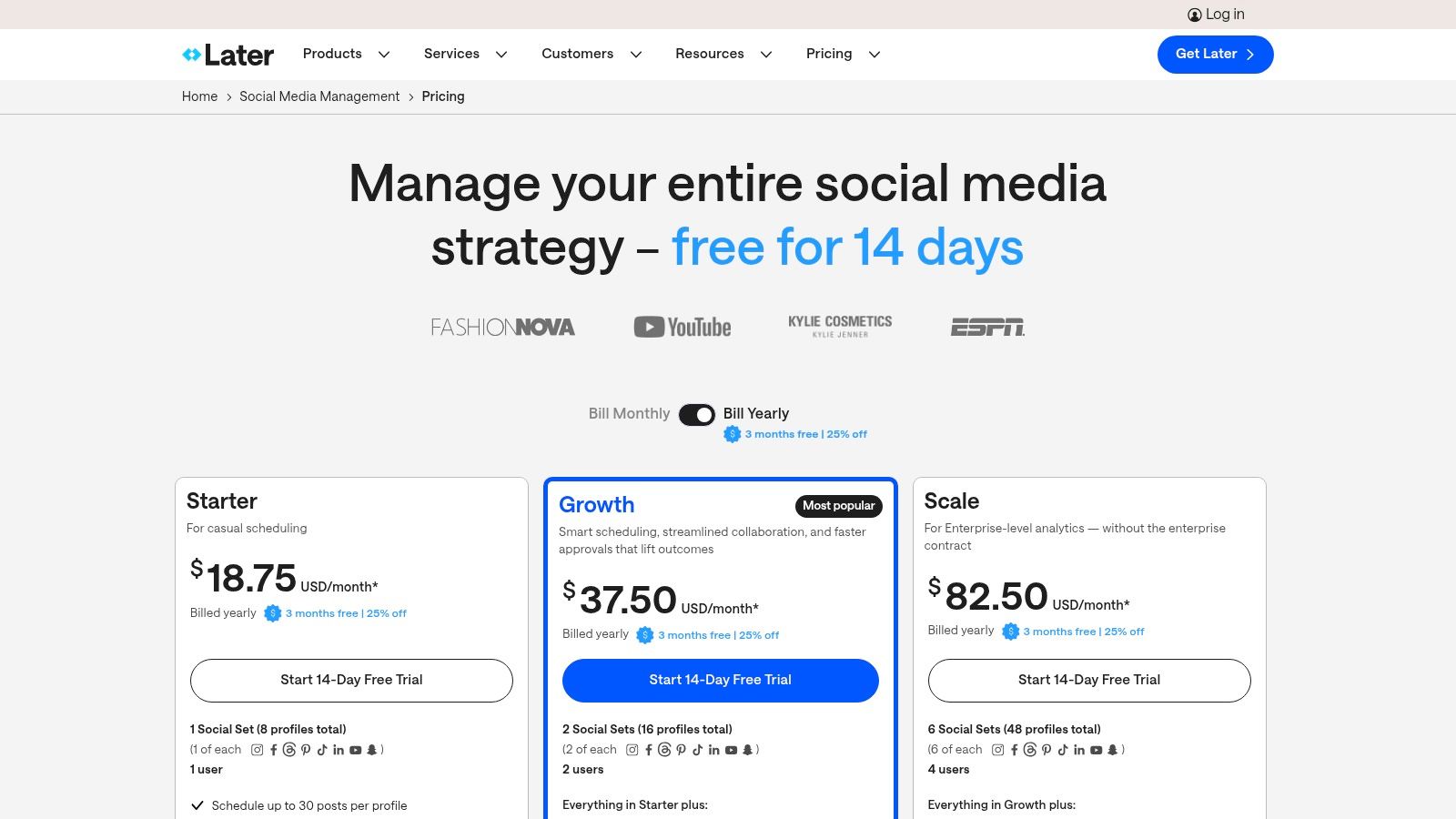
While scheduling is its forte, Later includes powerful engagement features. Its Social Inbox centralizes Instagram and Facebook comments and DMs, preventing missed conversations. The platform also offers a robust link-in-bio tool and simplifies collaboration with external approvers via approver links, allowing clients or stakeholders to review and approve content without a login. This combination makes it ideal for influencers and small teams managing visually-driven social strategies.
Key Details & Use Case
Ideal For: Influencers, content creators, and small businesses that prioritize visual planning for Instagram and TikTok.
Standout Feature: The Visual Planner provides an unparalleled preview of the Instagram grid, making it easy to curate a cohesive and attractive feed.
Pricing: Plans start with a free-forever option. Paid plans begin at $25 per month, and a 14-day free trial is available for paid tiers.
Pros
Highly intuitive visual content calendar: Offers a user-friendly, visually driven planning interface with a smooth onboarding experience, making it easy to adopt and manage content workflows.
Excellent Instagram-native workflows: Includes platform-specific features such as streamlined product tagging, enhancing efficiency for e-commerce and creator-led brands.
Affordable entry-level plans: Provide cost-effective pricing options well-suited for creators, startups, and small teams.
Cons
Less robust engagement and reporting features: Community management and analytics capabilities are not as comprehensive as those found in enterprise-level platforms.
Platform focus limitations: The tool is primarily optimized for visual platforms like Instagram and TikTok, making it less suitable for brands heavily focused on non-visual channels.
Website: https://later.com/pricing/
6. Agorapulse
Agorapulse is an all-in-one social media management suite that excels as one of the best social media engagement tools due to its powerful, streamlined inbox. Its design philosophy centers on making high-volume interactions manageable and measurable. The Unified Inbox automatically organizes comments, ad comments, mentions, and private messages into a single, intuitive feed. It allows teams to set up automated moderation rules, translate conversations instantly, and save common replies to maintain brand consistency and speed.
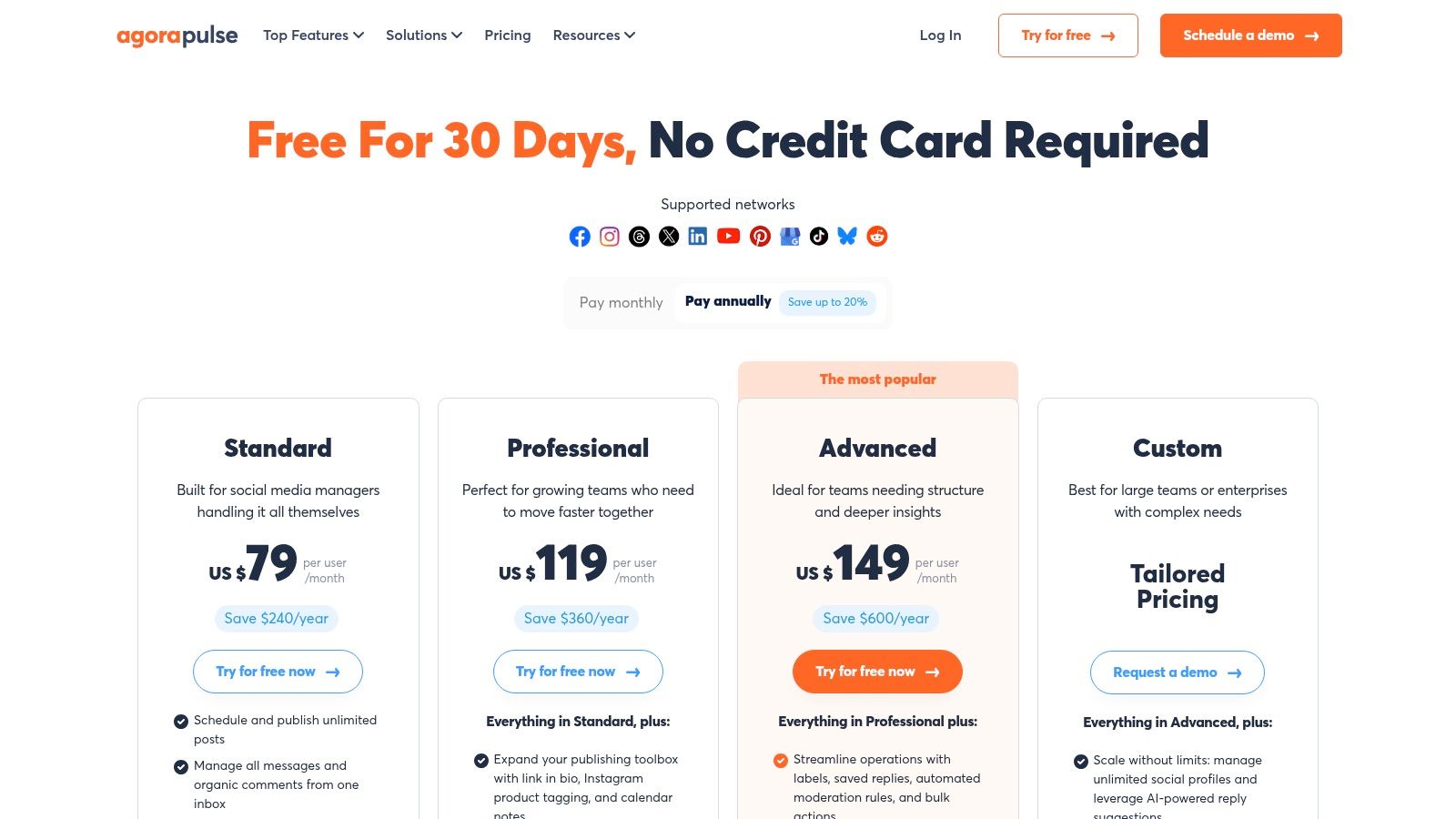
The platform is particularly well-suited for agencies and growing businesses that require structured collaboration. Approval workflows ensure content quality, while its built-in social CRM tracks conversation history with individual users, providing valuable context for future engagement. Furthermore, Agorapulse stands out with its clear reporting features that connect social media activity to tangible business outcomes, including ROI analysis through Google Analytics integration. Its native Canva integration also simplifies the content creation process directly within the scheduler.
Key Details & Use Case
Ideal For: Agencies and growing teams needing structured workflows, robust inbox management, and ROI-focused reporting.
Standout Feature: The Unified Inbox, with its automated moderation rules, saved replies, and collision detection, makes it incredibly efficient for teams to manage engagement without overlap.
Pricing: A free plan is available for beginners. Paid plans start at $49 per user per month (billed annually), with a 30-day free trial on offer.
Pros
Comprehensive inbox management and team workflows: Advanced inbox controls and structured collaboration features are included by default, supporting efficient communication and accountability.
Broad network support: Integrates with major platforms, including TikTok, LinkedIn, and Instagram, enabling centralized multi-channel management.
Strong ROI tracking and branded reporting: Offers detailed performance measurement tools and customizable reports, making it easier to demonstrate marketing impact to stakeholders.
Cons
Per-user pricing model: Costs can increase significantly as additional team members are added, making it expensive for larger teams.
Dense user interface: The platform’s layout and feature depth may feel overwhelming for new users during initial onboarding.
Website: https://www.agorapulse.com/pricing
7. Sendible
Sendible strikes a powerful balance between comprehensive features and affordability, making it a standout social media engagement tool for agencies and small businesses alike. It offers a unified Priority Inbox that centralizes comments, messages, and mentions from key platforms like Facebook, Instagram, and LinkedIn. This allows teams to manage conversations efficiently without constantly switching between native apps. The platform is built with collaboration in mind, offering client dashboards and streamlined approval workflows.
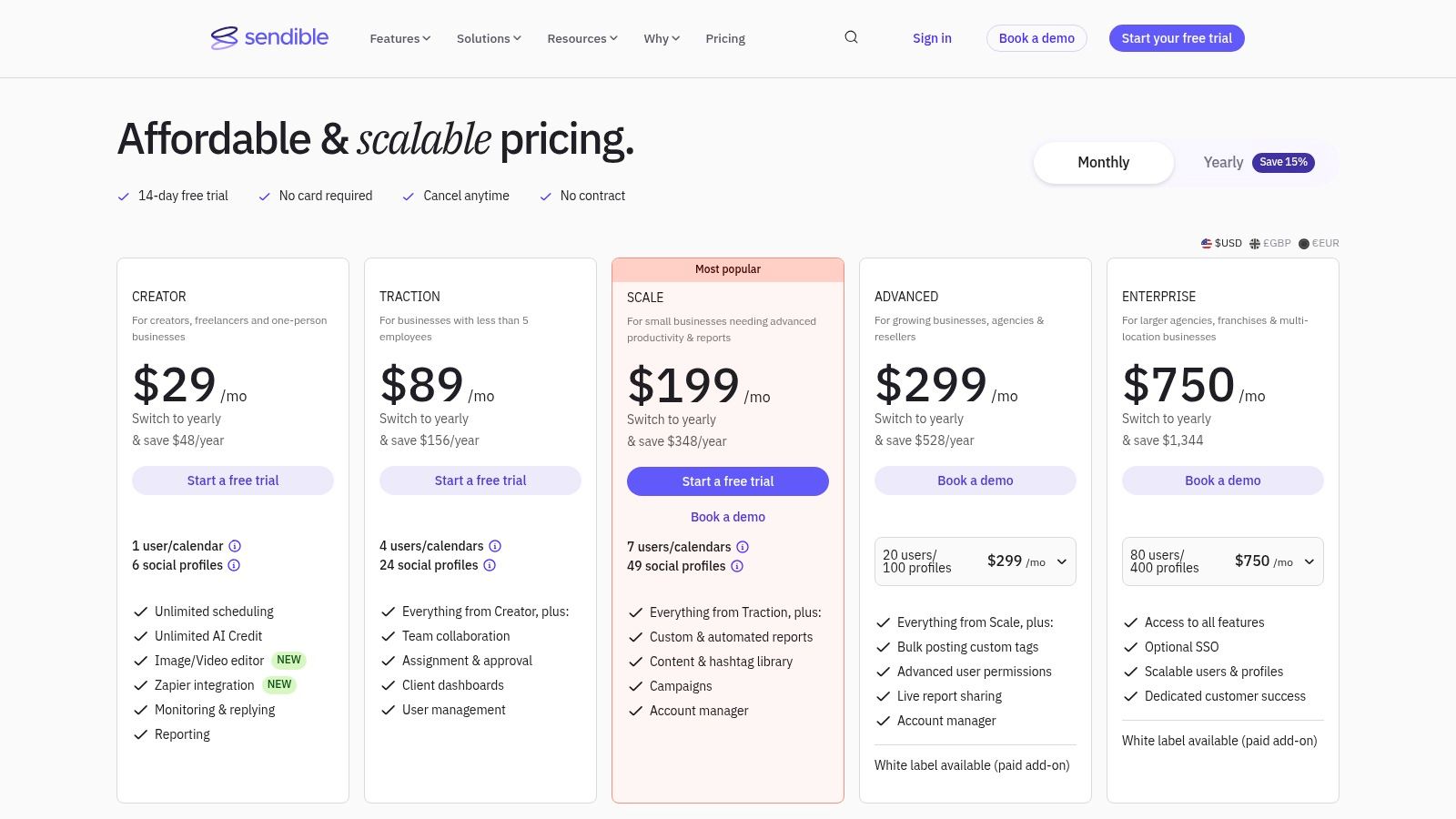
What sets Sendible apart is its agency-focused feature set, including white-label options that allow marketing firms to present the platform as their own branded solution. Integrations with tools like Canva, Google Drive, and Dropbox simplify content creation, while automated reporting keeps clients informed. This combination of multi-client management, engagement tools, and branding capabilities makes it an incredibly versatile and scalable choice for growing teams.
Key Details & Use Case
Ideal For: Marketing agencies and small-to-medium businesses managing multiple clients or social media profiles.
Standout Feature: The white-label reporting and client management dashboards provide a professional, branded experience for agency clients.
Pricing: Plans start at $29 per month for one user. A 14-day free trial is available without requiring a credit card.
Pros
Excellent value with scalable plans: Offers flexible pricing structures that grow alongside your team, making it suitable for expanding businesses.
Agency-specific features: Includes capabilities such as white-labeling and dedicated client seats, making it particularly attractive for agencies managing multiple accounts.
Generous 14-day free trial: Provides a risk-free trial period without requiring a credit card, allowing teams to evaluate the platform thoroughly before committing.
Cons
Advanced permissions restricted to higher tiers: Certain sophisticated access controls and permission settings are only available on more expensive plans.
Less modern interface design: While functional, the user interface may feel slightly dated compared to newer competitors with more contemporary layouts.
Website: https://www.sendible.com/pricing
8. Iconosquare
Iconosquare positions itself as an analytics-first platform, making it one of the best social media engagement tools for data-driven brands and creators. While its core strength is deep reporting, its engagement features are robust, particularly for Instagram and TikTok. The platform provides detailed competitor and hashtag tracking, allowing users to benchmark their performance and discover new opportunities for interaction. On higher-tier plans, a dedicated inbox consolidates comments and mentions, streamlining the response process.
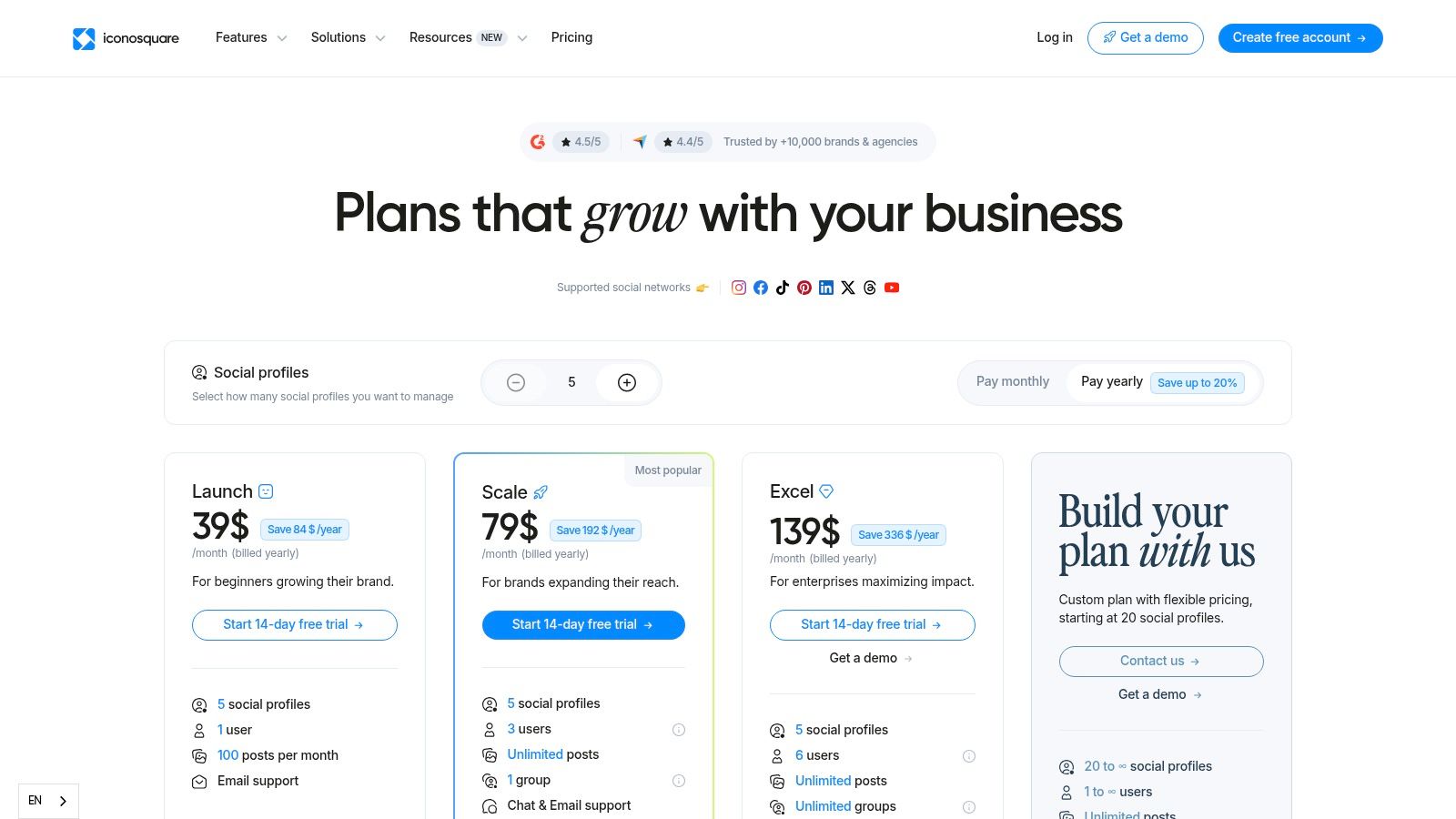
This tool is ideal for social media managers who need to justify their strategy with hard numbers. Iconosquare’s analytics suite offers extensive data retention (over two years on some plans) and provides clear insights into the best times to post for maximum engagement. While the primary focus is on metrics, its scheduling and collaboration features, like approval workflows, make it a well-rounded solution for small to mid-sized teams looking to balance performance tracking with active community management.
Key Details & Use Case
Ideal For: Data-driven creators, small businesses, and agencies that prioritize performance analytics alongside engagement.
Standout Feature: Its deep analytics suite, which includes comprehensive competitor and hashtag tracking, offers powerful insights to inform engagement strategy.
Pricing: Plans start from €29 per month (billed annually), with more advanced engagement features like an inbox reserved for Scale and Excel tiers. A 14-day free trial is available.
Pros
Strong reporting depth and benchmarking: Delivers comprehensive analytics and competitive benchmarking at a competitive mid-market price point.
Advanced posting time and trend insights: Provides actionable recommendations on optimal publishing times and emerging content trends, supporting smarter strategic decisions.
Clean and intuitive user interface: Presents complex performance data in a clear, accessible format, making analysis efficient and user-friendly.
Cons
Engagement features are limited to higher tiers: Core functionality, such as a unified inbox, is restricted to more expensive plans.
EUR-based pricing display: Subscription pricing is listed in euros, which may create confusion or require currency conversion for some international users.
Website: https://www.iconosquare.com/plans-and-pricing
9. Zoho Social
Zoho Social leverages its position within the broader Zoho ecosystem to offer a powerful, value-driven solution, making it one of the best social media engagement tools for businesses invested in integrated workflows. Its core strength is its seamless connection to Zoho CRM, allowing teams to enrich social media leads with CRM data and track the customer journey from first interaction to final sale. The platform consolidates conversations into a single monitoring dashboard where users can respond to messages, mentions, and comments efficiently.
This tool is particularly beneficial for small and medium-sized businesses that need structured collaboration without the enterprise-level price tag. It provides features like content approvals and team member roles, ensuring brand consistency even with multiple contributors. The ability to create custom listening streams helps teams monitor keywords and hashtags, keeping a pulse on brand sentiment and industry conversations beyond direct mentions.
Key Details & Use Case
Ideal For: Small-to-medium businesses, especially those already using or considering the Zoho suite of products (like Zoho CRM).
Standout Feature: The deep integration with Zoho CRM, which links social media engagement directly to lead and customer management, providing a 360-degree view.
Pricing: A free plan is available for one brand. Paid plans start at $10 per month (billed annually), with flexible billing that scales with your needs.
Its value proposition is strongest when viewed as part of a larger business operations toolkit, offering a cohesive experience that many standalone tools cannot match.
Pros
Highly competitive pricing: Offers affordable plans, including a generous free tier, making it accessible for startups and small businesses.
Seamless Zoho CRM integration: Connects directly with Zoho CRM to provide a unified view of customer interactions across sales and social channels.
Built-in team collaboration features: Includes structured approval workflows and collaborative tools that support organized content management.
Cons
Regional pricing variability: Subscription costs and add-on fees can vary significantly depending on region and currency, potentially complicating budgeting.
Less modern interface design: Although functional, the platform’s interface may feel less contemporary compared to newer competitors.
Website: https://www.zoho.com/social/
10. Meta Business Suite
For businesses and creators deeply embedded in the Meta ecosystem, the Meta Business Suite is an essential, no-cost starting point for engagement management. As the official, native platform, its core strength is the unified inbox, which seamlessly integrates Facebook Page comments, Instagram comments, and Messenger conversations into a single, manageable stream. This eliminates the need to switch between apps, making it highly efficient for handling direct communication.
The suite is designed for centralizing all Meta-related activities, allowing users to create, schedule, and publish posts, Reels, and Stories across both Facebook and Instagram from one dashboard. You can also set up basic automated replies in Messenger, like instant responses or away messages, to ensure your audience always receives a prompt acknowledgment. Its direct integration means you get real-time notifications and access to new features as they roll out.
Key Details & Use Case
Ideal For: Small businesses, solo entrepreneurs, and content creators who focus primarily on Facebook and Instagram for their social media presence.
Standout Feature: The native, unified inbox for Facebook, Instagram, and Messenger is completely free and provides a simple, centralized hub for all Meta-based communication.
Pricing: Completely free to use for anyone with a Facebook Page or Instagram Business/Creator account.
While it is one of the best social media engagement tools for those on a budget, its capabilities are strictly limited to Meta's platforms, requiring other tools for managing networks like X or LinkedIn.
Pros
Completely free with native Meta integration: Provides direct, no-cost access to Meta platforms, ensuring seamless publishing and management within the ecosystem.
Centralized Meta management: Conveniently consolidates posts and messages from Facebook, Instagram, and Messenger into one dashboard.
Mobile accessibility: The mobile app enables users to manage content and engagement efficiently while on the go.
Cons
Platform limitations: Restricted to Facebook, Instagram, and Messenger, with no support for additional social networks.
Occasional technical issues: Some users report bugs or temporary access disruptions.
Limited advanced features: Lacks the comprehensive analytics, reporting depth, and sophisticated team collaboration tools available in paid platforms.
Website: https://business.facebook.com
11. Capterra
While not a direct engagement tool itself, Capterra is an indispensable resource for discovering the perfect platform for your needs. It’s a massive software marketplace where you can compare hundreds of social media tools side-by-side. Its value lies in its powerful filtering system, which allows you to narrow down options by specific features like a unified inbox, sentiment analysis, or scheduling capabilities. This makes it one of the best starting points for finding social media engagement tools tailored to your exact requirements.
The platform aggregates verified user reviews, independent buyer guides, and detailed feature lists, offering an unbiased overview of the market. You can directly compare pricing models, deployment options (cloud-based vs. on-premise), and see which tools integrate with other software you already use. Capterra streamlines the research process, helping you move from a broad search to a shortlist of qualified vendors with confidence.
Key Details & Use Case
Ideal For: Any business, from solo creators to large enterprises, during the research and selection phase of choosing a social media tool.
Standout Feature: The robust, side-by-side comparison functionality, combined with verified user reviews providing a comprehensive and transparent market overview.
Pricing: Completely free for users to browse, compare, and read reviews.
The site provides direct links to official vendor pages and free trials, making it easy to take the next step once you've found a promising option.
Pros
Extensive software catalog: Offers a wide selection of software options with powerful filtering and comparison tools, making research efficient and thorough.
Verified user reviews and ratings: Provides access to a large volume of authentic feedback, helping users make informed decisions.
Free for research and discovery: Users can explore and compare software options without any cost, lowering the barrier to entry.
Cons
Sponsored listings priority: Paid or sponsored listings may appear higher in search results, which can affect impartiality in discovery.
Overwhelming number of options: The vast selection of tools can feel daunting for new users or those unfamiliar with the category.
Website: https://www.capterra.com/social-media-management-software/
12. GetApp
GetApp isn't a social media engagement tool itself but rather a powerful discovery platform that helps you find the right one. As a Gartner-owned marketplace, it provides a crucial starting point for your research with its annual 'Category Leaders' rankings. This system scores tools based on verified user reviews, usability, features, and overall value, giving you an unbiased, data-driven shortlist.
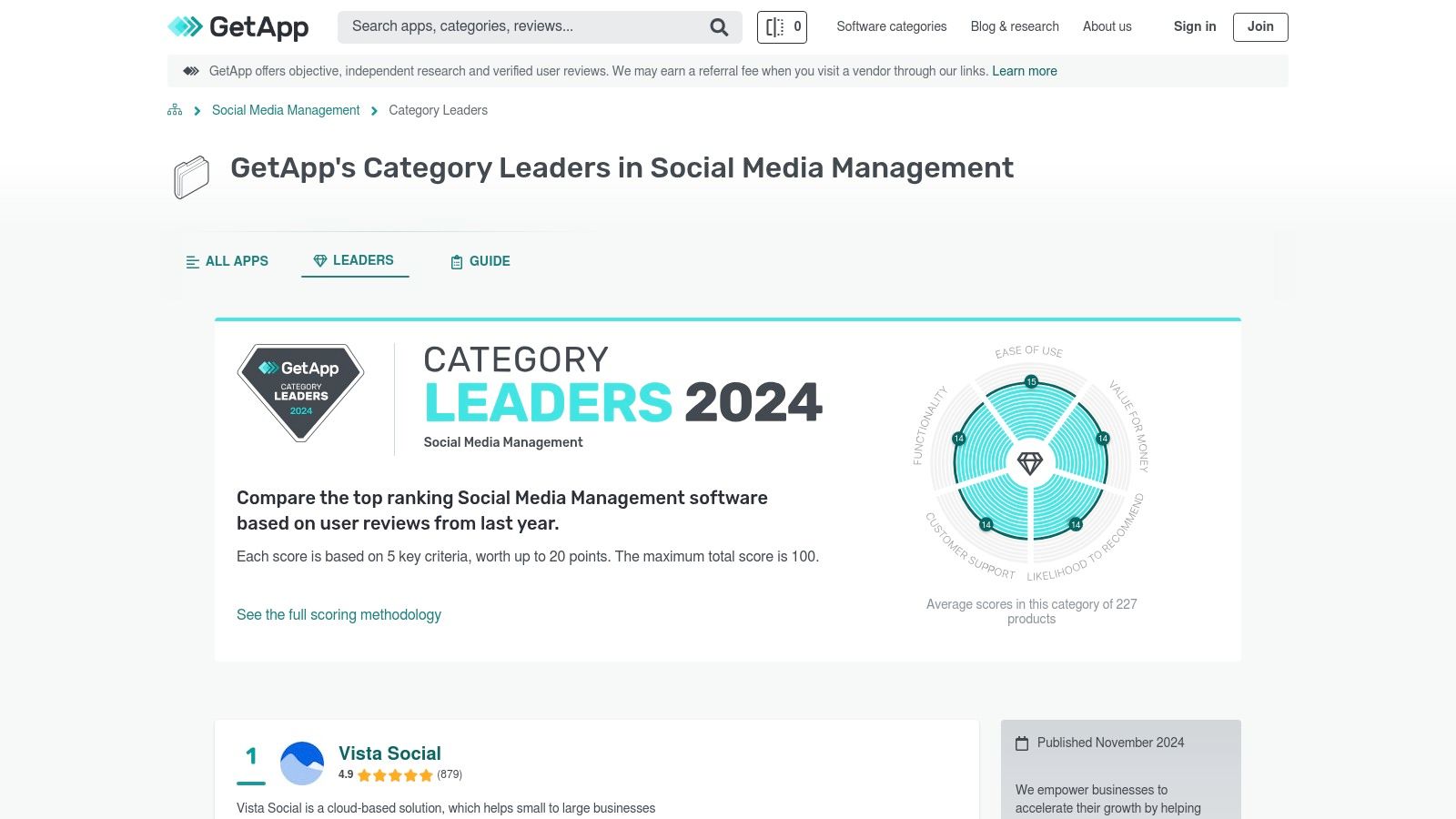
The platform excels at condensing complex information into an easily digestible format. Each application profile includes screenshots, core features, pricing tiers, and integration capabilities. This allows you to quickly compare the best social media engagement tools side-by-side without visiting dozens of different websites. Direct links to vendor pages make it simple to start a free trial or learn more.
Key Details & Use Case
Ideal For: Any business or marketer in the initial research phase, looking to compare top-rated tools and create a shortlist.
Standout Feature: The 'Category Leaders' grid provides a quick, visual comparison of the top players in the market based on aggregated user data and feature analysis.
Pricing: Free to use for research. Pricing for individual software is listed on each respective profile.
A practical tip is to use its filters to narrow down options based on business size and specific features, ensuring you only spend time evaluating relevant software.
Pros
Quick comparison of top tools: Provides an efficient way to identify highly rated engagement tools and compare options side by side.
Aggregated data in one place: Combines user reviews, pricing, and feature information, saving time on research.
Credibility of ownership: Being owned by Gartner adds a layer of trust and data-backed insights for informed decision-making.
Cons
Annual ranking updates: Rankings refresh only once per year, so users should verify the most current details directly on vendor sites.
Directory-only functionality: Serves as a research and comparison resource rather than an engagement tool you can use directly.
Website: https://www.getapp.com/marketing-software/social-media-management/category-leaders/
Top 12 Social Media Engagement Tools Comparison
Gainsty 🏆
Core offering: AI-powered, done-for-you organic Instagram growth with targeting and DM automation.
Target audience: Influencers, creators, SMBs, brands, and agencies.
Unique selling points: Delivers real followers (no bots), granular targeting, rapid results, and dedicated account managers.
Price & value: Free 7‑day trial; Upgrade ≈ $59/mo (annual $49); Turbo ≈ $79/mo ($59/yr); money-back guarantee during trial.
Rating / UX: ★4.9/5 — fast setup, 24/7 support.
Sprout Social
Core offering: Full social media management, including Smart Inbox, publishing, analytics, and listening.
Target audience: Brands, agencies, enterprise teams.
Unique selling points: Enterprise-grade analytics, governance, and AI-assisted replies.
Price & value: Higher per-seat pricing; 30‑day trial available.
Rating / UX: ★★★★ — robust team workflows.
Hootsuite
Core offering: Scheduling, Unified Inbox, analytics, listening, and paid social management.
Target audience: Solo users to enterprise teams.
Unique selling points: Large app ecosystem, mature permissions, and comprehensive training.
Price & value: Variable pricing; cost increases with additional seats; 30‑day trial.
Rating / UX: ★★★★ — scalable and well-established.
Buffer
Core offering: Publishing, Community Inbox, analytics, and AI copy tools.
Target audience: Creators, startups, and small teams.
Unique selling points: Simple UI, predictable channel pricing, and unlimited scheduled posts (paid plans).
Price & value: Affordable with a free plan supporting up to 3 channels.
Rating / UX: ★★★★ — easy to use.
Later
Core offering: Visual content calendar, Instagram product tagging, and Social Inbox.
Target audience: Instagram/Reels-first creators and brands.
Unique selling points: Visual planning, IG-native workflows, link-in-bio management.
Price & value: Affordable entry-level pricing; 14‑day trial.
Rating / UX: ★★★★ — creator-friendly.
Agorapulse
Core offering: Unified Inbox, social CRM, reporting, and approval workflows.
Target audience: Agencies and growing teams.
Unique selling points: Automated inbox rules, branded reporting, and Canva integration.
Price & value: Mid-priced; 30‑day trial.
Rating / UX: ★★★★ — strong inbox management.
Sendible
Core offering: Engagement/reply, scheduling, reporting, and white-label options.
Target audience: Agencies and multi-client SMBs.
Unique selling points: White-label functionality, client dashboards, rich integrations.
Price & value: Scalable bundles; 14‑day no-card trial.
Rating / UX: ★★★☆ — agency-focused.
Iconosquare
Core offering: Analytics-first platform with deep reporting, competitor tracking, and hashtag insights.
Target audience: Data-driven creators and brands.
Unique selling points: Long-term data retention, benchmarking, and best-time posting insights.
Price & value: Mid-market pricing (in EUR); 14‑day trial.
Rating / UX: ★★★★ — excellent analytics.
Zoho Social
Core offering: Publishing, unified inbox, analytics, and Zoho CRM integration.
Target audience: SMBs in the Zoho ecosystem and teams needing CRM integration.
Unique selling points: CRM integration, flexible billing, and regional pricing.
Price & value: Competitive; free plan available after trial; regional pricing applies.
Rating / UX: ★★★☆ — great value within Zoho.
Meta Business Suite
Core offering: Native Meta posting and unified inbox for Facebook, Instagram, and Messenger.
Target audience: Small teams or Meta-only users.
Unique selling points: Free native features, mobile apps, and basic automations.
Price & value: Free.
Rating / UX: ★★★ — native convenience, limited cross-network functionality.
Capterra
Core offering: Software marketplace with filters, verified reviews, and buyer guides.
Target audience: Buyers researching tools.
Unique selling points: Wide vendor coverage, verified reviews, and direct vendor links.
Price & value: Free to use.
Rating / UX: ★★★★ — broad discovery tool.
GetApp
Core offering: Gartner marketplace with ranked grids and app profiles.
Target audience: Buyers seeking ranked shortlists.
Unique selling points: Category Leaders rankings, usability, and value scoring.
Price & value: Free to use.
Rating / UX: ★★★★ — helpful shortlist and vendor links.
Your Next Move: From Engagement Management to Authentic Growth
Navigating the landscape of social media engagement tools can feel overwhelming, but as we've explored, the right platform is a powerful ally in building a vibrant online community. We've dissected a range of options, from comprehensive all-in-one suites like Sprout Social and Agorapulse to visually focused schedulers like Later and Buffer. Each tool offers a unique approach to streamlining your workflow, tracking conversations, and understanding your audience's behavior.
The core takeaway is that efficiency is a non-negotiable component of modern social media strategy. You can no longer afford to manually track every mention, comment, and message across multiple platforms. The best social media engagement tools act as your command center, consolidating interactions and providing the data necessary to move beyond guesswork. They change reactive management into a structured, insightful process.
Synthesizing Your Options: How to Choose Your Tool
Making the final decision requires a clear understanding of your specific operational needs and long-term goals. Don't be swayed by the longest feature list; focus on the functions that will solve your most pressing problems.
To distill your choice, consider these pivotal questions:
What is my primary pain point? Is it disorganized team collaboration, a lack of performance analytics, the sheer volume of incoming messages, or inefficient content scheduling? If analytics is your priority, a tool like Iconosquare might be ideal. For teams needing robust approval workflows, Sendible or Agorapulse could be the answer.
What is my budget? Your financial constraints are a critical factor. Free tools like Meta Business Suite are excellent starting points for those focused solely on Facebook and Instagram. For those with a modest budget, platforms like Zoho Social offer impressive value.
What is my team size? A solo influencer has vastly different needs than a marketing agency. Tools like Hootsuite and Sprout Social are built for scalability, offering features that support multiple users, clients, and permission levels.
Which platforms are most important to my brand? Ensure your chosen tool offers deep, native integration with your core social networks. If Instagram is your primary channel, a visually-oriented tool like Later is a strong contender.
From Management to Momentum: The Proactive Growth Strategy
While mastering engagement management is a crucial achievement, it represents only half of the equation. Efficiently handling your current audience is reactive; true, sustainable success comes from proactively reaching new, relevant followers. This is where you shift from merely managing your community to actively growing it.
This is the fundamental difference between a management tool and a growth service. Your engagement platform (like Buffer or Sprout Social) is your defensive line, ensuring no opportunity to connect is missed. A growth service, however, is your offensive strategy, actively seeking out and attracting the audience you want to engage with.
For instance, many brands are expanding their reach by creating more dynamic video content. To truly drive authentic growth, beyond managing engagement, understanding, and implementing effective YouTube marketing strategies is key. This same proactive mindset applies to every platform. By pairing a powerful management tool with a dedicated growth engine like Gainsty for Instagram, you create a complete ecosystem. You're not just talking to your existing followers; you're constantly introducing your brand to new people who are genuinely interested in what you have to say.
Ultimately, the goal is to build a system where your tools handle the mechanics, freeing you to focus on creating high-quality content and forging authentic connections. The path to a thriving, engaged online presence begins with making a smart, informed choice. Take advantage of the free trials, test the user interfaces, and select the platform that feels like a natural extension of your brand. Your community is waiting.
Ready to move beyond just managing your engagement and start actively growing your audience? While the tools in this list help you talk to your current followers, Gainsty helps you find new ones. We connect your Instagram account with a real, relevant audience through organic, targeted growth strategies. Start building a bigger, more engaged community today with Gainsty.