1. Niche/Micro-Community Hashtags
While massive hashtags like #photography offer immense volume, but they also come with intense competition, making it nearly impossible for your work to stand out. Niche or micro-community hashtags are highly specific tags that cater to a smaller, more dedicated audience. Instead of shouting into a void, you're entering a focused conversation with people who are actively seeking the exact type of content you create.

This strategy is about quality over quantity. Using a tag like #astrophotography (popularized by outlets like National Geographic) connects you directly with space enthusiasts, while #filmisnotdead gathering a passionate community of analog photographers. The benefit is twofold: your content reaches a highly relevant audience, and you're more likely to attract genuine engagement, followers, and even collaborations from within that specific community. Finding the right fit is crucial, and you can explore various Instagram niche ideas to see where your work aligns best.
How to Implement Niche Hashtags
Research and Curate: Identify 5-10 highly specific hashtags that precisely describe your sub-genre, such as
#urbexfor urban exploration or#minimalistphotographyfor clean compositions.Study the Community: Before using a tag, follow its page. Observe the top-performing posts to understand the community's aesthetic and unspoken rules.
Engage Authentically: Don't just post and run. Like and comment on other photos within the niche hashtag. This signals that you're an active participant, not just a marketer.
Create Tailored Content: If you're targeting
#macrophotography, ensure your posts highlight intricate details and close-up perspectives that the audience expects and appreciates. This targeted approach is a cornerstone of an effective instagram photography hashtags strategy.
2. Style/Aesthetic Hashtags
Beyond what your subject is, style hashtags define how it looks. These tags categorize your work based on visual style, mood, or editing approach, connecting you with an audience that appreciates a specific aesthetic. Whether it's the warm, nostalgic feel of #vsco or the dramatic, shadow-heavy look of #darkphotography These tags build a following based on a shared visual language rather than a common subject matter.

This approach is powerful for building a recognizable brand. For instance, using #cinematicphotography attracts viewers who love a movie-like feel, while #portra gathers photographers aiming to emulate the iconic Kodak Portra film stock. These communities, often popularized by editing apps like VSCO and creators like Peter McKinnon, are highly engaged because they are passionate about a particular look. Using style hashtags effectively tells Instagram's algorithm who will appreciate your specific creative vision, leading to more meaningful discovery.
How to Implement Style/Aesthetic Hashtags
Define Your Look: Before using these tags, establish a consistent editing style to ensure a cohesive look. Your grid should have a coherent feel that aligns with the hashtags you choose.
Be Authentic: Select 3-5 style hashtags that genuinely describe your work. Don't use
#filmlookIf your image is a sharp, high-contrast digital shot.Balance Popularity: Mix a broad tag like
#moodygrams(over 100M posts) with a more specific one like#agameoftonesto balance reach and relevance.Evolve with Your Art: As your editing style changes over time, update your core set of style hashtags to reflect your new aesthetic. This is a key part of maintaining an effective instagram photography hashtags strategy.
3. Location/Geographic Hashtags
Connecting your photography to a physical place is one of the most powerful ways to build a relevant audience. Location or geographic hashtags anchor your work to a specific city, region, or landmark, making it discoverable to locals, travelers, and businesses in that area. Instead of just floating in a global feed, your content becomes part of a local visual dialogue.
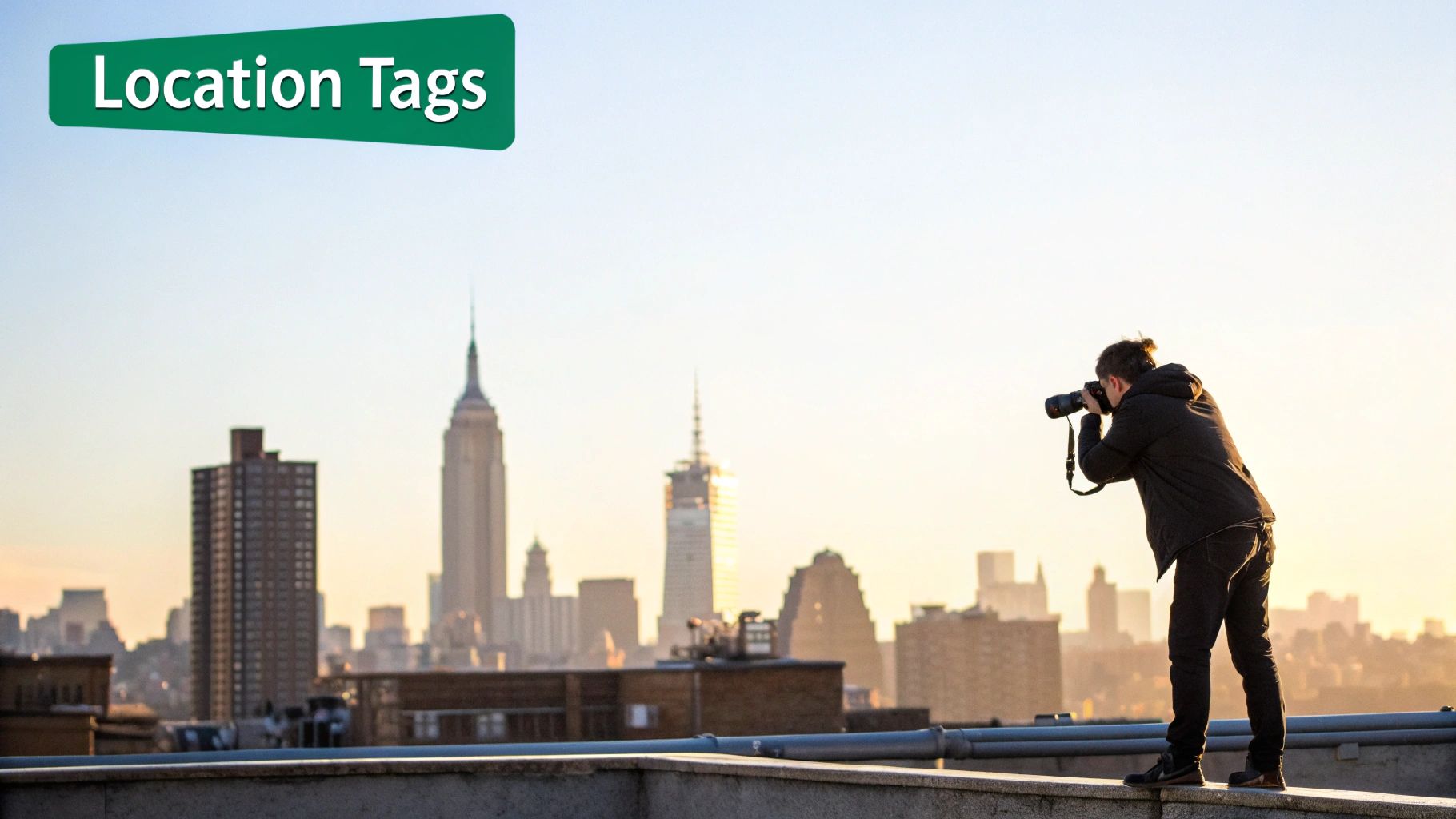
This strategy is essential for local client work and for reaching an audience interested in a particular destination. Using a tag #tokyophotography instantly places your work alongside other visuals of the city, while a more focused tag, like, #nycstreetphotography connects you with a specific urban photography scene. The primary benefit is targeting; you reach people with a demonstrated interest in that location, leading to higher engagement from a geographically concentrated audience and potential features from local accounts.
How to Implement Location Hashtags
Layer Your Tags: Combine broad and specific tags. For a photo of the Brooklyn Bridge, use
#newyorkcity,#brooklyn, and#brooklynbridgeparkto capture different search intents.Research Local Variations: Look for community-specific tags beyond the obvious. Instead of just
#londonexploring tags like#thisislondonor#shutup_londonwhich often have more engaged communities.Geo-tag Your Post: In addition to using hashtags, always add the physical location to your post. This boosts visibility in Instagram's location-based "Explore" pages.
Mix Tourist and Local Spots: While popular landmark tags get volume, including hashtags for lesser-known neighborhoods or "hidden gems" can help you stand out. This balanced use of location-based instagram photography hashtags is key to attracting both broad and niche audiences.
4. Engagement/Growth Hashtags
Engagement or growth hashtags are high-volume tags designed primarily to boost visibility and interaction metrics. Tags like #photooftheday or #instagood are part of a broader, platform-wide conversation, often curated by Instagram itself or large feature accounts. While not specific to any photography genre, they tap into the daily habits of millions of users looking for popular, trending, or simply beautiful content.
The primary goal here is reach. Using a tag like #picoftheday signals your post as a contender for that day's top content, attracting a broad audience beyond your niche. The benefit is a potential spike in likes, comments, and profile views from users who follow these massive tags. However, their sheer volume means your content has a very short lifespan in the feed. This makes them a high-risk, high-reward tool in your instagram photography hashtags arsenal.
How to Implement Engagement Hashtags
Use Sparingly: These tags are best used as supplements, not the foundation of your strategy. Limit them to 1-2 per post to avoid diluting your niche focus.
Combine and Conquer: Pair a popular tag
#instadailywith highly specific niche and location hashtags. This balances broad reach with targeted relevance.Time Your Posts: Your content is more likely to be seen if you post during peak user activity hours when these tags are most active and being curated.
Monitor Your Analytics: Track which engagement tags actually lead to genuine followers versus bot activity. If a tag only attracts spam, replace it with a different one.
5. Trending/Seasonal Hashtags
Trending and seasonal hashtags tap into the immediate pulse of Instagram, capitalizing on current events, holidays, viral challenges, and the changing seasons. These tags are time-sensitive and momentum-driven, offering a short but powerful window to boost visibility by joining a widespread, active conversation. Instead of relying solely on evergreen tags, this strategy aligns your content with what users are actively searching for and engaging with right now.
This approach is about timeliness and relevance. Using a tag like #summervibes during July connects your beach photography with a massive, seasonally-attuned audience, while a challenge-based hashtag like #blackandwhitefebruary groups your work with a dedicated community participating in a specific event. The primary benefit is tapping into a pre-existing surge of interest, which can expose your photography to a much broader audience than your niche tags alone. To master this, you can learn how to find trending hashtags on Instagram and apply these insights effectively.
How to Implement Trending/Seasonal Hashtags
Plan Ahead: For predictable events like holidays or seasons, plan and create your content 2-4 weeks in advance. This allows you to post early and gain traction before the hashtag becomes overly saturated.
Monitor Trends: Dedicate time each week to check Instagram's "Explore" page and other trend-tracking tools. Be ready to pivot your content strategy to join a viral challenge or relevant conversation.
Join Weekly Challenges: Participate in recurring community challenges like
#macro_mondays#WanderlustWednesday. These provide consistent opportunities for exposure to an engaged audience.Combine and Conquer: Don't use trending tags in isolation. Pair a popular seasonal tag
#autumnvibeswith your niche tags (e.g.,#forestphotography,#moodygrams) to attract both a broad and a targeted audience. This is a key part of a balanced instagram photography hashtags strategy.
6. Community/Hashtag Challenge Hashtags
Beyond simple categorization, some hashtags unite photographers around a shared mission, creative challenge, or social cause. These community and challenge hashtags transform your post from a standalone image into a contribution to a larger, collaborative project. Instead of just showcasing your work, you’re participating in a collective movement, which fosters a much deeper sense of connection and purpose.
This approach is about building relationships and shared identity. For instance, a tag like #thestorybehind encourages photographers to share the narrative context of their images, while #womenphotographers creates a powerful, supportive space for female artists. Participating in these challenges, often popularized by communities like EyeEm or major brands, signals that you're an active, engaged member of the photography world, not just a passive content creator. It’s an excellent way to gain visibility among peers who share your values.
How to Implement Community/Challenge Hashtags
Find Your Cause: Identify challenges or movements that genuinely align with your artistic vision or personal values, such as
#sharetheloveor a brand-sponsored contest.Participate Authentically: Don't just add the tag. Read the rules or purpose of the challenge and create content that truly fits the theme. A half-hearted entry is easily spotted.
Engage with Fellow Participants: The real power here is community. Spend time viewing, liking, and commenting on other submissions under the hashtag. Acknowledge and support others' work.
Share the Journey: Document your creative process for the challenge. This can provide additional content for your feed or stories, further connecting you with the audience following the instagram photography hashtags of the community.
7. Equipment/Gear-Specific Hashtags
Hashtags that specify the camera, lens, or software used to create an image tap into communities built around specific tools. These equipment-centric tags, like #shotoniphone or #canon5dmarkiv, connect you with fellow photographers who use the same gear, as well as an audience interested in the capabilities of that equipment. It’s a way to showcase what’s possible with a particular tool and join a conversation with its dedicated user base.
This strategy appeals to both brand loyalists and aspiring photographers researching their next purchase. Using a tag like #fujifilm places your work in a gallery admired by other Fuji shooters, while #adobelightroom connecting you with a massive community of editors. These tags are often monitored by the brands themselves, creating opportunities for your work to be featured on their official accounts, which can lead to a significant boost in exposure and credibility.
How to Implement Equipment/Gear-Specific Hashtags
Be Specific but Brief: Instead of listing every piece of gear, choose one or two key components that define the shot, such as
#nikonz7or#sigma35mmart.Showcase Capabilities: Use these hashtags when your photo is a prime example of what that gear can achieve, like a stunning low-light shot tagged with
#sonya7iii. When considering equipment, it's valuable to explore resources that guide you in choosing the best drones for professional photography to accurately tag your aerial work.Balance with Other Tags: Combine gear hashtags with niche, location, or style tags. A post tagged
#shotoniphone #nycstreetphotographyhas a much broader yet targeted reach than one with only the equipment tag.Educate and Share: When posting tutorials or behind-the-scenes content, equipment tags are essential. They provide context and attract viewers searching for tips related to their specific setup, making your instagram photography hashtags more effective.
8. Composition/Technique-Specific Hashtags
Beyond describing what your photo is of, you can use hashtags to explain how it was made. Composition and technique-specific hashtags attract an audience interested in the craft of photography itself, including fellow creators, students, and enthusiasts looking to improve their skills. These tags act as a mini-lesson, signaling your technical proficiency and artistic intent.
Using a tag like #leadinglines immediately tells viewers to look for how you guided their eye through the frame, while #bokeh highlighting your mastery of depth of field to create a pleasingly blurred background. This approach scales your post from a simple snapshot to a demonstration of skill, attracting a more discerning audience that appreciates the technical artistry behind a great shot. It’s an effective way to position yourself as a knowledgeable photographer within the community.
How to Implement Composition/Technique Hashtags
Be Accurate and Intentional: Only use a technique tag if it’s a clear and deliberate element of your photo. Using
#goldenratioon a randomly composed shot will confuse viewers and dilute the tag’s value.Educate Your Audience: In your caption, briefly explain how you used the technique. For example, "I used the classic #ruleofthirds to place the subject off-center, creating a more dynamic and balanced composition."
Limit and Combine: Stick to 1-3 technique hashtags per post to maintain focus. Combine them with subject and style tags (e.g.,
#leadinglines,#streetphotography,#moodygrams) for a well-rounded instagram photography hashtags strategy.Follow and Learn: Follow these hashtags to see how other photographers are interpreting compositional rules. This inspires and helps you understand community standards and expectations.
9. Editing/Post-Processing Hashtags
Beyond the subject of your photo, the editing process itself is a powerful story that can connect you with other creators. Editing or post-processing hashtags signal your technical skill and aesthetic choices, attracting an audience interested in the "how-to" behind a beautiful image. These tags change a simple photo post into a showcase of your post-production workflow, building a community around shared tools and techniques.
This strategy appeals to fellow photographers, aspiring editors, and clients looking for a specific visual style. Using tags like #lightroompresets or #colorgrading connects you with a community actively exchanging tips, presets, and inspiration. Showcasing your editing prowess with #beforeafter carousels can be incredibly engaging, demonstrating the transformative power of your skills and attracting followers who want to learn from your process.
How to Implement Editing/Post-Processing Hashtags
Show the Transformation: Create carousel posts or Reels that reveal the before-and-after of your edits. Pair them with specific tags like
#photoeditingor#retouchingto highlight the change.Tag Your Tools: Mention the software you use, such as
#lightroom,#photoshop, or#captureone. This helps you appear in searches by users of those specific platforms.Balance Your Set: Use only one or two editing hashtags per post. This ensures your content remains focused on the final image's subject matter rather than appearing overly obsessed with the technical process.
Share Your Knowledge: If you create or sell presets, consistently use a branded hashtag alongside a popular tag like
#presets. This builds brand recognition and taps into an existing market of buyers looking for quality instagram photography hashtags and tools.
10. Hybrid/Strategic Multi-Purpose Hashtag Sets
Instead of relying on a single category of hashtags, this advanced strategy involves creating balanced sets that combine tags from multiple categories. The goal is to maximize visibility across different discovery channels simultaneously. By blending broad, niche, location, and community-specific tags, you create a powerful combination that appeals to the Instagram algorithm while reaching diverse, highly relevant audiences. This method avoids putting all your eggs in one basket, ensuring a more stable and strategic reach.
This approach treats your hashtag block as a curated portfolio designed for discovery. For instance, a travel photographer might use #tokyophotography (location), #cinematicphotography (style), #sonyalpha (equipment), and #agameoftones (community) on a single post. Each tag serves a distinct purpose, targeting different user search intents and community feeds. This multi-pronged approach is a cornerstone of a well-rounded instagram photography hashtags strategy, giving your content the best possible chance to be seen by the right people.
How to Implement Hybrid Hashtag Sets
Categorize and Combine: Create 3-5 pre-made hashtag sets for your most common photo types. For each set, select 3-5 tags from various categories like niche, style, location, equipment, and community.
Balance Popularity: Ensure each set has a mix of high-volume (over 1M posts), medium-volume (100k-1M), and low-volume (under 100k) hashtags for a balanced reach.
Test and Track: Use Instagram Insights to monitor which hashtags from your sets are driving the most impressions. Regularly swap out underperforming tags to optimize your sets. To delve deeper into this, you can learn more about a comprehensive Instagram hashtag strategy guide.
Rotate Sets: Avoid using the same set on every post. Rotate between your pre-made sets to keep your hashtag usage fresh and prevent your content from being flagged as spammy by the algorithm.
10-Category Comparison: Instagram Photography Hashtags
Niche or micro-community hashtags require medium effort through targeted research and engagement, use low to medium resources, and typically produce high engagement with modest reach, resulting in higher-quality followers. They are ideal for specialized portfolios, community building, and establishing subject-matter authority, with the key advantage of low competition and more authentic audiences.
Style or aesthetic hashtags involve medium complexity to maintain consistent editing and branding, require moderate resources such as presets and visual alignment, and help create a recognizable visual identity. They work best for building a signature look, attracting collaborations, and brand work, with the advantage of drawing in like-minded followers.
Location or geographic hashtags are low to medium in complexity, require minimal resources, and drive local visibility and discovery. They are especially useful for travel creators, local businesses, and event coverage, offering strong networking and partnership opportunities.
Engagement or growth hashtags are easy to apply and require very little effort, but they tend to generate high reach with lower follower quality and short-term results. These are best used for rapid exposure, contests, or explore-page attempts, with the main benefit being quick visibility spikes.
Trending or seasonal hashtags demand medium to high effort due to timing and trend monitoring, and require faster content creation. When used correctly, they can create short-term engagement spikes and are ideal for seasonal campaigns, challenges, or holiday content by leveraging timely momentum.
Community or hashtag-challenge hashtags are high-effort because they require consistent, authentic participation and ongoing interaction. They lead to deeper engagement and stronger relationships, making them ideal for cause-driven campaigns and community growth, with the advantage of encouraging user-generated content and collaboration.
Equipment or gear-specific hashtags require low to medium effort and minimal resources, and they help connect with gear enthusiasts and potential brand partners. These hashtags are best for gear reviews, tutorials, and equipment-focused content, offering credibility and buyer interest.
Composition or technique hashtags involve medium complexity and require accurate application of techniques along with educational content. They position creators as technically skilled and attract learners, making them ideal for tutorials and craft-focused portfolios.
Editing or post-processing hashtags requires medium effort and credible demonstrations, such as before-and-after content. They help increase visibility among editors and open opportunities for preset sales or collaborations by highlighting editing expertise.
Hybrid or strategic multi-purpose hashtag sets demand high effort, continuous research, and analytics tracking, but deliver a balanced mix of reach and follower quality. These are best suited for growth-focused creators and brand accounts, with the key advantage of long-term, resilient performance optimization.
Putting It All Together: Your Blueprint for Hashtag Mastery
Navigating the world of Instagram photography hashtags can feel like learning a new language. However, as we've explored, it's less about memorizing a dictionary of tags and more about understanding the grammar of discoverability. Moving beyond generic tags #photography is the first and most crucial step. The real power lies in the strategic combination of niche, style, location, and community-specific hashtags that speak directly to your ideal audience.
The ten categories we've detailed, from hyper-specific equipment tags like #canonr5 to aesthetic descriptors like #moodygrams, are not isolated options. They are the building blocks of a sophisticated, multi-layered strategy. Your goal is not to find a single "magic" hashtag but to build a cohesive set that tells a complete story about your image. This approach transforms hashtags from a simple discovery tool into a powerful branding instrument, signaling your expertise, artistic vision, and community affiliation all at once.
Key Takeaways for Immediate Action
To transition from theory to practice, focus on these core principles:
Diversify Your Portfolio: Never rely on a single category. A successful post will blend broad, medium, and niche tags. Think of it as a pyramid: a few popular tags at the base for wide reach, a solid middle layer of community tags, and highly specific niche tags at the peak to attract true connoisseurs of your work.
Analyze and Adapt: Your work is not done after you hit "Share." Regularly dive into your Instagram Insights for each post. Identify which instagram photography hashtags are driving the most impressions and engagement. This data is your roadmap for refinement; prune the underperformers and double down on what works.
Embrace Rotation: Instagram's algorithm rewards fresh, relevant content. Avoid copying and pasting the same block of 30 hashtags on every single post. Create three to five distinct, curated sets for your different photography styles or subjects. Rotating these sets keeps your strategy dynamic and prevents your content from being flagged as spammy.
Your Path Forward
Mastering your hashtag strategy is an ongoing journey of experimentation and learning, not a one-time task. It requires a commitment to understanding your audience and a willingness to adapt as trends and communities evolve. By implementing the hybrid strategies outlined in this guide, you move from passively hoping for discovery to actively engineering it. You're not just tagging photos; you're building pathways for your ideal followers to find you, appreciate your art, and join your community. This intentional approach is what separates fleeting visibility from sustainable, long-term growth on the platform.
Ready to take the guesswork out of your growth strategy? Gainsty uses advanced AI to analyze your profile and niche, delivering perfectly optimized sets of instagram photography hashtags tailored to each of your posts. Stop experimenting and start growing with data-driven recommendations by visiting Gainsty today.