
Why Hashtag Analytics Matter More Than Hashtag Counts
Counting hashtags tells you how you labeled a post. Hashtag analytics means evaluating whether those labels are associated with discovery and meaningful audience response. Those are different jobs, and completing the first doesn't tell you anything reliable about the second.
A creator can carefully assemble a long tag list and still have no evidence that it attracts the right people. For a recipe account, useful discovery might lead to saved instructions or a follow. For a local business, it might lead to a profile visit from someone who could become a customer.
Start With an Outcome, Not a Tag Limit
An analysis of 48,065,694 Instagram posts from 306,278 top users found an average of 1.014402684 hashtags per post, associated more hashtags with lower average engagement, and recommended five or fewer relevant tags rather than filling the platform's then-available 30-tag limit, according to the HubSpot and Mention Instagram engagement report. That's a historical observation and recommendation, not proof that reducing your own hashtag count will improve performance.
The distinction matters because your post's subject, format, creative quality, and publication timing can change the result. A tag list attached to an excellent tutorial shouldn't receive all the credit for that tutorial's success.
> Practical rule: Choose the audience action you want before choosing the hashtags you'll test.
For your next educational post, you might prioritize saves. For a post introducing your services, profile visits could be more useful. Neither choice requires abandoning reach, but it does require treating reach as supporting evidence rather than the final verdict.
Give Every Test a Clear Job
Use a simple sequence to keep your decisions accountable:
Define: Describe the audience and the action you want from them.
Measure: Record the available post-level results using consistent definitions.
Test: Change a hashtag variable while keeping other content choices comparable.
Adapt: Keep promising combinations, revisit uncertain results, and remove irrelevant tags.
A hashtag strategy without measurement is a labeling exercise. That's not necessarily useless, but it isn't evidence of growth. Your aim is to find a repeatable relationship between relevant discovery and qualified engagement, not to make the caption look thoroughly optimized.
The Origin and Rise of Hashtags on Instagram
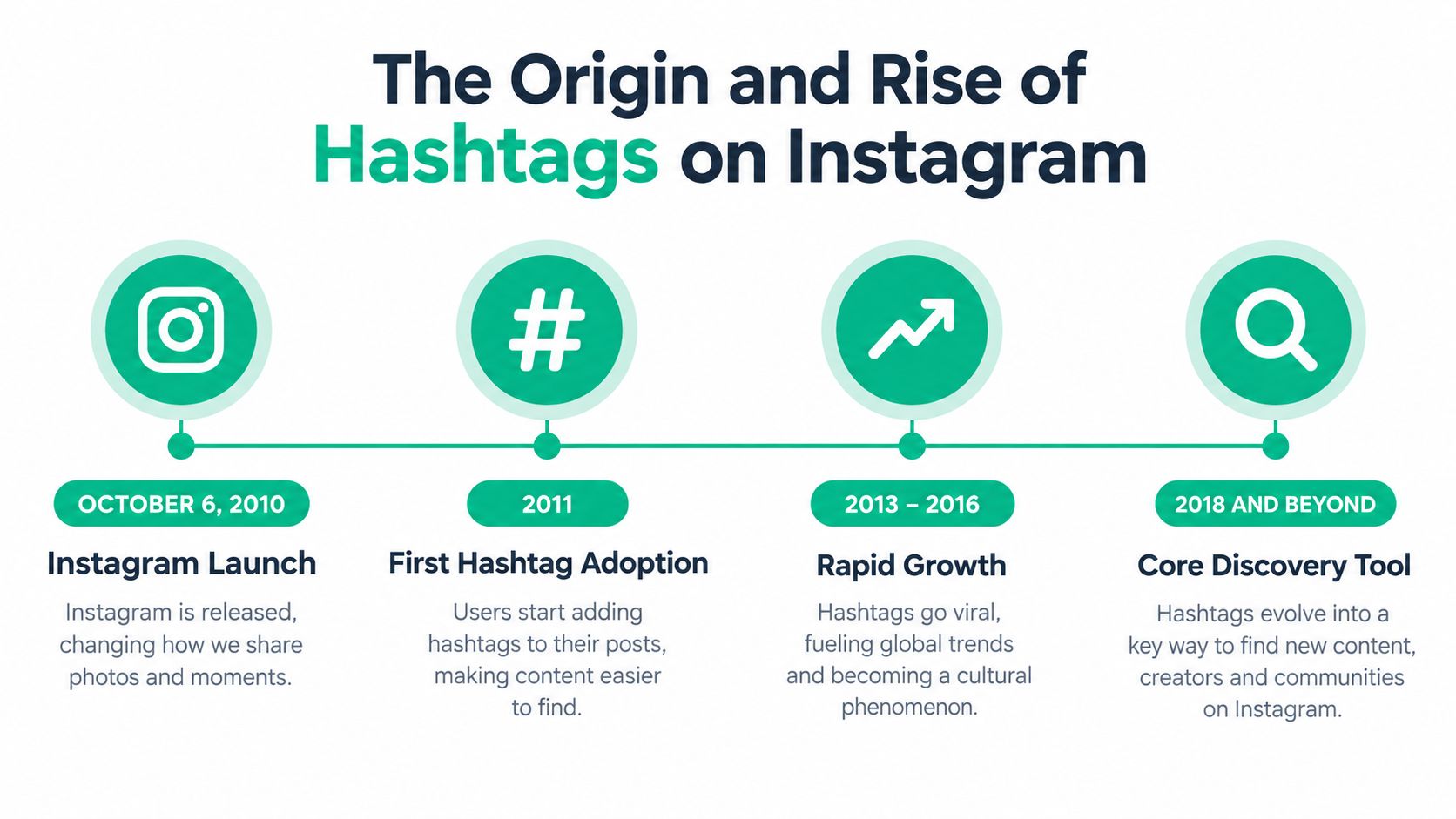
A tag that brought the right viewers to a post years ago may describe a different community today. Instagram launched on October 6, 2010. Researchers later studied posts from late 2010 through 2015, sampling 51,527 users across New York, Los Angeles, and London. Their datasets included more than 41 million posts and approximately 7 million hashtags, as documented in academic research on Instagram hashtag adoption. That historical record matters for testing: tag meanings shift, so past performance is a reason to retest a hashtag, not trust it indefinitely.
Hashtags began as labels people added to photos, making posts easier to group by topic and helping users find others discussing similar interests. For analysts, that use left a record of the vocabulary communities chose. The timeline below shows hashtag growth from 2010 to 2018; notice how quickly the vocabulary expanded after 2011, a reminder to check whether a tag still fits its audience.
Read Tags as Community Vocabulary
A hashtag signals more than a subject. It can also suggest what viewers expect to find. A ceramic artist, for example, might describe the same mug with tags about pottery, interior styling, or handmade gifts. Each points toward a different audience: one may be looking for making techniques, another for home décor, and another for a finished gift.
That difference affects how you judge results. A tag may attract views yet bring few saves or profile visits if its implied audience doesn't match the post. Treat each tag as a hypothesis about who will respond, then compare outcomes rather than relying on the tag's popularity alone.
Watch for Changes in Meaning
When reviewing a hashtag, check its context as well as its performance:
Community adoption: Are people in your intended niche still using the term?
Geographic relevance: Does the surrounding content fit your market or location?
Vocabulary changes: Are newer phrases a better match for the same audience need?
Topical drift: Is the tag now appearing beside unrelated content?
These checks require interpretation, not a popularity contest. A hashtag can stay familiar while becoming a less accurate description of your post.
Keep a working glossary for your hashtag groups. Note what each cluster means, who it is intended to reach, and what kind of content belongs with it. Then rotate comparable tag groups across similar posts and track outcomes such as saves, profile visits, and follows. This helps separate a hashtag's contribution from differences in the content itself.
The Core Metrics Every Hashtag Dashboard Should Track
A hashtag dashboard works like a map of a post's journey: first, who encountered it; then, what they did; finally, whether any action led to a business result. Keep those stages separate. Reach counts unique accounts that saw a post, while impressions count its displays, including repeat views. A hashtag-attributed impression indicates a discovery source, not necessarily a new person or a customer.
Track these metrics in sentence form rather than as a table.
Reach measures the unique accounts that saw the post, so it helps you understand audience exposure.
Non-follower reach shows how many reached accounts do not already follow you, which helps you judge discovery beyond your existing audience.
Impressions measure total displays or views, including repeat views, so they reflect overall exposure rather than unique people.
Hashtag-attributed impressions refer to impressions assigned collectively to hashtags, where that field is available, and they suggest hashtag-related discovery.
Saves count how many times people saved the post, which can indicate that the content is worth revisiting.
Shares count how often someone passed the post along, which can signal recommendation behavior.
Comments measure the number of comments received, but those comments still need qualitative review to determine whether they reflect useful engagement.
Profile visits show how many people visited your profile, which can indicate interest in learning more.
Follows measure follow actions within the reported scope, which makes them a useful audience growth signal.
Website clicks and conversions track link actions and completed website events, which are the clearest indicators of business response.
A save is a bookmark, not a purchase commitment. A share resembles a recommendation, but it doesn't show whether the recipient became interested. Profile visits suggest curiosity, and follows suggest interest in seeing more. These are possible signs of intent, not direct evidence of someone's motivation. Use this guide to Instagram performance metrics to place the numbers in context.
The metrics become useful when you choose a primary outcome before comparing posts. An educational creator might compare saves relative to reach, then review shares and profile visits. A service business might prioritize profile visits and qualified inquiries, while still recording discovery.
Keep the comparison fair: use the same denominator, such as saves divided by reach, across similar posts. Read comments for relevant questions rather than counting every reaction as equal. Check the reporting scope, too. Account-wide follows and post-level follows are different measures, so don't compare them as if they were interchangeable. If a field isn't available, leave it blank; missing data is not zero.
To judge whether a hashtag drove an outcome, treat the test like a controlled experiment. Rotate comparable hashtag groups across similar posts, keep the content and other conditions as consistent as practical, then compare saves, profile visits, or follows. Aggregated Instagram numbers can show performance around a post, but they cannot isolate an individual tag's contribution. The rotation gives you stronger evidence than a tag count or a single successful post.
A useful dashboard distinguishes what Instagram counted from what you infer. Exposure can show that a post was seen; it cannot, by itself, prove customer interest, loyalty, or revenue.
Reading Instagram's Native Hashtag Insights
Suppose a post earns saves and profile visits after you add several hashtags. Instagram's native reporting can help you see where exposure came from, but it cannot tell you which tag caused those actions. For eligible professional accounts, post Insights may show impressions attributed to hashtags collectively, rather than results for each tag, as described in Social Media Examiner's Instagram hashtag measurement guide. Reach and engagement remain post-level measures.
That's like seeing the total passengers on a bus without knowing which stop brought each person aboard. A successful post with several tags offers no reliable tag-by-tag leaderboard. Dividing its saves evenly among the tags would be your own attribution method, not Instagram's measurement.
Find the Available Fields
Open your professional account's dashboard and check the relevant post's Insights. Look for discovery-source reporting, if available, and note the exact field names. This guide to seeing analytics on Instagram can help you locate the reporting area.
Use the visual checklist to orient yourself, then follow the fields shown in your account.
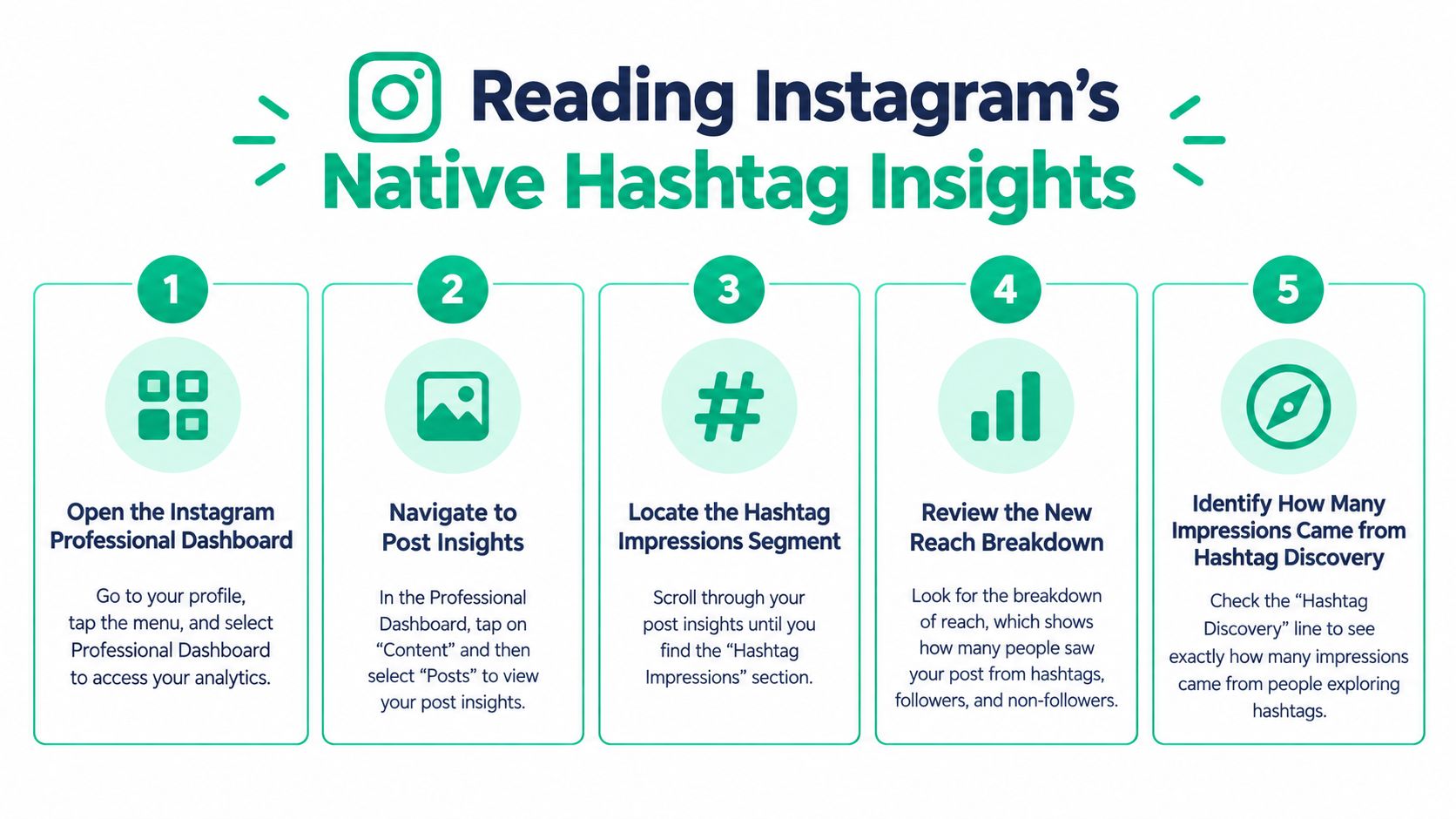
If both values are available, divide hashtag-attributed impressions by total impressions. The result is the share of recorded impressions attributed to hashtags. It does not measure the share of unique people discovered through tags.
Read the Numbers With Their Limits in Mind
A single post can show that hashtag exposure occurred alongside saves, shares, profile visits, or follows. It cannot establish that a particular tag produced those outcomes. Treat the aggregate figure as a starting point, not a tag verdict.
To compare posts, record their identity, topic, format, hashtag cluster, caption structure, publishing conditions, and any relevant audience changes. Include reach, non-follower reach, total impressions, hashtag-attributed impressions when available, and audience actions such as saves, shares, relevant comments, profile visits, and reported follows. Note when you collected the results and which fields were unavailable.
Compare posts at the same age after publication. A mature post has had more time to accumulate actions than a new one, so their totals are not directly comparable.
For stronger evidence, rotate hashtag clusters across comparable posts while keeping topic, format, caption structure, publishing conditions, and audience as consistent as practical. Then compare the outcome you chose, such as saves, profile visits, or follows. Changing one tag while holding the rest of the set steady can help test that individual tag, though ordinary publishing conditions still leave uncertainty. Repeated results support an inference, not absolute proof.
Why Volume Is the Wrong Hashtag Strategy
Adding tags is a decision about classification, not a guarantee of attention. A broad label might describe your general industry while saying very little about the specific person who would value the post.
A 2025 peer-reviewed analysis of Instagram content from the United States and United Kingdom found that, in most examined cases, posts containing hashtags or mentions had lower average interaction than posts without them; the authors concluded that tagging doesn't guarantee increased engagement in their analysis of tagging and Instagram interactions. This doesn't establish that removing tags will improve every account.
Separate a Plausible Explanation From a Proven Cause
My strategic interpretation is that audience mismatch can help explain disappointing results. If a general fitness tag places a specialized rehabilitation tutorial before people seeking workout entertainment, the content may not satisfy their expectations. That's a hypothesis you can test, not a causal finding you can assume from an engagement average.
Specificity alone isn't enough either. A niche tag attached to an unclear or unhelpful post won't fix the creative.
Decision test: Would someone browsing this topic feel that your post belongs there?
For another perspective on the question of whether tags still deserve attention, consult SimpleLab Digital's hashtag insights. Use that discussion to challenge your assumptions, then make decisions from your own controlled comparisons.
Evaluate Relevance Before Popularity
Instead of ranking candidates by apparent size, create a qualitative assessment:
Use a short checklist instead of ranking hashtag candidates by apparent size. Ask whether the term matches the people you want to reach for audience fit. Check content fit by confirming that the post delivers what the label implies. Review niche specificity to see whether the tag describes a meaningful subtopic. Consider geographic fit by asking whether the term is appropriate for your service area. Finally, look for experimental evidence by checking whether the cluster has supported your chosen outcome repeatedly.
For a hypothetical fitness creator, a tag describing beginner strength training may fit an introductory tutorial better than a general fitness label. The narrower wording makes the intended audience clearer, but it still needs testing.
Retire the habit of pasting the same popularity-driven pack into every caption. Build clusters with a stated purpose instead, such as beginner education, local discovery, or product use. You'll have a clearer explanation for every tag you keep, and a more useful question to answer with your data.
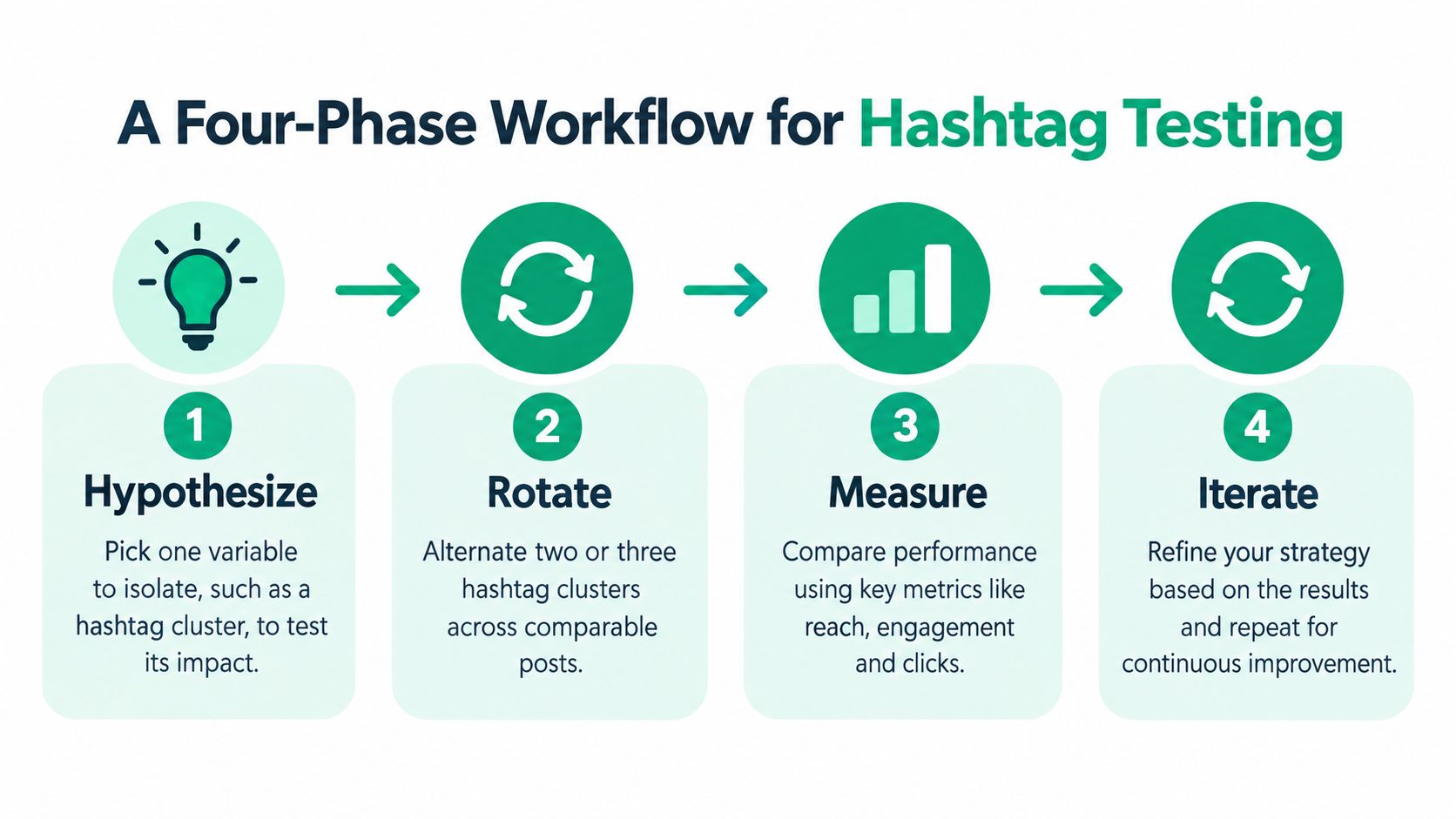
A Four-Phase Workflow for Hashtag Testing
Start with a spreadsheet, your publishing calendar, and a question you can answer. You don't need a complicated dashboard to make a more disciplined comparison.
Use this process diagram to keep the experiment focused.
Hypothesize and Rotate
Hypothesize. Write a prediction tied to an outcome. A hypothetical bakery might ask whether replacing #PlantBasedDesserts with #VeganBakery increases profile visits on comparable product posts. Because that example changes an individual tag, keep the other tags stable.
For a broader cluster test, a fitness creator could compare general topic labels with beginner-specific labels. Use trending Instagram hashtag discovery techniques to gather candidates, but treat every candidate as unproven.
Rotate. Assign the alternatives across comparable upcoming posts, using randomized or alternating allocation. Don't give the experimental set only your strongest creative. Keep offers, calls to action, formats, and publishing conditions comparable, and include an untagged comparison if your question is whether using tags helps at all.
Measure, Retain, and Iterate
Measure. Create a row for each post. Add columns for the hypothesis, cluster, conditions, collection date, primary outcome, supporting metrics, and unusual events. Compare median results across the cycle rather than choosing the highest-performing post.
EmbedSocial's hashtag analytics guidance recommends evaluating downstream outcomes such as profile visits, saves, qualified comments, website clicks, and conversions rather than relying on exposure alone. Select the outcome before reviewing results so you don't declare success using whichever metric happens to look strongest.
Retain and iterate. Keep a cluster when its advantage appears across comparable posts and supports the chosen objective. If results conflict, document that uncertainty and continue testing rather than forcing a winner.
An agency can extend the worksheet with campaign-specific tags, UTM-tagged profile links, and landing-page events. Those tools help connect campaign activity with website response, but a UTM identifies the clicked campaign link, not the hashtag someone originally encountered.
Use a weekly planning session to assign tests and update completed observations. Report the scope plainly: a cluster associated with stronger profile activity isn't automatically a proven source of sales.
Tracking Hashtag Performance Over Time and After Metric Changes
A sudden reporting decline deserves a definition check before a strategy change. If the field you're measuring changed, you may no longer be comparing equivalent observations.
Reporting on 2025 platform changes indicates that Views replaced some Reels and Stories play metrics and Minutes Viewed replaced watch time in affected workflows, according to Accio's reporting on Instagram analytics changes. The same reporting describes limited native historical depth and no raw data export, which makes preserving your own records important.
Maintain a Dated Metric Dictionary
Record each metric's name, meaning, reporting scope, availability, and collection method. Add the date when you notice a definition or interface change. Don't relabel historical plays as current views, or assume a renamed viewing-duration field is directly comparable.
Preserve observations: Keep periodic screenshots and spreadsheet records, plus exports where your external tools provide them.
Mark transitions: Label reporting periods affected by changes.
Compare stable definitions: Use ratios only when both their numerator and denominator remain comparable.
Separate sources: Keep native observations distinct from externally tracked website events.
A documented experiment history helps you distinguish changed reporting from changed audience response. It also lets another team member understand how you reached a recommendation.
Common Questions About Ongoing Hashtag Reviews
How often should I refresh clusters? Review them during your regular content planning, but don't replace everything merely because it feels repetitive. Reconsider a cluster when the content direction, audience, vocabulary, or repeated results change.
When should I retire an underperforming tag? Remove clearly irrelevant tags immediately. For a relevant candidate, wait for repeated comparable observations and check whether creative differences explain the apparent weakness. A losing cluster doesn't identify its weakest individual member.
How should I evaluate a campaign-specific tag? Match the measurement to the campaign's purpose, such as participation, relevant submissions, profile activity, or tracked inquiries. Record campaign-link results separately from discovery evidence instead of assigning every conversion to the tag.
What if year-over-year performance appears lower? Check metric definitions, data availability, content mix, and observation windows before concluding that the audience lost interest. If comparability broke, report that limitation explicitly.
The most useful long-term record isn't a permanent list of winning hashtags. It's a series of documented decisions showing what you tested, what you observed, and how confidently you can act on the result.
Gainsty offers an Instagram social assistant focused on organic follower growth and engagement for creators and businesses. If you're looking for support alongside your own Insights-and-spreadsheet testing, visit the platform to explore its approach and bring a clear audience goal to your next hashtag experiment.