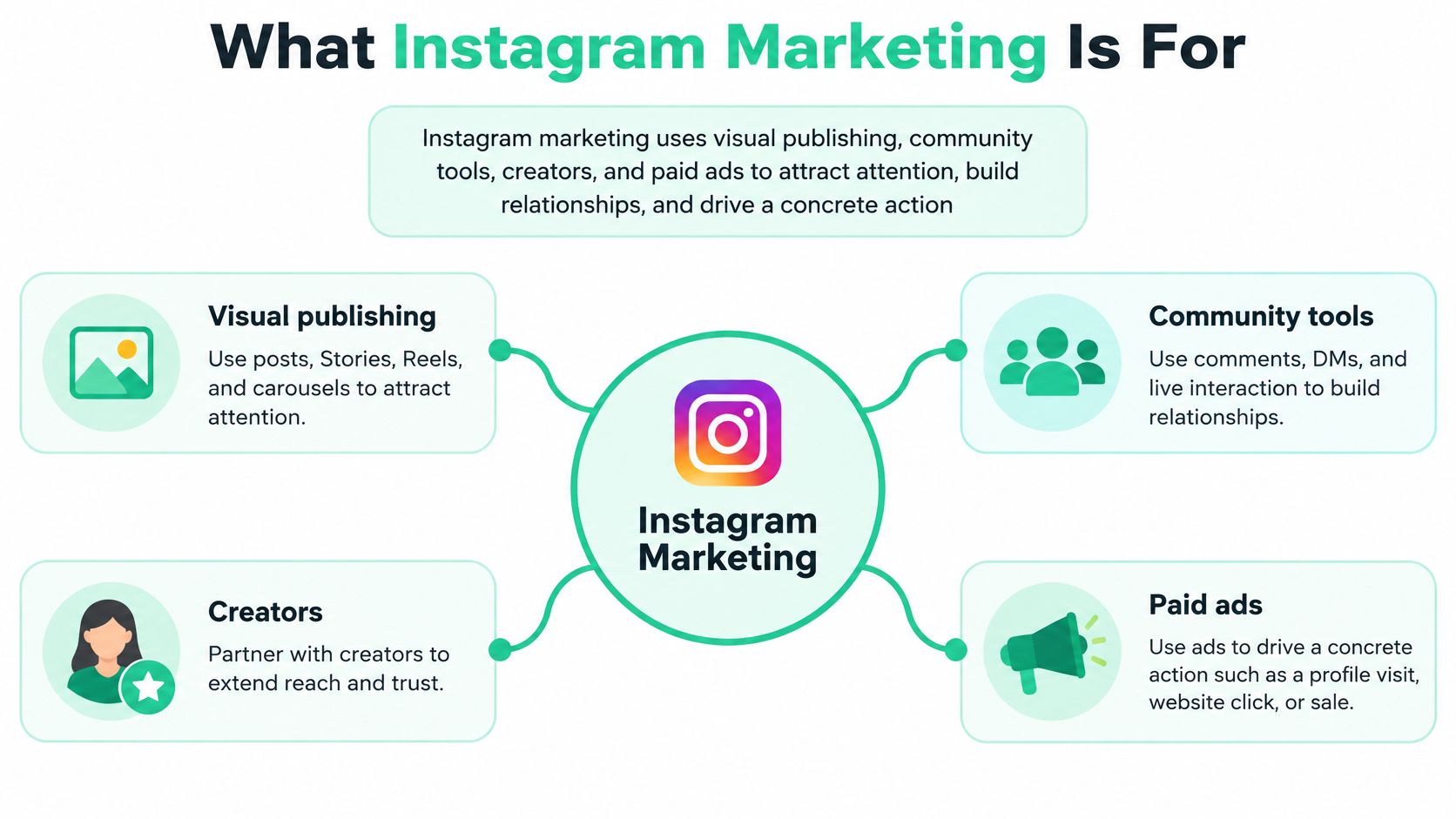
What Instagram Marketing Is For
At its simplest, What Is Instagram Marketing comes down to a path. You publish something visual, a specific person pays attention, trusts you a little more, and then takes a next step you can count.
Say a bakery posts a photo of morning croissants. That's presence. If the caption tells nearby office workers they can reserve a box for pickup, the Story adds a poll and a link, and the owner replies to comments about allergens, that's marketing. The photo now has a job.
Presence Is Not a Plan
A neat grid with no audience in mind and no next step doesn't create demand. It just exists. Marketing connects four tools on purpose, visual publishing, community tools, creators, and paid ads, so attention has somewhere useful to go.
You don't need all four at once. A solo coach might rely on Reels and direct messages. A shop might add product posts and a small ad budget. The mix changes, but the test stays the same. Did the right person do something?
Why Businesses Moved Here So Fast
The channel grew unusually quickly. According to DataReportal's Instagram statistics compilation, Instagram launched on October 6, 2010, reached 1 million registered accounts by December 2010, passed 10 million users by September 2011, and reported 300 million monthly users by December 2014.
Treat those milestones as company-reported historical figures, not an independently audited user panel. Still, the sequence explains the shift. Within four years, a photo app had become a place where a niche account could speak to one community and a larger brand could reach a broad audience in the same feed.
That dual use is still the point. Short-form video, Stories, comments, direct messages, creator collaborations, and product-focused posts let you build awareness and relationships together. Before you choose tactics, choose which problem you're solving.
Trust: Do people who already know you need proof, updates, or a reason to return?
Discovery: Do strangers need a reason to notice you and visit your profile?
Action: Do warm viewers need a clearer offer, link, or conversation?
Each answer points to different content and a different measure of success. That choice matters more than posting more often.
Organic, Paid, and Creator Paths Beyond Followers
Posting frequency isn't a strategy. It's just output. You first need to pick how people will encounter you, then design content that can earn or justify that distribution.
Organic posts and video help build trust and repeat attention among people who already care. Instagram ranks them using predicted actions such as watch time, comments, likes, shares, and profile taps. You spend time and creative effort rather than a media fee; watch saves, shares, profile visits, and follows to see whether that effort is working.
Paid ads help you reach people beyond your followers by location, interest, or behavior. Meta delivers them through an auction, so you need a media budget as well as creative. Judge them by clicks, conversions, and return on ad spend.
Creator collaborations put your message in front of a niche audience that already trusts someone else. You might offer a fee, product, or revenue share, and you can pay to boost the content further. Track qualified profile visits and the specific action you agreed on in the brief.
How Organic Distribution Actually Works
Your followers don't see posts in chronological order. As Instagram's ranking explanation describes, the system evaluates thousands of signals and, for Feed, weighs five predicted actions heavily, spending time on the post, commenting, liking, sharing, and tapping the profile image.
That creates a loop. If viewers linger, comment, share, or tap through, the model predicts more value and can show the post more widely. If they scroll past quickly, distribution shrinks. You're not just asking, "Did people like it?" You're asking whether the post earned time and a higher-intent action.
If you're weighing where effort belongs, this comparison of organic and paid social media approaches helps you separate relationship building from bought reach. Use organic content to prove an idea resonates before you pay to spread it.
Paid ads work differently. You buy delivery through Meta's system and filter by location, interests, demographics, or behavior. That control is useful only if the creative and landing step already work, which is why learning to optimize social ad spending starts with clicks, conversions, and return on ad spend, not audience size.
The Signal for Reaching Non-Followers
For discovery, watch three indicators closely, watch time, likes per reach, and sends per reach. Recent reporting summarized in Black Alpaca's Instagram algorithm guide identifies those measures as key, with sends especially relevant for reaching people who don't already follow an account, and notes brands published more and gained more total views and interactions while average engagement rate fell from 3.79% to 3.54%.
That drop is your warning. More posts and more total interactions can still mean weaker efficiency. A like is private approval. A send is a recommendation to a specific person, so it carries your content into a new conversation.
A post that people send travels farther than a post they only like.
Build two kinds of posts on purpose. Follower-facing content gives existing viewers proof, behind-the-scenes access, offers, and replies. Discovery content needs a first-second hook, a useful or emotional payoff, steady pacing, and a reason to forward it to one named type of person, such as a friend training for a first race.
Judge both through a funnel, qualified reach, engaged viewing, profile visits, follows, or clicks. If follower count rises but profile visits, saves, and conversions don't, you haven't proved marketing worked. You've only proved a number got bigger.
What Each Instagram Format Is For
Don't paste the same idea onto every surface and call it repurposing. Each format reaches a different mix of people and asks for a different action, so the creative needs a different opening, length, and payoff.
The diagram below maps that split before you assign content.
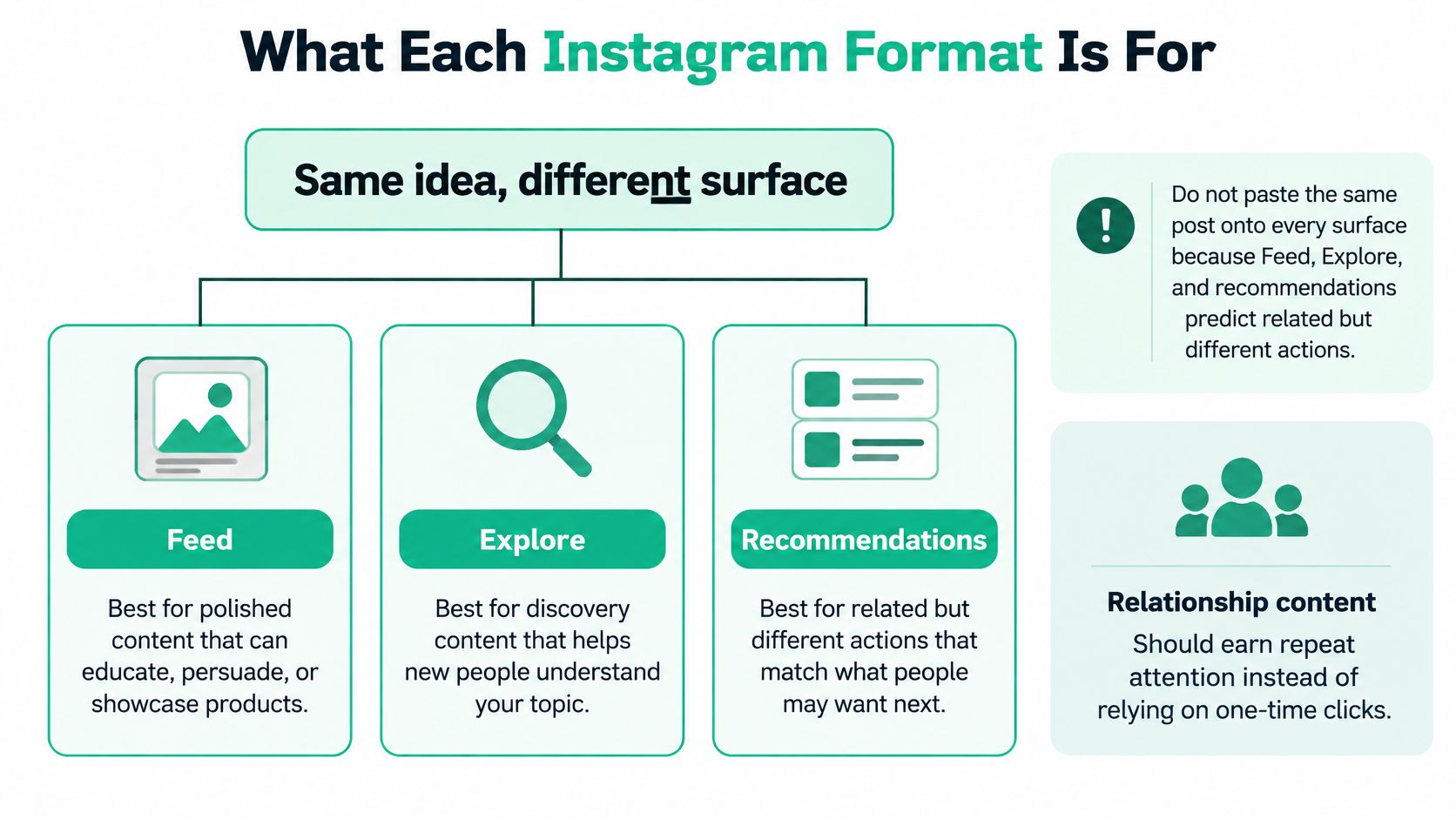
Feed posts reach followers and may appear in recommendations. Use them for proof, offers, and relationship building, then look at time on post, comments, shares, and profile taps.
Stories mostly reach current followers and disappear after 24 hours. They suit updates, replies, and links; measure replies, sticker taps, and link clicks.
Reels can reach non-followers through recommendations. Use them for discovery, teaching, or entertainment, and watch time and sends per reach.
Explore introduces your content to people who don't follow you. For topic-based discovery, look at profile visits, follows, and saves.
Live video and DMs serve people who are already interested. Use them for conversations that can lead to action, then count replies, bookings, and qualified messages.
Give Each Surface One Job
Feed posts suit proof, offers, and deeper captions for people who already follow you. Carousels can work well here because each swipe gives viewers a reason to stay, and the Rapid Ads guide to Instagram carousels is useful if you later turn a strong organic sequence into an ad.
Stories are better for timely, lower-polish contact. Use polls, questions, and links to start replies, then count those replies and clicks. A Story that produces three serious questions can beat a polished Feed post that produces silent approval.
Reels are your main discovery format, so open with the problem or result in the first second. This guide to using Instagram Reels for business can help you structure that hook. Don't save the payoff for the end if strangers have no reason to wait.
Explore is where non-followers meet you through a topic. According to Meta's Explore ranking documentation, signals include viewing time, full-screen clicks, profile visits, follow-button clicks, and saves. That means clarity beats insider references. A stranger should understand who you help within seconds.
Live video and direct messages sit closest to conversion. Use them for questions, demonstrations, bookings, and follow-up with people who've already shown interest. Don't judge a Live by viewer count alone if two viewers booked calls.
Test One Variable at a Time
Change only the hook, duration, topic, call to action, or format. Then compare results per impression, watch time, completion, shares, saves, profile-visit rate, follow rate, and qualified site clicks.
Check followers gained from each theme at 7, 30, and 90 days. If a topic brings a spike that disappears, it attracted curiosity. If people stay, save, and reply, it built an audience you can market to again.
Metrics That Show the Marketing Worked
Most beginners get stuck here. They're told to chase awareness, engagement, and sales, but nobody tells them which number should steer each decision. So they default to followers and likes because those numbers are visible.
Survey results can point you toward ideas, but they don't prove cause and effect. In HubSpot's Instagram marketing report, audience interaction was reported as the highest-ROI strategy by 40% of respondents, product demonstrations and teasers were identified by 46% as producing the strongest engagement and ROI, and 51% of surveyed Instagram marketers said they use AI to analyze performance, audience data, or competitive intelligence.
Read those figures as reported belief. They don't show that a comment caused revenue for your account. Your own tracking has to make that connection.
Watch time and retention tell you whether the hook held attention. If they are weak, rewrite the first second and tighten the pacing.
Sends per reach suggest whether a post is reaching beyond your followers; if few people send it, make it worth forwarding to one specific person.
Saves show whether viewers found it useful enough to keep, so a low save rate may call for a clearer how-to or reference payoff.
Profile visits bridge attention and action. If people engage but don't visit, give them a stronger reason to tap through.
Qualified DMs, bookings, sign-ups, and purchases are business outcomes; if visits aren't turning into those actions, check the offer, link, and follow-up.
Follower count alone is a weak primary score. If followers increase without visits or conversions, don't scale the creative yet.
Separate Diagnostics From Outcomes
Diagnostic metrics tell you whether the creative earned attention, watch time, retention, shares, saves, and profile visits. Outcome metrics tell you whether the business moved, qualified direct messages, bookings, email sign-ups, purchases, and repeat customers.
You need both, but don't confuse them. If you want a broader framework for that distinction, learn to track marketing KPIs that drive revenue and then map each Instagram number to a stage you own.
Say a Reel gets broad views and almost no sales. That isn't automatically a failure. It tells you the hook created awareness while the offer, profile, or landing page didn't convert strangers. Fix the step after attention.
Now say five local customers reply to a Story about limited appointments and three book. Reach looks tiny, revenue doesn't. For a local service, those replies are stronger evidence than a viral post watched in other countries.
Decision rule: Weak retention means fix the hook. Strong retention with low profile visits means fix the reason to tap through. Strong visits without sales means fix the offer, not the posting schedule.
Build four habits around that rule. Track the conversion that matches your goal, label campaigns consistently, compare against a baseline, and report by format and audience segment. A Reel for strangers and a Story for regulars shouldn't be judged by the same target.
Tools That Show What Worked
You don't need a complicated stack to start. You need three views that connect a post to attention, attention to a visit, and a visit to business.
Professional account Insights shows per-post reach, watch time, profile visits, and follows. Focus on watch time, profile visits, and follows to see whether attention leads anywhere. Meta Ads Manager lets you manage paid audiences and conversion tracking; use its campaign results to check clicks, conversions, and return on ad spend. UTM-tagged links in web analytics connect posts and formats to site activity, so you can compare sessions, leads, and sales by source.
Set Up Each Tool for One Question
Professional account Insights. Switch from a personal account so you can read per-post reach, watch time, profile visits, and follows. Check which Reels hold viewers past the first seconds instead of sorting only by likes.
Meta Ads Manager. Build paid audiences by location, interest, and behavior, and set up conversion tracking before you spend. Name every campaign with a consistent label that includes goal, format, and audience, so you can compare results later.
UTM-tagged links. Tag links in your bio and Stories with source and format labels. Then your web analytics can tell you whether a Reel, Story, or ad produced the session, lead, or sale.
This deeper walkthrough of Instagram analytics for business growth helps you turn those views into a routine. Start simple. One dashboard, one outcome, one changed variable each week.
Record a baseline before your first test. Native dashboards use their own definitions and reporting schedules, so compare like with like over the same period. If a number you need, such as sends, isn't shown the way you want, log shares manually in a sheet. A rough, consistent record beats a precise dashboard you never review.
How Businesses and Creators Use It
Abstract definitions get clearer when you watch the same system serve different buyers. Notice that none of these accounts tries to use every feature, and none ends the story at follower count.
A Neighborhood Coffee Roaster
Stories carry today's roast, the pickup window, and a quick poll for people nearby. That's relationship content with a short life and a clear local action.
A Reel shows a 20-second brew method for someone who just bought a grinder. It's built to be sent to that friend, not admired in silence. The roaster counts Story replies that become weekend orders and profile visits from outside the neighborhood. Likes from coffee fans who'll never visit are pleasant, but they aren't the score.
A Fitness Coach Selling Programs
Reels teach one mistake in a lift, such as rushing the descent on a squat. Each video solves one visible problem, so a stranger knows immediately whether it's relevant.
The caption invites viewers to request a free form check by direct message. Feed posts then show client proof and answer objections for people who already follow. If views rise for a week but nobody asks about coaching, the coach doesn't celebrate. She changes the topic or the invitation and counts qualified conversations and bookings.
Hashtags and a posting calendar support this work. They help organize discovery and keep publishing steady. They don't replace a hook worth sending.
A Small Product Brand With a Limited Run
The brand posts two organic demonstrations and asks a creator in the same niche to test the product for an existing audience. One demo earns more saves and sends because it answers the question buyers ask.
Only that winning demo becomes an ad, targeted by interest and location. The score is the site click and purchase, not applause on the original post. Paid spend amplifies proof, it doesn't manufacture it.
Across all three cases, targeting means niche relevance. City and language for the roaster, training goal for the coach, and the creator's likely buyers for the brand. Each account picked one discovery format and one conversion step, then repeated what moved people.
Pick One Goal Before You Post More
Don't add content until you can finish this sentence, "This month, Instagram should produce more of this one action." Vague growth gives you vague decisions.
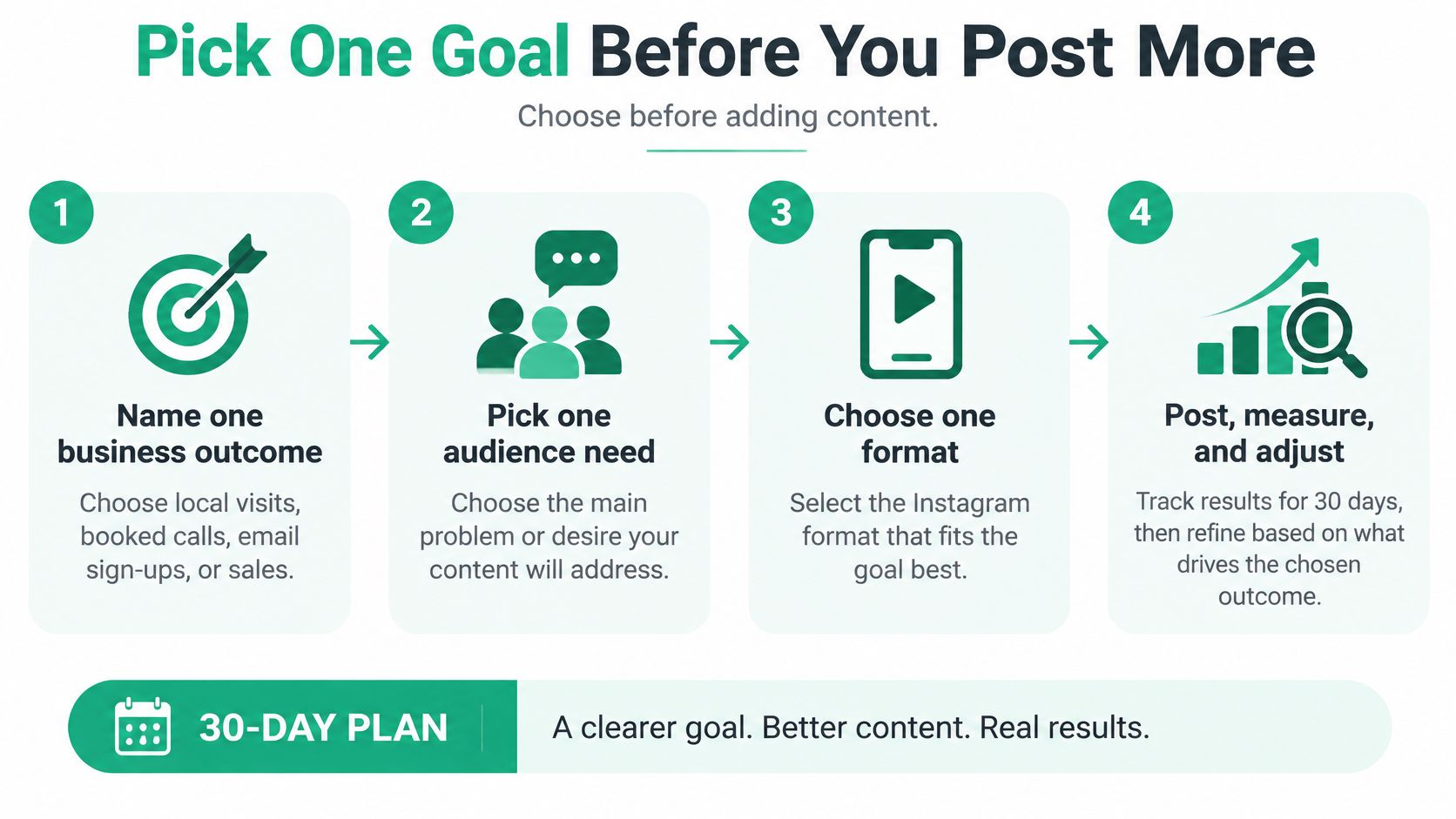
Name one business outcome. Choose local visits, booked calls, email sign-ups, or sales.
Pick two formats only. Use one discovery format, usually Reels, and one relationship format, Stories or Feed.
Write one caption action. Ask viewers to send the post, reply with a word, tap the profile, or click the link. Don't ask for all four.
Record your baseline. Note watch time, sends per reach, profile visits, and your chosen outcome before you change anything.
Change one thing each week. Test the hook or the offer, not both, so you know what caused the shift.
Decide at day 30. Keep the version that moved the outcome. Stop the version that only added likes.
Know the limits before you judge yourself or any outside help. Instagram can change distribution, your account history affects how far posts travel, and no outside service controls the platform. We work within those limits too, and we can't guarantee results if Instagram changes its platform.
If you consider support, judge it against that written goal and baseline. Our process is three steps, connect your Instagram account, set targets based on competitors, age, location, gender, and language, then watch your account grow organically through done-for-you organic outreach handled manually without bot scripts. That still doesn't replace your content test. Use the same decision rule, fix the hook for weak retention, fix the tap-through reason for low visits, and fix the offer when visits don't become sales.
Pick your one outcome, record your baseline, and make your next post worth sending to a specific person. If you want targeted, manual help reaching the right audience while you test that content, visit Gainsty to start a free trial and set targets by competitor, age, location, gender, and language.