Pick a Growth Bet Before You Spend
The OECD report on strengthening SMEs and entrepreneurship reports that only about 4% of micro-start-ups grow on average, yet these businesses create between 22% in the Netherlands and 53% in France of new jobs. Growth is concentrated, not evenly spread. Most firms stay small. A few find a repeatable way to turn attention into customers and pull away.
That same OECD work defines high-growth firms as those achieving at least 20% annual growth in employment or sales over a three-year period. Use that bar to separate real scale from ordinary busyness. A busy month isn't a growth strategy. A system that adds sales year after year, without relying on your personal hours for every order, is closer to one.
Which Growth Bet to Fund First
If buyers do not yet pay or return, start with market research and product-market fit. Cash risk is low, and within 2-6 weeks you can look for evidence that people will pay and want to buy again.
If a niche already looks for your offer, test organic social, including Instagram. Cash risk is low to medium; over 4-8 weeks, watch how many profile visits become inquiries.
Use paid acquisition only when your margin can cover a known acquisition cost. Cash risk is high, but customer-acquisition cost and payback can give you a signal within days to 30 days.
Try partnerships and referrals when a partner already has the trust of your target buyer. Cash risk is low; measure referral rate and referred revenue over 4-8 weeks.
If you already have a customer list, start with retention and repeat sales. It carries the lowest cash risk. Review repeat rate and contribution margin monthly to see whether it is working.
Pick the first bet that fits your situation. If strangers don't pay yet, research is your bet, not ads. If you already have buyers, retention is usually the cheapest revenue you own. If another business already serves your buyer and trusts you, a referral arrangement can beat cold outreach for cash risk.
The temptation is to fund everything at once. According to the 2025 JPMorgan Business Leaders Outlook, 64% of surveyed business leaders planned to invest more to support sales, including 35% adding products, 34% increasing advertising, and 31% expanding social-media campaigns. For a small team, splitting cash three ways often means no single test gets enough budget or time to produce a readable result.
Practical rule: Unproven offer means research first. Repeat buyers mean retention plus one capped test. Attention without inquiries means fix the path to a sale before buying more reach.
Before you spend, write down how you'll judge the result. If you need a practical starting point for tying activity to outcomes, learn to measure your small business marketing results so each bet has a number attached before money leaves the account. Pick one proof KPI from the options above, one time window, and one budget cap. That's your bet. Everything else waits.
Prove the Offer Before You Scale It
Think of product-market fit as a key that must turn before you pour fuel into the engine. Fuel is ads, content volume, and audience growth. If the key doesn't turn, more fuel only floods the engine. Strangers need to understand the offer, pay for it, and get a result they'd pay for again.
You don't need a research department to test that. You need a short loop you can run this month.
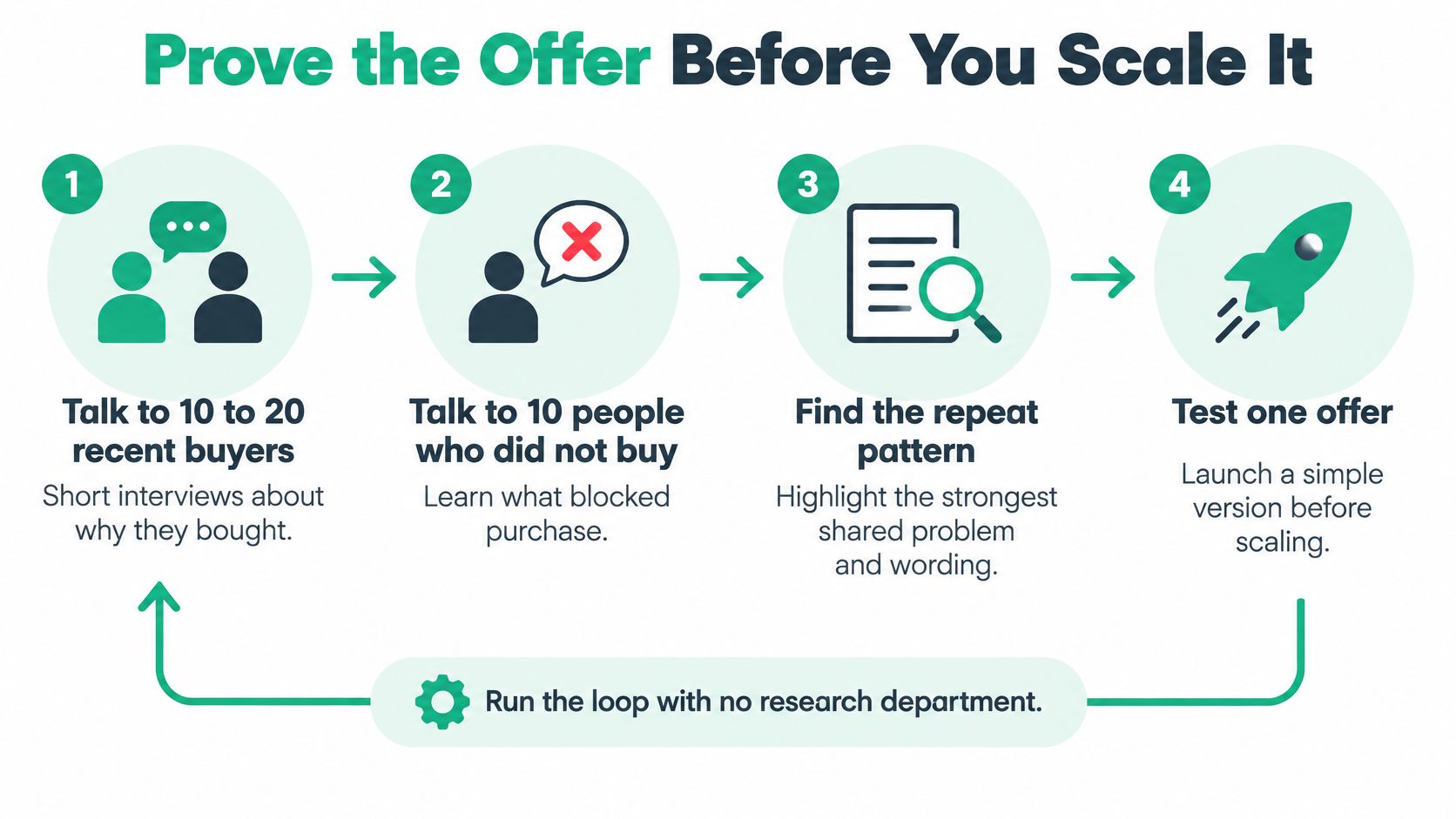
The Four-Step Research Loop
Talk to recent buyers and near-misses: Speak with 10 to 20 recent buyers and 10 people who almost bought. Ask what they tried before, what nearly stopped them, and what result they'd pay again to get. Write down their exact words.
Write the offer in one sentence: Name who it's for, the painful job, the result, and the price. If you can't fit it in one sentence, buyers won't repeat it to a friend.
Test one change at a time: Show that sentence to a comparable slice of your audience. Change only the promise or only the price, not both. Search behavior can help you check whether people already look for this problem, and you can turn keyword research into demand validation before you build anything bigger.
Keep what produces payment: Keep the version that creates qualified inquiries, paid orders, or booked calls. Drop the version that only earns likes.
Say a bakery hears the same phrase from six buyers, "I need a birthday cake I can order on my phone by Thursday." That's not a new product line. That's a clearer promise, a deadline, and an ordering path. The test is whether that sentence, placed on the profile and counter card, produces orders without a discount.
The Pass or Stop Test
An offer passes when three things happen. Strangers pay without a heavy discount. At least some buyers come back or refer someone else. Delivery doesn't depend on you working every hour yourself.
Don't wait for advanced analytics to run this test. The OECD Going Digital report reports that big-data analysis is used by 11% of small firms versus 33% of large firms. That gap is exactly why a simple weekly test wins. One hypothesis, one change, one count of inquiries and sales beats a dashboard nobody reads.
Until one offer passes, freeze ad spend and audience-growth spend. Scaling an unproven offer doesn't multiply revenue. It multiplies the number of people who say no, and you pay for each one.
Grow When Cash Is the Constraint
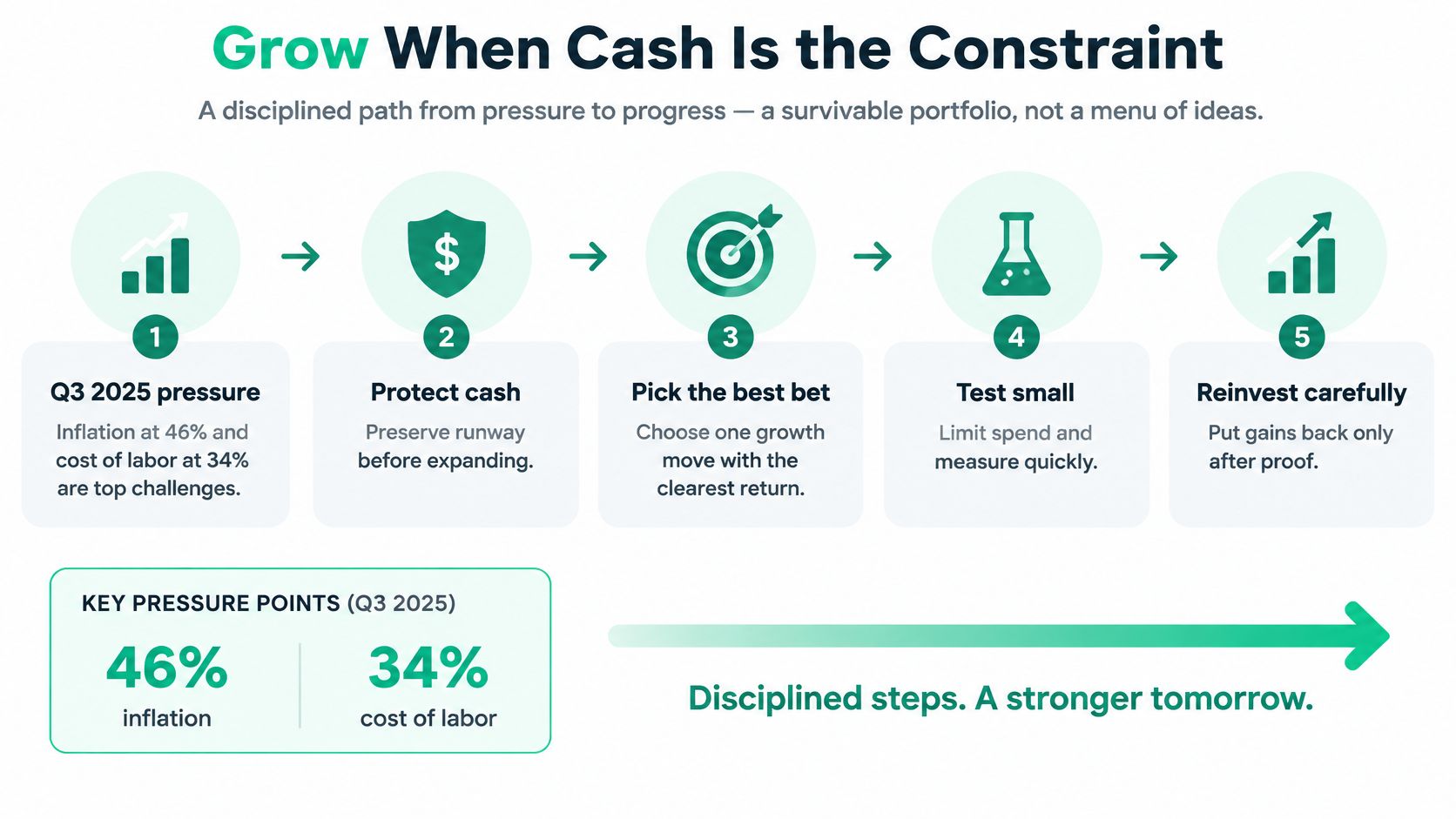
Most owners don't lack ideas. They lack cash they can afford to lose while an idea proves itself. In the Thryv survey reported by Business Wire, in Q3 2025, 46% of surveyed U.S. small businesses identified inflation as their biggest challenge, 34% cited the cost of goods and services as the largest growth roadblock, and 33% said rising costs prevented entry into new markets. Under that pressure, growth has to be a portfolio you can survive, not a wishlist.
The image below frames that sequence, from protecting cash to reinvesting only after proof.
Cap, Payback, Stop
Cap the test before you start: Set a small fixed amount, often one week of discretionary marketing cash or a single staff day. Write the cap down. A cap you agree with yourself after spending isn't a cap.
Require a payback window: For a low-ticket offer, require payback inside 30 days. For a high-ticket service, inside 90 days. Count only inquiries that match your buyer profile, not every message.
Set the stop rule in advance: End the test after two weeks of profile visits with no inquiries, or when measured acquisition cost passes the gross profit on an average sale. Decide now, while you're calm.
Hold budget and timing as constant as you can across the segments you compare. If one offer runs on a payday weekend and the other runs during a quiet week, you're measuring the calendar, not the offer. Compare qualified inquiries and gross profit per customer, so a post with strong reach and weak economics can't hide.
Build Assets That Survive a Pause
Prioritize owned assets that keep working when ads stop. An email or SMS list you collected with permission. A review habit after each good outcome. A referral ask at the moment a customer is delighted. Reusable content that answers the same buying question every week.
Local visibility belongs in that owned pile too, and work like building customer trust through local listings costs more time than cash while helping nearby buyers find and verify you. Social channels then do one job, create measurable demand that lands on an asset you control, rather than renting attention forever.
Say a cafe tests a referral card with the bakery next door before boosting a post. The card costs printing and a conversation. Say a consultant holds five outreach conversations before funding a paid campaign. Both tests can fail cheaply and teach something specific. A slow, attributable gain beats a spike your cash account can't carry.
Move Attention Through a Real Funnel
Picture the funnel as a hallway with doors, not a megaphone. A megaphone makes noise in one room. A hallway only works if each door opens into the next room.
The diagram below shows those doors in the order a buyer moves through them.
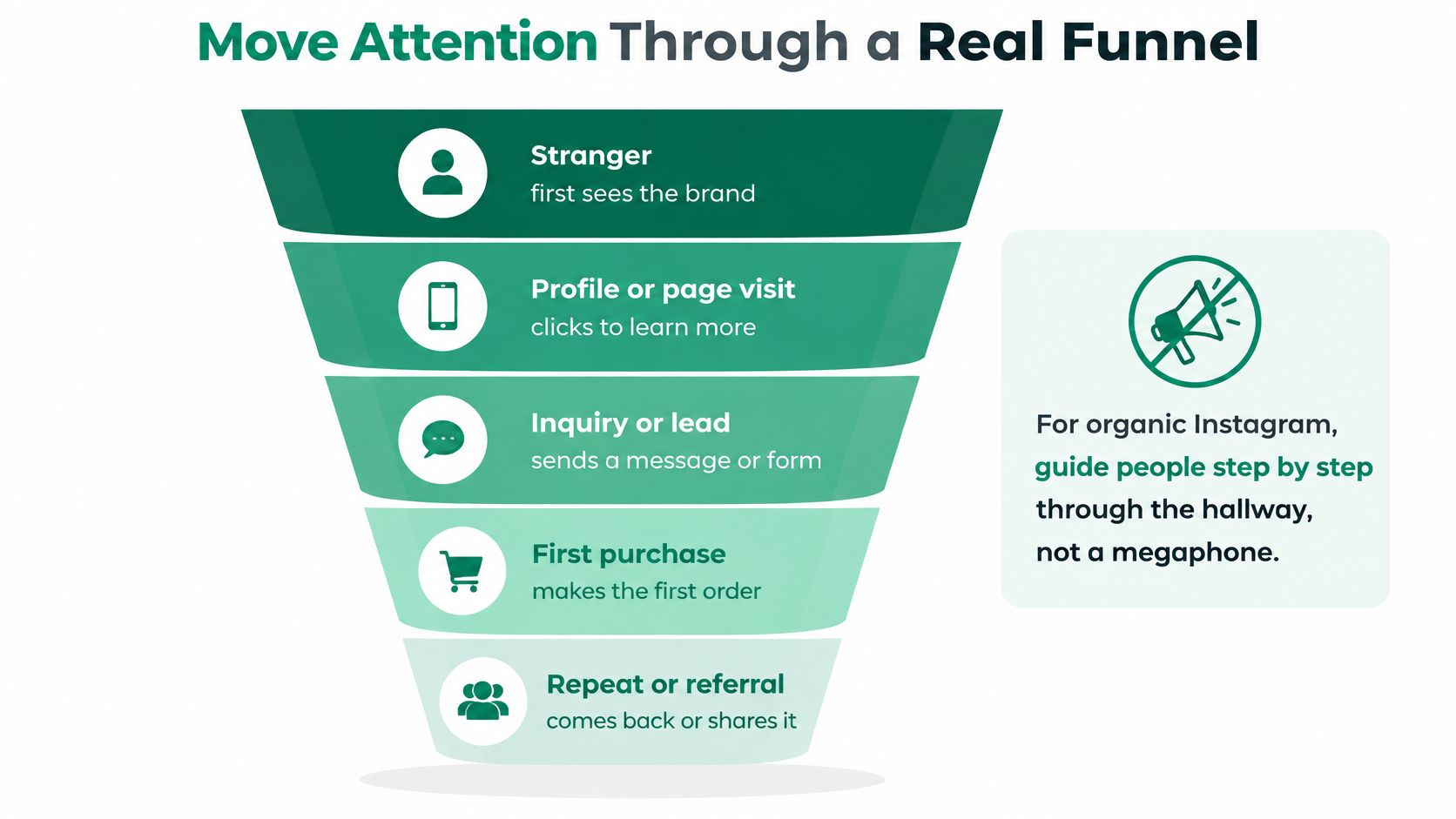
The stages are simple. A stranger sees you. A profile or page visit means they chose to look closer. An inquiry or lead means they raised a hand. A first purchase means money changed hands. Repeat or referral means the relationship continued without you buying that attention again.
Give Each Channel One Job
On organic Instagram, proof and education earn the visit. Show the finished result, the constraint you solved, or the mistake you help buyers avoid. A clear profile line and link earn the inquiry, because a visitor should know in seconds who you help and what to do next. A prompt, human reply earns the booking. If you want help structuring that content side, these content marketing tips for small businesses fit the same hallway logic.
Paid acquisition has a narrower job. It amplifies an offer that already converts organically. The daily cap should be money you can lose without missing payroll or rent. Stop the ad if cost per qualified inquiry stays above the gross profit of a typical sale. Don't average a losing week into a hopeful month.
Partnerships borrow trust instead of buying clicks. Use three shapes only. A shared guide with a complementary local business. A referral fee or reciprocal introduction with clear terms. A creator or industry peer whose audience already has the problem you solve.
A channel is working only when the next door in the hallway opens.
Use AI Without Sounding Like Everyone Else
AI can speed up drafts, captions, and first-pass replies. It can also make every brand in your niche sound identical, which lowers trust. The JPMorganChase Institute overview of AI use by small businesses cites a 2025 study finding that 55% of small businesses used AI, up from 39% in 2024, while 58% of users reported saving more than 20 hours per month and 66% reported monthly savings of $500–$2,000.
Those figures measure time and cost, not profit. Saving hours matters, but hours saved writing posts nobody acts on don't grow a business. Judge AI on a measurement ladder instead.
Hours saved: Did the draft take less of your week?
Engagement quality: Did buyers, not just peers, respond?
Qualified leads: Did inquiries match your buyer profile?
Revenue: Did those leads buy at a workable margin?
Retention: Did they come back or refer?
Keep customer insight, your own examples, and final judgment human. Let AI shorten the blank page. Don't let it invent proof you don't have or replace the conversation that closes a sale.
Retention Metrics That Show Real Growth
Retention is the compounding floor under every other strategy. A new follower, click, or first sale is a spark. A repeat purchase, rebooking, or referral is the fire that keeps the business warm after the spark fades.
That distinction matters because acquisition gets more expensive when delivery leaks. If buyers don't return, every month starts from zero, and you must buy or chase the same revenue again.
KPI Ladder From Attention to Profit
Check followers and reach weekly to see how much attention you earn, but don't mistake a larger audience for demand if nobody asks to buy. Also check profile visits that become inquiries each week; this shows whether visitors are raising a hand rather than viewing and leaving.
Track your lead-to-customer rate weekly to see whether your offer and follow-up turn qualified leads into buyers. Then check acquisition cost and payback to find out whether those new customers are affordable. Cheap followers mean little if each sale costs too much to win.
Review repeat rate and contribution margin monthly. Together, they show whether growth adds lasting profit instead of producing a one-time sales spike.
Read these measures in that order. If reach rises but inquiries stay flat, your content attracts viewers, not buyers. If inquiries rise but sales don't, your offer, price, or reply process needs work. If sales rise but repeat rate falls, delivery is the problem.
Keep the Stack Short
You don't need more software. You need a short chain that connects source to sale. The 2026 U.S. Chamber of Commerce small business technology report found that 99% of U.S. small businesses used at least one technology platform and 41% of small businesses were classified as high-tech adopters using six or more platforms, while businesses using two or more platforms were roughly 10 percentage points more likely than low-tech users to report growth in sales, profits, and employment.
For most small teams, two connected tools beat six disconnected ones. Use Instagram or another source, plus a simple CRM or spreadsheet. Define a qualified lead in writing. Note conversion by source each week, and keep organic reach separate from paid reach so a boosted post can't hide a weak profile. If you want to go deeper on the value side, improving customer lifetime value connects directly to the repeat rate row.
Then act before you acquire more people.
Ask for the next step early: Offer the rebooking or reorder before the customer leaves.
Message past buyers with a reason: Send a dated email or SMS when the offer returns or a size restocks.
Ask while delight is fresh: Request a review or referral within a day of a good outcome.
Count each action against the repeat rate. If inquiries rise and repeat rate falls, stop acquisition and fix delivery first.
How the Same Play Looks by Industry
The sequence stays the same across industries. The constraint changes. These four scenarios show the first bet, the stop rule, and the retention move in practice.
The collage below reflects the mix most owners juggle, customers in person, work on a laptop, and orders going out.

Four Short Stories
A neighborhood cafe asks 15 regulars why they skip certain weekdays. The answer becomes a weekday offer, emails are collected at the counter, and Instagram shows that day's special with a reservation cue. A referral card with the bakery next door comes before any boosted post, and the test stops if the special fills seats only at a discount that erases margin. Retention is the email that brings regulars back on a quiet Tuesday.
A fitness coach sells a 12-week program instead of chasing followers. Posts show real client constraints and form cues, and a physio partnership sends people who already need structured training. The stop rule is clear, if consultation calls don't convert, the program promise gets fixed before more content goes out. Retention is a scheduled check-in, not another giveaway.
A local real-estate agent treats each listing as its own campaign. Inquiries go into a simple CRM, replies follow a set timing, and paid promotion runs only on listings whose past inquiry-to-showing rate can support the spend. If a listing draws views but no showing requests, promotion stops and the listing presentation gets reviewed. Retention is staying in touch with past buyers who become the next referral source.
A boutique retailer fixes stock and reorder gaps before making more content. Customers get an email when a sold-out size returns, and new drops are posted to an audience that has already bought. The stop rule is operational, no promotion for items that can't be restocked or delivered on time. Retention is the restock message that turns a missed sale into a second chance.
Circle the story whose constraint matches yours. Unknown demand, a proven offer with weak distribution, expensive leads, or one-time buyers each point to a different first bet. Copy the sequence, not the surface tactic.
Set a 90-Day Growth Budget
A quarterly budget turns your chosen bet into a plan you can defend when a slow week tempts you to change direction. Start with one target stated as a number, such as qualified inquiries per month or repeat customers per quarter. Then name the single constraint that limits it.
Divide the quarter's discretionary marketing cash across three buckets, offer research, owned-asset building, and one capped channel test. Write the split down so it can't drift into a little bit of everything.
The Quarterly Procedure
Set the target and constraint: Pick one number and one limiter, unknown demand, weak distribution, expensive leads, or one-time buyers.
Fund the constraint first: Give the largest share to the bucket that removes that limiter, not the bucket that feels most familiar.
Hold a reserve: Keep a small buffer so a slow month doesn't force a panic cut to retention work, which is usually your cheapest revenue.
Review on a fixed date: Check results on the first Monday of each month against your KPI ladder. Move money only when a bet clears its stop rule or payback window.
If you run social activity, a social media ROI calculator to measure campaign success can help you translate inquiries and sales into a payback figure before you reallocate. Use your own margin and close rate, not a generic benchmark.
Many firms spread a quarter's budget across every channel in their feed. Each test ends up half-funded, and none reaches a readable signal. One plan, funded long enough, tells you something you can act on.
Run One Experiment This Month
You don't need a new strategy deck. You need 30 days, one offer, and a count you trust.
Week 1 is for clarity. Write the one-sentence offer and talk to 10 customers or near-misses. Note the exact words they use for the problem and the result.
Week 2 is for proof. Publish proof to your existing audience, finished work, a constraint solved, a question answered, and track profile visits against qualified inquiries. Followers can rise or fall. You're watching whether buyers raise a hand.
Week 3 is for ownership. Add one owned-asset ask, an email signup, a review request, or a referral ask, and cap any paid test at its prewritten stop rule. If distribution on Instagram is the gap, we provide done-for-you Instagram growth, handling organic outreach manually without bot scripts, and we offer a 7-day free trial where we do the work, and you watch your account grow. Judge that option the same way you'd judge any channel, on inquiries and repeat buyers, not follower counts. One reviewer put it plainly, "Growth is a bit slow compared to running ads, but the follower quality is high. People engage, book calls, and retention is solid over several months."
Week 4 is for the decision. Read your KPI ladder and keep only the bet that produced inquiries, sales, or repeat buyers. If the offer is unproven, do the interviews before any tool. If the offer converts, fund the one distribution test that cleared its payback window.
If your 30-day test shows the offer converts, but the right people aren't seeing it, Gainsty can handle the manual, organic Instagram outreach for you while you stay focused on replies, delivery, and repeat buyers. Start with the same rule you'd apply to any growth bet, set your inquiry target and stop rule first, then visit us to begin your trial and judge the results on qualified demand, not follower volume alone.