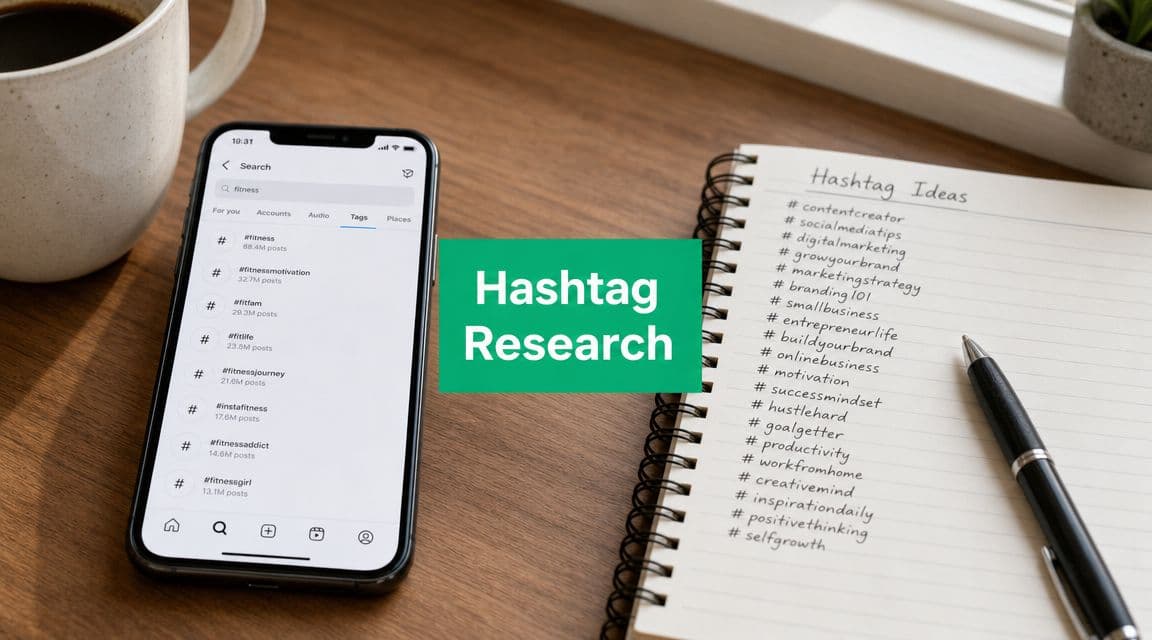
Why Hashtag Research Still Matters in 2026
You publish a solid Reel, the edit is sharp, retention looks decent, and the post still stalls. Then a weaker post with clearer topic signals keeps getting discovered. I see that pattern all the time, and hashtags are usually part of the difference.
Instagram is still one of the largest discovery channels on the internet. According to Hootsuite's Instagram statistics roundup, the platform has around 3 billion monthly active users, is the fourth-most-visited website, roughly half of users discover new brands while browsing the app, and Reels account for about 46% of time spent on Instagram while being shared more than 4.5 billion times per day. On a platform that large, small relevance signals matter.

That is the part many marketers miss. Hashtags are no longer a volume play. They work best as classification signals. They help Instagram place a post into the right topic cluster, and they help users who browse by interest, niche, or problem find content that matches what they already care about.
Reels made that job more demanding. A hashtag set now has to support the actual content, not rescue it. Strong results usually come from alignment across the hook, spoken keywords, on-screen text, caption language, and tags. If those pieces point to different topics, reach gets muddy, and testing gets harder.
That is why I treat hashtag research as a measurement system, not a caption habit. The goal is not to generate a long list of tags. The goal is to prove which tags help the right posts earn qualified discovery, then build reusable sets around those patterns. AI can speed up collection and clustering, but it still needs a human filter. It is good at finding variants. It is not good at judging intent, competition, or whether a tag fits the actual post.
If you want a stronger handle on how discovery works in short-form video, this guide to Instagram Reels in 2026 is worth reading alongside your hashtag workflow. For teams publishing interviews, clips, and short educational content, examples of podcast promotion via Reels are also useful because they show how one asset can be positioned for different audience intents without turning the caption into keyword stuffing.
The old advice focused on quantity. That is why so many accounts ended up pasting 20 to 30 generic tags with no testing discipline behind them. What still works is a tighter topic fit and cleaner post-to-tag alignment.
A practical standard looks like this:
Broad tags have limited value: They can add context, but they rarely carry discovery on their own in crowded categories.
Specific tags often outperform popular ones: Smaller tags usually describe intent more clearly and produce cleaner test results.
Repeatability matters more than inspiration: A documented system beats picking hashtags at the last minute.
ROI matters more than impressions: If a tag brings the wrong audience, the extra reach is noise.
Hashtag research still matters because Instagram discovery is not random. It is a recommendation system trying to categorize content fast. Good hashtag research gives that system better inputs, gives your team cleaner testing data, and turns guesswork into something you can improve post by post.
Laying the Foundation for Effective Hashtag Research
Most hashtag problems start before research begins. The account doesn't know what the post is supposed to achieve, who it's for, or what language that audience uses.
If the goal is fuzzy, the tags will be fuzzy too. A local bakery, a SaaS founder, and a fitness coach might all post “educational content,” but the search behavior around those posts is completely different.
Start with one clear job for the post
Pick the primary outcome before you search for anything. Not five outcomes. One.
A useful way to frame it:
Reach new people: Use tags that map to topic interest and entry-level discovery.
Strengthen community: Lean toward subculture, insider, and recurring audience language.
Drive local attention: Prioritize neighborhood, city, venue, and event phrasing.
Support sales content: Focus on problem-aware or use-case-aware tags instead of broad inspiration tags.
This sounds obvious, but it fixes a common mistake. Teams often choose hashtags based on what the brand does in general, not what the specific post is trying to do.
Define the audience by language, not demographics alone
Audience notes like “women founders” or “homeowners” are too broad to guide good hashtag research for Instagram. You need wording patterns.
Look for:
Problem phrases: What does the audience complain about, ask about, or compare?
Identity signals: What do they call themselves?
Context words: Where are they using the product, skill, or idea?
Format expectations: Do they engage with tutorials, opinions, before-and-after content, checklists, or local recommendations?
If you haven't done this work yet, start with your caption and keyword strategy first. This piece on Instagram keyword research helps connect hashtags to the broader search language your audience already uses.
Practical rule: If your audience would never search or follow a hashtag, it doesn't belong in your test set just because it's popular.
Study competitors for logic, not copying
Competitor research gets misused all the time. People copy the exact tags from a strong post and assume the hashtags caused the result. That tells you almost nothing.
Instead, reverse-engineer the logic behind the post:
Post topic: Look at whether the content is broad inspiration, niche education, industry insight, product-focused content, or timely commentary. This helps explain who the post was intended to attract and why it performed the way it did.
Tag style: Examine whether the hashtags are focused on community tags, local tags, product-category tags, campaign tags, or niche-specific tags. The tag mix often reveals the audience the creator is trying to reach.
Comment quality: Review the responses to see whether they indicate the post reached the intended audience. Specific questions, relevant feedback, and thoughtful discussion are generally stronger signals than generic reactions.
Caption alignment: Check whether the hashtags support the same themes, language, and audience implied by the caption and visual content. Strong alignment usually creates a clearer signal about what the content is about and who it is for.
That last point matters. Strong posts usually have alignment across the creative, the caption, and the tags. Weak posts often have a clean visual and then a generic pile of unrelated hashtags attached at the end.
Build guardrails before you collect tags
Before you ever open Instagram search, define what counts as a usable hashtag for your account.
A simple filter works well:
Relevant to the content pillar
Relevant to the intended viewer
Useful for either discovery or categorization
Specific enough to test later
If a hashtag fails those checks, skip it. Your goal isn't to build a huge list. It's to build a list you can defend.
The Discovery Workflow Finding High-Potential Hashtags
Good hashtag research for Instagram starts with a seed list. Not a hashtag generator. Not a trending page. A seed list.
That means writing down the core words behind the content before you turn them into tags. If the post is about first-time homebuyer tips, your seed terms might include “first home,” “mortgage prep,” “homebuying mistakes,” “starter home,” and your city name. If it's a chef account, the seed might start with “weeknight pasta,” “easy dinner,” “Italian cooking,” or “meal prep.”

A practical workflow from Search Influence's hashtag research guide starts by building a keyword seed list, expanding it through Instagram's search suggestions and related posts, then categorizing tags by size and intent. The same workflow recommends building reusable sets of about 20 to 30 hashtags per content category, then rotating and testing combinations instead of posting the same set every time.
Start with topic keywords before hashtag strings
Here's the order I use:
Write the core topic in plain language
List audience variants
Add use-case variants
Add local or seasonal variants if relevant
Convert the strongest phrases into hashtag candidates
That sequence matters because hashtags pulled straight from tools tend to sound like labels. Hashtags built from real audience language tend to sound like search behavior.
For example:
Travel creator: boutiquehotel, slowtravel, cityguide, weekendtrip, hiddenplaces
Food brand: mealprep, easyrecipes, glutenfreebaking, comfortfood, weeknightdinner
B2B consultant: sales process, CRM workflow, DemandGen, founder-led marketing, revops
The point isn't to use those exact tags. The point is to see how different niches produce different intent patterns.
Use Instagram search like a research tool
Instagram's own search bar is still one of the best places to validate language. Type a seed phrase and watch what appears.
Focus on three things:
Suggested variants: These reveal common wording patterns around your topic.
Related post quality: Open the hashtag feed and inspect whether the content matches your niche.
Community fit: Look for signs that the tag has a real audience, not just random usage.
A hashtag with clean topical alignment is often more useful than a larger tag with mixed content. If the top posts under a hashtag feel inconsistent, your post may rank into a messy audience pool even if the tag looks attractive on paper.
If the tag feed looks confused, your results will be confused too.
Check how people actually use the tag
Most lazy research falls apart without proper inspection. Don't just record the hashtag. Inspect the environment around it.
Review a sample of posts and ask:
Are creators using the tag in captions, comments, or both?
Does the content type match your format, like Reels versus static posts?
Do the comments suggest real interest from the intended audience?
Is the tag being used by peers, customers, or unrelated accounts?
That last one matters more than people think. If a hashtag is dominated by giveaway accounts, meme pages, or off-topic content, it can pollute your test set fast.
Built by intent, not just by size
A useful hashtag library includes different jobs for different tags.
I group candidates like this:
Topic tags describe what the content is about and help platforms and users understand the subject matter of the post.
Community tags connect your content to a specific niche or audience identity, making it easier to reach people who share those interests.
Location tags support local discovery and regional relevance, helping nearby users find your content.
Seasonal or event tags capture timely search behavior around holidays, trends, conferences, launches, or other time-sensitive moments.
Branded tags help organize company campaigns, user-generated content, customer submissions, or community participation around a specific brand initiative.
Many marketers stop at “big tag plus small tag.” That's incomplete. Intent tells you why a tag belongs in the set.
Let AI speed up the sorting, not replace judgment
Manual research is still necessary, but AI can cut the repetitive work. Tools can cluster related terms, surface likely tag variants, and help map a post to several audience angles faster than doing everything in a spreadsheet from scratch.
One option is Gainsty, which offers Instagram growth tools that include hashtag research and can help analyze content themes and suggest relevant hashtag directions. Used properly, that saves time on expansion and organization. It doesn't replace testing. It shortens the path to a testable shortlist.
What actually makes a hashtag high-potential
A high-potential hashtag usually has four qualities:
It matches the post exactly
It attracts the audience you want
It fits the format you're publishing
It's specific enough to test against alternatives
That's a better standard than “high volume.” Volume can be useful, but only after relevance is clear.
Organizing and Prioritizing Your Hashtag Library
Research gets messy fast. After one week of serious collection, many people conducting this research already have too many tags and no system for deciding which ones to use. That's when people fall back to copying the same old set.
The fix is a library. Not a giant dump of hashtags. A working library with buckets, labels, and sets built for specific content pillars.

Bucket by intent first
Start with the reason a hashtag exists in your stack. Intent is more useful than popularity when you're selecting tags under a deadline.
I recommend these buckets:
Topic tags: Directly describe the subject of the post.
Niche tags: Speak to a narrower audience or specialized subcommunity.
Community tags: Reflect identity, culture, or shared habits.
Location tags: Useful for regional businesses, events, and local creators.
Branded tags: Reserved for campaigns, user-generated content, or recurring series.
Once that's done, you can layer on competition or post volume notes in your sheet. But if you skip intent, your sets usually become random mixes.
Then rank by practical usefulness
Not every hashtag in your library deserves equal status. Some are core. Some are experimental. Some should be retired.
A simple status system works well:
Core – These are tags with strong topical relevance that consistently fit your content pillars. They are used frequently because they clearly describe your niche and audience.
Support – These tags are useful for specific content angles or subtopics, but they are not necessary on every post. They help add context when relevant.
Test – These are new, experimental, or uncertain tags that you are evaluating. Monitor their impact on reach, engagement, and audience quality before making them a regular part of your strategy.
Archive – These are tags that have become weak, oversaturated, outdated, or no longer relevant to your content goals. Remove them from active use and revisit only if circumstances change.
This is what makes your library usable. You stop asking, “What hashtags should I use?” and start asking, “Which core and test tags fit this post?”
Build sets around content pillars
Instead of one master hashtag block, create sets for recurring post types. A coach might need separate sets for mindset posts, client education, testimonials, and local workshops. A restaurant might need different sets for menu features, behind-the-scenes kitchen content, local discovery, and seasonal promotions.
That's where organization starts paying off.
Use a set structure like this:
Anchor tags: The clearest topic identifiers
Audience tags: The people you want the post in front of
Context tags: Format, occasion, or location
Test tags: New candidates rotated in for learning
A reusable set should save time without becoming permanent. If it never changes, it stops teaching you anything.
Don't chase the 30-tag limit
Instagram may allow up to 30 hashtags, but that doesn't mean you should use all 30. Performance guidance summarized by the American Marketing Association notes that using more than three hashtags can significantly reduce engagement, and posts with over ten hashtags averaged 188 engagements per post. The same source also points to guidance favoring about 3 to 5 highly relevant hashtags, while other practitioners' advice favors 5 to 10 effective hashtags over caption saturation.
That's the main takeaway. Your working range is usually much smaller than the platform limit.
A practical selection model
When I'm choosing final hashtags for a post, I'd rather have a tight, coherent set than a long caption footer full of weak maybes.
A simple model:
Pick 2 or 3 tags that describe the post with precision.
Add 1 or 2 that identify the audience or subcommunity.
Add 1 or 2 that reflect context, such as location, format, or event.
Rotate 1 test tag if the post is suitable for experimentation.
That gives you a focused group without turning the caption into clutter. It also makes results easier to interpret later. If a post performs well, you can learn from the combination.
Testing and Measuring Hashtag Performance
Most Instagram hashtag advice stops too early. It tells you how to find hashtags, maybe how to mix them, then leaves you with a bigger list and no proof that any of it worked.
That's the gap that matters. You don't just need reach. You need incremental reach. You need to know whether the hashtags added discovery that the content wouldn't have earned anyway.
Academic work discussed in this PMC article on hashtag performance evaluation points out that hashtag testing can be “unreliable and non-uniform.” That matches what practitioners run into in real accounts. Results can look noisy unless you keep the test design clean.
Track the right signals inside Instagram Insights
Instagram Insights gives you the raw materials for better decisions. You're looking for post-level patterns, not one-off wins.
The most useful checks are:
Impressions from hashtags
Reach
Interactions
Follower activity after the post
Comparisons across similar posts using different tag sets
If you need a refresher on where these metrics sit and how to read them, ReachLabs.ai on Instagram Insights is a useful walkthrough.
Run cleaner A and B comparisons
Don't test hashtags on completely different posts. That's where bad conclusions come from.
A cleaner method looks like this:
Keep stable: Content format, posting cadence, creative quality, and overall topic.
Change: Hashtag set, tag mix, or tag count.
Why: When testing hashtags, keep the core content variables consistent so you can better understand whether the tag changes influenced performance.Keep stable: Content format, hashtag set, posting cadence, and creative quality.
Change: One variable inside the topic.
Why: This helps identify which specific themes, angles, or audience interests generate the strongest response.Keep stable: Content format, hashtag strategy, topic, and posting cadence.
Change: Placement or rotation strategy.
Why: Adjusting where and how tags are used while keeping everything else constant can help isolate the impact of execution rather than content quality.
For example, compare two educational Reels on the same topic family. Keep the hook style, caption style, and audience target close. Then test a narrower community set against a broader topical set.
If you change the content, caption style, and hashtags all at once, you aren't testing hashtags. You're guessing.
Ask the uncomfortable question
A post can do well for reasons that have nothing to do with hashtags. The hook may be stronger. The reel may have better watch behavior. The topic may be hotter.
So ask this every time: Did the hashtags contribute, or did the post succeed on its own?
That question changes your process. It pushes you to separate vanity visibility from actual discovery value.
A few practical rules help:
Retire tags that never seem to contribute meaningfully
Keep a shortlist of tags that repeatedly show up in strong discovery posts
Watch for false winners, especially tags attached to already strong content
Document failures, because bad tags often repeat unacknowledged across teams
Measure in cycles, not isolated posts
One post rarely proves much. A pattern across several comparable posts does.
Use a simple review rhythm:
Publish with an intentional set.
Record the post-level results.
Compare against similar recent posts.
Keep, modify, or drop the set.
Repeat with one meaningful change.
That's how hashtag research for Instagram becomes a growth lever instead of a caption ritual. Not because every tag works, but because the weak ones get filtered out.
Common Mistakes and Advanced Growth Integration
The most common hashtag mistake isn't using too few or too many. It's using them without a system. That's why the same problems keep showing up: repeated sets, generic tags, no testing history, and no connection to audience language.
A second issue is treating hashtags like a standalone tactic. They aren't. They work alongside content quality, caption keywords, watch behavior, saves, shares, profile clarity, and audience fit.

The mistakes that keep dragging performance down
A few patterns show up again and again:
Repeating the same set forever: This kills learning and often narrows discovery over time.
Using tags that are too broad: They look impressive but don't attract the right audience.
Ignoring local, seasonal, and subcommunity language: These aspects often hold significant real opportunity.
Forgetting compliance issues: If you haven't reviewed risky tags lately, check this resource on banned Instagram hashtags.
Recent guidance summarized by Bastion highlights a better model than static lists: topic keyword → tag cluster → engagement check → repeat. That's a more useful operating rhythm than copying yesterday's caption footer into tomorrow's post.
Where hashtags fit in a serious growth system
Hashtags help most when they reinforce the rest of the post.
That means:
The visual or Reel clearly signals the topic
The caption uses the same language as the tags
The profile itself tells the right audience they're in the right place
The comments and engagement pattern support the same niche positioning
When all of that lines up, hashtags become cleaner inputs. When it doesn't, they can't rescue the post.
The accounts that get the most out of hashtag research don't treat it like decoration. They treat it like one tested layer inside a broader organic discovery system.
If you want a faster way to turn post topics into testable hashtag sets, track what contributes to discovery, and connect hashtags with your broader Instagram growth workflow, Gainsty is worth exploring. Its primary value isn't generating more tags. It's building a repeatable process that helps you choose, test, and refine them without going back to guesswork every week.