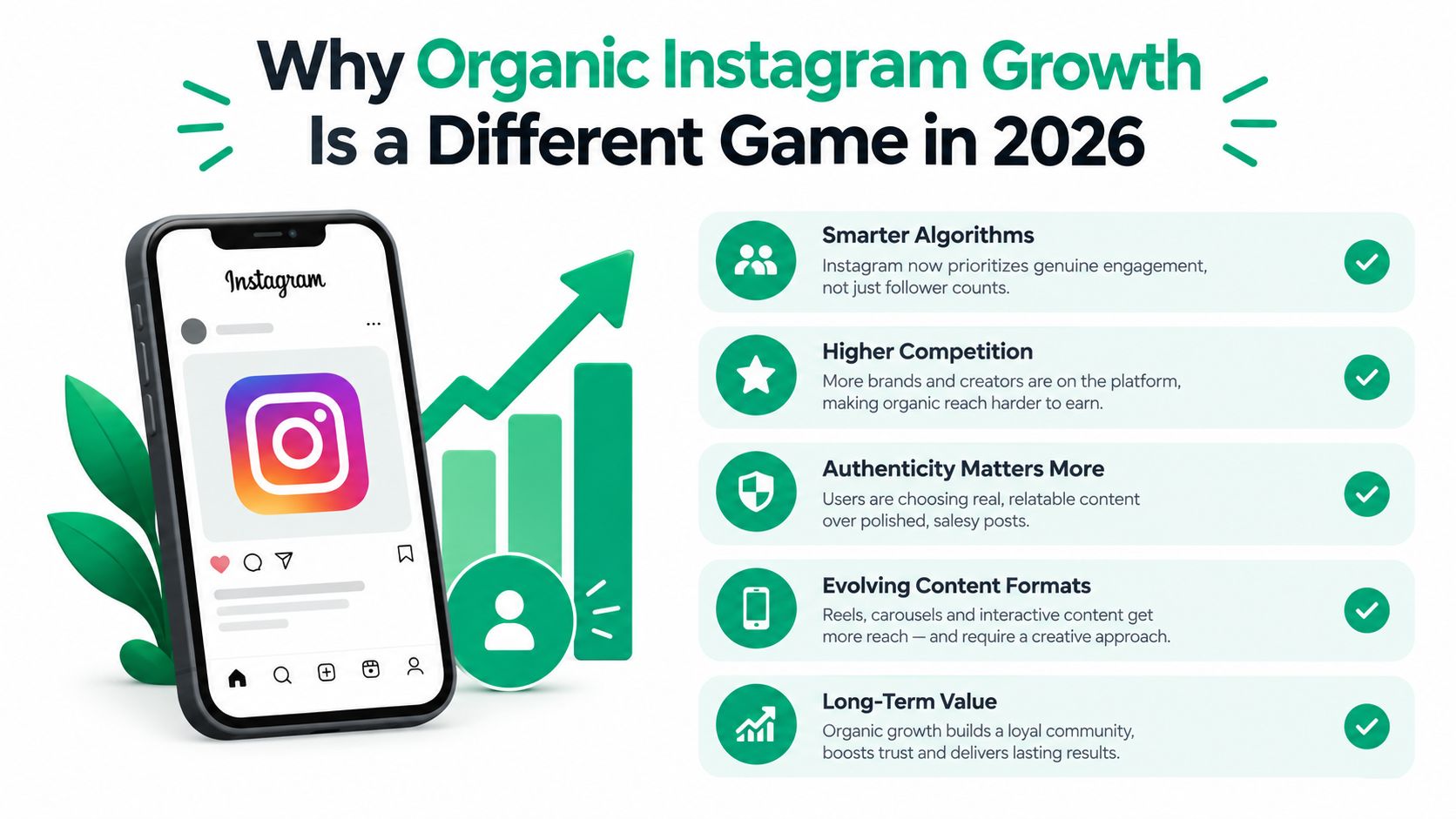
Why Organic Instagram Growth Is a Different Game in 2026
The old Instagram habit of posting and hoping is dead. The platform now rewards predicted performance, so the question is not how often you publish. It is whether each post earns the right signals fast enough to travel.
The reach numbers make that clear. Average organic reach is down to about 3.5% of followers in 2025 to 2026 (Instagram organic reach statistics). At the same time, Instagram's overall scale still matters, with the platform crossing 2 billion monthly active users in October 2022 and reaching 3 billion monthly active users in September 2025 (Instagram benchmarks). Size creates opportunity, but weak content still disappears.
What the platform is actually rewarding
Instagram cares about saves, shares, completions, and profile taps. Engagement remains thin across the platform, with average rates around 0.48% to 0.50%, so the posts that move are the ones that trigger stronger intent, not the ones that just collect light likes (Instagram algorithm coverage, Instagram benchmarks).
A post that gets saved and shared is worth more than three posts that only get a few taps.
That is why niche clarity matters so much. A creator selling personal brand deals needs a different content mix than a local business trying to drive foot traffic, and both need a different path than a DTC brand building category authority. If the audience is vague, Instagram has little to classify. If the audience is specific, each post has a job.
A simple audience worksheet that actually works
Use three filters before you make content.
Who is this for beyond demographics? Skip broad labels. Write the person in their real context, such as new consultants trying to look credible on camera or parents comparing local services on weekends.
What problem or aspiration makes them stop scrolling? Give them a pain point, shortcut, or identity upgrade. That is the hook.
What is the single action after viewing? Save it, comment, DM you, visit your profile, or share it with a teammate.
Use a quick disqualification test too. If an idea does not serve the defined audience, does not solve a real problem, and does not produce one clear action, it stays out of the queue. That is the difference between posting and building.
Match Content Formats to Specific Growth Jobs
Stop treating every format like it has the same purpose. That's how people end up with feeds full of content that looks active but doesn't move anything. Reels, carousels, feed posts, and Stories each do a different job in the distribution chain.
Here's the cleanest way to think about it. Reels are for discovery, carousels are for saves and authority, feed image posts are for brand clarity, and Stories are for retention and conversation. If you build your mix around those jobs, the account starts to behave with intent instead of noise.
Reels are best for watch-through and shares, which makes them strongest for top-of-funnel discovery, but overusing them often leads to chasing reach without niche fit.
Carousels work best for saves and re-reads, which makes them useful for mid-funnel education, but they fail when every post turns into a text wall.
Feed image posts are strongest for profile visits and brand recall, so they help with trust and identity reinforcement, but they can fall flat when they look polished without saying much.
Stories are built for replies, DMs, and repeat views, so they support retention and relationship depth, but they lose value when they slip into casual, low-value updates.
The mistake is overusing the one format you're comfortable making. If you can design, you lean on graphics. If you like talking to camera, you post Reels and ignore the rest. That creates a lopsided account and weakens the whole mix.
If you need a bank of ideas for educational carousels, carousel post ideas for consultants is a useful reference point. It's especially helpful if you want the middle of the funnel to do more than repeat generic advice.
Use format roles like a portfolio
The best content plans don't ask every post to do everything. They assign jobs. A Reel earns discovery, a carousel earns saves, a feed image clarifies the brand, and Stories keep the audience warm enough to respond when you ask for action.
Short version: Reels bring people in, carousels prove you know the niche, Stories keep the relationship alive.
That structure also makes it easier to diagnose weak performance. If Reels are performing but profile visits are flat, the content is attracting the wrong crowd. If carousels are getting saves but not follows, the value is there, but the account promise isn't strong enough. Format selection is not aesthetic, it's operational.
Build a Content Plan That Balances Volume and Per-Post Quality
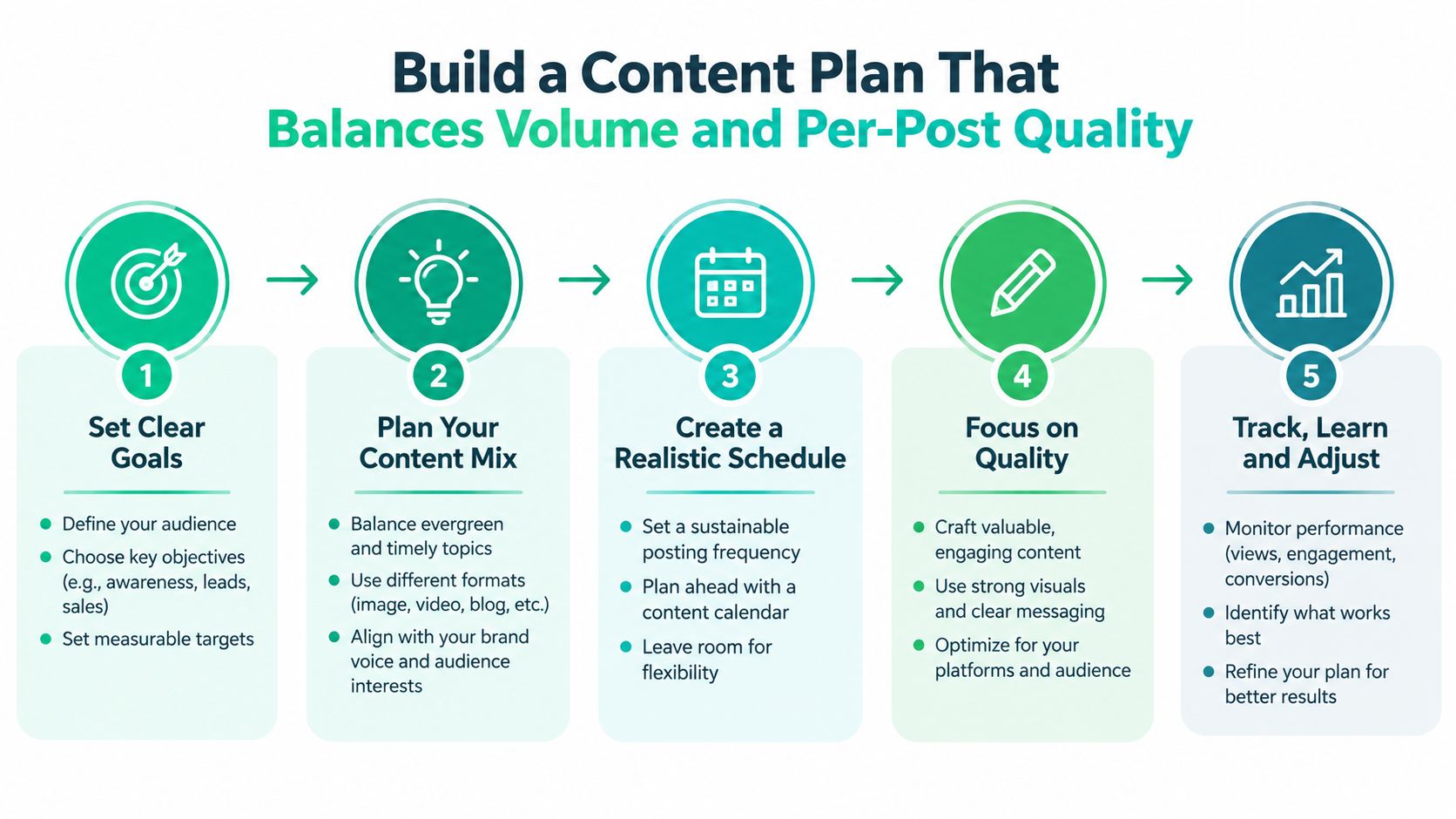
Posting constantly is a waste of time. Post enough to create repetition, then make each slot do a specific job. For most accounts, 3 to 5 posts per week is a sane baseline, with one Reel acting as the reach anchor and the rest split across formats that support saves, authority, and retention. A 2,400-account study found that median per-post engagement fell from 2.10% when accounts posted less than once per week to 0.53% at 7 to 14 posts per week, while total weekly engagement climbed from 1.71% to 9.15% over the same range. Total weekly engagement was 5.4 times higher at 7 to 14 posts per week (posting frequency study).
That trade-off is the decision. Per-post efficiency usually drops as volume rises, but total attention can still improve if the content mix is disciplined. Smaller accounts have even more reason to care about cadence. The same study reported that 1k to 10k follower accounts posting daily saw about 12 times the weekly engagement of accounts posting weekly.
A weekly structure that doesn't collapse
Use a simple rotation.
Monday: Reel for discovery.
Wednesday: Carousel for saves and authority.
Friday: Feed post for brand depth or proof.
Daily: Stories for retention, replies, and lightweight touchpoints.
Batch the work in 90-minute blocks. Draft hooks first. Weak openings kill good ideas fast. Build the rest of the post around the hook, not the other way around.
A monthly planning system keeps the cadence from turning messy. The Social Media Scheduler monthly plan is a practical way to map themes before the week starts. For calendar structure, this content calendar template is worth copying into your own workflow.
Working rule: Repurpose the core idea, not the exact post. One strong concept can become a Reel, a carousel, and three Story frames without feeling recycled.
Reuse assets without getting lazy
A Reel script can become a carousel outline. A carousel can become a talking-head Reel. A Story poll can become next week's caption angle. That is how lean teams stay consistent without burning out on fresh invention every day.
The goal is not more content for its own sake. It is a steady system where each post has a role, each week has a rhythm, and the account keeps showing up without turning into a content mill.
Engagement Tactics That Trigger Saves, Shares, and DMs
Instagram doesn't need more generic engagement. It needs the right signal from the right people. Saves, shares, DMs, and watch-through are the actions that tell the platform a post has real utility, not just decorative appeal.
Build for each signal on purpose
Saves need posts worth returning to. That means a carousel with a clear payoff slide, a checklist people will want later, or a comparison people can reference when they're making a decision. Shares need a social reason to pass the post along, so write captions with a clean line people can send to a friend or teammate without explaining it themselves. DMs usually come from Stories, polls, question stickers, or captions that invite a low-friction reply. Watch-through depends on strong first seconds, a clean content arc, and a loop that makes the Reel feel finished before it ends.
A lot of people waste time on high-effort tactics too early. Manual comment seeding and DM outreach can help if you're small and precise, but they're not a substitute for content worth saving. Passive tactics scale better because the post does the work for you.
To earn more saves, use a clear payoff slide, checklist, or framework, usually in a carousel, with a moderate level of effort.
To drive more shares, write captions with a sendable line, most often in a Reel or carousel, and this is usually a low-effort tactic.
To generate more DMs, use polls, question stickers, and reply prompts in Stories, which usually takes moderate effort.
To improve watch-through, focus on a strong hook, a tight loop, and a quick payoff in Reels, again with moderate effort.
To deepen comments, use a specific opinion prompt or a choice-based question in a feed post or carousel, and this is usually low effort.
Keep the daily routine small and focused
Spend 15 minutes a day on real accounts in your niche. Leave thoughtful comments, reply to Stories, and respond to people who already show intent. Skip pods and fake reciprocity. They inflate activity and poison the signal.
If you want a deeper breakdown of tracking these interactions, the Instagram analytics guide is a practical companion for building a review habit around the right metrics. Use it to connect engagement back to actual growth, not just visible activity.
Direct answer: If a post doesn't invite a save, share, DM, or completion, it's probably too weak to carry organic growth.
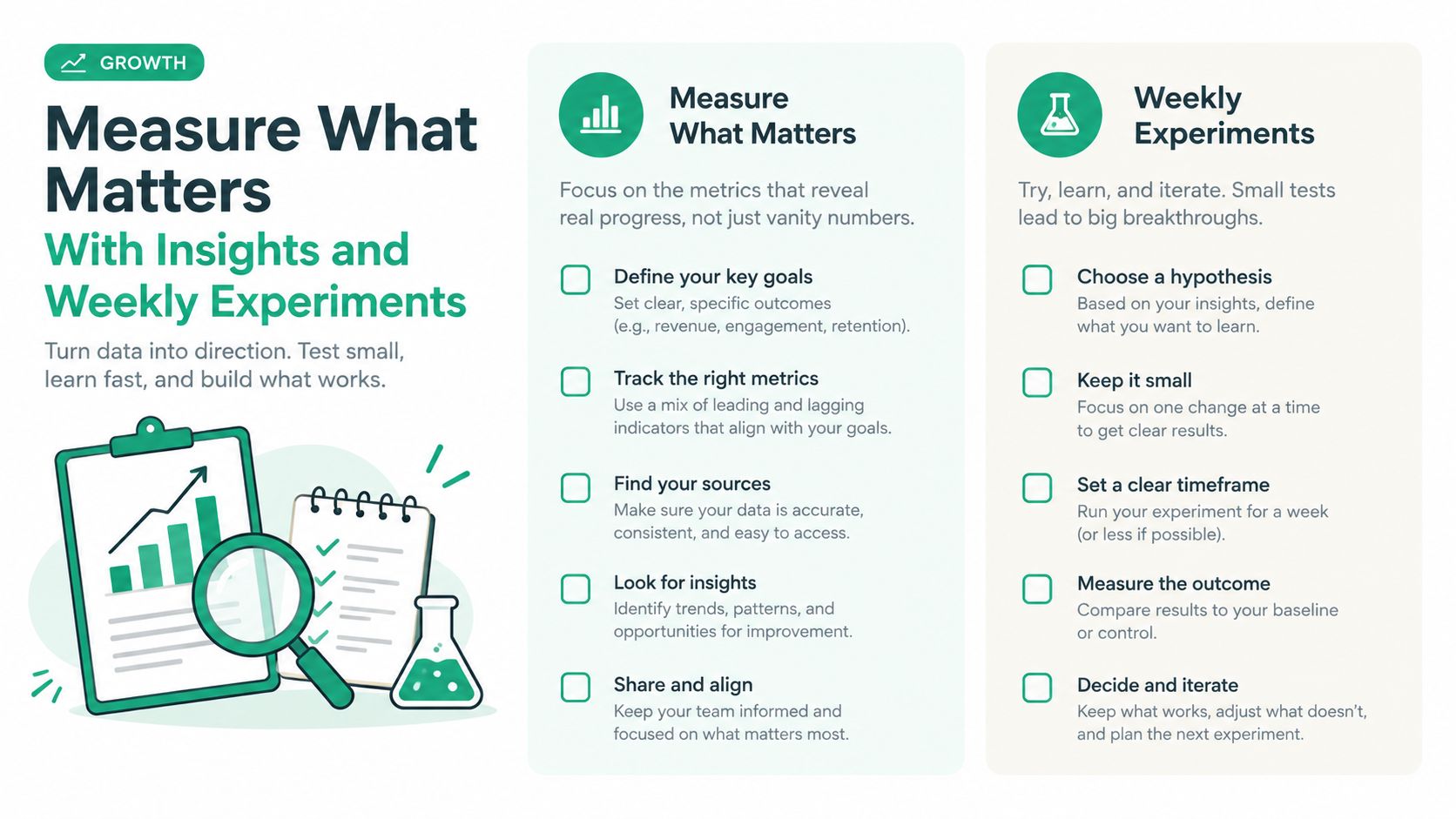
Measure What Matters With Insights and Weekly Experiments
Follower count is a lagging vanity metric. It can climb while the account still underperforms. The weekly job is simple, measure whether content earns attention efficiently and whether that attention turns into actions that matter.
Start with four numbers: reach rate, save rate, share rate, and profile visits per impression. Those tell you far more about organic momentum than likes alone. Track engagement as a repeatable KPI, and keep your review habit tied to a practical Instagram analytics guide so you connect performance back to growth, not just visible activity.
Run one test at a time
Pick one variable per week. Test the hook, the format, the posting time, or the CTA, but never all four together. If you change too much at once, the results are noise.
Use a small experiment log with four fields:
Hypothesis: What you expect to improve.
Change: What you altered.
Result: What happened in Insights.
Decision: Commit, iterate, or kill it.
Commit when one variable clearly improves the signal you care about. Iterate when the idea has promise, but the packaging is off. Kill it when the post gets attention but does not move the right metric.
Review on a fixed cadence
Weekly reviews should answer one question, which posts earned the strongest follower-normalized engagement? Monthly reviews should identify which format is carrying reach, which topic cluster produces saves, and which CTA gets replies. That keeps you from mistaking activity for growth.
A small account with stronger save and share behavior can outgrow a bigger account with weaker intent. That is the standard now. If you are not reviewing Insights this way, you are guessing.
Using AI Growth Assistants Safely Without Bots or Fake Followers
AI helps organic growth only when it stays in the assistant lane. Bots, fake followers, and mass-action automation distort your data, weaken trust, and make it harder to see which posts earn saves, shares, and follows.
Use AI for drafting, research, and targeting support, not for pretending to be a person. It can generate caption variants, scan competitors, test hooks, and organize audience ideas. It should not run follow-unfollow loops, mass-like campaigns, or fake engagement. If a tool automates behavior a real account owner would notice and control, it is the wrong tool.
Some teams use human-supervised platforms like Gainsty for the planning side of growth, then pair that with broader automation services from AY Automate for repetitive workflow support. That setup keeps decision-making human and uses software for the grind. For workflow examples, see how to use AI for social media marketing.
Vet the tool before you trust it
Check four things before you let any assistant near your workflow.
API legitimacy: The tool should work in a way that does not put the account at obvious risk.
Targeting logic: It should support real audience filters, not random spray-and-pray behavior.
Disclosure policy: You need to know what it does, what it does not do, and where humans review output.
Brand safety: If the tool creates spammy behavior, walk away.
Use AI where speed matters and judgment does not suffer. That covers caption drafts, idea clustering, and first-pass competitor scans. Keep it out of community replies and DMs, where tone and context matter more than efficiency.
If follower quality drops or engagement falls after a tool change, pull back immediately and audit the process.
Safe AI support removes friction from the slow middle of growth. It should never replace your judgment.
Your 30 Day Organic Growth Checklist
Week 1 is about the base, not the content machine. Rewrite the bio, define the niche in one sentence, build a clear audience persona, and screenshot your current Insights so you have a baseline. Finish with a short list of content ideas that match the audience, not your own preferences.
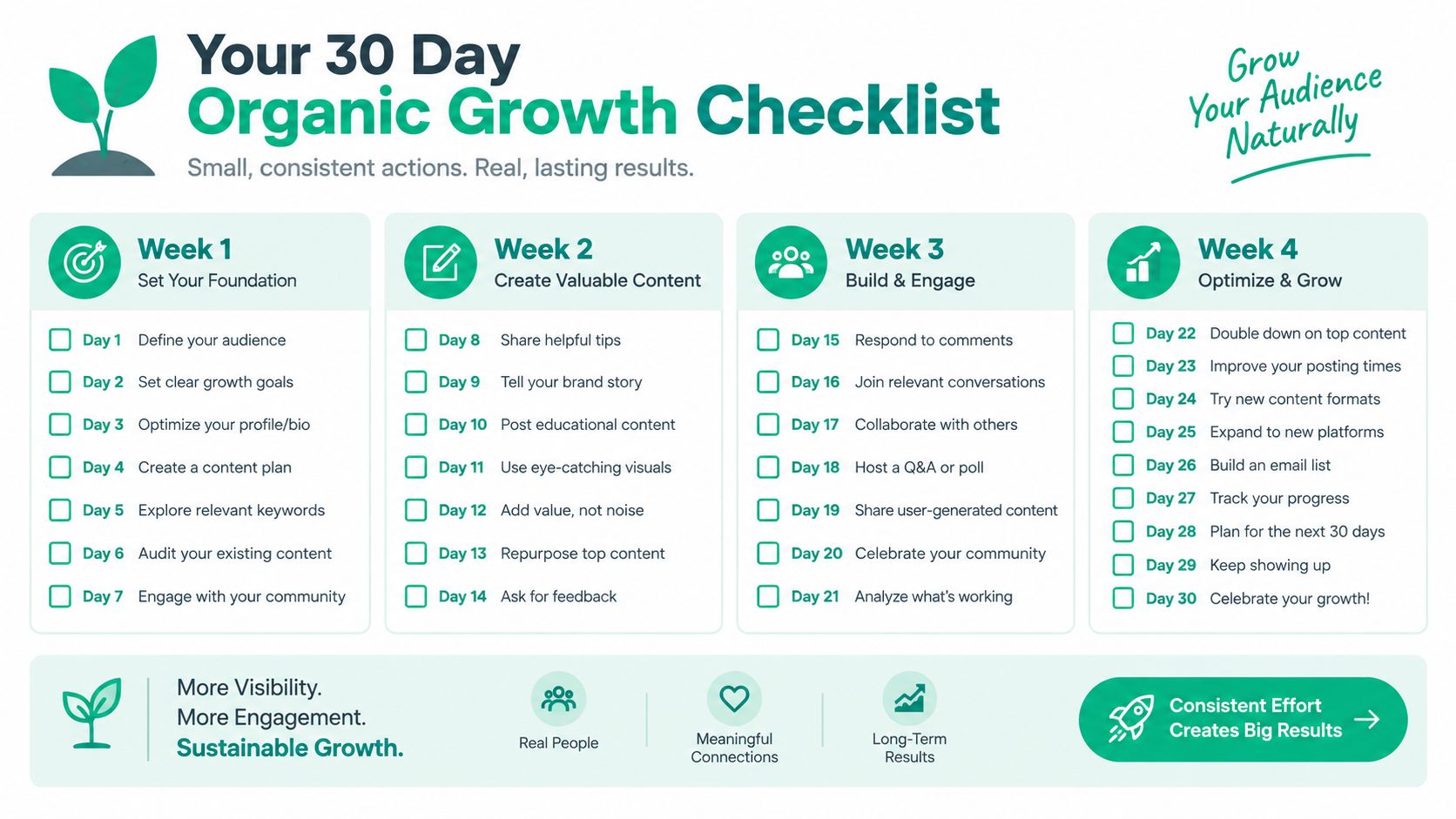
Week 2 is format control. Publish 2 to 3 Reels, 1 carousel, and daily Stories with a clear role for each post. Decide which post is for discovery, which one is for saves, and which one is for retention. If you're not assigning a job, you're probably wasting the slot.
Week 3 is signal work. Add save-worthy carousels, a share prompt in at least one caption, and one DM-friendly Story sequence. Start your first weekly experiment and track only one change. Keep the rest stable so you can read the result cleanly.
Week 4 is optimization. Use AI for research and caption testing only if you can review every suggestion yourself. Audit follower quality, check whether the right people are engaging, and cut any experiment that produced noise instead of signal. Your day-30 review should decide what becomes habit, what gets revised, and what gets dropped before you scale.
If you want a tighter system for building that kind of organic growth, visit Gainsty and see how a human-managed approach can support content planning, audience targeting, and safer growth execution without bots or fake followers.