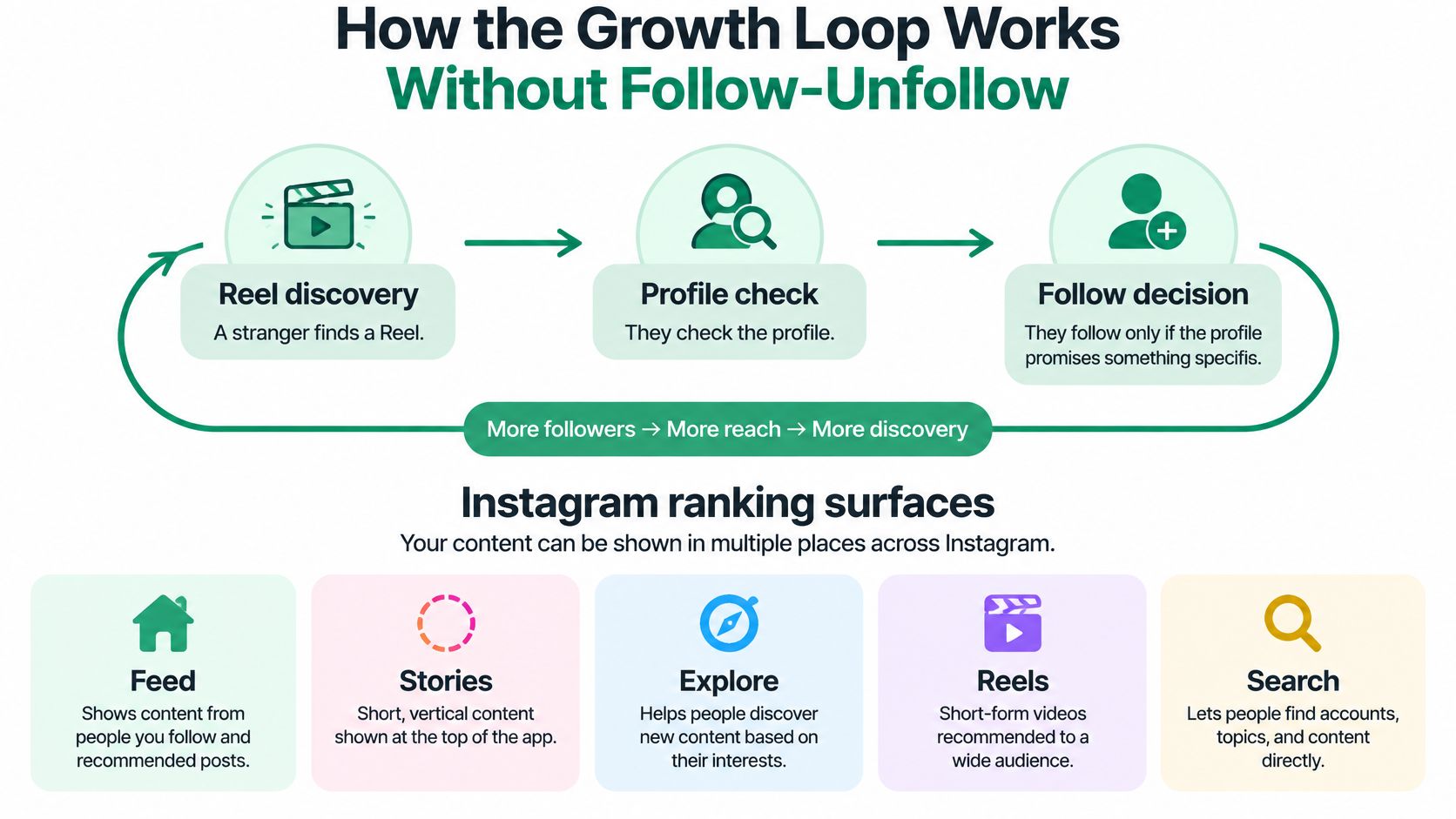
How the Growth Loop Works Without Follow-Unfollow
A stranger discovers a Reel, checks the creator's profile, and follows only if the account promises something specific. A funny coffee video might earn a view. A profile offering practical help brewing better coffee gives that viewer a reason to return.
The potential audience is substantial. DataReportal's Instagram statistics reported at least 1.74 billion Instagram users worldwide in January 2025, based on Meta's advertising-planning data. You don't need to follow those people first to become discoverable.
Instagram doesn't rank everything with one universal algorithm. Its creator guidance on algorithms and ranking describes separate systems across surfaces, with discovery and existing relationships playing different roles.
Match the surface to the handoff
Likes, saves, shares, comments, and viewing behavior provide different evidence of interest. Don't assume that a Reel with strong watch time will automatically produce follows, or that a Story with useful replies needs broad reach to succeed.
Instagram surfaces, their job and the metric that proves it
Reels help you reach non-followers. Track non-follower reach and profile visits, then make sure pinned posts and a clear niche promise give visitors a reason to follow. Explore and Suggested Posts introduce your account to new audiences; measure profile visits per 1,000 people reached and check that your grid matches the content they discovered.
Feed carousels aim to earn saves and shares, so track both per 1,000 people reached and look for subsequent profile visits. Stories build familiarity with repeat viewers; replies, link taps, and repeat views show whether those conversations may lead to follows. Search brings in people looking for a topic, so check profile visits from search where available and make sure your bio uses language that matches their intent.
Use this loop to separate discovery from conversion.
Say a coffee roaster's Reel reaches 40,000 non-followers but produces only 60 profile visits. In this hypothetical example, the video found viewers, but few wanted to investigate the account. That points toward a weak content-to-profile handoff, not necessarily a weak video.
Check whether the Reel identifies the intended audience and suggests an ongoing benefit. A satisfying roasting montage might need a clearer connection to home-brewing advice.
For additional planning ideas, the Instagram follower tips from PostSyncer offer a companion resource. Keep your weekly diagnosis ordered: non-follower reach, profile visits per reach, then follows per visit.
Set Up a Profile That Turns Visitors Into Followers
Your profile is a conversion page. Someone arriving from a recommendation shouldn't have to inspect your entire history to understand what following will give them.
Originality matters before and after that visit. Sked Social's Instagram statistics summary describes Instagram's originality policy update, which prioritizes original material in recommendations and limits eligibility for accounts repeatedly reposting others' work. Build your profile around your own demonstrations, explanations, and evidence, not a collection of borrowed viral posts.
Make the promise immediately legible
Make the name field descriptive. Pair your name with the topic people recognize, such as Maya | Sourdough for Beginners. Don't spend this space on a vague slogan that tells a searching visitor nothing about your specialty.
Write a bio around audience, benefit, and proof. Explain who you help, what they'll learn, and one truthful reason to trust you, followed by a relevant action. Use a demonstrable result or credential rather than inventing impressive numbers; these Instagram bio tips can help tighten the wording.
Check the profile photo at thumbnail size. Use a recognizable face or a simple, high-contrast logo. Detailed lettering and busy backgrounds may look attractive enlarged but become unreadable beside a comment or Reel.
Choose a destination that continues the promise. If the Reel introduces a brewing checklist, send visitors to that checklist rather than a generic homepage. Don't make them sift through unrelated offers to find the resource they expected.
Pin complementary evidence. Choose a strong introductory Reel, a useful educational carousel, and a proof post that demonstrates your method or result. Pinning only lifestyle content can leave visitors entertained but uncertain about the account's purpose.
Organize Highlights by visitor questions. Names such as Start Here, Results, and Free Templates explain what's inside. Avoid cryptic labels and outdated offers that make the account feel neglected.
Inspect the visible grid as a newcomer. The first screen should communicate a recognizable subject, even if the visual style changes. A mixture of unrelated topics forces visitors to guess what future posts will contain.
Profile test: Ask someone unfamiliar with the account what you post, who it's for, and why they'd follow. If they need an explanation from you, revise the profile.
Pinned proof helps a stranger assess your credibility; Stories let them hear your reasoning and see your process. Neither needs expensive production. They need to confirm that the account consistently delivers the benefit that attracted the visitor.
Choose One Niche, Track the Right Numbers and Run a 30-Day Test
Start with an audience sentence: This account helps [specific people] solve [specific problem] so they can [desired outcome]. For a coffee roaster, that might mean helping home brewers troubleshoot disappointing coffee rather than posting about coffee culture in general.
Choose recurring pillars with distinct jobs: teach useful techniques, prove them through demonstrations, and show behind-the-scenes decisions that make the business understandable. Keep personality inside that positioning rather than treating it as permission to publish anything.
The testing workflow should connect each pillar to observable actions.
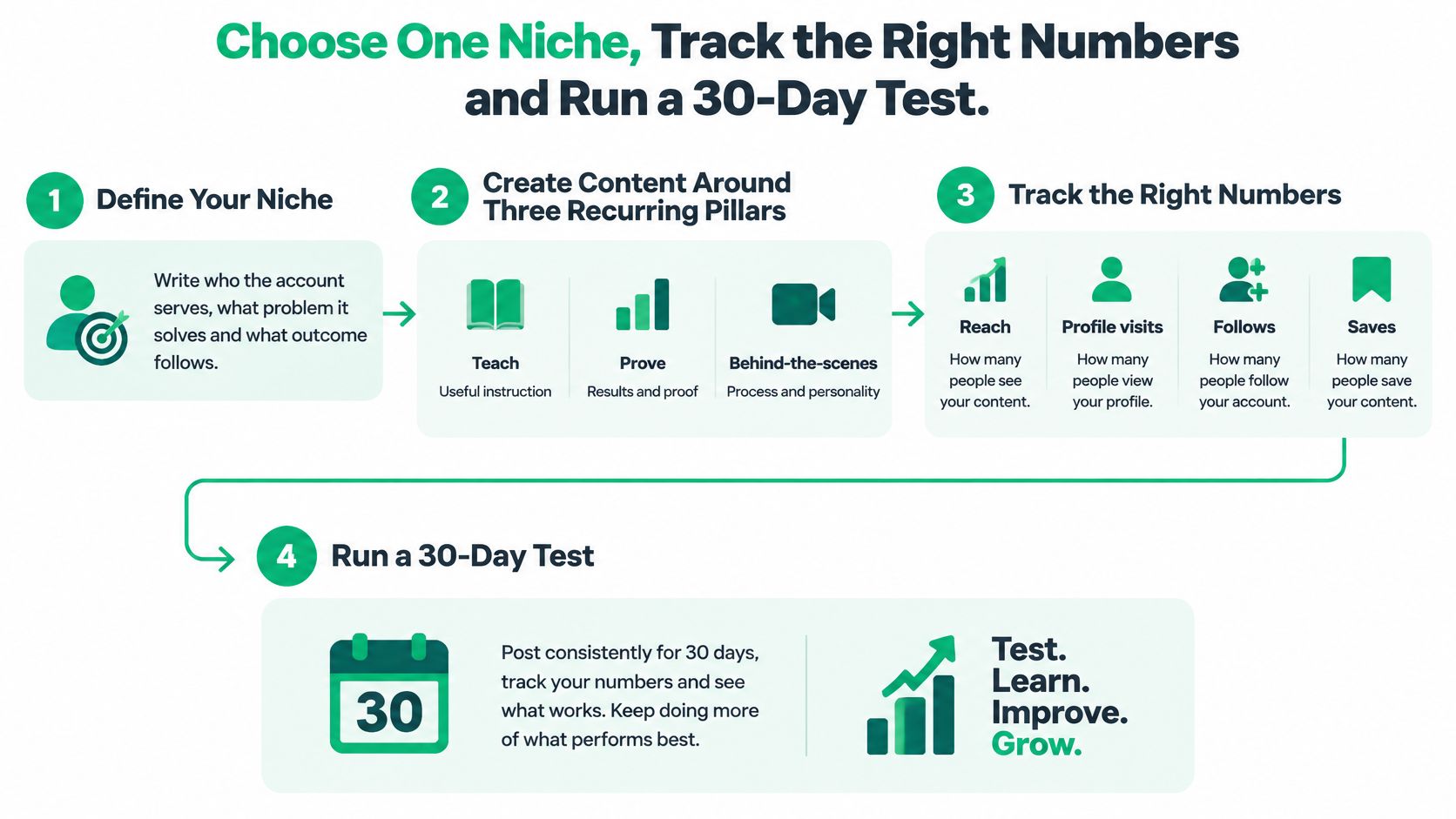
Define the formulas before publishing
Instagram's ranking explanation identifies predicted actions such as spending time on a Feed post, commenting, liking, sharing, and tapping the profile. Your measurement sheet should distinguish those actions instead of compressing everything into likes.
Growth metrics, formulas, and how to read them
Calculate reach rate by dividing reach by your follower count. Check Post Insights and compare posts in similar formats to see how widely each was distributed relative to account size. Profile-visit rate is profile visits divided by reach, where Post Insights attributes those visits. A low rate can signal weak curiosity or an unclear invitation to visit your profile.
For follow conversion, divide new follows by profile visits using attributed Insights or a matched account reporting period. Compare the result with your rolling median, not a public benchmark. Content efficiency is shares plus saves divided by reach; Post Insights can show whether people found a post useful enough to keep or pass along.
To calculate qualified follows per 1,000 reached, divide relevant new follows by reach and multiply by 1,000 in your tracking sheet. Consider scaling only when this measure and useful actions both beat your median. For context, engagement rate is likes plus comments divided by followers, using Insights and a manual calculation. Treat it as a directional measure, not the growth target.
Multiply ratio metrics by a hundred when displaying percentages. Keep the denominator consistent: engagement divided by followers isn't interchangeable with engagement divided by reach.
Qualified follows require judgment. Instagram doesn't provide a universal qualified-follower metric. Define relevance using observable fit, such as location for a local business or topical interest for an educator, and record that definition beside your calculations.
Not every Insights view exposes the same attribution. If post-level visits or follows aren't available, mark them unavailable rather than assigning all account growth to the latest post. Use a matched reporting period and note overlapping campaigns.
A tracking sheet is enough to begin. Add content pillar, format, opening hook, topic, CTA, publishing time, and review dates; this guide to Instagram performance metrics can help organize the reporting.
Run a controlled publishing test
Choose a cadence you can maintain throughout the test. Publish a controlled mix of Reels, carousels, and Stories without changing frequency whenever a post disappoints. A sustainable schedule produces cleaner comparisons than a burst followed by silence.
Change one variable in each weekly experiment. Test the hook, format, topic, or posting window while keeping the others as stable as possible. If you change the subject, length, editing style, and CTA together, you won't know which change mattered.
Log the full response. Record watch time or retention, likes per reach, shares, saves, profile visits, follows, and account-level unfollows. Note whether comments contain relevant questions or merely broad reactions.
Use an early review and a later review. Check after a day and again a week later, treating these as operating checkpoints rather than deadlines imposed by Instagram. Don't delete a disappointing post before observing whether recommendations continue.
Keep content that attracts the right visitors. A lower-reach tutorial can deserve another version if it produces relevant inquiries and follows. A widely viewed joke might not deserve a sequel if those viewers have no interest in your actual topic.
For the video component of your planning, pair viewing with a concrete task: write down one hook you can test without changing your topic.
Decide when to hold rather than scale
Use your rolling median as the baseline, grouping comparable formats where possible. Scale a format only when it beats that baseline on both qualified follows relative to reach and saves or shares relative to reach.
Consider a hypothetical format producing 2.1 new follows per 1,000 reached, against an account median of 1.4. Its combined saves and shares are 3.0 per 1,000 reached, below a median of 4.5. Those illustrative results justify holding the format for another test, not expanding it immediately.
Inspect the opening and payoff before deciding what to rewrite. Strong retention with weak useful actions suggests the demonstration needs more substance; early drop-off suggests the opening may be unclear.
A post that attracts the wrong audience isn't a winning post simply because it beats your usual view count.
At the end of the test, identify which audience problem repeatedly produces relevant visits, useful actions, and retained interest. Keep that mechanism and develop another execution. Don't confuse repeating a successful idea with reposting the same asset indefinitely.
Reels, Carousels and Stories Compared
Each format moves a viewer through a different step: discovery, consideration, or conversation. Match the format to the action you want, then measure whether it led to the next step.
Reels are useful for reaching non-followers, but a generic hook without a payoff can waste that attention. Carousels can earn saves, shares, and profile visits when they get to the point without filler slides. Single-image posts work well for proof, quotes, and recaps, though relying on them as your main discovery format may limit what you can explain. Stories help you connect with repeat viewers through replies and link taps; a stream of sales offers without context gives them little reason to respond.
Socialinsider's Instagram brand benchmarks report approximately 0.52% engagement for Reels, 0.55% for carousels, and 0.37% for images in 2025, using likes plus comments divided by followers. These are brand-account comparisons, not promised results for your niche. Stories aren't comparable using those figures; judge them by replies and link taps instead.
Choose the format by the task
Reels introduce your idea to people who don't follow you. Put the problem or result in the opening, then show how you got there. A coffee account, for example, can start with a muddy cup and explain the brewing mistake instead of opening with a logo animation. Track reach alongside profile visits and follows to see whether attention becomes audience growth.
Use on-screen words that accurately name the topic. Unrelated keywords and unnecessary runtime may attract the wrong viewers or delay the payoff.
Carousels turn an idea into something people can save or share. Make the first slide specific, deliver a useful point early, and make each swipe advance the explanation. Track saves and shares relative to reach, then check whether profile visits and follows follow those actions.
A prompt such as “Save this brewing checklist for your next bag” gives the reader a practical reason to save. Generic engagement requests don't.
Leave room for proof and conversation
Single images work well for a clear result, customer question, or concise recap. They're less suited to discovery when the subject needs motion or step-by-step instruction.
Stories continue the relationship with people who already know the account. Show a decision behind a polished post, explain why an approach changed, or answer a follower's question. Judge Stories by replies and link taps, not by comparing their reach with Reels.
Production rule: Choose the simplest format that makes the lesson clear. More editing isn't automatically more value.
If production is the bottleneck, compare AI tools for social media before adding another subscription. Check whether a tool reduces repetitive work while preserving your original explanation, recognizable voice, and accurate demonstrations. Faster generic content won't solve weak audience fit.
Hashtags, Discovery and Safe Outreach
Avoid tactics that create activity without genuine interest:
Copied watermarks and recycled material: Publish your own demonstrations instead of building an account around other creators' clips.
Engagement pods: Arranged reactions make it harder to distinguish audience demand from reciprocal participation.
Misleading hooks: Don't promise a solution the post never delivers.
Mass commenting: Repeated praise and unsolicited pitches give people little reason to trust your expertise.
Discovery work starts with language your audience uses. Write captions as understandable, searchable sentences, keep on-screen text accurate, and add location information only when that place matters to the offer.
Choose topic-specific hashtags rather than attaching the same broad list to everything. Use this Instagram hashtag strategy guide to organize relevant tags, but treat them as supporting context, not a substitute for a useful post.
Build a collaboration worth accepting
Find adjacent creators with overlapping audiences. A coffee roaster might approach a home-barista educator or a bakery, not an unrelated account chosen only for its size. Look for a reason both audiences would benefit.
Read the recent conversations. Check whether commenters ask practical questions, discuss purchases, or describe relevant problems. Giveaway participation and generic reactions tell you less about collaboration fit.
Participate before pitching. Leave a thoughtful comment when you can add an explanation, useful distinction, or genuine question. Don't manufacture an interaction quota or expect a collaboration in exchange.
Send a concrete proposal. Offer a joint Reel demonstrating a pairing or a co-authored carousel answering a shared audience question. Explain the concept, each person's contribution, and the intended viewer benefit.
Agree on delivery and evaluation. Set the asset, publishing date, permissions, and review point before creating it. Judge the result by relevant profile visits and follows, not just views on the partner's post.
Keep your discovery and outreach notes together so you can distinguish promising relationships from distracting activity.

A smaller partner with closely matched audience needs can be the better choice. You're borrowing relevance and trust, not merely access to a follower count.
Diagnose Stalled Growth and Start Your First Week
When impressions rise and follows stay flat, more posts can repeat the same gap. Before increasing output, identify whether the failure is discovery, curiosity, conversion, or audience fit.
Use this diagnostic before changing your schedule.
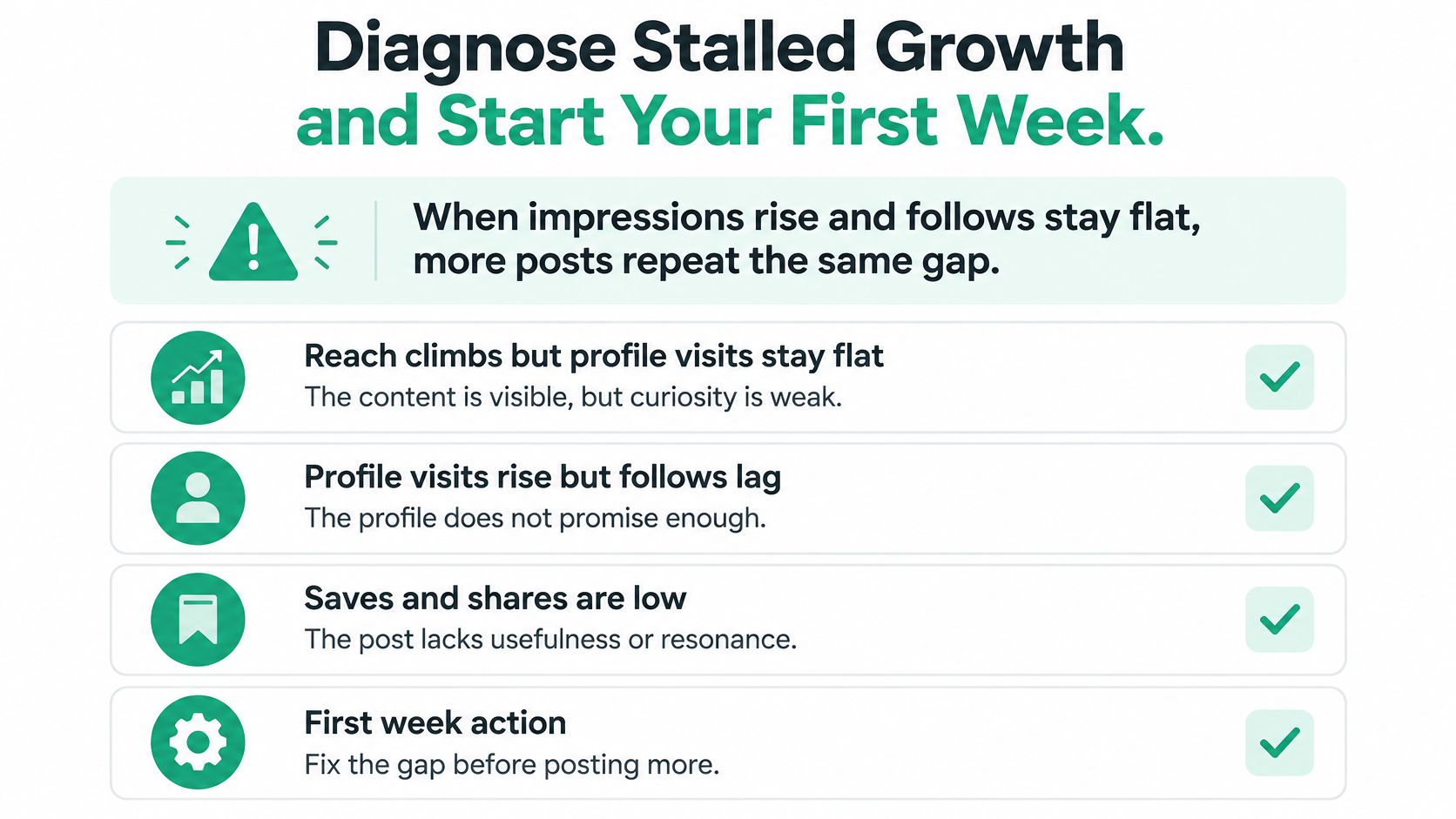
Reach climbs but visits stay flat: Check whether the opening attracts people interested in your niche and whether the post gives them a reason to investigate.
Visits rise but follows lag: Repair the profile promise and pinned evidence before spending more time on production.
Follows and unfollows both climb: Inspect which topics attract people whose expectations your subsequent posts don't meet.
Everything stays flat: Test a different opening or format while keeping the audience problem stable.
Make the first week measurable
Ask an unfamiliar person to assess your bio and pinned posts, then log your recent publishing history to establish a baseline. Publish a Reel and carousel addressing the same audience problem, and schedule both early and later reviews.
Treat the later review as an initial signal, not a promised turning point. Use the full 30-day test to decide what deserves another cycle.
If editing prevents you from running the test, evaluate the LunaBloom AI video creation app against a specific production task. A tool is useful only if the finished video still communicates your original lesson clearly.
For an additional starting point, our free Instagram analysis tool requires only a public username and no login. We don't guarantee a specific number of followers, likes, or comments, so judge progress through your metrics log rather than a promised follower total.
Visit Gainsty to use our free Instagram analysis tool and identify a practical starting point for your account. We also offer managed organic growth with audience targeting, but our managed method includes follow/unfollow, so the analysis tool is the better fit if you want to avoid that activity.