Understanding Modern Instagram Engagement
The days of a high like count being the ultimate sign of success are long gone. Today, figuring out how to increase engagement on Instagram means you need to pay attention to a much deeper set of signals. The algorithm now heavily favors content that builds a real connection and keeps users on the platform longer. We've moved from an era of passive scrolling to one that demands active participation.
Cookie-cutter tactics just don't work anymore. Your audience is smart—they can spot low-effort, inauthentic content from a mile away. What they really want is value, entertainment, and a reason to interact. This is exactly why formats like multi-slide Carousels and snappy Reels consistently crush the performance of static images. They simply give you more room to educate, entertain, and tell a compelling story.
The Data Behind Content Performance
Recent data really drives home how critical your choice of content format is. Yes, the platform is more crowded than ever, but picking the right post type gives you a clear advantage right out of the gate.
This chart breaks down the average engagement rates for the most popular formats, and the differences are telling.
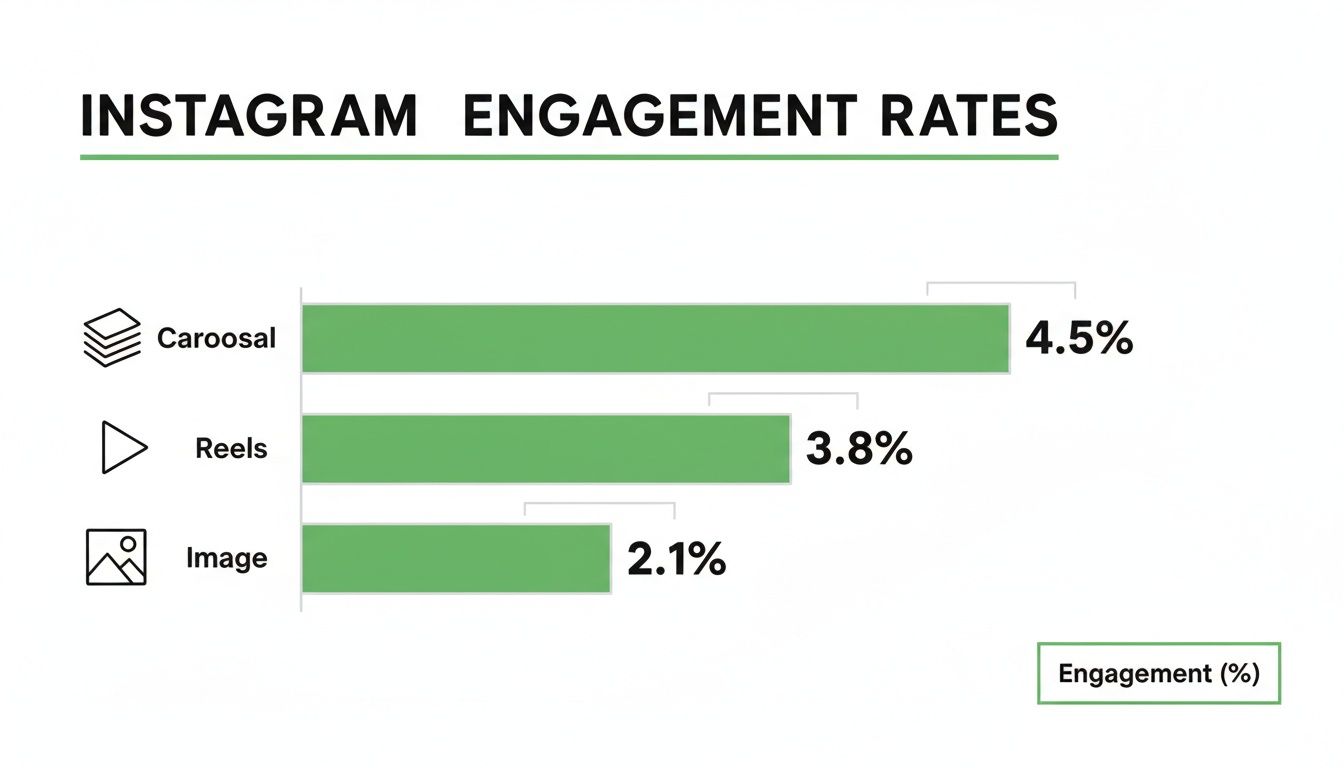
It’s pretty clear from the data: interactive and dynamic formats like Carousels and Reels just get more people to engage than a single, static image.
Here's a quick look at how the different content types stack up against each other.
Instagram Engagement Rates by Content Type
A quick comparison of average engagement rates for the most popular Instagram content formats.
Carousels – With an average engagement rate of 0.55%, they are best for educational content, storytelling, and step-by-step guides because users swipe through multiple slides, spending more time on your post.
Reels – Averaging 0.50% engagement, these are ideal for entertaining short-form videos, behind-the-scenes content, and trends, as the algorithm favors video content and pushes it to a wider audience.
Images – At 0.45% engagement, single images work well for high-quality visuals, quick announcements, and user-generated content, providing immediate impact and easy consumption.
In fact, the overall average engagement rate across Instagram has dipped to around 0.50%, which is a massive 28% decrease year-over-year. In such a competitive space, you can’t afford to just wing it. If you want to dive deeper into the numbers, you can discover more insights about Instagram's evolving statistics.
The key takeaway is simple: Engagement isn't just a vanity metric anymore. It's a direct signal to the algorithm that your content is valuable, which is what gets you more reach and visibility.
The Three Pillars of Modern Engagement
To really nail your engagement strategy, you need to build it on a solid foundation. I like to think of it as a three-legged stool—if one leg is wobbly, the whole thing falls apart. We'll be building on these three core principles throughout this guide:
Innovative Content Creation: This is all about moving beyond the basics. We’re talking high-value, shareable content designed specifically for formats like Reels and Carousels. You need a strong hook to stop the scroll, and you have to deliver on that promise.
Authentic Community Interaction: Engagement is a two-way street. You have to be in the trenches—responding to comments, joining conversations in your niche, and making your followers feel like you actually see and hear them.
Smart, Data-Driven Adjustments: It's time to stop guessing and start measuring. Using your Instagram Insights is non-negotiable. You need to know what resonates with your audience, pinpoint your top-performing posts, and tweak your strategy based on what the data tells you.
Creating Content That People Actually Want to Share
Alright, let's move from theory to practice. This is where the real growth starts. Creating content that earns saves, shares, and genuine comments isn't about getting lucky—it's about having a solid, repeatable system for different formats.
I'm going to walk you through some of the battle-tested formulas I've seen work time and time again.
Forget the idea that a single, beautiful photo is enough to stop the scroll anymore. To really increase your engagement on Instagram today, you have to master the art of storytelling within formats built for interaction. It's a mindset shift: you're not just posting; you're actively creating opportunities for connection.
Crafting Reels That Hook Viewers Instantly
With short-form video absolutely dominating the platform, Reels are non-negotiable. Seriously. And the first three seconds are everything. If you don't give someone a compelling reason to stop scrolling right away, you've already lost them.
The secret is to lead with a powerful narrative hook. This goes beyond just slapping some trending audio on a clip. It's about presenting a problem, a question, or a bold statement that immediately sparks curiosity.
Here are a few hook formulas that work like a charm:
The "Mistake" Hook: "You're making this common mistake when [activity]."
The "Secret" Hook: "Here's the secret to achieving [desired outcome] that no one talks about."
The "How-To" Hook: "How to [do something specific] in under 60 seconds."
The "Transformational" Hook: "This one change transformed my [area of life/business]."
Imagine a fitness coach using this: "You're probably doing your squats wrong. Here’s how to fix your form." That line instantly creates a knowledge gap and promises a quick, valuable fix, making you want to stick around to see the answer.
A Reel's job is simple: educate or entertain in a super-compact package. The faster you deliver on the promise of your hook, the more likely you are to earn a save or a share.
The numbers back this up, big time. A staggering 2.35 billion users engage with Reels every single month. Not only that, but Reels also generate 22% more interaction than regular video posts. For influencers, the engagement rate on Reels hits 2.08% on average—the highest of any format. This is where you need to be.
Building Carousels That Encourage Swiping
Carousel posts are your best friend for teaching something valuable. Think of them as mini-presentations or bite-sized blog posts that invite your audience to swipe through a story. The goal is simple: make each slide so good that the viewer has to see what's next.
One of the most effective structures for a carousel is the classic Problem-Agitate-Solve (PAS) framework.
Slide 1 (The Cover): Kick things off by stating a common pain point with a bold, can't-miss headline. Something like, "Your Houseplants Keep Dying? Here's Why." It needs to be visually punchy and easy to read.
Slides 2-4 (Agitate): Now, you dig into the problem a bit. Explain why it's so frustrating and point out the common mistakes people make. This is where you build that "aha, that's me!" connection.
Slides 5-9 (Solve): This is the meat of the post. Provide clear, step-by-step solutions. Use a mix of text, images, and simple graphics to keep it scannable and easy to digest. Each slide should offer one solid tip.
Slide 10 (The CTA): Don't just end it—give them something to do. A strong call to action is key. Try "Save this for your next plant rescue!" or ask a question to get comments flowing, like, "What's the one plant you can't seem to keep alive?"
This approach turns a simple post into a valuable, save-worthy resource. If you're hunting for more inspiration, you can adapt some of these creative ideas for interactive content to work within a carousel format.
Writing Captions That Spark Real Conversations
Your visuals grab the attention, but your caption is what actually starts the conversation. A great caption does three things: it adds context, shows off your personality, and tells your audience exactly what to do next.
The Hook-Story-Offer framework is a brilliantly simple way to structure your captions for more impact.
Hook: Start with a bold, relatable, or intriguing first line that makes people tap "…more." A question or a surprising statement works wonders here.
Story: Share a short anecdote, a lesson you learned, or a behind-the-scenes moment that connects to the post. This is how you build trust and let people get to know the real you.
Offer (CTA): Finish with a clear call-to-action. Don't just say "comment below." Ask a specific, low-effort question that's easy for anyone to answer.
For example, instead of a flat "New coffee recipe!" caption, try this:
Hook: "I almost gave up on making iced lattes at home."
Story: "They always tasted watery and weak until I discovered this one simple trick with my ice cubes. It was a total game-changer for my morning routine."
Offer: "What's your go-to morning drink? Let me know in the comments!"
See the difference? This structure feels natural and turns a passive announcement into a genuine invitation for a chat. For a deeper dive into these frameworks, check out our guide on how to create engaging content.
Ultimately, making shareable content is all about generously giving value and making it incredibly easy for your audience to join the conversation.
Using Hashtags and Timing to Maximize Your Reach

Creating killer content is a huge win, but it’s only half the battle. If you really want to learn how to increase engagement on Instagram actually rewards, you have to get that content in front of the right eyeballs. This is where a sharp strategy for hashtags and post timing becomes your secret weapon for discoverability.
A lot of people either skip hashtags entirely or just cram in 30 of the biggest, most generic tags they can find. Both are dead-end strategies. A huge tag like #fitness this has millions of posts, meaning yours gets buried in seconds. A much smarter approach uses a tiered strategy to hit different pockets of your audience.
This way, you’re not just shouting into the void; you’re starting conversations with people who are actually interested in what you have to say.
Building a Smart Hashtag Strategy
Stop chasing volume and start focusing on relevance. The goal is to create a thoughtful mix of hashtags, varying in size and specificity, to give your post its best shot. This layered technique helps you gain traction in smaller, dedicated communities first, which can then help you climb the ranks in the bigger ones.
A well-rounded hashtag set usually includes:
Broad Industry Tags (1-2): These are the high-level tags that describe your field, like
#DigitalMarketingor#HomeDecor. They give you a quick, wide burst of exposure.Niche-Specific Tags (5-10): Now, get specific. Instead of
#fitness, try something like#KettlebellWorkoutsForBeginners. This is how you find people actively looking for exactly what you’re posting.Community or Location Tags (3-5): Tap into local scenes or passionate subcultures with tags like
#LondonFoodiesor#YogaCommunity. These build a sense of belonging and attract a highly dedicated crowd.Branded Tags (1-2): Create a tag that's all your own, like
#GainstyGrowthor one for a specific campaign. It’s perfect for collecting user-generated content and building your own content library.
For example, a small bakery sharing a new croissant recipe could use a mix like: #baking (broad), #sourdoughcroissant (niche), #nycbakery (location), and #YourBakeryNameTreats (branded). This covers all your bases. To really dive deep, check out our complete Instagram hashtag strategy guide.
Finding the Best Time to Post for Your Audience
Let's bust a huge myth: there is no universal "best time to post." Generic advice suggesting you post at 9 AM on a Tuesday is a shortcut to nowhere if your audience is on the other side of the world or stuck in meetings.
The only data that matters is your data.
Your Instagram Insights are a goldmine for this. To find your personalized peak times, you need to roll up your sleeves and dig into the analytics the platform gives you for free.
Pro Tip: Don't just check your Insights once and call it a day. Make it a monthly ritual. Follower habits can change with the seasons or trends, and staying on top of it is crucial for keeping engagement high.
Finding this data is simple. Just head to your Professional Dashboard, tap Account Insights, then choose Total Followers. Scroll down to the "Most Active Times" chart, and you’ll see an hourly and daily breakdown of when your followers are actually online.
By consistently posting during these windows, you give your content the best chance to be seen right from the start. That initial burst of activity is a huge signal to the algorithm, helping push your post to an even wider audience in those critical first few hours. It turns your posting schedule from a guessing game into a precise, data-backed growth strategy.
Building a Loyal Community Through Real Interaction
Killer content and a smart hashtag strategy will get you noticed, but that’s only half the battle. What truly drives sustainable growth is turning your profile into a genuine community—a place where people feel seen, heard, and connected. It’s a subtle but crucial shift from broadcasting to people to starting conversations with them.
Think of engagement not as a metric to be checked off, but as the living, breathing heart of your brand. Every time someone leaves a comment, they’re opening the door for a connection. Your job is to walk through it.
Go Beyond Basic Comment Replies
Let's be real: a quick "Thanks!" or a heart emoji doesn't build a relationship. It's a dead end. Every reply is a chance to spark more discussion and make that person feel genuinely appreciated. This simple habit does wonders, signaling to both your followers and the algorithm that your page is a hub for real conversation.
So, how do you write replies that actually foster connection?
Ask a question back. Someone comments, "Love this post!" Instead of just a thank you, try, "So glad you do! What part resonated with you the most?" This invites them to share more and keeps the ball rolling.
Acknowledge their perspective. If a follower shares their own experience, validate it. Something as simple as, "That's such a great point, I hadn't thought of it that way before," shows you're actually listening and value their input.
Always tag them. Use the "@" symbol to tag the user in your reply. It sends them a notification, making it far more likely they’ll come back to continue the chat.
The most powerful engagement tool you have is genuine curiosity. Treat every comment as the start of a potential conversation, not the end of a transaction.
Putting in this tiny bit of extra effort shows you care. It’s the difference between a follower feeling like just another number and feeling like they’re part of your inner circle.
Practice Proactive Engagement
You can’t just host the party; you have to be part of it, too. Community building is an active sport, which means getting out from behind your own profile and interacting with others in your niche. Too many creators sit back and wait for engagement to come to them. The ones who really succeed go out and find it.
This proactive approach proves you're a real member of the community, not just someone trying to push a product or service.
A Simple Proactive Routine That Works
Carve out 15-20 minutes each day to do this. It pays off, I promise.
Engage with your followers' content. Pop over to the profiles of people who consistently like and comment on your posts. Leave a thoughtful, authentic comment on their latest photo or Reel. This kind of reciprocity is incredibly powerful for building loyalty.
Jump into hashtag conversations. Search a few of your core hashtags and filter by "Recent." Find interesting posts and get involved in the comments. Add value, share an opinion, or reply to someone else's comment. It’s an amazing way to get discovered by new, highly relevant people who are already talking about your topic.
Think of it this way: your community is already out there, you just need to show up where they are. While our focus is on organic growth, the sheer size of the platform makes this kind of interaction essential. As of early this year, Instagram’s ad reach hit a staggering 1.74 billion people, growing by 5.5% in just one year. You can read the full analysis of Instagram's audience growth. That massive, active user base is exactly why being present and interactive is so valuable.
These small, consistent actions compound over time, slowly but surely turning passive followers into your biggest fans.
Tap Into Collaborations and User-Generated Content to Amplify Your Reach

Let's be honest: creating amazing content and engaging with your audience day-in and day-out is a ton of work. But you don't have to grow your Instagram account in a silo. Some of the most powerful growth comes from partnering with others and, even better, getting your own community to create content for you.
This works because it's all about social proof. Think about it—when a creator you follow or a friend recommends something, it just hits differently. It feels more authentic than a brand talking about itself, and that built-in trust can introduce you to a whole new audience that's ready to listen.
Finding and Pitching the Right Collaborators
Great collaborations feel like a natural fit. You're looking for that perfect synergy where both you and your partner bring real value to each other's audiences. The goal is to find creators or brands whose followers are basically your ideal customers in waiting.
Don't just think about big-name influencers. A local coffee shop could team up with a neighborhood bookstore for a giveaway. A fitness apparel brand might partner with a nutritionist for a live Q&A session on Instagram. It’s about finding a complementary fit.
Once you’ve got a list of potential partners, your outreach needs to be on point. Generic, copy-pasted DMs are the fastest way to get ignored. Show them you've actually done your homework.
Be a genuine fan: Get familiar with their content. Start your message by mentioning a recent post you loved—it shows you’re not just sending out a mass email.
Bring a clear idea to the table: Don't just say, "Hey, want to collab?" Pitch something specific, like a co-hosted Reel, a product swap and review, or a joint contest.
Show them what's in it for them: Clearly explain how the partnership will benefit their brand and their audience. Will they get great new content? Exposure to your followers? Make it a no-brainer.
If you really want to level up your partnership strategy, digging into a modern influencer marketing guide can give you some incredible insights.
How to Encourage and Use Fan-Made Content
User-generated content (UGC) is pure gold. It’s authentic, trustworthy content made by your actual customers, and it’s one of the best ways to build a real community. When you share UGC, you're not just filling your content calendar for free; you're celebrating your audience and making them feel seen.
Featuring content from your followers turns them from passive observers into active participants in your brand's story. It’s one of the most powerful ways to build lasting loyalty.
So, how do you get people to start creating content about you? You have to make it easy, fun, and worthwhile.
Simple Ways to Get More UGC
Here are a few tactics that I’ve seen work time and time again:
Run a Low-Key Contest: Ask followers to post a photo or Reel with your product and a unique hashtag. The prize doesn't have to be huge—often, a feature on your page or a small gift card is more than enough motivation.
Create a Branded Hashtag: Come up with a unique hashtag that’s easy to remember. It not only encourages people to post but also creates a beautiful, curated gallery of all your UGC in one place.
Don't Be Afraid to Just Ask: Seriously, sometimes it's that simple. Use a Story or a caption to prompt your audience: "Show us how you use our product in your daily routine! Tag us and use #YourHashtag."
By mixing smart collaborations with a solid UGC strategy, you can dramatically increase engagement on Instagram, expand your reach, and cultivate a community that genuinely advocates for your brand.
Measuring What Matters to Optimize Your Strategy

You can't improve what you don't measure. After putting in all that work creating amazing content and building your community, it's time to stop guessing what works and start knowing. This is where you close the loop, using real data to make smarter decisions that actually move the needle.
Too many people get hung up on vanity metrics like follower count. A big number looks great, but it doesn't tell you if anyone is actually paying attention. To truly understand engagement, you need to look at the numbers that signal a real connection with your audience.
The Metrics That Really Matter
Your Instagram Insights are a goldmine, but it's easy to get overwhelmed. The trick is knowing where to focus. A post with hundreds of Saves and Shares is infinitely more powerful than one with just a lot of likes. Those actions tell you your content was so valuable that someone wanted to keep it for later or show it to a friend.
Here are the engagement metrics you should be tracking:
Saves: This is your "high-value content" alarm. When someone saves your post, they see it as a resource they want to come back to. That's a huge win.
Shares: A share is basically a personal recommendation. Someone liked what you did so much that they sent it to their friends or posted it to their own Story. You can't beat that kind of organic reach.
Comments: Don't just count them; read them. Are people asking real questions, sharing their own experiences, or tagging friends? That's the sign of a thriving community, not just passive followers.
Story Replies & Sticker Taps: These are direct conversations. When people reply to your Stories, vote in your polls, or take your quizzes, they're actively participating with your brand.
Before we dive into how to use this data, let's quickly break down what these key metrics are really telling you.
Key Engagement Metrics and Their Meaning
Understanding what different Instagram metrics tell you about your content's performance and audience connection.
Likes – Measures surface-level approval; a quick “I see this, and I like it.” This is good for a quick pulse check but isn’t a reliable indicator of deep engagement or value.
Comments – Reflects the level of conversation and community around your content. High-quality comments show your content is thought-provoking and sparks discussion.
Shares – Indicates how valuable and “shareable” your content is; essentially a personal endorsement. Use this insight to create more content like this to expand your reach to new, similar audiences.
Saves – Shows the utility or “evergreen” value of your content. Content that gets saved is seen as a resource, so focus on creating more tutorials, guides, or tips.
Reach – The total number of unique accounts that saw your post. This tells you how effectively your content is spreading beyond your immediate followers.
By looking at this full picture, you get a much clearer idea of what’s truly hitting the mark with your audience.
Create a Monthly Content Check-In
Data is only powerful if you actually use it. I recommend setting aside a little time once a month to do a simple content audit. The goal isn't to get lost in a spreadsheet but to spot obvious trends that can guide your strategy for the next 30 days.
Here’s a simple routine to follow:
Find Your Winners: Open your Instagram Insights and filter your posts from the last month by Saves, then Shares, and finally Comments. Look at your top 3-5 posts for each metric. What do they have in common? Was it the format (Reel vs. Carousel), the topic, or maybe the call to action?
Analyze the Duds: Now, do the opposite. Sort your posts by the lowest engagement. Be honest—why do you think these fell flat? Was the hook weak? Was the topic not a great fit for your audience?
Form a Plan: Based on what you found, make a simple "test and learn" plan. For example: "My educational Carousels got the most saves, so I'll create two more next month. The selfie-style posts got the lowest reach, so I'll do fewer of those."
This simple feedback loop turns content creation from a shot in the dark into a data-backed process. If you want to get even more specific with your numbers, you can dig into the different ways to calculate your Instagram engagement rate formula for social media performance. This approach ensures every post you create is a little smarter than the last.
Got Questions? We’ve Got Answers
Even the best-laid plans run into a few hurdles. When you're deep in the trenches of growing your Instagram engagement, questions are bound to pop up. Here are some quick, no-nonsense answers to the things we get asked about most.
How Often Should I Be Posting to Boost Engagement?
Forget the magic number you read somewhere. What truly matters is a rhythm you can stick to without your quality taking a nosedive. For most people, aiming for 3-5 solid feed posts per week is a great starting point.
But don't stop there. Use daily Stories to stay on your followers' radar without overwhelming their feeds. The real key? Dive into your Instagram Insights. See when your audience is actually online and active, then post accordingly. Let the data guide your cadence, not some arbitrary rule.
Is Buying Followers or Likes a Good Idea?
Let me be blunt: absolutely not. It's a tempting shortcut, but it’s a trap that will torpedo your account's health.
Those purchased followers are just bots or ghost accounts. They will never like, comment, or share your content. This immediately tanks your engagement rate, signaling to Instagram's algorithm that your content isn't worth showing to your real followers. You’ll end up with a dead account that looks popular but has zero actual influence. Stick to authentic, organic growth—it’s the only path to real results.
Help! My Engagement Suddenly Dropped. What Happened?
First, don't panic. An engagement dip can happen for a ton of reasons. Maybe the algorithm shifted (again), your audience is getting a bit tired of the same old content, or their interests are simply evolving.
The first thing to do is play detective with your Insights. Pull up your recent posts and compare them to your greatest hits from the past. What's changed? This is your cue to experiment. Try a different style of Reel, run an interactive poll in your Stories, or refresh your hashtag list. Often, a small, strategic tweak is all it takes to get things moving in the right direction again.
An engagement dip can happen for several reasons. It could be a change in the Instagram algorithm, content fatigue if your posts feel repetitive, or a shift in audience interests.
Ready to stop guessing and start growing? Gainsty uses advanced AI and expert strategies to connect you with real, engaged followers who genuinely care about your content. Start your organic growth journey with Gainsty today