Comparing the Short-Form Video Giants

The ongoing battle for short-form video supremacy has completely changed the game for brands and creators. Deciding where to post your next video isn't a casual choice anymore—it's a strategic move that dictates your reach, engagement, and ultimately, your growth. This guide goes beyond the obvious to give you the real-world context you need to choose wisely.
We’re going to get into the nitty-gritty of each platform’s algorithm, audience makeup, creative tools, and how you can actually make money. Getting a handle on these key differences is the only way to build a content strategy that truly works for your goals.
Quick Comparison: Instagram Reels vs TikTok
Before we dive deep, let's start with a bird's-eye view. This table quickly lays out the core DNA of each platform, giving you a framework for the more detailed analysis ahead.
Primary Goal
Instagram Reels: Deepen engagement with your existing community and diversify your content within the Instagram app.
TikTok: Drive massive content discovery and achieve viral reach on a platform built entirely for video.
Core Audience
Instagram Reels: Skews toward Millennials (25–34), strong user base in North America and Western Europe.
TikTok: Dominated by Gen Z (10–25), with a huge and fast-growing global audience.
Algorithm Focus
Instagram Reels: Considers video performance but also heavily weighs your existing social connections and who you follow.
TikTok: Focuses almost exclusively on a video’s individual performance and a user’s explicit interests.
Monetization
Instagram Reels: Mostly indirect through brand deals, affiliate marketing, and driving sales from your profile or shop.
TikTok: Direct creator payouts via the Creator Program, LIVE gifts, and integrated e-commerce features.
Since launching in 2020, Reels has become absolutely central to Meta's entire game plan. It’s not just a feature anymore; it’s a powerhouse. Over 2 billion users now watch Reels every month, and together they rack up an incredible 200 billion daily views across both Instagram and Facebook. In fact, Reels now account for 38.5% of all content posted on Instagram, which shows you just how vital the format has become. For a deeper look at its trajectory, you can find more 2025 Instagram Reels statistics on Teleprompter.com.
This guide isn't about telling you which platform is "better." It's about helping you figure out which one is the right strategic fit for you.
How Each Algorithm Dictates Your Reach
The single biggest difference between Instagram Reels and TikTok comes down to how they think. At their core, their algorithms have fundamentally different philosophies on what content to show you, and understanding this is the key to winning on either platform.
TikTok’s algorithm is a pure discovery engine. It’s all about the content, not the creator. When you post a video, it gets shown to a small test audience. The algorithm watches closely for engagement signals—watch time, likes, comments, shares.
If people like it, TikTok pushes it to a bigger audience. Then a bigger one. This is what creates that "meritocracy" effect, where an account with zero followers can genuinely go viral overnight. The algorithm cares less about who you are and far more about how good that one specific video is.
TikTok: The Ultimate Content Meritocracy
The "For You Page" (FYP) is the heart of TikTok. It’s an endless, hyper-personalized stream of videos the algorithm thinks you'll love based on your past behavior. It’s incredibly good at identifying niche interests and connecting you with content you didn't even know you wanted.
For creators, this means your ticket to massive reach is often through a trending sound, a viral challenge, or just one brilliant video that hits a cultural nerve. The barrier to getting seen is almost non-existent.
The flip side? One viral hit doesn’t guarantee your next one will perform at all. Each video is judged on its own, making it tough to build predictable, consistent growth.
Instagram Reels: A Hybrid Social Graph Model
Instagram Reels, on the other hand, live inside a much larger, more established social world. Its algorithm is a hybrid, trying to balance a video's individual performance with your existing social connections—what experts call the "social graph." It pays attention to who you follow, the posts you’ve liked, and your general history on the app.
This means a Reel's initial push is heavily influenced by your current followers. While the Explore page and Reels tab are powerful discovery tools, the algorithm gives a bit of a head start to content from accounts you already know and love. We go into much more detail on this in our guide on how Instagram's algorithm works.
Key Takeaway: TikTok is built for novelty and broad, explosive engagement—perfect for top-of-funnel brand awareness. Instagram rewards consistency and deepening community bonds, making Reels a fantastic tool for nurturing the audience you already have.
This core difference should completely shape your content strategy. On TikTok, you can throw a bunch of things at the wall to see what sticks. On Instagram, a more calculated approach that serves your existing community will almost always win out.
Strategic Implications For Your Content
So, how does this translate to what you actually post every day? Your approach needs to match the algorithmic playground you're in.
On TikTok, your strategy should be about:
Trend Velocity: You have to be fast. A trending sound or format might only be relevant for a couple of days, so jumping on them quickly is everything.
Broad Appeal: Aim for content that’s instantly relatable, funny, or entertaining to a wide audience. Your goal is to stop the scroll.
High-Volume Experimentation: Since every video is a fresh start, don’t be afraid to post often and try wildly different ideas to find what resonates.
On Instagram Reels, you’ll want to prioritize:
Niche Value: Give your audience something they can use. Think tutorials, insider tips, or behind-the-scenes content that your followers will actually save and come back to.
Community Engagement: Use your captions to start conversations. Promote your new Reel in your Stories with stickers to get your most loyal fans to watch it first.
Aesthetic Consistency: Your Reels are a piece of your larger profile. Keeping a consistent brand look and feel is far more important here than on TikTok.
Ultimately, the right choice comes down to your goals. If you're chasing explosive, sometimes unpredictable reach, and you're ready to play the trend game, TikTok’s algorithm is an unmatched launchpad. But if your mission is to build a loyal, engaged community that you can eventually convert into customers, the integrated ecosystem of Reels offers a much clearer, more sustainable path.
Finding Your Ideal Audience on Each Platform
Deciding between Instagram Reels and TikTok often boils down to a single, critical question: who are you actually trying to talk to? While both platforms are absolute behemoths, their user bases couldn't be more different in vibe, age, and even location. Getting this right isn't just about looking at age stats; it's about understanding the culture and mindset of the people you want to reach.
Your choice here will dictate everything that follows in your content strategy. A brand trying to connect with established professionals is going to thrive in one ecosystem, while a startup built on global youth trends needs to be in the other. It's all about matching your brand's voice to the right crowd from day one.
TikTok: The Global Gen Z Powerhouse
TikTok's audience is legendary for being young, energetic, and incredibly global. Its core is still very much Gen Z (ages 10-25), but don't let that fool you—the platform's addictive algorithm is pulling in older users fast. Still, its biggest power move is its massive international reach.
The platform has absolutely exploded worldwide, making it the undisputed king of short-form video. We're talking about a jaw-dropping 1.59 billion monthly active users. An incredible 51% of them are in the Asia-Pacific region, making TikTok non-negotiable for any brand with eyes on Southeast Asian markets. While the U.S. has the most users of any single country, TikTok's real magic is its diverse, worldwide community. Check out more on this global showdown over at MediaComponents.com.
This gives you a clear strategic edge. If your brand has global ambitions and your product speaks to a young, trend-hungry audience, TikTok is the best launchpad you could ask for.
Instagram Reels: The Millennial Stronghold
Instagram, on the other hand, feels more established and regionally focused. Its core audience is made up of millennials (ages 25-34), who account for a solid 31.6% of its users. This is a demographic that typically has more disposable income and is already comfortable shopping and interacting with brands right inside the app.
Key Differentiator: TikTok users are there for discovery and pure entertainment—they're chasing the next big trend. Instagram users are more invested in community and lifestyle, following creators and brands that reflect their personal interests and goals.
Geographically, Instagram’s influence is heavily concentrated in North America, Western Europe, and Australia. Its deep integration with Facebook and the wider Meta ecosystem gives it a home-turf advantage in these markets. For businesses focused on these regions, Reels is a direct line to a mature audience that’s ready to engage and buy.
To really get a handle on what makes your audience tick on Instagram, diving into specialized Instagram monitoring solutions can give you the insights you need to sharpen your strategy.
Making the Strategic Choice
So, where should you put your time and money? The answer is found by laying a map of your target customer over each platform's demographic profile.
Here’s a simple way to think about it:
Targeting Gen Z (under 25)? Go all-in on TikTok. This is where their culture is born and bred. You have to be fluent in their language to win.
Targeting Millennials (25-34)? Instagram Reels is your home base. This audience grew up with Instagram and is more likely to connect with brands they already know and trust.
A U.S.-based service provider? If you're a coach, consultant, or local business, you’ll find more qualified leads and professional connections through Instagram Reels.
A global D2C product? For a fashion, beauty, or tech gadget brand that ships worldwide, TikTok is your ticket. Its potential for viral product discovery is unmatched.
Ultimately, the Instagram Reels vs. TikTok debate isn't about which one is "better." It's about which audience is better for you. An e-commerce brand hoping for a viral hit will find a massive, receptive audience on TikTok. But a personal brand focused on building long-term client relationships will see far more success by nurturing a dedicated community on Instagram Reels.
Comparing Creative Tools and Content Styles
The creative tools inside an app are more than just a set of features—they're the paintbrushes that shape the platform's entire culture. You can see this clearly when comparing the in-app creative suites of TikTok and Instagram Reels. They directly influence whether the content feels raw and off-the-cuff or polished and professional.
Where you land in the Instagram Reels vs. TikTok debate will really hinge on which creative environment clicks with your brand's voice and how you like to produce content.
TikTok: The Trend Incubator
Let's be clear: TikTok sets the trends. Its creative suite is built for speed, spontaneity, and, most importantly, participation. The whole platform runs on a massive, constantly evolving library of sounds and effects, making it incredibly easy for anyone to jump on a cultural moment with just a few taps.
This is where TikTok’s magic really happens. Features like Duets (where you react to a video side-by-side) and Stitches (letting you add your own clip to someone else’s) aren't just tools. They're the very foundation of its collaborative, remix-driven culture. They actively encourage users to riff on each other's ideas, which is what fuels those massive viral trends.
TikTok’s creative space rewards experimentation and authenticity over pixel-perfect production. The native editing tools are surprisingly robust, allowing most creators to make great stuff without ever leaving the app.
Expansive Audio Library: TikTok is famous for its massive collection of popular music and user-generated sounds, which are critical for discovery. Business accounts, however, have to stick to a more limited commercial music library.
Collaborative Features: Duets and Stitches are the heart of the TikTok experience. They build a sense of community and shared creation that’s tough to find anywhere else.
Advanced In-App Effects: From the classic Green Screen to a wild array of AR filters and voice changers, the tools are designed to be fun, accessible, and always on-trend.
This environment is perfect for content that's reactive, funny, and built on jumping into a conversation. If you want to get a feel for what works, checking out some TikTok content ideas can give you a great starting point.
Instagram Reels: The Polished Performer
Instagram Reels, on the other hand, is playing a different game. While its creative features are always getting better, they're designed to help you create content that fits neatly into the broader, more aesthetic-focused Instagram world. The vibe is less about raw, spontaneous moments and more about producing polished, visually appealing videos that match your brand's overall look.
Sure, Reels has its own version of Duets called Remix, but it’s used less for sparking global trends and more for engaging with your existing followers. The content on Reels often feels more planned and intentional—like a video extension of a carefully curated feed.
Key Insight: TikTok's tools are all about helping you join a global conversation with quick, reactive content. Instagram's tools are built to help you enhance your existing brand story with more deliberate and polished videos.
You can also see this difference in the technical limits. TikTok now allows videos up to 10 minutes long, opening the door for more detailed storytelling. Reels, however, are currently capped at 90 seconds. This reinforces its role as a short, punchy format meant to complement your other Instagram content, like Stories and feed posts.
Of course, if you want to push your production value even further, there are plenty of powerful third-party Instagram video editing apps that can give your content a professional sheen before you upload.
Ultimately, the right choice boils down to your production style and content philosophy. If your brand thrives on fast-paced trends and authentic, user-generated-style videos, TikTok’s creative suite is your natural home. But if your strategy revolves around high-quality, visually consistent content that reinforces a carefully crafted brand image, you'll feel much more comfortable in the creative environment of Instagram Reels.
Strategies for Monetization and Growth
Choosing between Instagram Reels and TikTok isn't just a creative decision—it's a financial one. Both platforms can be lucrative, but they approach making money in fundamentally different ways. Your monetization plan should be a huge factor in which platform you pour your energy into, because one is built for direct creator payouts and the other excels at turning community into customers.
TikTok’s path to growth often feels explosive. It’s a top-of-funnel awareness machine, and its monetization tools are designed to reward creators directly for capturing that massive attention. This makes it an absolute powerhouse for earning money from the content itself, especially if you're an entertainer, comedian, or someone who lives on the edge of new trends.
Instagram, on the other hand, positions Reels as one powerful piece of a much larger commercial ecosystem. Growth here is usually a bit steadier and more about building a real community. Making money isn't so much about getting paid per view; it’s about using your influence to drive sales, land brand partnerships, and build a lasting business on the platform.
Direct Creator Payouts and E-commerce
When you look at earning money straight from the platform, TikTok simply has more options baked into its DNA. These features are a natural part of the user experience, so it feels normal for followers to support their favorite creators financially.
TikTok’s main monetization tools include:
TikTok Creator Fund/Creativity Program: This is their system for paying eligible creators based on how well their videos perform. While the exact earnings can feel unpredictable, it’s a direct financial incentive to go viral.
LIVE Gifts and Tips: During a live broadcast, viewers can send virtual gifts that translate into real cash. For creators who can foster a strong, real-time connection, this is a major source of income.
TikTok Shop: This is a fully integrated e-commerce machine. It lets creators and brands sell products directly through videos, their profile, and livestreams, turning the app into a social commerce giant.
Instagram’s direct payment tools are still playing catch-up. The Reels Play Bonus program, which paid creators for views, was an invite-only feature that has since been put on pause. While features like Subscriptions and Badges (similar to TikTok's LIVE Gifts) exist, they haven’t become as central to the platform’s culture.
Strategic Insight: TikTok is built to help you earn from your content's popularity. Instagram is built to help you earn from your community's loyalty. If your main goal is getting direct payouts for viral videos, TikTok has a clear edge.
Brand Partnerships and Indirect Monetization
This is where Instagram’s mature, polished ecosystem really pulls ahead. For years, Instagram has been the king of influencer marketing, and Reels has only cemented its reign. The platform’s advanced analytics and business tools make it far easier for brands to find, evaluate, and work with creators.
Instagram Reels is typically better for:
Landing Brand Deals: Brands are more comfortable and experienced running campaigns on Instagram. The platform’s focus on aesthetics and tight-knit niche communities makes it the perfect ground for long-term partnerships.
Driving Website Traffic: That link in your bio is gold. Paired with Link Stickers in Stories that can promote a new Reel, Instagram gives you a much clearer funnel for turning viewers into website visitors or email subscribers.
Direct-to-Consumer Sales: Features like Product Tags in Reels create a frictionless shopping experience, turning your video into a clickable, interactive storefront. It's a game-changer for e-commerce brands.
The influencer market on TikTok is definitely growing fast, but Instagram is still the default for brands looking for polished, professional collaborations. The ability to tell a complete brand story across Feed posts, Stories, and Reels makes it a more well-rounded platform for business.
Of course, using both can be a powerful hybrid strategy. For more information, refer to our guide on connecting Instagram and TikTok for enhanced reach.
Ultimately, it comes down to your business model. Are you a creator whose primary goal is to entertain a massive audience and cash in on virality? TikTok’s toolkit is made for you. Are you a brand, coach, or business owner focused on building a loyal community you can convert into paying customers? Instagram Reels gives you a more direct and powerful path to get there.
Making the Right Choice for Your Brand
So, after digging into the algorithms, audiences, and creative tools, where does that leave us in the Instagram Reels vs TikTok showdown? There’s no single winner. The "better" platform is the one that aligns with your specific brand and what you’re trying to achieve.
The whole decision really boils down to this: are you chasing explosive reach or aiming for a deeper community connection?
Think of TikTok as a massive engine for top-of-funnel awareness. Its algorithm is built to make content famous, not just creators. This gives every single video a genuine shot at going viral, making it the perfect playground for brands that want massive, fast exposure. It's the place to launch a new product, kickstart a global trend, or just connect with a younger audience through raw, entertaining videos.
On the other hand, Instagram Reels is a masterclass in nurturing an audience you already have. It operates inside a much bigger social ecosystem, letting you strengthen relationships with followers who are already bought into your story. Reels are fantastic for turning casual interest into actual sales, building lasting brand loyalty, and speaking to a slightly older, more established millennial crowd.
Who Should Choose Which Platform
To make things even clearer, let's map this out based on a few common brand types and what they’re usually trying to accomplish. This should help you figure out where to put your time and money.
B2C E-commerce Brands: If your main goal is to have your product discovered by millions and tap into a global Gen Z audience, TikTok is your priority. The trend-obsessed culture there can launch a product into orbit with a single viral video.
Personal Brands & Coaches: If you're building authority and want to nurture long-term client relationships, Instagram Reels is the stronger play. All the other features—Stories, DMs, Feed posts—work together to create a complete funnel for showcasing your expertise and converting leads.
Local Service Businesses: For brick-and-mortar shops or local service pros, Instagram Reels usually offer more bang for your buck. Its community-centric vibe and ties to local discovery tools make it far more effective for marketing in a specific geographic area.
The data backs this up, especially when it comes to raw interaction. TikTok sports an average engagement rate of 3.15%, which absolutely dwarfs the 0.65% you typically see on Reels. This difference gets even more obvious with larger accounts. You can post the same video on both platforms and see wildly higher engagement on TikTok, which just proves its power for pure, unadulterated reach. You can read more about this engagement gap on Socialinsider.io.
Adopting a Hybrid Strategy
Of course, you don’t have to pick just one. A hybrid strategy can work wonders, letting you play to the strengths of both platforms. But it’s not as simple as just cross-posting the same video everywhere.
Key Takeaway: A smart hybrid strategy means creating content with one primary platform in mind, then thoughtfully adapting it for the other. For example, you could shoot a viral-style video for TikTok, then repurpose it for Reels with a new, conversation-starting caption and a set of relevant Instagram hashtags.
This decision tree gives you a simple way to think about it from a monetization perspective.
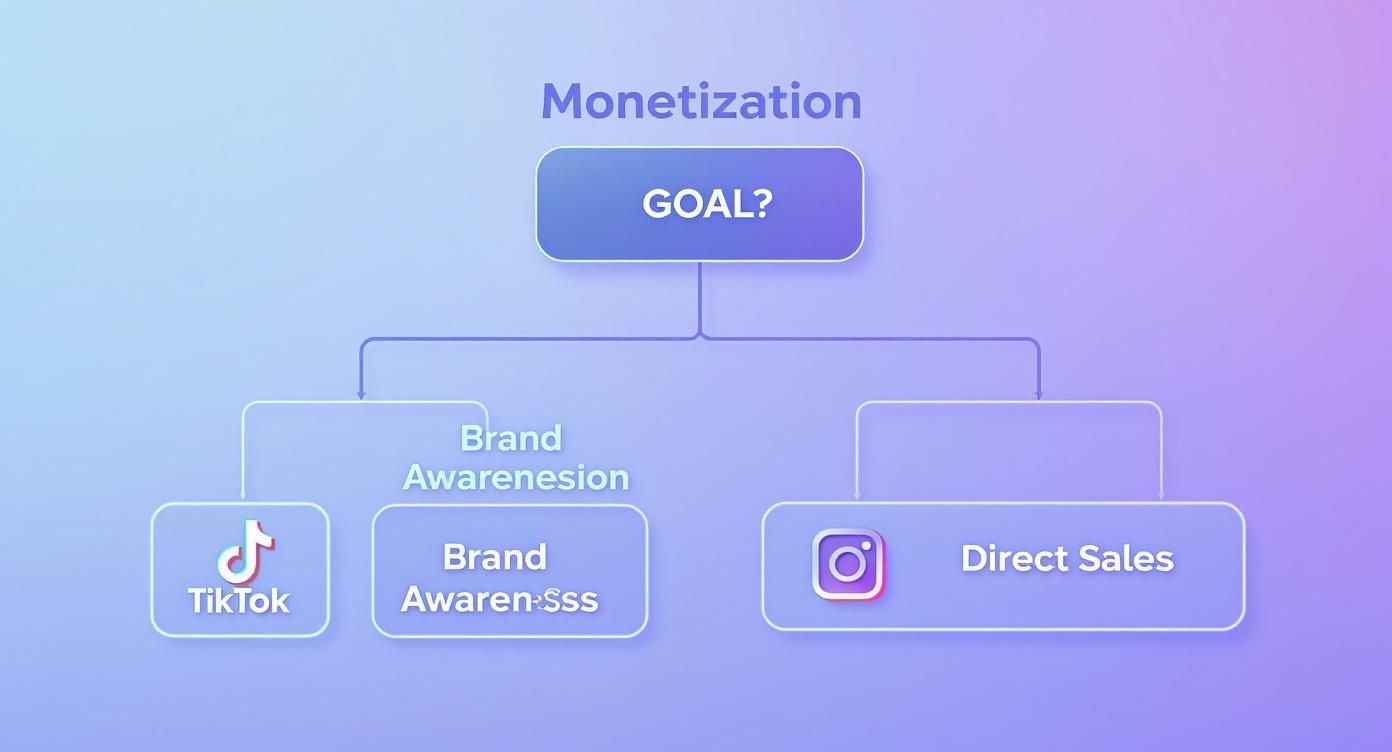
As the chart shows, TikTok is your go-to for casting a wide net and building brand awareness, while Instagram offers a more direct line to making sales. In the end, whether you go all-in on one platform or create a dual strategy, success comes from aligning your content with your core business goals.
Got Questions? We've Got Answers
Diving into the Reels vs. TikTok debate always brings up some practical, "what should I actually do?" questions. Let's clear up a few of the most common ones so you can sharpen your strategy.
Can I Just Post the Same Video to Both TikTok and Reels?
You can, but you really shouldn't. It's tempting for efficiency's sake, but it's a shortcut that will cost you reach. At the bare minimum, you absolutely have to remove the watermark from the other platform; the algorithms are smart enough to spot it and will likely penalize your video's visibility.
The best strategy is to adapt, not just copy. Keep the core video, but tailor the final touches. Use a sound that's blowing up on TikTok for your TikTok post. For Reels, write a more detailed caption designed to get your Instagram followers talking and use hashtags that are specific to that community.
Which One Is Easier to Go Viral On?
Ah, the million-dollar question. Both platforms offer a shot at virality, but they get you there in different ways. TikTok’s algorithm is all about the content itself, which means even brand-new accounts have a real chance at explosive, overnight success if they nail a trend.
The Bottom Line: TikTok gives you a slightly better shot at going viral out of nowhere based on a single video. Virality on Reels feels more connected to consistently creating great content for a niche you've already started to build.
Reels' virality is often more of a slow burn, tied to your existing community and niche authority. That's not to say you can't have a Reel pop off, but it's usually because it perfectly served an audience you were already cultivating.
Which Platform Drives More Website Traffic?
When it comes to getting people to click a link, Instagram Reels has the edge. The entire Instagram ecosystem is built to support it. Every single account gets a clickable link in their bio, providing a clear path for anyone who discovers you through a Reel.
On top of that, larger accounts can use link stickers in their Stories to create a seamless journey from a Reel to a specific product or landing page. TikTok gives you a bio link, too, but it just doesn't have the same powerful, in-app linking tools that make Instagram a more direct engine for traffic.
Ready to turn these insights into real, measurable Instagram growth? Gainsty combines smart AI with expert strategy to attract the right kind of followers—the ones who actually care about what you post. Take the guesswork out of growth with a risk-free, organic approach. Start your free trial at Gainsty.com.