
Why Instagram Engagement Matters More in 2026
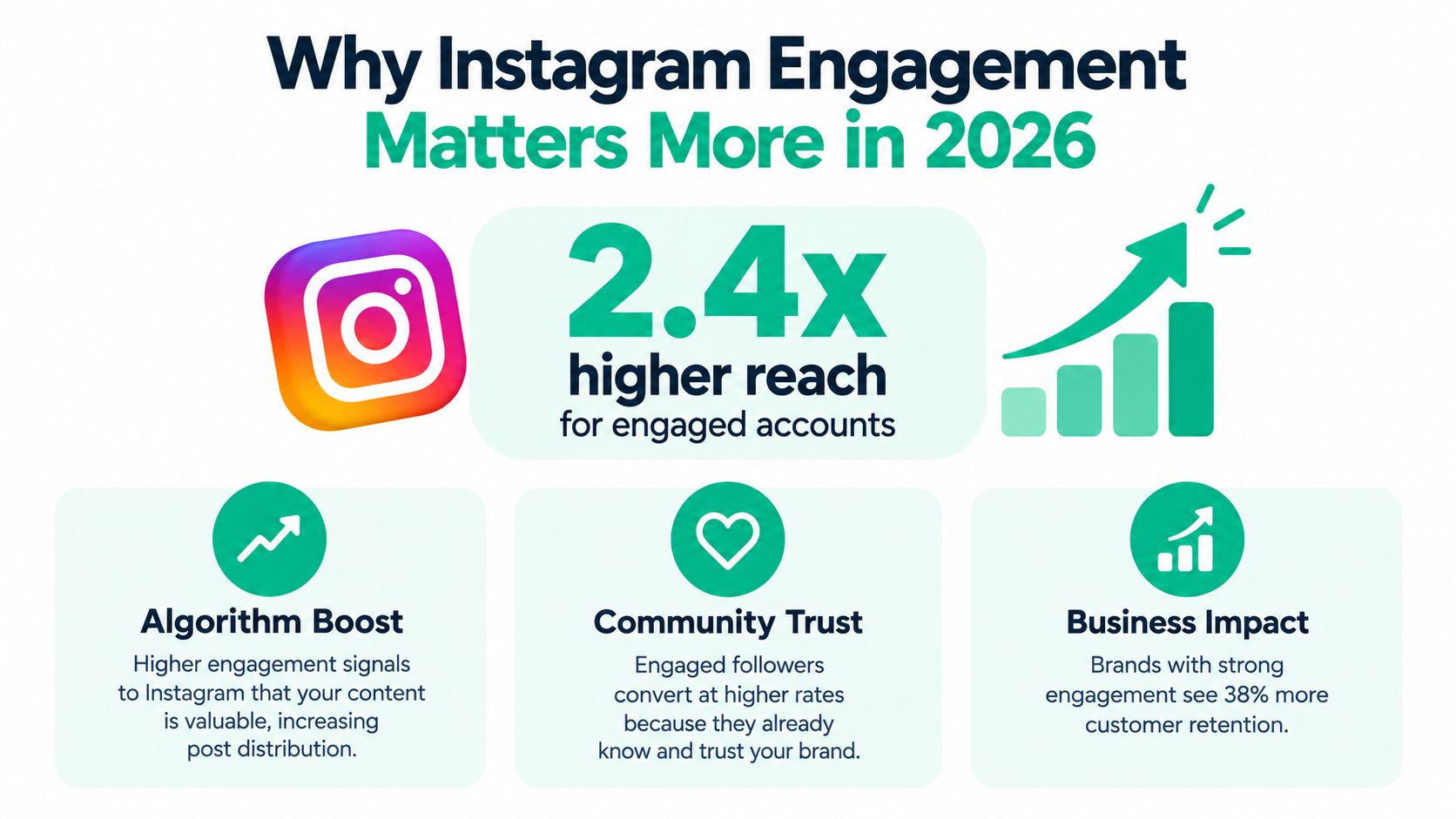
A client may see followers stall and assume the account has been “shadowed.” The more common problem is simpler. The content is being seen, but people are not taking the actions that signal interest, so the account fails to build momentum. On Instagram, weak engagement does not just make a dashboard look flat, it slows distribution, makes community formation harder, and raises the effort required from every future post.
That matters because Instagram now concentrates attention in places brands can use. Its advertising audience is large, and younger adults are especially active there, which means the platform rewards content that can prove relevance fast. In practical terms, that shifts the question from “How many people saw this?” to “Did the right people do something with it?”
Reach is opportunity, engagement is proof
Reach shows exposure. Engagement shows response. A post can reach plenty of accounts and still fail if it does not prompt action worth tracking.
Practical rule: if a post gets attention but no meaningful action, it has not earned another round of distribution.
That is why engagement works as a health signal. It shows whether the message feels relevant, whether the format fits the audience, and whether the account is building the trust that leads to follows, replies, saves, and conversions. Discovery engagement and relationship engagement serve different jobs. Discovery tells you whether new people noticed you. Relationship tells you whether existing or newly reached people are moving closer to your brand. Likes often help with the first job, while saves, shares, replies, and DMs usually reveal stronger intent in the second.
What this guide focuses on
A lot of Instagram advice stops at “post more.” That advice skips the part that matters. Strong accounts separate discovery from relationship, then measure each one against the behavior it should produce.
What Instagram Engagement Actually Includes
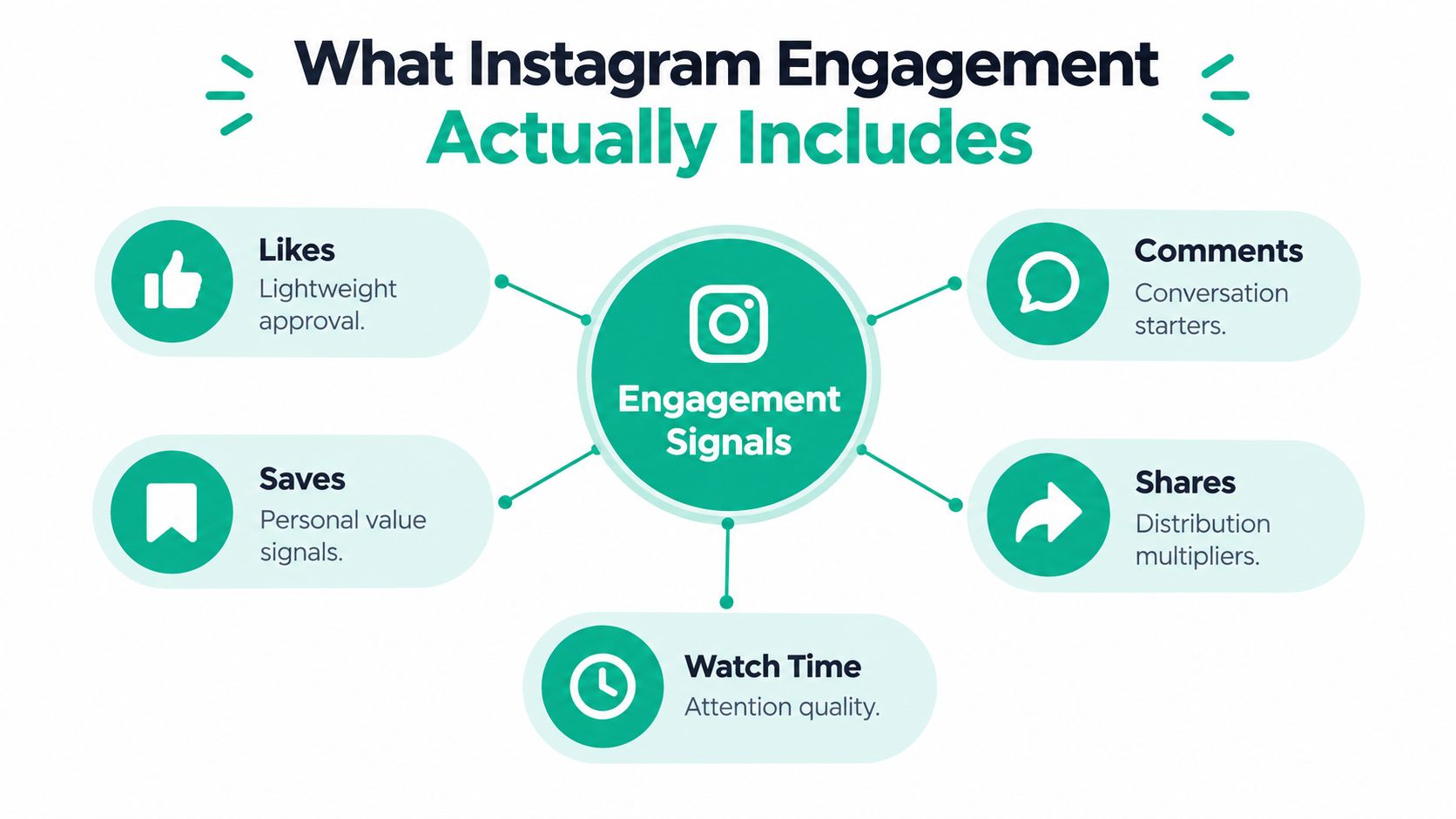
When discussing Instagram user engagement, many say "engagement" when they really mean likes and comments. That's too narrow. Instagram uses several signals, and each one tells a different story about how a person felt and what they're likely to do next.
The signals and what they mean
A like is lightweight approval. It's the digital equivalent of nodding as you walk past. A comment is a public reaction, which means the person cared enough to add their voice where others can see it.
A save is a bookmark. The person is saying, “I want to come back to this,” which usually means the content has utility. A share is closer to a recommendation, since someone is sending your post to another person as a useful or entertaining thing worth seeing.
A DM is a hand-raised question. It often means stronger intent than a public like because the person has moved from passive viewing to private contact. Reach is how many unique accounts saw the content, while impressions count repeated views, so the same person can contribute more than once.
Why watch time changes the picture
For Reels, watch time matters because it reflects quiet attention. Someone can watch without liking, commenting, or following, and that still tells Instagram the content held interest. Short attention is easy to miss if you only watch public metrics.
Pew Research Center's 2025 social-media findings show how concentrated this audience can be in the U.S., with 80% of adults 18 to 29 using Instagram, compared with 62% of adults 30 to 49, 40% of adults 50 to 64, and 19% of adults 65 and older (Pew data via SocialPilot). That age spread is why one creative style won't fit every audience segment.
Use the right word for the right job
If the post is built for awareness, look at reach and shares. If it's built for trust, look at replies and DMs. If it's built for usefulness, look at saves. Mixing those jobs together is where accounts get confused and chase the wrong signal.
A save is not the same thing as a like, and a DM is not the same thing as a comment. Treating them as equal is how strategy turns into guesswork.
How Engagement Rate Is Calculated
Engagement rate looks simple until you ask what's in the formula. Some dashboards divide interactions by followers, others divide by reach, and the answer changes how good or bad your content looks.
The two formulas that matter
There are two main ways to calculate engagement rate.
Engagement per follower: Total engagements divided by follower count. This works best when comparing accounts of similar size. Its main drawback is that it can flatter small accounts and hide weak reach.
Engagement per reach: Total engagements divided by reach. This works best for measuring content-market fit on a post-by-post basis. Its main drawback is that it can look volatile on low-reach posts.
A follower-based rate is easy to understand, but it can mislead. If a post reaches beyond your existing followers, the denominator stays fixed while the audience expands, so the rate may fall even when the content is doing a better job of finding new people. That's why many teams now treat reach-based engagement as the more honest signal for content performance.
A simple worked example
Say a post gets 180 total engagements and reaches 6,000 accounts. Engagement by reach is 3%. If the same post is measured against a 4,000-follower account, the follower-based rate would be 4.5%.
Both numbers are technically correct, but they answer different questions. The first tells you how the post performed among people who saw it. The second tells you how much activity it generated relative to your current audience size.
What the benchmark is good for
A global 2025 benchmark covering 2,967 company Instagram accounts with at least 1,000 followers reported an average Instagram engagement rate of 3.6% per post, using a calculation that includes organic, boosted, and promoted content but excludes paid advertisements (Dash Social benchmark PDF). That number is useful as a directional comparison, not a universal target, because account size, industry, posting mix, and promotion all change the picture.
For a fuller breakdown of measurement choices, a practical reference is Gainsty's guide to Instagram engagement rate formulas. The main habit to build is consistency. Pick one primary formula, use it the same way every week, and compare like with like.
How Instagram's Ranking Systems Shape Engagement
Instagram doesn't run on one algorithm. Feed, Stories, Explore, Reels, and Search each use separate ranking systems, so a post can do well in one place and underperform in another. That's why “the algorithm” is usually the wrong phrase, and surface-specific planning is the better habit.
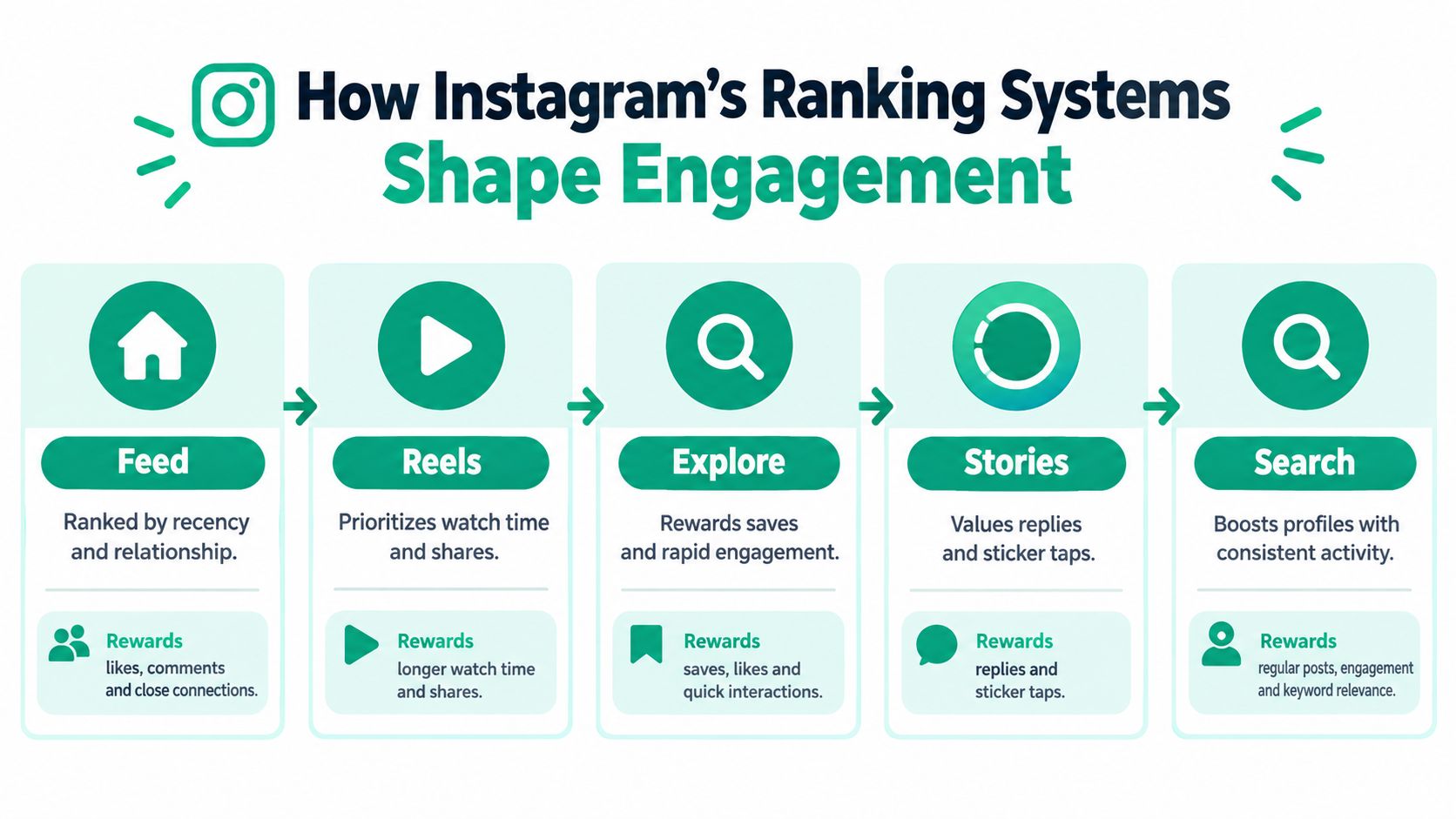
Each surface rewards a different action
Instagram says its ranking systems estimate the probability that a user will take actions such as liking, commenting, saving, or sharing, and posts predicted to generate stronger actions receive greater visibility (Instagram ranking explanation). In plain English, the platform is trying to guess what people will do next, not just what they glanced at.
That means the job of the creator is to make the next action obvious. On Feed, that might be a carousel worth saving. On Reels, it might be a short, clear payoff that keeps the viewer watching. On Stories, it may be a sticker, poll, or reply prompt that makes responding easy.
Relationship history affects future distribution
Recent interactions and followed content also influence relevance, which creates a direct feedback loop. If someone regularly engages with your account, Instagram has a reason to show them more of your future posts. If they stop interacting, your content has less evidence to stay visible to them.
Simple takeaway: the best signal from a real follower is repeated engagement, because it teaches Instagram that your content still belongs in that person's feed.
That's why consistency matters more than random spikes. A post that sparks the right action on the right surface sends a stronger message than broad attention with no clear intent. If you design content by surface, the ranking system becomes easier to work with instead of easier to blame.
Which Formats Drive Which Engagement Signals
A post can perform well and still solve the wrong job. That is the mistake behind a lot of weak Instagram user engagement thinking. Reels are built for discovery, carousels are built for utility, single images work best for a fast emotional hit, and Stories are where relationship signals usually show up.

Format by format, what tends to happen
Analysts at Metricool found that Reels generate more than four times the interactions of single-image posts, while Story replies rose 88% year over year even as reach and impressions stayed flat (Metricool study summary). That means video earns the discovery slot in your monthly mix, not every slot.
Reels are usually the right format when you want Instagram to introduce you to people who do not know you yet. Carousels work better when the topic needs steps, examples, or a sequence people may want to save. Single-image posts still have a place when the idea is visually strong and immediately felt, especially for announcements or a sharp point of view.
Make the format match the job
If you want shares, build something people will send to a friend. If you want saves, give them a checklist, framework, or reference. If you want replies, ask for a judgment, a choice, or a lived experience, not a bland yes-or-no prompt.
A simple monthly rule helps here. Assign each format a job. Use Reels for reach, carousels for holding attention on information, and Stories for trust and conversation. For a closer look at how short-form video fits into that mix, this 2026 guide to Instagram Reels is a useful companion.
When video production gets expensive or time-consuming, some teams also use tools that help them make faceless reels with AI without turning the content into filler. That only works if the script, hook, and edit still feel native to Instagram.
Don't copy a format without copying the job
A trending Reel is not automatically a good model for a brand that needs comments, and a highly saved carousel is not automatically the right answer for a founder who needs more discovery. The format should follow the engagement outcome, not the other way around.
A Tactical Playbook to Grow Authentic Engagement
The fastest way to improve Instagram user engagement is to reduce friction around the exact action you want. If you want saves, make the content useful. If you want replies, make the prompt easy. If you want shares, make the post feel like something worth sending.
Content design first
Start with one clear promise per post. If the content tries to teach, entertain, and sell in the same frame, people hesitate. A single ask works better than a crowded caption because the reader knows what the post is for.
Use a hook that names the payoff quickly, then make the body easy to scan. A carousel should reward swiping. A Reel should reward staying. A Story should reward tapping, replying, or voting.
Practical rule: the more specific the action you want, the easier it is for the audience to take it.
Cadence, response, and cleanup
Posting frequency matters less than rhythm. Reels, carousels, and Stories do not need identical timing, and they shouldn't be measured with the same expectations. What matters is whether the account stays active enough to keep giving the audience something to respond to.
Response speed matters too. If comments and DMs sit untouched, the conversation cools off, and the account stops looking like a live relationship. Replying quickly to real questions, follow-up comments, and Story responses signals that the account is worth talking to again.
There are also things to stop doing. Engagement bait creates noisy reactions that don't turn into loyalty. Vague calls to action waste space. Posting hard and disappearing breaks the conversation you just asked people to start.
A useful external reference for tactical ideas is Veo3 AI's guide to improving social media engagement, especially if you want more ways to structure prompts and content formats without leaning on tricks.
Measure the output that matches the input
If a post is built for saves, check saves. If it's built for replies, check replies. If it's built for discovery, check whether the reach brought in people who returned later. One metric can't judge every format fairly, so each format needs its own scoreboard.
When teams keep the metric tied to the creative job, they stop overreacting to vanity swings and start seeing which post types earn attention. That's the habit that makes the account more durable over time.
Measuring What Matters and Avoiding the Vanity Trap
Follower counts can go up while actual influence goes nowhere. Reach can rise while follower-based engagement falls. That's not a contradiction, it's a sign that your content is traveling beyond the core audience and needs a different measurement lens.
Split the dashboard into two layers
Reach-oriented engagement includes the signals that help content travel, like impressions, Reels plays, and discovery-driven interactions. Relationship-oriented engagement includes the signals that show trust, like saves, DMs, Story replies, and repeat viewing.
If you measure those together, the numbers blur. If you separate them, the account becomes easier to diagnose. Reels and carousels should usually be judged on discovery performance first, while Stories and DMs tell you whether the audience is warming up.
For a practical measurement setup, Gainsty's Instagram analytics guide is useful for teams that want a cleaner reporting routine.
Common misconceptions to drop
More comments do not automatically beat more saves. Comments can be loud, but saves often signal deeper utility. Any follower growth is not good growth if the new audience doesn't engage again.
The same goes for public visibility. A post can look strong because it reached a lot of people, while the relationship layer stays weak. That's why the most reliable routine is to review each content type against the action it was meant to generate, then compare the result to the last few posts of the same type.
A simple weekly habit
Check one discovery metric, one relationship metric, and one conversion-adjacent metric every week. Keep the definitions stable. When the metric moves, ask whether the creative matched the job.
That approach survives algorithm changes better than chasing whatever number looks biggest on the screen. It also helps you stop optimizing for applause and start optimizing for the right audience behavior.
If you want a clearer way to turn Instagram engagement into repeatable growth, Gainsty helps teams track the actions that matter and build organic follower growth around real audience behavior. It's a practical fit if you want to improve discovery, strengthen relationships, and keep your content strategy grounded in measurable engagement instead of vanity metrics.