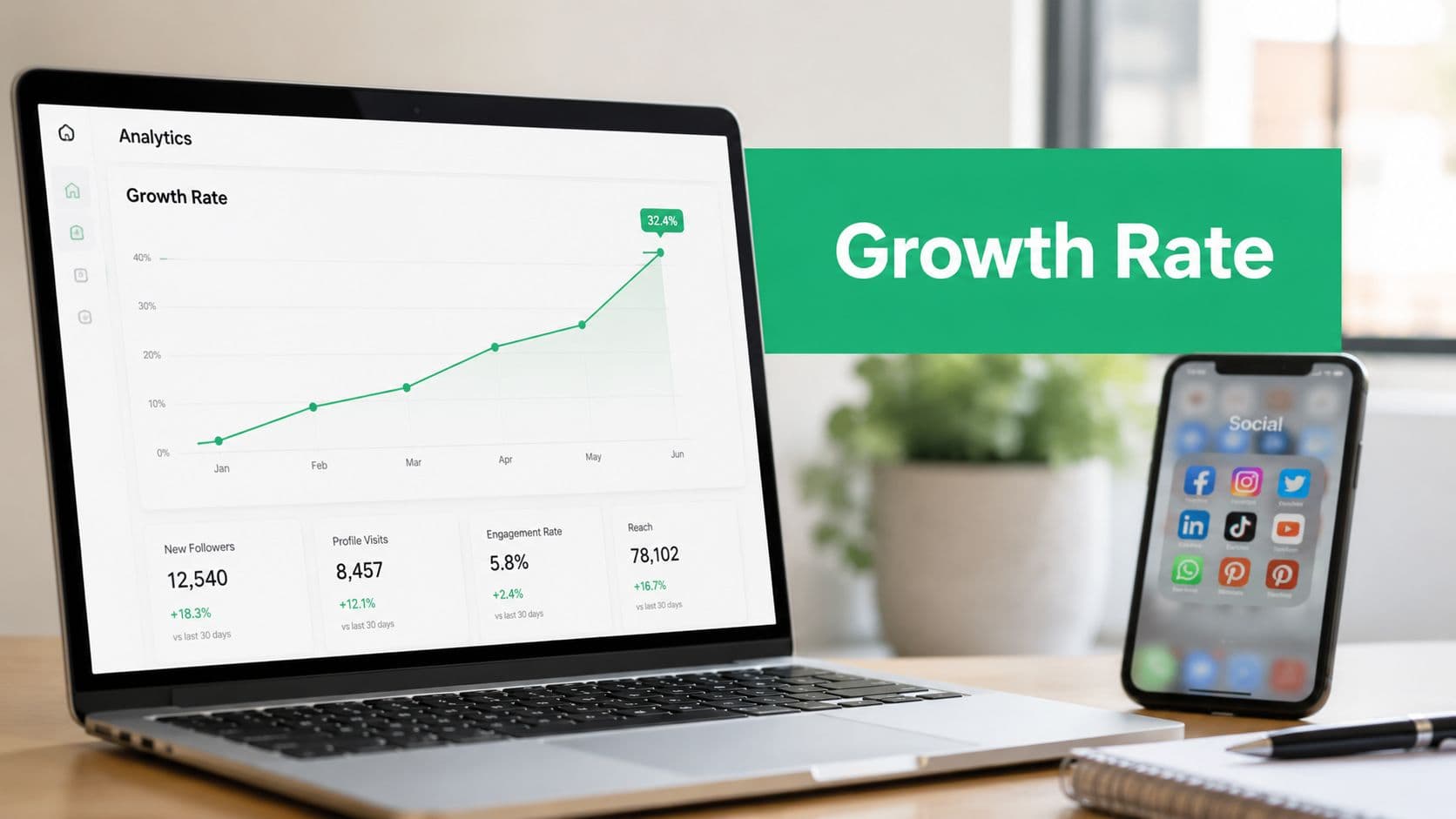
The Reality of Social Media Expansion
The scale is still expanding, and the pace matters because it sets the context for every brand decision that follows. Datareportal says the global social media user identity base reached 5.79 billion by April 2026, with annualised growth of 5.4% and roughly 9.3 new users every second. In plain terms, social is still adding people at a rate that keeps it central to brand planning, not a channel that has settled into maturity. For a visual summary of the trend, see the infographic showing global user statistics and platform growth trends.

Macro growth doesn't tell you what your account is doing
That backdrop can be misleading if you stop at the headline. A platform can keep expanding while an individual account stalls, because total audience growth and account health are different measures. Global adoption tells you how large the pool is. It does not tell you whether your content is earning repeat attention from the right audience.
The executive question is narrower and more useful. Is the current content mix converting attention into followers, followers into engagement, and engagement into business outcomes? If follower count is still the main scoreboard, the team is optimizing for the easiest number to inflate, not the hardest one to earn. A closer look at social media trend analysis helps separate channel movement from vanity totals, which makes it easier to judge whether growth is changing account quality.
Practical rule: if a platform is growing faster than your account, the platform is not the problem. Targeting, format choice, or consistency usually is.
That point matters even more on video-heavy channels, where reach can look healthy while retention stays thin. Teams building around motion, hooks, and watch time should use strategies for video marketing success as a reference for turning platform attention into real viewing behavior. Big markets do not rescue weak execution.
Calculating Your True Growth Rate
The useful version of social media growth rate starts with a basic formula. For follower growth, use (new followers during the period ÷ starting followers) × 100. If you begin a month with 10,000 followers and end with 10,500, your follower growth rate for that period is 5%. The math is simple. The interpretation is where teams go wrong.

Use the same time window every time
A weekly number tells you something different from a monthly or quarterly one. Weekly growth catches campaign bursts and content spikes. Monthly growth is better for seeing whether your machine is working. Quarterly growth is the cleanest way to judge whether the account is compounding or just bouncing around.
For a longer view, analysts often use CAGR, or compound annual growth rate, when comparing multi-period account performance. The structure is (ending value ÷ beginning value)^(1 ÷ number of periods) - 1, which helps smooth out short-term noise. You don't need to calculate it by hand if your dashboard tool supports it, but you do need to understand what it means. CAGR answers a leadership question that raw monthly growth can't, which is whether your audience base is expanding steadily or only in bursts.
Practical rule: never compare a campaign week to a normal week and call it strategy. Compare like with like, or the number is just decoration.
Engagement needs its own growth view too. Track the change in total likes, comments, saves, shares, or whatever combination matters most to your format, then compare that change against follower growth over the same period. If followers rise but engagement stays flat, your audience may be growing in size but not in intent. That's a health issue, not a success story.
For teams building a measurement stack, the internal guide on best social media measurement tools is a helpful reference point for choosing systems that don't just report totals, but help compare periods cleanly. And if your team also tracks retention and expansion across customer journeys, Sift AI's overview of key customer success metrics is a smart complement, because it reinforces the idea that growth only matters when it connects to durable outcomes.
Platform Benchmarks and Momentum
Platform growth is uneven, and that unevenness should shape budget decisions. Statista reported that Instagram grew 25.3% year over year in 2024, ahead of Pinterest at 23.2%, LinkedIn at 13.9%, and Facebook at 3.1% in early 2024 (Statista, Statista). The takeaway is not that one platform is universally better. It's that audience momentum is concentrated where recommendation systems and content formats are still pulling fresh attention.
What the growth spread says about allocation
A mature platform can still be valuable, but its growth profile is slower. That changes how you allocate resources. Faster-moving networks deserve more creative testing, more repurposing discipline, and more attention from leadership because the margin for capturing incremental reach is better. Slower-growing networks may still support conversion, community, or customer care, but they should not consume the same experimentation budget as the places where discovery is compounding.
Instagram: Recorded a 25.3% year-over-year growth rate in 2024, making it one of the fastest-growing major social platforms.
Pinterest: Achieved a 23.2% year-over-year growth rate, reflecting strong momentum, particularly for visual discovery and shopping-related content.
LinkedIn: Grew by 13.9% year over year, continuing to expand as a platform for professional networking, thought leadership, and B2B marketing.
Facebook: Posted a 3.1% year-over-year growth rate, indicating slower growth compared with newer or more rapidly expanding social platforms.
That list doesn't say “abandon Facebook.” It says the growth engine is not evenly distributed. Short-form, recommendation-led formats tend to benefit more from platform mechanics, which is why a brand can't assume its next best channel will grow the same way as the last one. The audience may be large everywhere, but the speed of discovery is not.
A second implication is strategic humility. If your brand is underinvesting in a high-momentum platform because an older channel feels safer, you're probably making a comfort decision, not a growth decision. If your category fits a visual or identity-driven format, that mismatch gets expensive fast. The best teams treat platform momentum as a leading indicator, not a vanity chart.
Quality Versus Quantity in Follower Acquisition
A bigger follower number is not automatically a better account. That sounds obvious until reporting season arrives, then teams start celebrating raw additions without asking who those followers are or what they do once they arrive. A slower, more relevant audience can be far more valuable than a larger audience that ignores every post.
Engagement-adjusted growth is the better lens
The stronger metric is engagement-adjusted growth. That means looking at follower growth alongside interaction quality, not in isolation. Hootsuite's guidance highlighted in SocialInsider's coverage points to platform-specific average engagement rates such as 3.5% on Instagram and 2.8% for Instagram Reels (SocialInsider). Those figures don't tell you what your brand should expect exactly, but they do reinforce the point that engagement is a separate signal from audience size.
If your follower count rises while engagement rate drops, the new audience may not match your content or your offer. If comments are thin, saves are low, and retention is poor, you're not building depth. You're accumulating passive reach. That's a dangerous form of growth because it can look healthy in a deck while the content is weakening.
What matters most is not how many people arrive, it's whether the right people stay and interact.
Ghost followers distort the picture. An account can carry a large audience number while a meaningful slice of that base never engages, never converts, and never helps distribution. The internal explainer on ghost followers is relevant here because it puts a name to the accounts that inflate optics without adding real demand. Those followers make growth look smoother than it is.
The strategic conclusion is uncomfortable but useful. If engagement quality rises more slowly than follower count, the account may still be improving. If the opposite happens, growth may be hollow. That's why leadership should ask not only whether the account is bigger, but whether the audience has more intent, better fit, and stronger response behavior than it did last quarter.
Tactics for Sustainable Organic Growth
Sustainable growth starts with specificity. Broad accounts usually grow slowly because broad content is hard to recognize, hard to recommend, and hard to remember. Niche accounts grow faster when they solve a clear problem, speak to a defined identity, or repeat a format that people know how to return to. Consistency matters, but consistency without positioning just creates repeatable noise.
Build around content that compounds
Your content pillars should answer three questions. What does the audience want to learn, what do they want to feel, and what do they want to do next? If those answers change every week, the algorithm has no stable pattern to learn from, and followers have no reason to expect value. Stable themes help because they teach both the platform and the audience what your account is for.
AI-assisted tools can help with targeting and outreach, but only when they support real human interest. That means using systems to find relevant conversations, identify active niches, and prioritize people who already signal fit. This is also where Gainsty can fit naturally as one option for managed organic Instagram growth, because it focuses on audience targeting and analytics rather than bots or fake followers. Used properly, a tool like that belongs in a workflow, not in a growth fantasy.
Practical rule: if a tactic can't be explained to a skeptical CFO without sounding like a shortcut, it probably isn't sustainable.
Volume still matters, but volume without depth is just more chances to be ignored. Brands that grow cleanly usually do a few things well and repeat them until the market recognizes the pattern. They test hooks, they refine creative, and they keep the content anchored to a real audience need. That's a sturdier path than chasing whatever format is loudest this week.
The executive-level goal is to build a community that would notice if you disappeared. That's the difference between a feed account and a defensible brand asset. Organic growth is strongest when every post has a job, every pillar has a purpose, and every follower added is one who could plausibly care again tomorrow.
Building a Measurement Dashboard
A dashboard should answer three questions fast. Are we growing, is the growth healthy, and what caused the change? If it can't answer those in a glance, it's reporting theater. The dashboard needs to make the right comparison easy, because people default to the simplest chart in front of them.
Separate daily monitoring from monthly review
Daily monitoring should focus on signals that move quickly, such as follower adds, engagement volume, and content reach. Monthly review should focus on growth rate, engagement rate, and whether the account attracted the right kind of attention. Quarterly review should connect social performance to bigger commercial markers, because that's where leaders decide whether a channel deserves more investment.
Build the dashboard around content buckets, not just platform totals. That way, you can see whether product-led posts, founder-led posts, educational posts, or entertainment posts are carrying growth. If a single format is doing all the work, the account is fragile. If multiple formats contribute, the system is more resilient.
A useful structure is this:
Top-line growth: follower additions, unfollows, net growth.
Engagement quality: comments, saves, shares, and comment relevance.
Content drivers: which topics, formats, or creators drove the spike.
Audience fit: where possible, compare growth against target segments, not just total followers.
Business linkage: traffic, leads, or assisted conversions if the platform supports it.
The strongest dashboards also annotate events. Campaign launches, creator collaborations, product drops, and paid boosts should sit on the timeline so the team can connect movement to cause. Without that layer, you're left guessing whether growth came from substance or timing. That's bad management, because you can't repeat what you can't identify.
If you're building this in a spreadsheet, start simple and keep the formulas visible. If you're using a platform tool, insist on exportable data and period-over-period comparisons. The point isn't software sophistication. It's decision clarity.
The Future of Social Media Performance
The next phase of social performance will reward teams that stop treating follower totals as the main signal and start managing audience quality. The global user base continues to expand, as noted earlier, but the brands that outperform will be the ones that can show growth is compounding in a useful direction. Raw scale still matters. It just does not answer the question executives care about, which is whether the account is attracting people who fit the brand and interact with the content.
A practical readout starts with the account, not the market. If follower growth slows while engagement quality improves, that can still be a net positive because the audience added is more relevant and more active. The reverse matters just as much. A spike in followers with weak comments, few saves, and low share activity usually points to a gap between reach and resonance. The smarter review asks who joined, how they behaved, and whether their actions support the rest of the funnel.
For agency teams connecting that view to broader objectives, the guide to agency social media growth is a useful companion because it keeps growth tied to objective-setting instead of empty scale. That framing matters for the next planning cycle. Growth should explain performance, not merely decorate a report.
A mature measurement model also separates momentum from noise. A campaign can produce a short-lived follower burst without improving long-term account health, while a smaller rise in followers can be more valuable if those users stay active and continue to engage with future posts. The difference shows up in repeat interaction, content saves, comment relevance, and the rate at which new followers become consistent participants. That is the level of analysis that tells leaders whether growth is compounding or just appearing on the surface.
If you want a cleaner way to measure follower quality, engagement health, and account momentum, Gainsty can help you assess organic Instagram growth with targeting and analytics in one workflow. Visit Gainsty to review how your current account health stacks up and see whether your growth rate is building audience quality.