Understanding Audience Segmentation

Think about it like this: you wouldn't recommend a gritty crime thriller to a friend who only reads historical romance novels. It just wouldn't land. The same logic applies to your marketing.
At its core, segmentation is about dividing a market into subgroups based on shared characteristics. These could be demographics like age or location, behaviors like past purchases or website visits, or even psychographics like their personal values and interests. By doing this, you can stop creating one-size-fits-all campaigns and start tailoring your message to what each specific group cares about.
The Core Benefits of This Approach
This is where the magic really happens. When your marketing feels less like a generic ad and more like a helpful recommendation, people pay attention. It just makes sense. Understanding the specific needs of different groups lets you craft campaigns that speak directly to what motivates them.
This leads to some pretty powerful results:
Improved Engagement: When your content is genuinely relevant, people are more likely to interact with it. That means more email opens, higher click-through rates, and better engagement on social media.
Higher Conversion Rates: An offer that perfectly matches a customer's needs is hard to resist. This alignment is what turns browsers into buyers.
Enhanced Customer Loyalty: Personalization shows your customers that you "get" them. It makes them feel seen and valued, which is the foundation of a strong, lasting relationship.
By focusing on smaller, well-defined groups, you transform your marketing from a blunt instrument into a set of precision tools. This not only improves results but also makes your marketing budget work much harder.
The list below breaks down exactly how powerful this can be for your business.
Core Benefits of Audience Segmentation
Personalized Marketing: By leveraging personalization, your business can craft messages that truly resonate with specific audiences. This approach moves beyond generic campaigns and helps create genuine, emotionally meaningful connections with customers.
Increased ROI: Targeting the most receptive audiences allows you to focus your marketing budget more efficiently. This precision eliminates wasted spend and maximizes your overall return on advertising investment.
Better Product Development: Customer insights gained from segmentation and feedback reveal what different groups value most. These insights guide refinements in product features, design, and services, ensuring better alignment with market needs.
Stronger Customer Bonds: When customers feel understood and valued, they’re more likely to develop long-term loyalty. This emotional connection turns one-time buyers into repeat purchasers and vocal advocates for your brand.
Ultimately, segmenting your audience gives you the clarity you need to make smarter marketing decisions and build a more resilient business.
Of course, before you can segment anyone, you need a crystal-clear picture of who you're talking to in the first place. That’s why the first, non-negotiable step is defining your target audience. Once you have that foundation, you can build a killer social media targeting strategy.
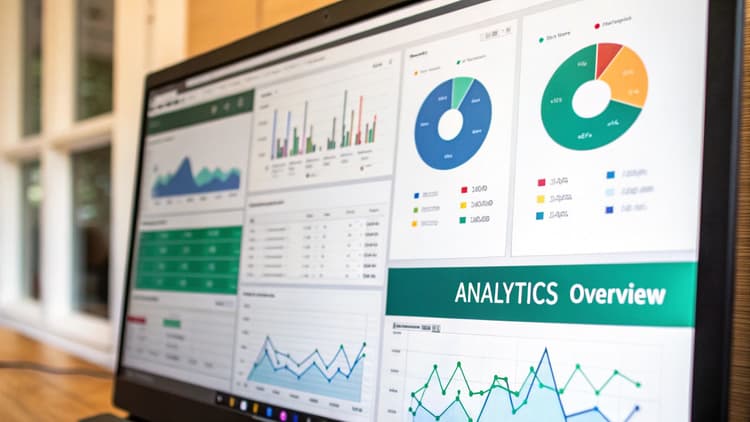
The proof is in the numbers, too. The global audience analytics market was valued at approximately USD 5 billion in 2024 and is projected to nearly double by 2030, a clear sign that businesses are betting big on this approach.
Why One-Size-Fits-All Marketing No Longer Works
In a world overflowing with digital messages, the fastest way to get ignored is to be generic. The old playbook of crafting one single message for your entire audience—what we call one-size-fits-all marketing—is like trying to unlock a dozen different doors with the same key. It just doesn’t work anymore.
Today's customers don't just appreciate personalization; they expect it. They're surrounded by platforms like Netflix and Spotify that learn their preferences and deliver experiences made just for them. When a brand sends them an irrelevant email or an ad for a product they don't need, it feels jarring and completely out of touch.
For businesses that haven't adapted, this disconnect leads to some pretty big problems.
The Cost of Being Generic
When you treat your audience as one giant, uniform group, you miss the very things that make them individuals. You’re overlooking the unique motivations, specific pain points, and distinct desires that actually drive their decisions. This isn't just a missed opportunity; it has tangible costs.
Broad, undifferentiated messages almost always fail to capture attention. The result? Poor engagement, wasted ad spend, and a total failure to build any real connection with the people you’re trying to reach.
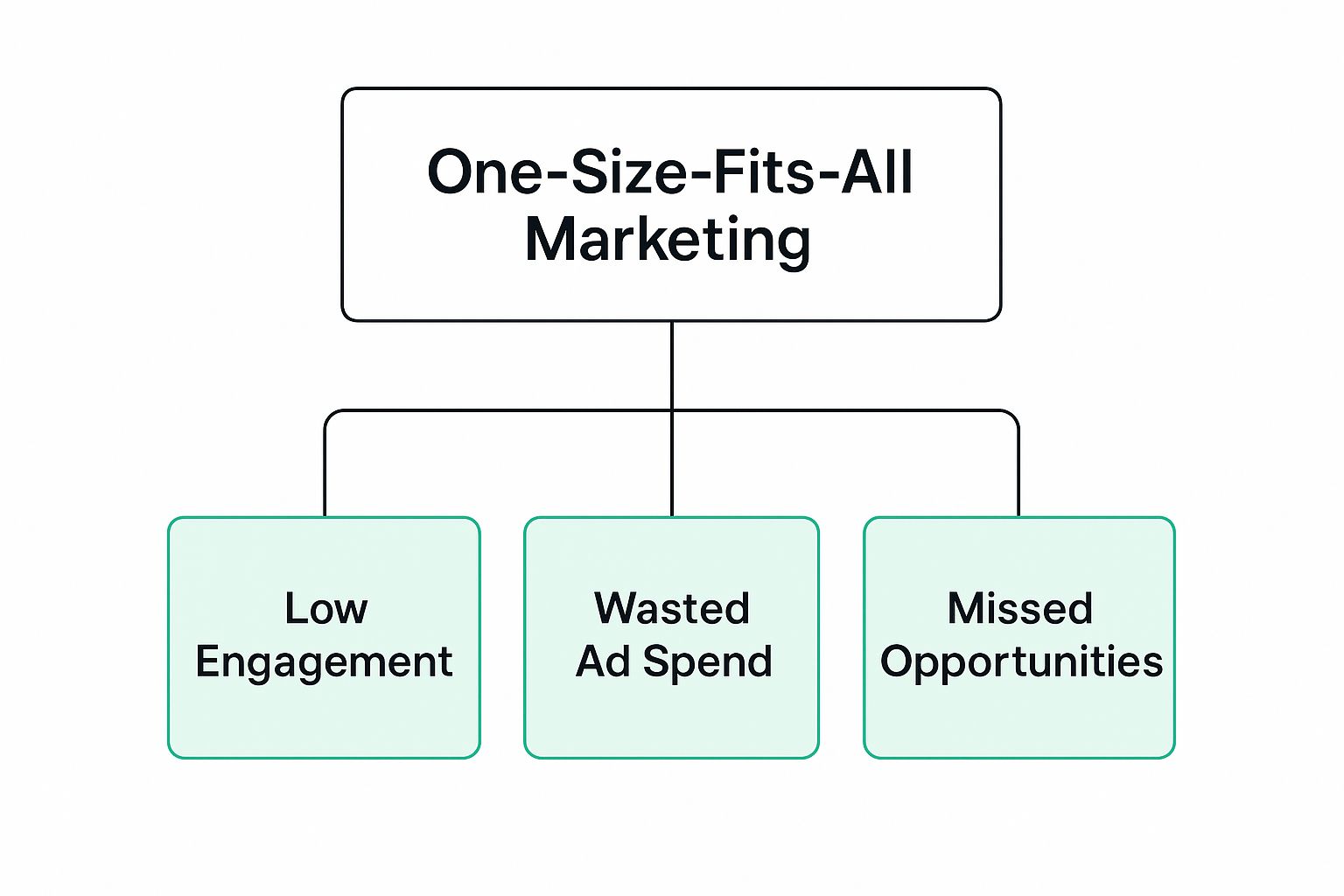
As you can see, a single, generic strategy fractures into multiple negative outcomes, undermining the very goals of your marketing efforts. Shifting to a more targeted strategy is no longer optional—it's essential for survival and growth.
The Power of a Personal Connection
This is where understanding what audience segmentation is comes in. It lets you trade that blunt instrument for a set of precision tools. Instead of just broadcasting a message, you start targeting it. And the data overwhelmingly supports this shift, showing a direct line between personalization and business success.
Consider this: a staggering 81% of consumers are more likely to buy from brands that offer personalized experiences. This preference translates into massive revenue gains, with companies using segmentation reporting a dramatic 760% increase in email marketing revenue. In fact, targeted campaigns are so effective that they account for roughly 77% of total marketing ROI. You can discover more about these segmentation strategy insights and see the full impact for yourself.
By speaking directly to the distinct needs of smaller groups, you do more than just sell a product. You show your customers that you see them, understand them, and value them as individuals.
This fundamental change in approach is what builds genuine customer loyalty and drives sustainable growth. It's the difference between being another piece of noise and becoming a trusted voice.
The Four Core Types of Audience Segmentation

To really get your arms around audience segmentation, you need to understand its four foundational pillars. Think of these as different lenses you can use to look at your audience. Each one reveals a unique—and valuable—perspective.
When you put them all together, you get a complete, three-dimensional picture of your customer. This is what lets you move beyond generic targeting and start creating marketing that genuinely connects.
These four types help you answer the most important questions about your customers: who they are, where they live, why they buy, and what they do. Let's break them down.
Demographic Segmentation: The Who
This is probably the segmentation type you're most familiar with. It's the most straightforward way to slice up an audience, focusing on quantifiable, statistical data. It answers the fundamental question: "Who are my customers?"
This data is often the easiest to get your hands on, and it provides a solid, reliable baseline for any marketing strategy you build. While it might seem basic, don't underestimate its power.
Knowing a group's average age and income helps you nail down your product messaging and pricing. Understanding their occupation can completely change the tone and style of your content.
Common demographic data points include:
Age: Are you talking to Gen Z, Millennials, or Baby Boomers?
Gender: Does your product have a specific gender appeal, or is it neutral?
Income: This is a direct line to understanding price sensitivity and purchasing power.
Occupation: The way you talk to a software engineer is going to be very different from how you talk to a freelance artist.
Education Level: This can influence the complexity and depth of your messaging.
Geographic Segmentation: The Where
Next up, we have geographic segmentation, which groups your audience based on their physical location. It answers a simple but critical question: "Where are my customers?"
This can be as broad as continents and countries or as granular as specific neighborhoods and zip codes. It’s obviously essential for any business with a brick-and-mortar presence, but it's just as crucial for online brands.
Why? Because location influences everything—culture, language, climate, and day-to-day needs. A clothing retailer, for example, isn't going to promote winter coats to customers in tropical climates. They’ll get swimwear ads instead. Simple, but effective.
By understanding where your audience is, you can make your marketing feel local and relevant, no matter how global your reach is. It's about meeting people where they are, both literally and figuratively.
Psychographic Segmentation: The Why
Okay, this is where things get really interesting. Psychographic segmentation moves beyond the "who" and "where" to dig into the "why" behind what people do. It groups people based on their psychological traits, like lifestyle, personal values, interests, and personality.
This is the data that helps you connect with your audience on a much deeper, more emotional level. It uncovers what truly motivates them to act.
For instance, a sustainable brand isn't just selling a product; it's selling a belief system. They would target a segment that values eco-conscious living, crafting messages that speak directly to those core beliefs, not just product features.
Behavioral Segmentation: The What
Finally, behavioral segmentation looks at how customers actually interact with your brand. It answers the question: "What do my customers do?" This is one of the most powerful and actionable forms of segmentation because it’s based on concrete user actions, not assumptions.
This data gives you direct insight into a user's intent and loyalty. By tracking behaviors, you can create campaigns that are incredibly relevant and perfectly timed.
Consider an e-commerce store sending a gentle reminder email to someone who has abandoned their shopping cart. Or offering an exclusive discount to a loyal customer who makes frequent purchases. It’s about reacting to their actions in a helpful, personalized way that builds the relationship.
Comparing the Four Main Segmentation Types
It can be a lot to keep straight, so here's a quick reference list to help you see how these four types of segmentation stack up against each other. Think of it as your cheat sheet for understanding the core of your audience.
Demographic Segmentation: This type of segmentation answers the question “Who are they?” It focuses on quantifiable traits such as age, gender, income level, occupation, and family size to categorize and understand your audience.
Geographic Segmentation: Geographic segmentation answers “Where are they?” It groups customers based on their physical location, such as country, city, zip code, climate, or population density, allowing businesses to tailor offerings to regional needs and preferences.
Psychographic Segmentation: This segmentation type answers “Why do they buy?” It delves into customers’ inner motivations, including their lifestyle, values, interests, personality traits, and beliefs, helping brands connect on a more emotional and personal level.
Behavioral Segmentation: Behavioral segmentation answers “What do they do?” It examines customer actions such as purchase history, website interactions, brand loyalty, and product or feature usage to identify behavioral patterns that drive decision-making.
Each lens gives you a different piece of the puzzle. Demographics and geographics provide the frame, but psychographics and behavioral data fill in the rich details that make the picture complete.
How AI Changes Modern Segmentation
For years, audience segmentation was a powerful but clunky process. Marketers would spend hours manually sorting customers into static boxes based on past data. It worked, but it was always a step behind.
Enter artificial intelligence. AI and machine learning are completely flipping the script, moving us away from analyzing the past and into predicting the future.
Think of old-school segmentation like sorting your mail into pre-labeled bins—"bills," "junk mail," "letters." It's organized, but it's rigid. AI is more like a personal assistant who not only sorts your mail but also predicts which bills you'll pay first and what kind of letter you're hoping to receive tomorrow.
It sifts through mountains of data, finding tiny patterns and hidden connections a human analyst would almost certainly miss. This enables us to graduate from simple categories, such as "people who bought shoes," to dynamic groups based on what they're likely to do next. AI can flag customers at high risk of leaving or pinpoint a group that's primed for a new product launch, all in real time.
From Static Groups to Predictive Personas
AI doesn’t just speed up the old way of doing things; it unlocks entirely new possibilities. Instead of you defining a segment and then trying to find people who fit, AI algorithms can identify clusters of users all on their own based on thousands of subtle behaviors. This is the magic of predictive segmentation.
This shift allows for a level of personalization that was pure science fiction just a few years ago. An e-commerce site, for instance, can now use AI to show every single visitor a unique homepage with product recommendations based on their predicted interests, not just what they clicked on last week.
It's a huge deal, and the market reflects it. The global AI marketing space is on track to hit approximately USD 356 billion by 2030. You can read more about these AI segmentation trends and their applications to get a sense of just how big this change is.
The Power of Dynamic Segmentation in Action
Because AI crunches data nonstop, our segments are no longer set in stone. A customer's profile can change in an instant based on their very last interaction with your brand.
Here’s where it gets really interesting:
Social Media Engagement: AI can analyze social media chatter in real time to tweak ad targeting on the fly. We cover how this works in our guide on using AI for Instagram growth.
Customer Lifecycle Prediction: Algorithms can anticipate when a customer is about to evolve from a "newbie" to a "loyal fan" and automatically send the perfect message to nudge them along.
Content Personalization: AI can figure out if a specific user is more likely to engage with a blog post, a video, or a case study—and serve them exactly that to keep them hooked.
With AI, businesses are no longer just reacting to what customers have done. They are proactively anticipating what customers will do next, creating a massive competitive advantage.
This leap from reactive to predictive is what modern audience segmentation is all about. It’s about truly knowing your customer on a deeper, almost intuitive level.
Real-World Examples of Brilliant Segmentation
Theory is one thing, but seeing how audience segmentation plays out in the wild is where it all clicks. It's easy to talk about concepts, but it’s far more powerful to see how the world's biggest brands use them to build fiercely loyal communities and drive mind-blowing growth.
These companies have turned segmentation into an art form. By looking at their playbooks, we can see a clear path to success. They prove that when you truly get what makes different groups of customers tick, your marketing stops feeling like marketing and becomes a natural part of their experience.
Spotify: The Master of Moods
Spotify is the undisputed king of behavioral segmentation. To them, you’re not just a subscriber; you're a listener with specific habits, tastes, and moods that change throughout the day. Their entire platform is engineered to understand what you do.
The most obvious examples are their legendary personalized playlists, like Discover Weekly and Release Radar. These aren't just random song collections. They are meticulously crafted by algorithms that analyze your listening history—every song you play, every track you skip, and every album you repeat.
Discover Weekly: This is for the "music explorers." It targets the behavioral segment of users who are always hunting for new tracks that match their existing tastes.
Your Daily Mixes: This carves up your listening habits by genre and mood, creating distinct vibes for your workout, your study session, or your commute.
This intense level of personalization, all driven by behavioral data, is a massive reason for Spotify’s incredible user retention. They don't just give you music; they make you feel seen.
Netflix: Custom-Built Binge-Watching
Netflix uses a sophisticated cocktail of behavioral and psychographic segmentation to create an experience that feels like it was made just for you. They get that two people can love the same genre for completely different reasons. One person might be drawn to character-driven dramas (a psychographic trait), while another just wants fast-paced action (a behavioral preference).
This insight runs deeper than just showing recommendations. Netflix is famous for customizing the thumbnail images you see for a movie or series based on what you’ve watched before.
If you watch a ton of romantic comedies, the thumbnail for Stranger Things might show the teenage romance subplot. But if you’re a horror fanatic, you’ll get a scarier, more monster-focused image for the exact same show.
This is segmentation on a micro-level. Netflix isn't just targeting broad categories; it's personalizing the experience for tiny, nuanced segments to keep you clicking "next episode."
Nike: Speaking to Every Athlete's Identity
Nike is a powerhouse of psychographic segmentation, targeting not just sports, but the very identity of an athlete. They know the mindset of a "weekend warrior" is worlds apart from that of an "elite competitor" or someone just lacing up their first pair of running shoes.
Their marketing campaigns speak directly to these different identities. A campaign for the "new runner" segment will be all about motivation, community, and crushing self-doubt. Flip over to the content for the "marathon veteran," and the language becomes technical, focusing on shaving seconds off a personal best.
By segmenting based on goals and self-perception, Nike forges an incredibly powerful emotional bond. They aren't just selling sneakers; they're selling aspiration and a sense of belonging to very specific tribes. It’s a strategy that has built one of the most dominant brand communities on the planet.
How to Get Started with Audience Segmentation

Alright, let's move from theory to action. Getting started with audience segmentation sounds like a huge undertaking, but it doesn't have to be. With a clear roadmap, you can start tapping into its power right away. The trick is to start simple and aim for progress, not perfection.
The whole process kicks off with one critical question: “What do I want to achieve?”
Before you even think about data, you need a goal. Are you trying to get existing customers to buy again? Are you aiming to bring in brand-new buyers? Maybe you’re fighting an uphill battle with abandoned carts. Your goal is your North Star—it guides every single decision from here on out. Without it, you're just sorting customers for the sake of sorting.
Once you’ve got a clear goal, it's time to gather your data. Honestly, this is where most people get stuck.
The Initial Steps in Your Segmentation Journey
Your customer info is probably scattered all over the place. Some of it’s in your CRM, some in your website analytics, some on your email platform, and more over on your social media accounts. The first real task is to pull it all together into one unified view. Think of this consolidated data as the raw clay you'll use to build your segments.
With your data wrangled, you can start looking for meaningful groups. Don't fall into the trap of trying to create a dozen complex segments on day one. Instead, focus on a few high-impact categories based on the models we've already covered, like behavior or demographics.
As you brainstorm, it can be incredibly helpful to explore a variety of powerful customer segmentation strategies to see what might click for your specific business.
The most effective way to start is by building 3-5 core customer personas. Personas are essentially fictional characters that represent your key segments. Give them a name, a backstory, a face. This simple act makes it so much easier for your entire team to understand and empathize with each group.
With your segments and personas in hand, you’re ready to launch targeted campaigns. For example, if you want to make a splash on social media, you’ll need to figure out how to find your target audience on Instagram and then create content that speaks directly to that specific group.
And the final, non-negotiable step? Measure everything. Keep a close eye on your key metrics to see what’s hitting the mark and what’s falling flat. Use those insights to tweak, refine, and improve your approach over time. Segmentation isn't a "set it and forget it" task; it's a continuous cycle of learning and optimization.
Common Questions About Audience Segmentation
As you dive into audience segmentation, a few questions always seem to come up. It's totally normal. Getting a handle on these basics will help you build your strategy on solid ground and skip the common pitfalls.
Let's clear up some of the most frequent questions people ask.
What Is the Difference Between a Segment and a Persona?
It’s easy to get these two mixed up, but they play very different roles.
Think of a segment as a big-picture group of real customers pulled together by data. They share a specific, measurable trait. Examples could be “first-time buyers,” “customers who haven't purchased in 90 days,” or “users who live in California.” It’s the what.
A persona, on the other hand, is the fictional, human face you put on that data. It’s a character you invent to represent a typical member of a segment, like “Sarah the Savvy Shopper.” Giving the segment a name and a story makes it so much easier for your team to understand, empathize with, and create marketing that truly connects with them. Segments are the data; personas are the who.
How Many Audience Segments Should I Create?
Okay, this is a big one. It's tempting to slice and dice your audience into dozens of tiny groups right away. Resist that urge. It’s a classic rookie mistake that leads to burnout and a messy, unmanageable strategy.
A good rule of thumb is to start with 3-5 high-value segments. Focus on the groups that will actually move the needle for your business. This could be your most loyal customers, a large group showing strong interest, or a segment you're trying to win back. You can always get more granular later on as you get more comfortable.
What Are the Best Tools for Getting Started?
You definitely don't need to break the bank to get started. There are fantastic tools out there for every budget.
Free Analytics: If you have a website, you likely already have access to tools like Google Analytics. It's an absolute goldmine of demographic and behavioral data you can use to build your first segments right now.
CRM Platforms: Your Customer Relationship Management system (like HubSpot or Salesforce) is packed with valuable information on purchase history and customer interactions. It’s one of the best places to look.
Dedicated Platforms: As you scale up, you might look into specialized tools that use AI to uncover deeper insights and automate the whole process. These platforms are great for really refining your approach down the line.
-Ready to grow your audience the right way? Gainsty uses advanced AI and expert strategies to help you get real, organic followers on Instagram.