What Is Social Media Marketing Anyway?

Let’s forget the jargon for a second. Imagine you're hosting a massive party. You wouldn't just stand on a chair and yell about your products, would you? Of course not. You'd mingle, strike up interesting conversations, share cool stories, and make genuine connections with your guests.
That’s social media marketing in a nutshell. You’re meeting people on their home turf—the apps they scroll through every single day—and becoming a welcome part of their online experience. The goal isn't just to get a follow; it's to build a loyal community that trusts your brand, which naturally encourages them to take action down the road.
It’s More Than Just Posting Pictures
At its heart, a solid social media strategy is a mix of creative art and data-driven science. It’s about getting inside your audience's head, spotting what’s trending, and using real numbers to make your next move smarter than your last. Many people think it's as simple as scheduling a few posts and calling it a day, but there's a lot more going on behind the scenes.
A successful approach is built on a few core components that work together.
To break it down, every effective social media plan rests on these four pillars. They provide the structure you need to turn random posts into a cohesive and goal-oriented marketing effort.
The Core Components of Social Media Marketing
Strategy & Goal Setting
This is about defining your purpose from the start—whether your focus is brand awareness, lead generation, or direct sales. Having clear goals creates a roadmap that guides every content, engagement, and optimization decision you make.
Content Creation
This involves creating and sharing content your audience genuinely wants to see, such as engaging videos, helpful posts, or informative resources. The main goal is to deliver value, entertain, and build a strong connection that keeps people coming back.
Community Management
Community management means actively interacting with your audience by replying to comments, responding to DMs, and participating in conversations. This helps followers feel acknowledged and turns casual viewers into loyal supporters and advocates.
Analytics & Reporting
This focuses on analyzing performance data to understand what content is working, what isn’t, and why. The goal is to use real insights to refine your strategy, improve results, and make smarter, data-driven decisions.
Understanding these parts helps you see that social media isn't just about shouting into the void; it's about building something meaningful with your audience.
Social media marketing isn’t a monologue; it's a dialogue. The goal is to transform your brand from a faceless entity into a trusted friend that provides value, entertainment, and support. This two-way communication is what sets it apart from traditional advertising.
The Big Shift From Broadcasting To Connecting
Think back to old-school marketing. It was a one-way street. Brands would broadcast their message through a TV commercial or a magazine ad, and the audience just listened. Social media completely flipped that script. Now, customers have the power to praise a company publicly or share a complaint that the whole world can see.
This dynamic has opened up an amazing opportunity for businesses to build deeper, more authentic relationships. When you listen to feedback, join conversations, and show the human side of your brand, you create powerful social proof and turn customers into your biggest fans. If you're just starting, our social media marketing for beginners guide is a great resource that expands on these key ideas.
In the end, knowing what social media marketing is about, recognizing its power to build trust on a massive scale. To get a handle on the bigger picture and learn what it takes to get real results, checking out these 15 proven social media marketing tips can give you a practical path forward. It's a long-term investment, but one that pays off by building a strong reputation and a lasting connection with the people who matter most.
Building a Social Media Strategy That Works
Just posting on social media without a plan is like getting in a car and driving with no destination in mind. Sure, you’re moving, but you have no idea where you’re going or why. A great social media presence is intentional, built on a solid strategy that turns random activity into a predictable marketing engine. This is where we shift from the what to the how.
Think of your strategy as the blueprint for a house. You wouldn’t just start nailing boards together without knowing how many rooms you need, the layout, or the purpose of each space. In the same way, your social media strategy defines what you want to achieve and how you’ll get there, making sure every single post, comment, and campaign serves a bigger purpose.
Start with Your Business Goals
Before you even dream up your next post, you have to define what success actually looks like for your business. Your social media goals can't just exist in a silo; they need to directly support your wider company objectives. Are you trying to boost sales? Build a community of loyal fans? Or position your brand as the go-to expert in your field?
These big-picture ideas need to be sharpened into specific, trackable social media goals. A fantastic framework for this is setting SMART goals:
Specific: Instead of a vague goal like "get more followers," get precise: "Increase our Instagram follower count by 1,000 new, targeted users in the next quarter."
Measurable: You have to be able to track it. Follower growth, website clicks, and engagement rates are all numbers you can pull directly from your platform analytics.
Achievable: Is your goal realistic? Setting a goal to gain a million followers in a month might not be, especially if you're just starting.
Relevant: Does this goal actually move the needle for your business? Will those 1,000 new followers eventually turn into leads or customers?
Time-bound: A deadline creates focus and a clear timeline for checking in on your progress. "In the next quarter" is a perfect example.
Know Who You Are Talking To
Okay, so you have your destination. Now you need to figure out who’s coming along for the ride. Shouting into the digital void is a waste of time and energy. To be effective, you need to speak directly to the people who are most likely to become your customers and brand cheerleaders. This is where creating an audience persona is absolutely critical.
An audience persona is basically a detailed, semi-fictional profile of your perfect customer, built from market research and real data about your existing audience. It goes way beyond basic demographics like age and location.
A strong persona gets into the nitty-gritty: your audience's pain points, their biggest motivations, their online habits, and even the kind of humor they respond to. It helps you see them as real people, not just "users," so you can create content that feels genuinely personal and useful.
To start building one, ask yourself questions like:
What are their biggest struggles that my product or service helps solve?
Which social media platforms are they scrolling through every day, and why?
What kind of content do they actually stop and engage with—funny videos, in-depth articles, or relatable memes?
What's their general vibe? Are they formal and professional, or more casual and witty?
Knowing the answers helps you tailor everything—your content, your tone, and your platform choice—to meet them exactly where they are.
Choose Your Platforms Wisely
With your goals set and your audience clearly defined, the next step is picking the right battlefield. A classic rookie mistake is trying to be on every single platform at once. This just spreads your resources too thin and usually leads to a mediocre presence everywhere. Instead, focus your energy on the platforms where your target audience is already active and engaged.
A B2B software company, for instance, will probably find its best leads on LinkedIn. A visual-first brand selling handmade jewelry, on the other hand, is going to crush it on Instagram and TikTok. Don't just follow the latest trend; go where your specific people hang out. At the end of the day, a strong social media presence has to create real business results, and a huge part of that is focused social media lead generation on the platforms that actually matter to your bottom line.
Develop a Resonant Content Plan
Finally, you need a game plan for what you’re actually going to post. This is your content plan, often laid out in a content calendar, and it’s your day-to-day guide for making things happen. It should map out the topics you’ll cover, the formats you’ll use (like Reels, carousels, or Stories), and how often you plan to post.
A healthy, balanced content plan usually includes a mix of different content types, each designed to do a different job:
Educational Content: How-to guides, insider tips, and tutorials that prove you know your stuff.
Entertaining Content: Funny memes, behind-the-scenes glimpses, and trending challenges that show off your brand's personality.
Community-Building Content: Questions, polls, and user-generated content that get people talking to you and each other.
Promotional Content: New product announcements, special offers, and testimonials that drive sales.
By planning your content, you stay consistent and can put your energy into creating high-quality posts that truly connect with your audience. For a much deeper look, check out our complete guide on how to create a social media strategy that gets results.
Choosing the Right Platforms for Your Brand
Jumping onto every social media platform is a classic rookie mistake. It's like trying to be the life of ten different parties at once—you just end up spread too thin, making a weak impression everywhere. The secret to smart social media marketing isn’t about being everywhere; it’s about being in the right places, where your target audience is already hanging out and ready to connect.
Each platform has its own vibe, its own unwritten rules, and its own audience. Think of them as different countries. You wouldn't talk the same way at a buttoned-up business conference (LinkedIn) as you would at a chaotic, creative arts festival (TikTok). The goal is to match your brand’s personality and what you want to achieve with an environment where it can actually shine.
This flowchart lays out a simple, effective way to think about it. Notice how picking the platform is the last step.
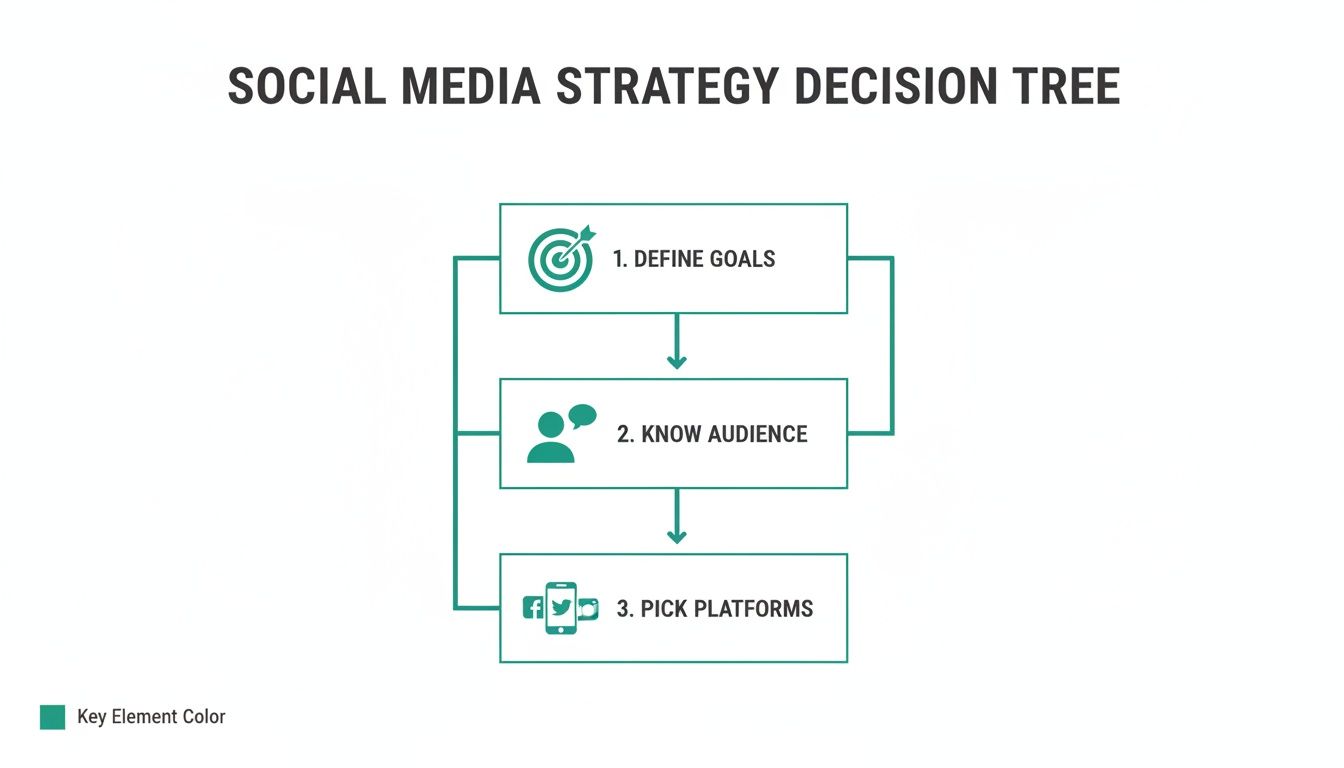
Before you ever think about where to post, you have to be crystal clear on why you're posting (your goals) and who you're trying to reach (your audience). Get that foundation right, and the rest falls into place.
A Breakdown of the Major Players
To pick your social media battleground, you need to know the terrain. Each major platform caters to different demographics and behaviors, offering unique advantages if you know how to play the game.
Which Social Media Platform Is Right for Your Business
To help you decide, let's break down the major players. This list gives a quick snapshot of where you might fit best, depending on who you're trying to reach and what you're trying to say.
Facebook
Facebook’s primary audience is Gen X and Millennials, making it ideal for broad, community-focused communication. It works best for sharing updates, curated articles, and engaging posts that help nurture long-term customer relationships, especially for local businesses.
Instagram
Instagram is dominated by Gen Z and Millennials who prefer visually engaging content. It’s best used for high-quality photos, Reels, Stories, and influencer collaborations to build a strong brand aesthetic and support lifestyle-driven marketing.
LinkedIn
LinkedIn targets professionals and B2B decision-makers, making it the go-to platform for industry insights, company news, and professional articles. Its main business use is B2B lead generation and positioning brands or individuals as thought leaders.
TikTok
TikTok attracts Gen Z and younger Millennials and thrives on short-form video, trends, and user-generated content. It’s best for driving viral brand awareness while showcasing personality, creativity, and authenticity.
X (Twitter)
X has a broad, news- and tech-savvy audience and is best for real-time updates, breaking news, and customer service interactions. Businesses use it to join trending conversations, manage public relations, and stay visible in fast-moving discussions.
Remember, this is a starting point. The best choice always comes back to where your specific audience spends their time. Don't just follow the crowd; follow your customer.
Why Instagram Is a Powerhouse for Growth
While every platform has its place, Instagram holds a special spot for any brand focused on visual storytelling and building a real community. It's a visual-first world, which gives you the power to craft a strong, curated brand identity through stunning photos, engaging Reels, and behind-the-scenes Stories.
Instagram's real magic is its ability to turn passive scrollers into an engaged community. It’s less about shouting a message and more about inviting followers into your world, creating a connection that feels personal and genuine.
This is a no-brainer for industries like fashion, travel, food, and fitness, where visuals are everything. But its versatile formats also make it a goldmine for service-based businesses, from real estate agents showing off properties to coaches building a personal brand. The whole platform is built to encourage interaction, making it fertile ground for organic growth.
The numbers don't lie. By February 2025, there were 5.24 billion active social media users across the globe. People are spending an average of 2 hours and 21 minutes a day scrolling through various platforms. With global ad spending on social projected to hit $276.7 billion in 2025, it's easy to see why 93% of marketers see these channels as essential.
For its part, Instagram boasts an ad reach of 1.74 billion and has blown past 3 billion monthly active users, making it a true titan. This environment of visual storytelling and authentic connection is exactly what a service like Gainsty is designed for—helping you tap into that potential with smart strategies that fuel real, organic growth. You can always explore more social media marketing statistics to dive deeper into these trends.
Mastering Organic Growth and Engagement

So you've picked your platforms and mapped out a strategy. Now for the million-dollar question: how do you actually grow your audience without just throwing money at ads? The answer is all about mastering organic growth—the art of building a genuine, loyal following from the ground up. This isn't about chasing quick wins or vanity metrics; it’s about creating real connections that stick around for the long haul.
Think of organic growth like tending a garden. You can't just demand a plant to grow overnight. You have to create the right environment—plenty of sunlight, water, and good soil—and then patiently nurture it. In the social media world, your "soil" is high-value content, and the "sunlight and water" are your authentic engagement and community interactions.
Creating Content People Actually Want to Share
The bedrock of any successful organic strategy is content so valuable that your audience feels compelled to interact with it. Instead of just shouting about your products, put yourself in their shoes. What do they really need? What makes them tick? Your goal should be to create content that is both "savable" and "shareable."
When someone saves your post, they're bookmarking it as something useful to come back to later. That's a huge compliment. And when they share it, they're essentially becoming a brand advocate, extending your reach to their own network for free. This happens when you shift from selling to serving—solving their problems, making them laugh, or teaching them something new.
A great content mix usually includes a few key pillars:
Educational Posts: Share practical tips, simple how-to guides, or industry insights that position you as an expert. For example, a real estate agent could create a Reel on "3 Red Flags to Spot During a Home Inspection."
Entertaining Content: Use humor, relatable memes, or behind-the-scenes moments to flash some personality and build a real human connection.
Inspirational Content: Post success stories, motivational quotes, or beautiful visuals that connect with your audience's goals and align with your brand's values.
This approach turns your feed into a destination people want to visit, not just an advertisement they want to scroll past.
The Two-Way Street of Community Interaction
Here's a hard truth: posting great content is only half the job. The other half is actively engaging with the very community you're trying to build. Social media is a conversation. If you’re only broadcasting your message without ever listening or replying, you’re completely missing the point.
True engagement is all about making your followers feel seen and heard. When you respond to comments, answer DMs, and jump into conversations in your niche, you start turning passive followers into a loyal community that trusts and supports your brand.
This kind of proactive engagement does more than just build goodwill. It signals to the platform's algorithm that your account is a lively hub of activity, which can help boost your visibility. But more importantly, it shows actual people that you care about them, not just their wallets.
How to Strategically Amplify Your Reach
Okay, so you're creating great content and engaging like a pro. But how do you get in front of new people? This is where tactics like hashtags and collaborations come in. Hashtags aren't just for decoration; they're powerful discovery tools that help categorize your content and put it in front of users who are actively searching for what you offer.
A smart hashtag strategy uses a mix of different types:
Broad, high-volume tags to get your content in front of a wide audience.
Niche-specific tags to connect with a highly relevant, targeted audience.
Branded tags to build a unique community and encourage user-generated content.
Collaborations are another massive amplifier. Influencer marketing, a cornerstone of social media, has ballooned into a $24 billion global market in 2024. In fact, as brands plan to spend more on influencers than traditional ads for the first time in 2025, the entire industry is shifting toward more authentic partnerships. This trend puts real, organic growth front and center, creating huge opportunities for small businesses and creators who use services like Gainsty to connect with genuine users.
While TikTok is currently a major player for brand-influencer collabs, Instagram remains an essential platform for powerful visual storytelling and building those authentic connections. You can dig into these powerful social media industry statistics to see exactly where the market is heading.
Ultimately, mastering organic growth comes down to a commitment to being real. When you consistently provide value, foster a genuine community, and use smart tools to connect with the right audience, you build a strong foundation for sustainable, long-term success.
Measuring the Metrics That Actually Matter
So, you're creating fantastic content and connecting with your community. That's a huge piece of the puzzle, but if you stop there, you're flying blind. The reality of social media marketing is simple: you can't improve what you don't measure. It’s easy to get buried in data, but the secret is focusing on the numbers that actually move the needle for your business, not just the ones that make you feel good.
Think of it like the dashboard in your car. You don’t need to be a mechanic to know that the speedometer and the fuel gauge are critical. They give you instant feedback on your speed and the amount of gas left in the tank. Social media metrics are your dashboard—they tell you if your strategy is on the right track or if it's time to pull over and make a change.
Separating Actionable Metrics from Vanity Metrics
One of the first traps people fall into is confusing vanity metrics with actionable metrics. Vanity metrics are those feel-good numbers that look impressive at a glance but don't really mean much for your bottom line. A huge follower count is the classic example—having 100,000 followers who don't engage or buy anything is worthless compared to 1,000 true fans who hang on your every word.
Actionable metrics, on the other hand, are the numbers that give you real, practical insights. They connect what you’re doing on social media directly to your business goals and help you make smarter decisions.
The goal isn't just to be popular; it's to be effective. Actionable metrics are your compass, guiding your strategy toward tangible outcomes like leads, sales, and brand loyalty, while vanity metrics can often point you in the wrong direction.
To make this crystal clear, let's break down the most important metrics into three categories that follow a natural customer journey.
Key Metrics to Track for Real Growth
Getting a handle on your analytics is a lot easier when you group them by what they tell you about your audience. Here's a simple way to look at it:
Awareness Metrics (How many people see you?):
Reach: This is the total number of unique users who saw your content. It’s a measure of how wide your net is being cast.
Impressions: This is the total number of times your content was displayed. If this number is much higher than your reach, it means people are seeing your posts multiple times, which can be a great thing.
Engagement Metrics (How are people interacting?):
Likes, Comments, and Shares: These are the bread and butter of engagement. They show your content is hitting the mark. A share is especially powerful—it’s a direct endorsement from a follower to their own network.
Engagement Rate: This is arguably the most telling metric. It’s calculated by dividing your total engagements (likes, comments, shares) by your reach or follower count. A high rate shows you have a genuinely interested and active audience.
Conversion Metrics (Are people taking action?):
Click-Through Rate (CTR): This shows the percentage of people who actually clicked the link in your post, story, or bio. It’s a vital sign for measuring how well you’re driving traffic off the platform.
Leads Generated: Did someone fill out a form, join your email list, or download a guide because of your post? That's a lead.
Sales: The ultimate goal. Can you trace a purchase directly back to a social media link or campaign?
Thankfully, you don't need to be a data scientist to find this stuff. Platforms like Instagram and Facebook have built-in analytics—often called "Insights"—that serve up all this data for you. By checking these numbers regularly, you'll quickly see what resonates and what falls flat, letting you double down on what works.
For an even deeper look, check out our full guide on how to measure social media success.
How Gainsty Accelerates Your Instagram Growth
Knowing the rules of organic growth is one thing, but actually putting in the hours to make it happen is a whole different ballgame. That’s where a service like Gainsty comes in, taking all that theory and turning it into a real, results-focused process for your Instagram.
The whole point is to build real, lasting growth—no bots, no fake followers, just genuine connections.
Think of Gainsty as having a smart assistant paired with a human expert. The system uses sophisticated AI to find potential followers who are actually interested in what you do, while a real person makes sure every single interaction feels human and authentic. It’s this combination that lets you target with incredible precision without losing that personal touch.
How The Process Works
Getting started is refreshingly simple. You just need to describe your ideal audience. This means providing a few key details like competitor accounts, specific locations you want to target, and the hashtags your community uses.
Once you’ve provided that info, the system gets to work, engaging with real users on your behalf.
Pinpoint Targeting: Whether you’re a real estate agent, a personal brand, or an e-commerce store, the system finds users who are most likely to follow you back and engage with your content.
Genuine Engagement: The service then interacts with these targeted accounts in a natural way, sparking their curiosity and bringing them back to check out your profile.
Safety First: Because authenticity is everything, the entire process is designed to be completely safe. There’s no risk to your account’s reputation.
The goal is simple: automate the repetitive, time-sucking work of finding new people. This frees you up to do what you do best—creating amazing content—while your audience of real, interested followers grows in the background.
At the end of the day, this method speeds up your growth by introducing you to the right people. It's built for anyone who gets that the real answer to what social media marketing isn't just a big follower number, but a genuinely engaged community.
Got Questions About Social Media Marketing? We’ve Got Answers.
As you start putting your social media plan into action, you're bound to run into some real-world questions. Let's tackle a few of the most common ones to clear things up so you can move forward with confidence.
How Often Should I Actually Be Posting?
This is the million-dollar question, isn't it? The truth is, there's no single magic number. Consistency always beats frequency. It’s far better to post high-quality content that your audience loves a few times a week than to spam their feeds daily with stuff that falls flat.
If you're looking for a starting point, here are some general guidelines the pros follow:
Instagram: Aim for 3-5 feed posts a week. For Stories, feel free to post multiple times a day—they're meant to be more casual and timely.
Facebook: 1-2 times a day usually works well.
X (Twitter): This one moves fast. 3-5 times a day is a good target.
LinkedIn: It’s a professional network, so 2-4 times a week is plenty.
Remember, these are just starting points. The best way to find your perfect rhythm is to experiment. Post at different frequencies, keep a close eye on your analytics, and see what your engagement rates tell you. Your audience will let you know what works.
What's the Real Difference Between Organic and Paid Social Media?
Getting this concept is central to understanding what social media marketing is all about. Think of organic and paid as two different tools in your toolkit. They work best together, but they do very different jobs.
Organic social media is all the free stuff you do—the posts you share, the Stories you create, the comments you reply to. The whole point here is to build a genuine community, strengthen relationships with your followers, and earn their trust over the long haul.
Paid social media, as the name suggests, is advertising. You're paying to push your content in front of a much larger, targeted audience that doesn't already follow you. It’s the perfect tool when you need to generate leads fast, launch a new product, or break into a new market.
Do I Really Need to Spend Money on Social Media?
Honestly, you can get pretty far with organic marketing if you're willing to put in the time and effort. But setting aside a budget—even a small one—unlocks a whole new level of growth.
Think of it like this: your organic content is the foundation for building long-term relationships. Your paid budget is the megaphone you use to shout about your most important messages. A little ad spend can put your best content in front of thousands of potential customers who would have never found you otherwise.
You don't need a huge budget to make an impact. Most successful brands use a mix of both, often putting a little money behind their top-performing organic posts to give them an extra boost. It’s one of the fastest ways to accelerate your growth.
Ready to stop guessing and start growing? Gainsty uses a unique blend of smart AI and human expertise to connect you with real, engaged followers on Instagram. Forget the bots and the grind—let us help you build an authentic community so you can focus on creating content you love. Start your organic growth journey today at https://www.gainsty.com.