The Problem With One-Size-Fits-All Advice
It’s tempting to grab onto those articles that promise a secret, perfect time slot that will make your posts go viral. But that approach is fundamentally flawed because it ignores the most important person in the equation: your follower.
Think about it. Are your followers night-owl gamers, early-morning fitness buffs, or 9-to-5 professionals on their lunch break? Posting at a “globally best” time is pointless if your community is fast asleep or stuck in a meeting. Relying on generic data can send you chasing engagement that just isn't there for your account.
Moving From Guesswork to a Data-Driven Strategy
The conversation around optimal posting times has definitely shifted over the years. We've moved away from the old wisdom that weekends were prime real estate. Now, consistent research shows that weekdays generally pull in more engagement.
Most data points to Tuesdays through Thursdays as the sweet spot, with peak activity often falling somewhere between 11 a.m. and 6 p.m. in local time zones. This makes sense—it’s when people are taking breaks, commuting, or winding down from their workday.
While these benchmarks are a decent place to start, this guide will show you how to go deeper. We’re going to stop guessing and start using your Instagram Insights. It's a free, powerful tool that gives you a personalized roadmap showing exactly when your followers are online and ready to engage.
Key Takeaway: Your account's data is the only source of truth. Generic "best times" are a starting point, not the finish line. Real growth comes from understanding your community's unique behavior.
To really dig into why a universal best time is a myth, you can learn more about finding the best time to post on social media for maximum engagement.
By making analytics your best friend, you can craft a posting schedule that works for your brand, not for some hypothetical global audience. This is how you unlock sustainable organic growth and build a genuinely connected community.
General Instagram Posting Benchmarks
Before you dive into your analytics, it can be helpful to have a general idea of what “peak times” look like for most accounts. Think of this table as a starting point—a set of hypotheses you can test against your data.
On Monday, the best time to post is between 11 AM and 2 PM because users are easing back into their routine and often scroll during lunch breaks.
On Tuesday, posting between 10 AM and 3 PM works best since engagement is usually at its highest, and users check social media consistently throughout the workday.
On Wednesday, the ideal posting window is 10 AM to 1 PM, when mid-week fatigue leads people to take short breaks and browse for inspiration or distraction.
On Thursday, posting between 11 AM and 2 PM performs well as users start planning for the weekend and are more open to discovering new content.
On Friday, the best time is 10 AM to 12 PM because engagement drops significantly after lunch when people mentally check out for the weekend.
On Saturday, posting between 9 AM and 11 AM is most effective since users are active early before getting into weekend plans.
On Sunday, the strongest engagement happens between 7 PM and 9 PM, when people are relaxing at home and scrolling before the new week begins.
Again, use these as a guide, not a rulebook. The real answers are waiting for you inside your Instagram Insights, which we'll explore next.
Tapping Into Your Goldmine: Let Instagram Insights Be Your Guide
If you're still relying on generic “best time to post” articles, it's time to stop. The real answers aren't in some industry-wide report; they're sitting right inside your account. Your most valuable tool is Instagram Insights, the free analytics suite available on all Creator and Business accounts. This isn't about guesswork—it's about using concrete data from your actual followers.

Think of this data as your personal goldmine. It shows you the real-time, daily digital habits of the community you’ve already built. It’s not theoretical; it’s a direct window into when your audience is ready and waiting for your content.
Getting to Your Audience Data
Thankfully, Instagram makes this information pretty easy to find. The interface is designed to give you a quick, powerful snapshot of who your audience is and when they're paying attention.
Here’s the path to get there:
Head to your Instagram profile and tap the Professional Dashboard link right under your bio.
You'll see a section called “Account Insights.” Go ahead and tap See All.
From there, select Total Followers to get into your audience demographics and analytics.
Scroll all the way down to the bottom, and you'll find the Most Active Times section.
This is where the magic happens. You'll see your audience activity broken down by hours and days. The “Hours” view is what we're interested in—it's a bar chart showing when your followers were online for each day of the week. A taller bar means more of your audience was active at that time. Simple as that.
Pro Tip: Don't just look at one week and call it a day. A single holiday, a major news story, or a random viral trend can throw off user behavior for a few days. I always recommend checking your Insights weekly but looking for consistent patterns over at least a month before you lock in a new schedule.
How to Actually Read the Activity Chart
That set of blue bars might seem basic, but it’s the blueprint for your entire posting schedule. Your job is to play detective and find the patterns. First, look for the days with the highest activity overall, then zoom in on the specific hours when those bars are at their tallest.
Let's say you notice that on Wednesdays, the bars start creeping up around 9 AM, hit their peak between 12 PM and 3 PM, and then slowly trail off. Boom. That three-hour window is your Wednesday sweet spot. It’s your prime-time slot when the biggest chunk of your audience is scrolling, and your content has the best chance of making an impact.
Here's how I break it down:
Spot the Peaks: Look for the 2-3 hour blocks where the bars are highest on your busiest days. These are your non-negotiable posting times for your most important content.
Note the Shoulders: The hours right before and after the peak are valuable, too. I call these “shoulder hours.” They're perfect for posting Reels or Stories to warm up the algorithm and build momentum.
Identify the Valleys: The low points, usually in the middle of the night, are just as important. They tell you exactly when not to post.
By translating these visual cues into a concrete schedule, you're no longer just throwing content at the wall and hoping it sticks. If you want to go even deeper into all the data available, our complete guide on how Instagram Insights are explained is a great next step. This data-first strategy ensures your hard work gets seen by the people who matter most: your followers.
Thinking Globally: Time Zones and Content Types
Your Instagram Insights chart is a fantastic starting point, but it has one major limitation: it tells a story based on your local time. That’s perfectly fine if your audience is just down the street, but what happens when you have followers scattered across the country—or even the globe?
Posting at 2 PM your time might hit the sweet spot for locals, but it’s the middle of the night for a huge chunk of your audience. Ignoring this is one of the biggest missed opportunities I see.
To check if this applies to you, pop back into your Instagram Insights. Navigate to Total Followers and scroll down to Top Locations. This gives you a clear breakdown of your audience by both cities and countries.
If you spot a significant percentage of followers—say, 20-30% or more—in a time zone that's three or more hours off from yours, it's time to adjust your strategy. You can't just post at one “best time” anymore.
Matching Your Content to Your Audience's Mindset
The next layer of a truly effective posting strategy is realizing that not all content is created equal. People interact with different formats at different times of the day, depending on what they're doing and their frame of mind. The question isn't just when to post, but what to post when.
Think about these common scenarios:
Quick-Hit Reels: Fun, snappy Reels often do best during morning commutes or late-night scrolling sessions. This is when people are looking for light, passive entertainment.
Educational Carousels: Detailed, save-worthy carousels are a different beast entirely. They demand more focus, making them perfect for midday work breaks or quieter moments when your audience has the mental space to read and absorb the information.
Live Streams & Q&As: You want active participation here, so schedule these for evenings or weekends when your community is more likely to have the free time to tune in and engage.
A Reel posted at 8 PM might capture the "couch and scroll" crowd perfectly. But an in-depth carousel on the same topic could completely flop at that time. Post that same carousel at 12 PM, though, and you’ll catch people on their lunch break who are actively looking for valuable content to save for later.
Catering to Different Time Zones
Regional habits also play a huge role here. What works in North America might not fly in Europe. For instance, North American audiences often show the highest engagement between 6 AM and 9 AM as people check their phones over breakfast or on the way to work. In Europe, however, the lunch hour rush tends to deliver the strongest results. If you want to dive deeper, you can explore how posting times vary by region.
So, how do you actually serve multiple time zones without burning yourself out? It's easier than it sounds.
Identify Your Two Primary Peaks: First, pinpoint the peak active hours for your top two audience locations.
Alternate Your Prime Content: Don't waste your best content by posting at the same time every day. Instead, alternate. Post for your primary time zone's peak on Monday, then post for your secondary time zone's peak on Tuesday.
Use Stories for the Gaps: Stories are your secret weapon for engaging audiences in those off-peak hours. They keep your account active around the clock without cluttering your main feed.
Testing Your Posting Times Like a Pro
Your Instagram Insights data is a fantastic starting point. It gives you a solid hypothesis about when your audience is online, but that’s all it is—a hypothesis. To turn that educated guess into a rock-solid strategy, you need to start testing.
The secret to effective testing is keeping it simple: isolate one variable at a time. If you post a Reel at 9 AM on Tuesday and then a carousel at 2 PM on Friday, you've changed the day, the time, and the content format. You’ll have no idea what actually made the difference in performance. Clean, simple experiments are how you get clear, actionable answers.
A/B Testing Your Time Slots
The most straightforward test to run first is pitting two different hours against each other on the same day. Let’s imagine your insights point to Tuesday mornings as a high-activity window. Great, now you have a theory to test.
Here’s how you could set it up:
Week 1: Post a carousel with industry tips on Tuesday at 9 AM.
Week 2: Post another carousel with similar tips on Tuesday at 1 PM.
The key here is that the content is comparable in style and value. This way, the main variable you’re truly testing is the time slot. After each post has been live for at least 24-48 hours, check the metrics. Did the 1 PM post get noticeably more reach or saves? If so, you've found evidence that your audience is more active in the early afternoon.
A single test isn't gospel. I always recommend repeating an experiment like this for a few weeks to confirm you've found a genuine pattern, not just a one-off fluke. Consistency turns a lucky guess into a data-backed decision.
A/B Testing Your Days of the Week
Once you've narrowed down your best time of day, you can apply the same logic to find your best day of the week. Maybe your data suggests both Tuesday and Thursday afternoons are strong contenders, but you want to find the absolute sweet spot.
Using your newly confirmed optimal time, you can design another simple experiment:
This Week: Post a high-energy Reel on Tuesday at 1 PM.
Next Week: Post a comparable Reel on Thursday at 1 PM.
By holding the time and content format steady, you can get a clean comparison between Tuesday and Thursday. You might discover that while both days perform well, your Thursday posts consistently generate 15% more shares. That’s a huge insight, telling you exactly where to schedule your most important content for maximum impact.
This process of analyzing, segmenting, and scheduling is especially critical if you have a global audience spread across different time zones.
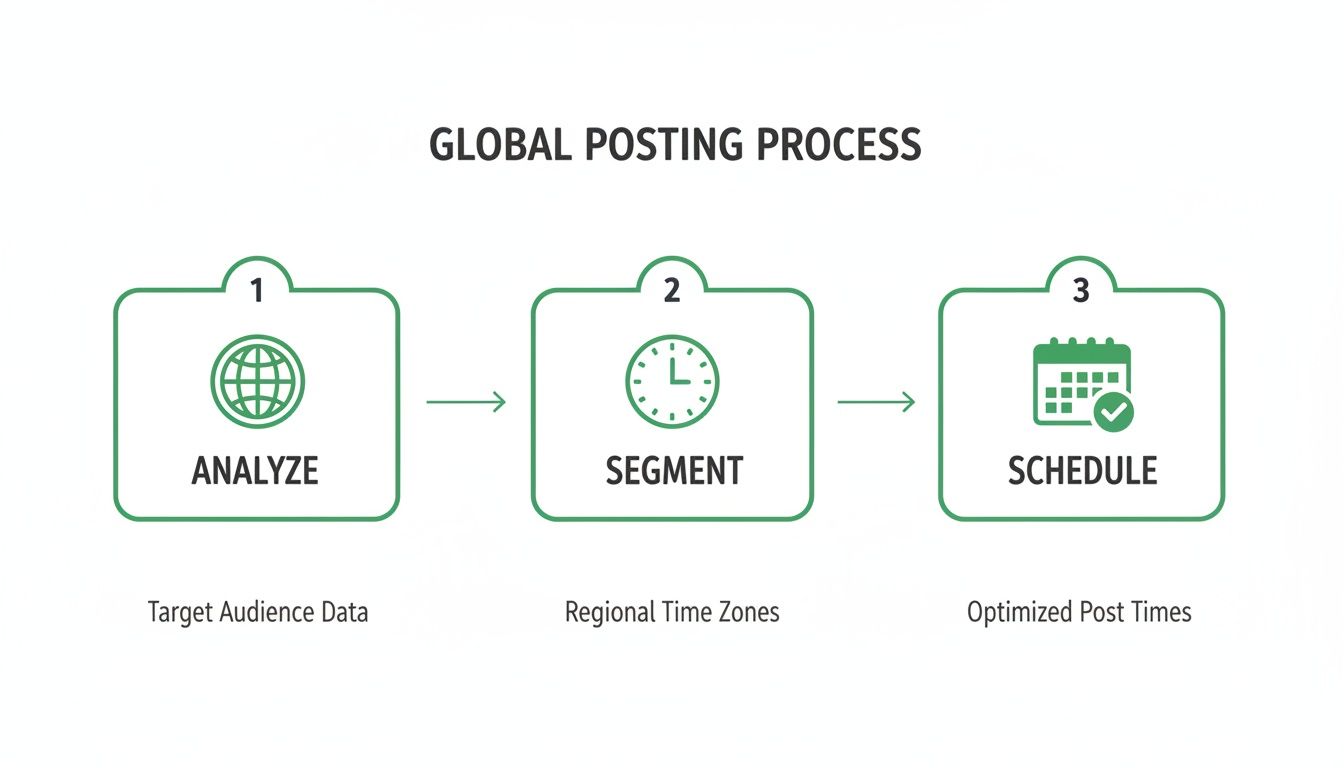
This workflow helps make sure your testing strategy isn't just based on one segment of your audience, which leads to much more reliable results.
Tracking What Matters Most
To figure out if your tests are working, you need to track the right numbers. Don't just get hung up on the like count; different metrics tell you different things about how your audience is reacting.
I highly recommend creating a simple spreadsheet to log the key performance indicators (KPIs) for each post you're testing. At a minimum, track these:
Reach: How many unique people actually saw your post?
Likes: A quick measure of initial appeal.
Comments: Shows people are engaged enough to have a conversation.
Saves: A gold-star metric that tells you the content is valuable.
Shares: The ultimate signal that your content truly resonates.
Over time, this log becomes your personal playbook. It’s what moves you from making assumptions to making confident, strategic decisions based on your audience’s behavior. If you want to go deeper, our guide to key Instagram performance metrics breaks down exactly what these numbers mean for your growth.
Building and Automating Your Content Calendar
All that digging through data and running tests has brought you here. Now it’s time to put it all together into a system that works for you—a consistent, repeatable content calendar that fuels your growth without burning you out. The goal is to stop posting on the fly and start being strategic.
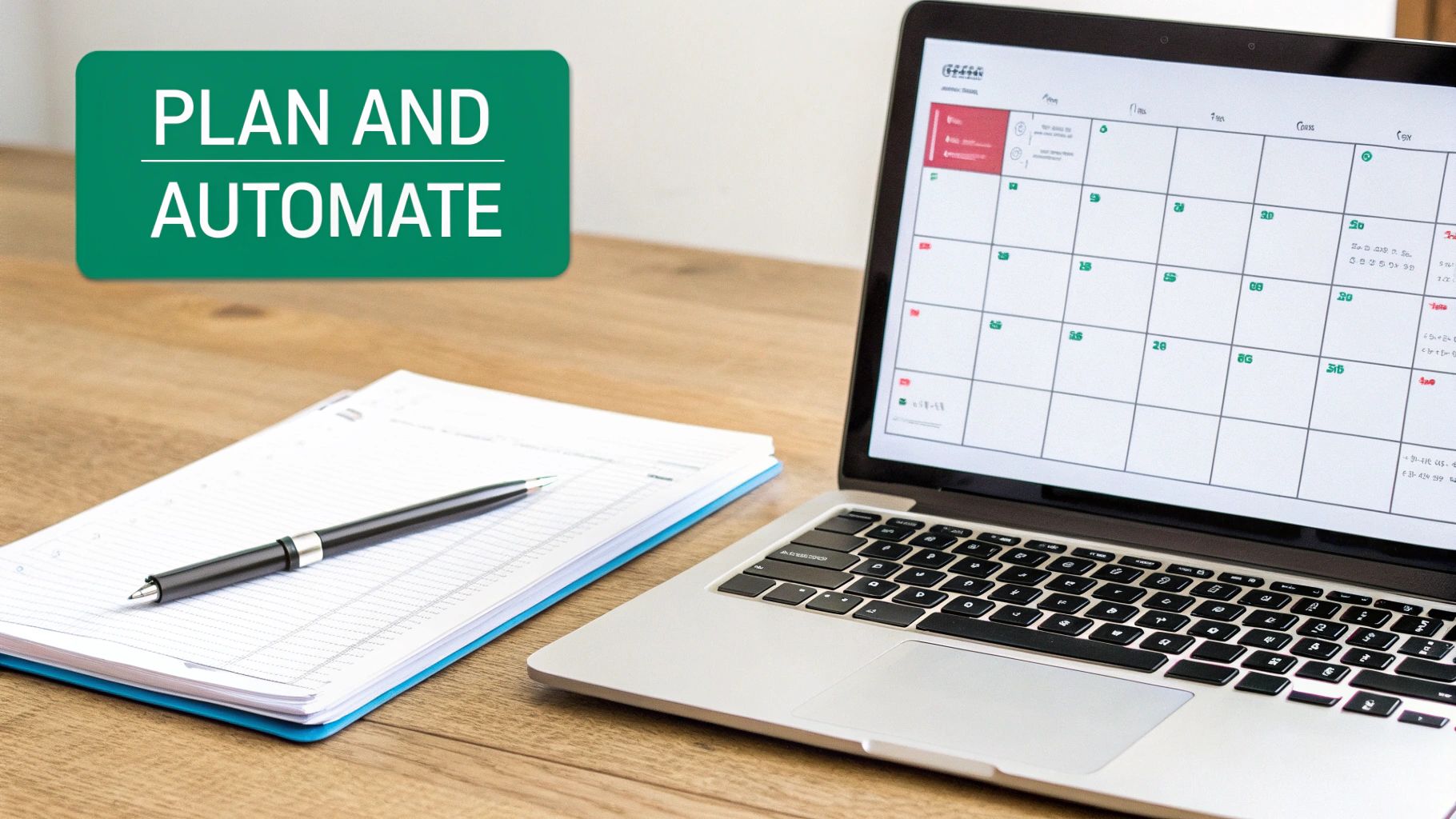
Think of this calendar as your roadmap. It's what ensures you're showing up in those optimal time slots every single time, which is a huge signal to the Instagram algorithm that your account is active and reliable. Consistency is what builds momentum.
Translating Data into a Weekly Schedule
So, what does this actually look like in practice? It’s completely different for every account because it's built around your specific audience. Let's walk through a few real-world scenarios.
A generic schedule is useless, but seeing how different niches might structure their week based on their audience's behavior can really help clarify things.
A Fitness Influencer: Their audience is often scrolling first thing in the morning (6-8 AM) before work or looking for inspiration in the evening (7-9 PM). Their schedule might front-load motivational Reels in the morning and save longer tutorial carousels for the evening wind-down.
A Local Coffee Shop: Their peak times are probably tied to the morning caffeine rush (8-10 AM) and the mid-afternoon slump (2-4 PM). They could share a friendly “good morning” post with user-generated content and then drop a Reel of a new drink special right when people are starting to fade.
A B2B Brand: Their audience is tuned in during business hours. Lunch breaks (12-2 PM) on weekdays are gold. This is the perfect time to share an insightful carousel, a client case study, or a quick take on industry news.
These examples show that knowing when to post to Instagram is really about getting in sync with your audience's daily rhythm. If you need a great starting point for organizing your thoughts, check out this Instagram content calendar template.
Key Insight: A content calendar isn’t about just filling slots. It’s a strategic document that matches your best content with your audience's peak attention windows.
The table below offers a few more examples of how different businesses might map out their posting times.
Sample Posting Schedules by Niche
For a fashion e-commerce business, the peak day is usually Saturday, with the best posting window between 11 AM and 1 PM, when shoppers are actively browsing. Content like a “new arrivals” Reel or carousel performs well as weekend shopping begins.
For a restaurant or foodie blog, Friday is often the strongest day, especially between 5 PM and 7 PM, when people are deciding what to eat. Posting a mouth-watering video of a featured dish can strongly influence dinner plans.
For a tech startup or SaaS brand, Tuesday tends to be the peak day, with optimal posting between 10 AM and 12 PM. Educational carousel posts explaining a key product feature work well during this focused, workday mindset.
For an artist or creator, Sunday evening is ideal, particularly from 7 PM to 9 PM, when audiences are relaxed and attentive. Behind-the-scenes content, time-lapse videos, or previews of new projects resonate especially well at this time. These are just thought-starters, but they illustrate how you can tailor your timing to capture your audience when they're most receptive.
The Power of Automation and Scheduling
Let's be real: trying to manually post every single piece of content at the exact right minute is a recipe for disaster. You'll get busy, you'll forget, and your consistency will fall apart. This is where automation becomes your secret weapon.
Using a scheduling tool isn't a “nice-to-have”; it's essential for any brand or creator who is serious about growth.
Scheduling gives you your time back. You can sit down and batch-create all your content for the week or even the month, load it into a scheduler, and walk away. This guarantees you never miss an optimal posting window again, period.
The shift is huge. Instead of constantly worrying about the logistics of posting, you can pour all that energy back into what really moves the needle: creating amazing content and actually engaging with the comments and DMs that start rolling in.
Common Questions About Instagram Posting Times
Alright, so you’ve got the data and a plan. But as you start putting it all into practice, you’ll inevitably run into some specific questions. That’s totally normal. Moving from theory to the real world is where the best learning happens, and a few expert pointers can make all the difference.
Let's dig into some of the most common questions that pop up once you start getting your hands dirty with analytics and testing.
How Often Should I Actually Be Posting?
This is the million-dollar question, isn't it? But here’s the truth: there's no magic number. The real goal is sustainable consistency, not a frantic sprint to burnout. Posting three times a day is completely pointless if the quality stinks and you give up after a week.
My advice? Start by pinpointing your absolute best time slots from your tests and insights. Then, commit to posting fantastic content in just those windows, even if that only means 3-4 times per week. Once you have that down to a science, you can start layering in more posts during your “shoulder hours”—those secondary peak times you identified.
The Instagram algorithm rewards consistency. It’s far better to post three amazing pieces of content a week, every single week, than to post seven times one week and then completely ghost your audience the next.
What if I Have a Small or Brand-New Account?
If you're just starting with fewer than 100 followers, you won't see the “Most Active Times” data in your Insights yet. Don't sweat it—everyone starts here. For now, you can lean on those general industry benchmarks we talked about earlier.
Think of these as your starting hypothesis for testing:
Midday Weekdays: Try posting between 10 AM and 2 PM on a Tuesday, Wednesday, or Thursday.
Weekend Mornings: Experiment with a post around 9 AM or 10 AM on a Saturday to see what happens.
The moment you hit that 100-follower milestone, your data becomes your new North Star. The whole point is to start gathering that initial feedback so you can pivot to a truly personalized strategy as soon as possible.
Does How Often I Post Really Affect My Engagement?
It absolutely does, but maybe not in the way you think. Simply posting more doesn't automatically get you more engagement. In fact, if you post too much low-quality content, you can cause “audience fatigue,” where your followers just start scrolling right past you.
The key is to connect your posting frequency directly to the value you provide. Every single post should have a purpose and should go live when your audience is actually there to see it. If you have five incredibly valuable things to share in a week and you schedule each one during a peak window, your engagement will probably climb. But if you just toss out five low-effort posts to hit a quota, you'll likely see your numbers dip. It's all about quality over quantity, placed in the right time slots.
To really change your entire approach, it helps to understand the broader social media marketing best practices that successful accounts rely on.
Should I Post Reels and Photos at Different Times?
Yes, you often should! It all comes down to your audience's mindset at different times of the day. A quick, funny Reel might do incredibly well at 8 PM when people are unwinding on the couch. That same person might be much more receptive to a detailed, educational carousel post during their lunch break at 1 PM.
Don't just assume one time slot fits all your content. This is a perfect thing to experiment with during your testing phase. Try posting your Reels during typical entertainment hours (early mornings, evenings) and save your more in-depth content for the more focused parts of the day (like midday). This kind of nuanced approach shows you don't just know when your audience is online, but you also understand why they're there.
Ready to stop guessing and start growing? Gainsty uses advanced AI and expert insights to build a growth strategy that attracts real, engaged followers. Forget bots and fake accounts—we focus on organic growth that delivers measurable results. Get your personalized growth plan today!