Where AI Fits in Social Media Growth
71% of surveyed social media marketers reported using AI tools in 2024, according to HubSpot's Social Trends Report. AI assistance is already part of the work, not just an experiment for unusually technical teams.
The potential audience is enormous. Early in 2025, social media had 5.24 billion active user identities, representing roughly 63.9% of the world's population, while the typical internet user spent 2 hours and 21 minutes daily on social platforms (DataReportal's global overview). These are identities, not unique people, because someone can operate multiple accounts.
Assistance, not an autopilot
AI social media growth means using machine learning and generative tools to help identify relevant audiences, develop content, test variations, select posting windows, and interpret responses. For a small business, that might mean sorting customer questions into useful themes rather than reading every comment from scratch.
Think of AI as a pit crew. You still choose the destination and steer the car; the crew makes preparation and adjustments faster. It can't compensate for content that gives the intended audience little reason to care.
Practical rule: Use AI to reduce the work around a useful idea, not to disguise the absence of one.
Keep reach separate from growth. Reach tells you that people encountered a post; durable growth involves relevant followers who return, save something useful, visit your profile, or act on your offer.
The important decisions are which tasks to delegate, which audience responses to optimize, and what evidence you'll require before expanding automation.
AI Growth Tasks at a Glance
AI growth tasks: role, human ownership and risk
For audience clustering, AI can group followers and similar accounts by interests and engagement. A person still needs to decide which segment to serve and why; otherwise, the team could target the wrong niche at scale. For idea generation, AI can surface themes from comments, search queries, and trends, but a person should choose topics grounded in real expertise rather than copying competitors.
AI can generate cover, carousel, and hook variants for visual and format testing. Keep the final brand appearance and taste check human to avoid synthetic, repetitive visuals. For caption drafting, let AI prepare first drafts, alternative hooks, and length variations while a person checks personal stories, claims, and brand voice. Fully automated captions can sound flat and weaken trust.
For posting-time selection, AI can estimate active windows from past activity, but a person should account for launches, events, and news that make a different moment more useful. For comment analysis, AI can sort responses into themes and sentiment; leave sensitive or personal messages to someone who can respond with care.
AI can flag changes associated with saves or profile visits for performance diagnosis, but a person must interpret what changed and why rather than chase short-lived spikes. For DM and reply automation, use AI to draft routine replies and FAQ answers. Keep complaints, collaborations, and sensitive conversations human-led so bot-like responses do not prompt unfollows.
The efficiency case is understandable: 38% of surveyed marketing, public relations, sales, and customer-service professionals identified increased efficiency as a leading benefit of generative AI for social media marketing in May 2024 (Statista's survey summary). But efficiency describes how work gets done, not whether the resulting interaction is appropriate.
AI is strongest where the work involves volume and pattern recognition. Humans should own meaning, relationships, and decisions where the wrong tone costs trust.
Read the risk column first
A caption draft is reversible before publication. An insensitive message sent directly to a disappointed customer isn't.
That difference should determine the approval process. Let an assistant group repeated questions about opening hours, for example, while a person answers a customer describing an upsetting experience.
Also separate drafting from sending. You can gain useful assistance without authorizing a system to publish or message autonomously.
Before adopting another task, ask:
Would the audience notice? Consider whether a human contribution is central to the value of the interaction.
Is the moment personal or sensitive? If it involves distress, conflict, identity, or a relationship, keep a person responsible.
Can we evaluate the result? Define an observable outcome and a review window before adding more software.
The safest starting point isn't necessarily the task that takes longest. It's the task whose errors you can catch before they reach someone else.
How Instagram Ranks Posts and What AI Should Optimize
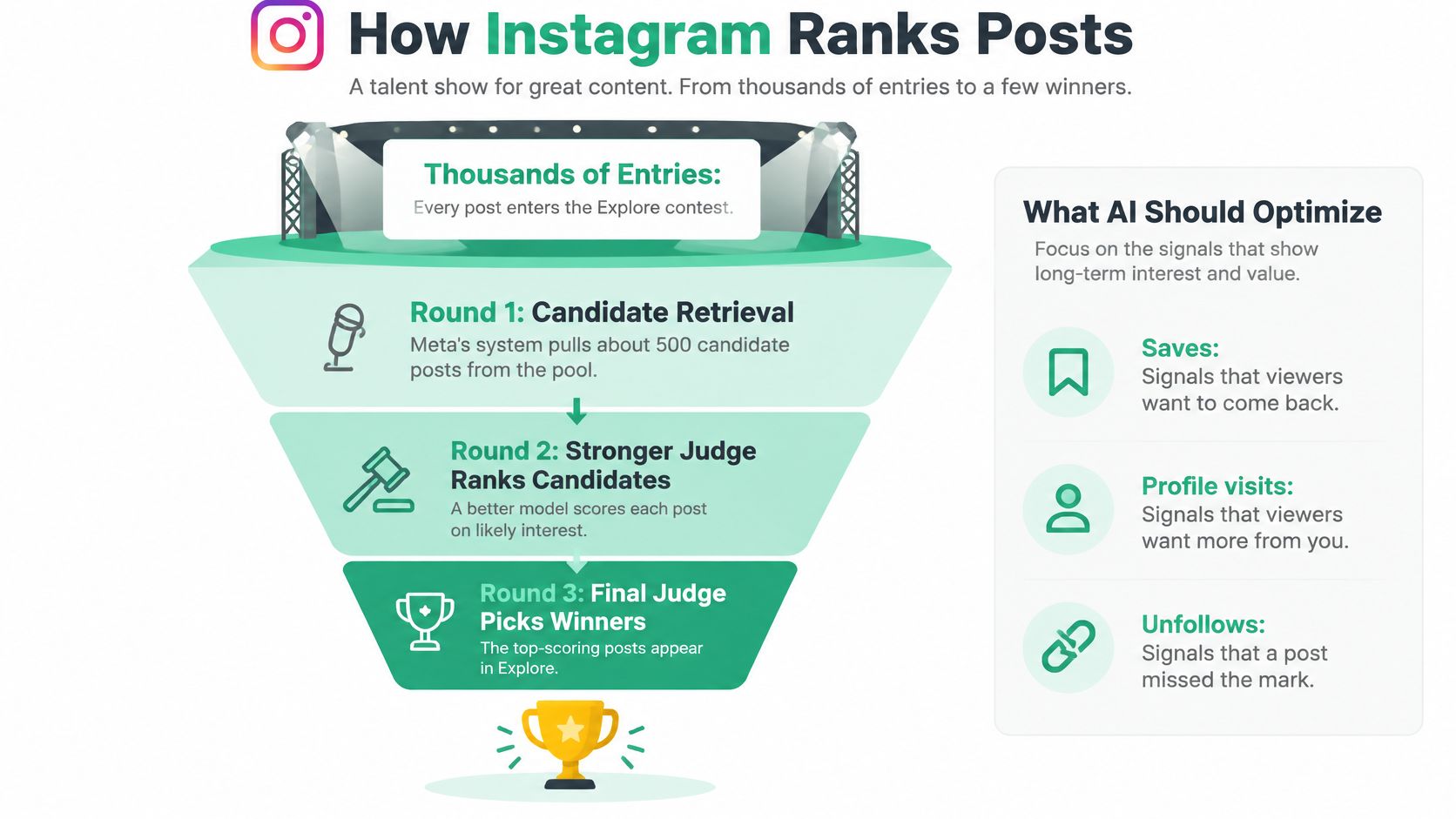
Instagram Explore is easier to understand as a talent show than as a single mysterious algorithm. Posts enter a candidate pool, and successive judges narrow the field while spending more attention on the remaining contenders.
Meta's explanation of its Explore recommender describes retrieval of approximately 500 candidate items, followed by models that narrow the selection to 150, then 50, and finally 25 items for the first Explore page. Its value model combines predicted actions, including likes, saves, and negative actions, using different weights.
The funnel below illustrates the selection process.
Optimize usefulness, not just applause
The important lesson is that engagement isn't one interchangeable signal. A like and a save represent different predicted actions, so optimizing exclusively for likes gives you an incomplete objective.
For your own content decisions, connect each desired response to a reason someone might take it:
Saves: Offer something reusable, such as a checklist, reference guide, or recipe.
Meaningful interactions: Ask a question that invites a specific experience rather than a reflexive reaction.
Profile visits: Make the connection between the post and your broader expertise clear.
Low negative feedback: Avoid misleading hooks, irrelevant repetition, and promises the post doesn't fulfill.
For example, a cooking carousel with a practical substitution guide gives someone a reason to return. A generic reaction-bait post might attract likes without demonstrating why the account deserves an ongoing place in their feed.
These are creative hypotheses, not guaranteed outcomes.
Give AI a narrow analytical job
AI can represent posts and accounts by topic, group similar interests, and suggest variants aligned with the responses you want. In plain language, it helps sort related material into useful piles and propose what to try next.
Don't confuse that assistance with access to Instagram's internal scoring. Meta's exact weights are proprietary, and profile visits are useful account-level outcomes, not a confirmed ranking weight in the description above.
Start your comparison with saves per post and profile visits per post, while recording reach alongside them. When exposure differs, compare rates as well as totals so that a more widely distributed post doesn't automatically appear more useful.
Personalizing Audiences and Content Variants
Personalization isn't writing a stranger's name into a message. For content planning, it means distinguishing who you're trying to help, which version best serves them, and when publishing makes sense.
Consider a hypothetical home-cooking account. Its audience might include people seeking easy weekday dinners, bakers interested in technique, and meal preppers collecting ideas for later.
Start with needs you can recognize
Use available engagement patterns and voluntarily shared questions to form tentative groups. The social media audience analysis guide can help you organize that work before asking AI to generate variations.
For the cooking account, weeknight cooks might need less effort after work, so a dinner post could open with a hook about simple preparation. Bakers may want to understand technique; a close-up crumb photograph paired with an explanation could serve them better. Meal preppers need food they can make ahead, making a batch-preparation carousel with storage guidance a useful option.
These are planning hypotheses, not permanent labels for individual followers. Someone can enjoy baking and still need an uncomplicated dinner.
Give AI the actual recipe, tested instructions, audience need, and voice examples. Ask it to vary the opening or presentation while keeping the underlying facts unchanged.
Change presentation without changing personality
Start with a small set of alternatives. If you're comparing a visual concept, keep the caption and posting conditions comparable; if you're comparing the hook, don't simultaneously replace the format.
Keep the same degree of warmth, specificity, and honesty across every version. An account shouldn't sound like an experienced home cook in one post and an anonymous advertising department in the next.
Personalize the doorway into the idea, not the truth of the idea itself.
Organic publishing also has limits. You can design for a segment, but you don't control exactly which individual Instagram will show a post to.
Use these guardrails:
Respect privacy: Prefer permitted public engagement signals and aggregated insights over private information or inferred sensitive traits.
Get permission: Use consent for personalized direct messages and check the applicable platform rules before sending them.
Avoid over-fragmentation: If a small audience produces little response to each version, keep the stronger general-purpose post.
Preserve evidence: Don't change product capabilities, recipe instructions, or expertise claims to make a variant more appealing.
Personalize when a recognizable audience need produces enough response to evaluate. Otherwise, one clear, useful version is a better starting point than a collection of barely distinguishable posts.
Testing AI Content and Measuring Real Growth
A 2025 field experiment comparing 12 human-created and 12 AI-generated culinary Instagram posts on an account with 770 followers found broadly comparable performance. Human-created posts produced more comments and hashtag impressions, while AI-generated posts produced more profile visits and non-follower reach; survey respondents identified visuals as the main engagement driver at 64%, informational value at 26%, and captions at 10% (the culinary Instagram experiment).
That's a useful reason to test visual ideation, presentation, and caption assistance. It isn't evidence that AI will outperform your own work across niches or account sizes.
Count verification as part of the work
Expectations are high: 97% of surveyed U.S. and U.K. business leaders said AI and machine-learning tools would help companies analyze social media data more efficiently in 2023 (The Harris Poll research for Sprout Social).
The operational picture is less comfortable. Reporting on Hootsuite research found that 81% of senior marketing leaders said budgets were wasted on tools that weren't fit for purpose, managers spent up to three working days weekly checking AI content and collecting insights, and 64% of leaders versus 39% of managers believed their tools delivered real-time insights (TechRadar's coverage of the research).
Track review time, corrections, and data collection alongside content production. A faster draft isn't a net saving if someone spends longer repairing it.
Build a comparison you can interpret
Consider a hypothetical bakery run by two people. A useful initial test could compare human-led and AI-assisted presentations of the same recipe over a fortnight.
Keep the recipe, offer, format, and posting windows comparable. Change only the selected variable, such as whether AI helps draft the opening caption, and record paid boosts, collaborations, holidays, or unusual events that could explain a change.
Use complementary methods rather than relying on a before-and-after follower screenshot:
Holdout posts. Keep some comparable posts free of AI assistance. These provide a reference for what happens without the new workflow.
Cohort tracking. Group new followers by acquisition period and review their observable engagement later. Use only information the platform and your permitted analytics make available.
Follower-quality audits. Look for relevant interests and continued interaction, without treating private accounts or quiet followers as automatically fake.
Assisted-versus-human comparisons. Compare several matched posts before deciding whether to retain the change.
Organic tests aren't perfectly randomized experiments. You can't guarantee identical exposure, so treat the results as directional evidence and repeat promising comparisons.
Use the social media analytics software guide to evaluate reporting options, but prioritize definitions, export access, and data freshness over dashboard appearance. Record when the underlying data was last updated.
Measure the path from discovery to action
Growth metrics that separate real results from vanity
Saves per post can indicate lasting usefulness when they improve across repeated comparisons, but an isolated viral spike tells you less. Profile visits per post show interest in learning more; check whether visits remain proportionate to reach and lead to follows or actions rather than ending at the profile. Non-follower reach measures discovery beyond your existing audience. Look for stronger discovery on assisted posts, and do not mistake exposure among current followers for new discovery.
Meaningful comments, such as specific questions, stories, and replies, offer better evidence of conversation and trust than emoji-only or bot-like responses. New-follower activity after 30 days helps you see whether acquired followers remain involved; raw follower totals cannot answer that question.
Unfollows after a post can signal fatigue or audience mismatch, so watch for stable or lower departures instead of focusing only on net follower growth. Finally, qualified actions connect content to business relevance through attributable inquiries, signups, or bookings. Likes alone do not establish that connection.
These metrics are evidence, not proof of causation individually. Define a qualified inquiry before counting it, and use campaign-tagged links or distinct codes where appropriate to connect content with actions.
For profitability, compare attributable business value with subscription costs, production, human review, and outreach time. Don't count every sale during the test as AI-generated revenue.
A customer perspective illustrates the distinction without establishing a universal result. Johannes B. wrote in Gainsty reviews:
"Growth is a bit slow compared to running ads, honestly, but the follower quality is high. People actually engage and book calls, and retention is solid over several months."
Treat authenticity as something to check
The trust risk deserves its own review. 39% of marketers reported difficulty balancing AI with human intelligence, while a separate 2025 consumer survey found 46% would view companies more negatively if they used AI-generated content (Brandwatch's marketer report).
There's no fixed percentage of AI assistance that's too much. Warning signs include repeated voice corrections, fewer substantive conversations, more audience complaints, or rising departures after assisted posts, though none alone identifies the cause.
Use these safeguards:
Disclose material assistance: Follow applicable requirements and make AI involvement clear when omitting it could mislead people.
Review facts and claims: Verify instructions, expertise statements, product details, and implied promises before publication.
Check originality: Compare drafts with past posts and remove invented personal experiences or recycled phrasing.
Monitor audience response: Investigate changes in unfollows and conversation quality rather than explaining them away.
Fewer, better-targeted posts may be the stronger choice when review capacity is limited. Publish only what your team can responsibly check.
A 90-Day Implementation Roadmap
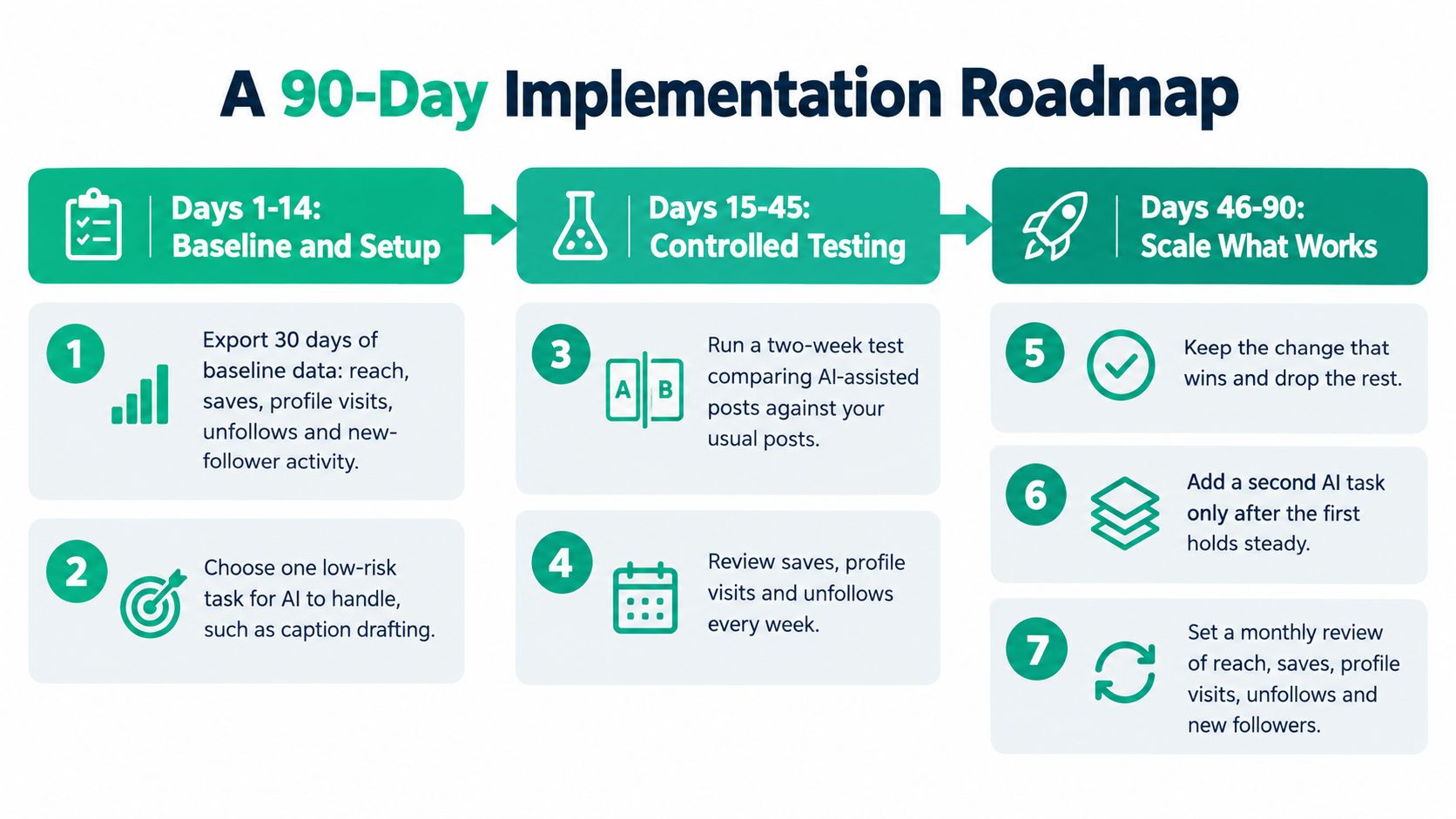
Treat this as a proposed operating schedule, not a prediction about when growth will arrive. Move forward when your records support the decision, and extend a phase when the evidence remains unclear.
The timeline summarizes the progression from setup to selective expansion.
Days 1–14
Export a baseline. Gather the previous month's available reach, saves, profile visits, unfollows, and follower activity. Note missing fields rather than filling gaps with estimates.
Choose a low-risk task. Select caption alternatives or comment-theme sorting before attempting autonomous audience conversations.
Write approval rules. Specify disclosure wording, the fact-checking checklist, and who signs off. Before testing any DM or reply automation, confirm compliance with Instagram's current terms and applicable limits; remove the task if you can't establish that.
Days 15–45
Run a controlled comparison. Use a fortnight-long initial test and change only the chosen variable. Give each post the same observation window before comparing it.
Log the decision. Record the outcome, review effort, possible confounders, and whether you'll keep, revise, or repeat the test. An inconclusive result belongs in the log too.
Add limited audience variations. Choose the strongest topics from your own results and test modest creative differences. Use the Instagram content calendar template to keep versions, approvals, and publication dates organized.
Days 46–75
Retain an unassisted comparison group. Keep some posts human-led so you don't lose your reference point while expanding the workflow.
Revisit follower cohorts. Schedule checks around a month and two months after acquisition, where data permits. Later cohorts may require follow-up beyond this roadmap, so don't compare them prematurely with older groups.
Days 76–90
Keep, change, or stop each task. Evaluate usefulness, profile interest, conversation quality, departures, and business relevance together. Don't expand a workflow merely because the team has become accustomed to it.
Document the repeatable process. Save approved prompts, voice examples, review rules, measurement definitions, and stop conditions. Another person should be able to reproduce the workflow without guessing what made the test acceptable.
The early failure is scaling without a baseline. During testing, it's changing several variables and losing the ability to interpret the result.
Later, the common mistake is declaring victory from follower totals alone. Keep the evidence requirements you wrote before the first assisted post.
Start a Controlled AI Test This Month
Choose the lowest-risk task from the comparison table and write its success criteria before publishing. Run a bounded test over the next fortnight, or postpone adoption until you can review the work properly.
For a caption experiment, you might require better saves and non-follower discovery relative to comparable posts, without a deterioration in conversation quality. If unfollows rise or meaningful comments fall, pause expansion and inspect the posts, audience fit, and approval checklist before continuing.
A managed option is still a test
If you'd rather delegate part of the process, Gainsty is an AI-powered social assistant for organic Instagram growth. Our process is to connect your Instagram account, set targets based on competitors, age, location, gender, and language, then support organic audience growth.
Our growth system works within Instagram's limits for each specific account. Those constraints depend on account history, Trust Score, and posting and browsing habits; they aren't a promise of particular reach or follower results.
We offer a free trial so you can evaluate the managed approach using the same evidence standard as an in-house test. Keep track of other changes during that period, because a new Reel, promotion, or collaboration could also affect the outcome.
Decision standard: Keep the assistance only when its audience value justifies its cost and review effort.
Don't launch competing changes simultaneously if you want an interpretable comparison. Decide in advance what would justify continuing, what would require adjustment, and what would make you stop.
AI speeds up discovery, testing, and analysis, and your account's own data decides what keeps working.
Gainsty offers AI-assisted organic Instagram growth with audience targeting and a free trial. Visit Gainsty to test the managed approach, then judge it by relevant engagement, follower quality, and qualified actions rather than follower totals alone.