The Honest Answer To How Long It Takes
A lot of people want a clean number because they're tired of guessing. They've posted consistently, updated the bio, tried Reels, and still can't tell whether the account is “slow” or just early. The honest answer is that follower growth usually happens in stages, and the timeline depends on whether your content is still being tested, already earning repeat reach, or starting to convert viewers into followers.

Instagram's own history shows how fast growth can accelerate once a format or platform reaches a network-effect stage, but that doesn't translate into a normal individual-account benchmark. Instagram grew from approximately 25,000 users on its first day in October 2010 to 1 million users in about 10 weeks, 100 million users in under three years, and 1 billion monthly active users by June 2018 (platform history and scale). That's a reminder that growth can compound fast, not a promise that your account should.
The three stages most accounts move through
The first stage is validation. Your posts are getting seen by a small audience, but Instagram is still figuring out who responds and why. Many creators feel stuck at this point, when the core problem is that the account hasn't accumulated enough signal yet.
The second stage is steady compounding. Posts start finding the right people more often, profile visits become more meaningful, and the follow button gets tapped by viewers who already understand the account's value. At this point, a focused content strategy matters more than random volume.
The third stage is acceleration. This is when content starts traveling farther through recommendations, shares, and repeat engagement. A useful way to sharpen that early work is to start with audience research for content planning, because generic posts usually take longer to earn traction.
Practical rule: if an account is still changing its niche, its voice, or its posting format every week, it usually can't stabilize growth long enough to compound.
The patience part matters because meaningful follower milestones usually take sustained activity over months, not a few days. Early growth is often quiet. Later growth can feel sudden, but only after the account has earned the right signals.
Five Variables That Control Your Growth Speed
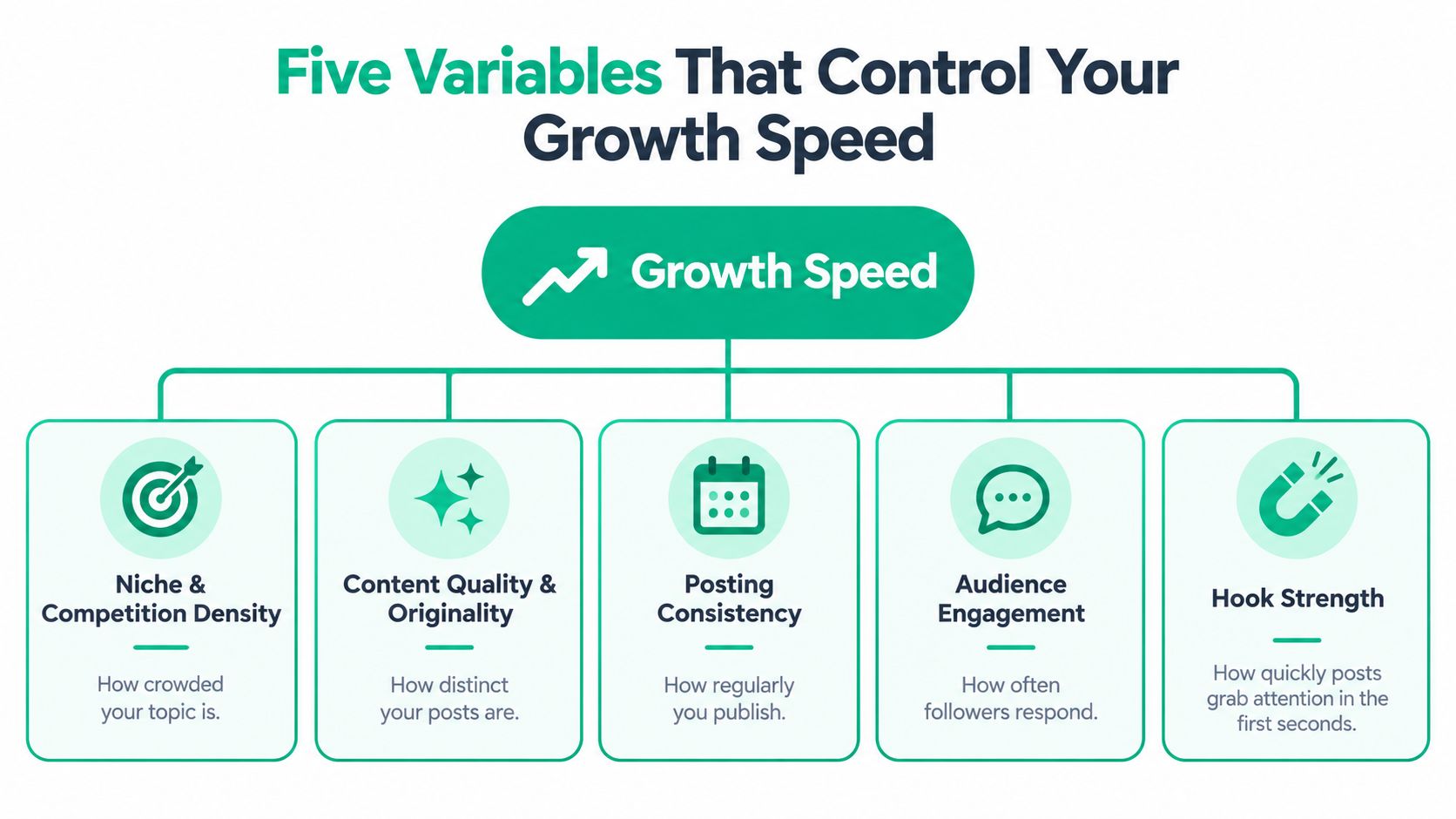
Growth speed isn't random, and it isn't controlled by one trick. It's the product of a few bottlenecks, and the account usually slows down at the weakest one. That's why two accounts in the same niche can grow at very different speeds even when they post about similar topics.
The first bottleneck is the market itself
A crowded niche has more competition for attention. Fitness, beauty, and productivity are full of strong creators, so a new account needs sharper positioning to stand out. A narrower B2B niche, by contrast, may have fewer creators speaking directly to the same buyer problem, which can make discovery easier even if the audience is smaller.
The second variable is content quality and originality. If your posts look like everything else in the feed, Instagram has little reason to keep pushing them. Distinctive hooks, useful framing, and clear point of view tend to shorten the time it takes for an audience to understand why they should follow.
The rest of the system is operational
Posting consistency matters because the account needs enough repeated exposure to gather meaningful data. Audience engagement matters because comments, saves, shares, and profile visits all tell the platform that people care enough to keep interacting. Hook strength matters because a weak opening loses the viewer before the post has a chance to earn anything.
A small account with the right topic and a clear hook can move faster than a larger account with vague positioning and sleepy creative.
That's why tools and process matter as much as talent. Some teams use software to tighten targeting and content planning, and some work completely organically. Gainsty is one option in that category, built around organic follower growth support rather than bots or fake followers, but the bigger lesson is simpler, your bottleneck decides your speed.
For a structured way to audit those constraints, a follower growth rate calculator is useful because it forces you to compare your current pace with your own baseline, not with somebody else's highlight reel.
Growth Benchmarks By Account Size
Small accounts often grow faster in relative terms, and that catches people off guard if they expect larger pages to move quicker. A newer account has more room to compound, while larger accounts usually need more effort to earn each additional follower. Bigger audiences also get harder to move with the same content because the account has already reached much of the easiest audience.
A 2025 benchmark dataset covering 2,967 companies reported average Instagram engagement of approximately 3.6% (benchmark report). The same report showed stronger audience growth for smaller accounts than for larger ones, with 2024 averages of 38.0% for accounts with 1,000 to 5,000 followers, 35.0% for 5,000 to 10,000, 33.8% for 10,000 to 50,000, and 27.0% for 100,000 to 1 million followers, per the same benchmark report. These are period averages, not guarantees, but they show the pattern clearly.
Accounts with 1,000 to 5,000 followers averaged 38.0% growth.
Accounts with 5,000 to 10,000 followers averaged 35.0% growth.
Accounts with 10,000 to 50,000 followers averaged 33.8% growth.
Accounts with 100,000 to 1 million followers averaged 27.0% growth.
How to read your own numbers
The cleanest monthly measure is net growth, calculated as new followers minus unfollows, divided by starting followers. That shows how well the account turns attention into audience. A month with strong reach but weak conversion can look active and still underperform.
Use a rolling eight- to twelve-week baseline, not a single week. One viral post can distort the picture, and one flat week can make a healthy account look weak. The goal is to measure repeatability, not chase the hottest spike.
Good benchmark behavior: compare your current growth with your own last few months, then look for a stable upward pattern before changing strategy.
For a simple way to sanity-check your pace, a follower growth rate calculator helps you compare current growth against your own baseline instead of someone else's highlight reel.
The practical takeaway is that follower targets should scale with account size. A small account making steady gains may be moving well, even if the absolute follower count still looks modest.
Understanding Instagram's Recommendation Funnel
Instagram does not use one single scoreboard to decide what spreads. Feed, Explore, Reels, Search, and other surfaces rely on separate ranking systems, and the signals include watch time, shares, follows, likes, comments, profile visits, and the predicted likelihood that someone will engage, as explained in Instagram's ranking explanation. Growth starts before the follow, at the point where recommendation turns into attention.
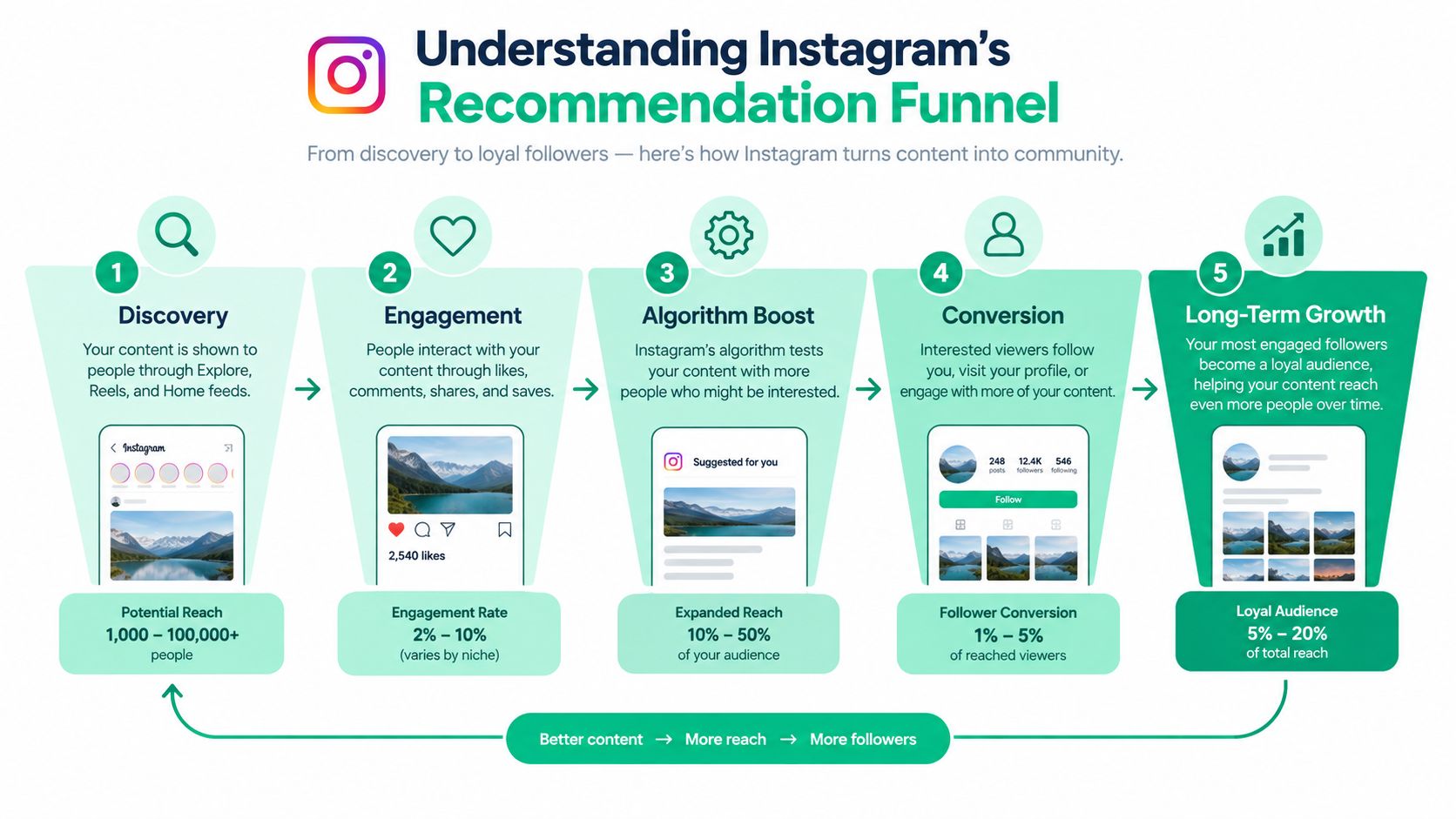
Accounts often miss this because they watch follower count and ignore the conversion path. A post can pull impressions and still add no followers if it never gets people to the profile. Another post can reach fewer people and convert better because it lands in front of the right audience and makes the account's value obvious right away.
Track the funnel, not just the post
The path is simple. Recommendation impression comes first, then a profile visit, then a follow. If that chain breaks, the fix belongs at the weakest step, not in a heavier posting schedule.
If retention is weak, the opening seconds of a Reel need work. If profile visits do not convert, the bio, pinned posts, and profile clarity need attention. If viewers engage but do not follow, the account may be entertaining without being specific enough to attract a lasting audience.
Instagram also warns that repeated violations can make an account temporarily ineligible for recommendation, which can stretch out growth time sharply. That is why engagement bait and other low-quality shortcuts usually backfire.
For a practical look at distribution behavior, how Instagram's algorithm works is a useful reference.
Reels Versus Carousels - Which Drives Real Growth
Reels usually drive discovery faster, but reach alone does not tell you whether an account is building the right audience. The practical question is whether the format brings in people who care enough to follow, return, and engage again.
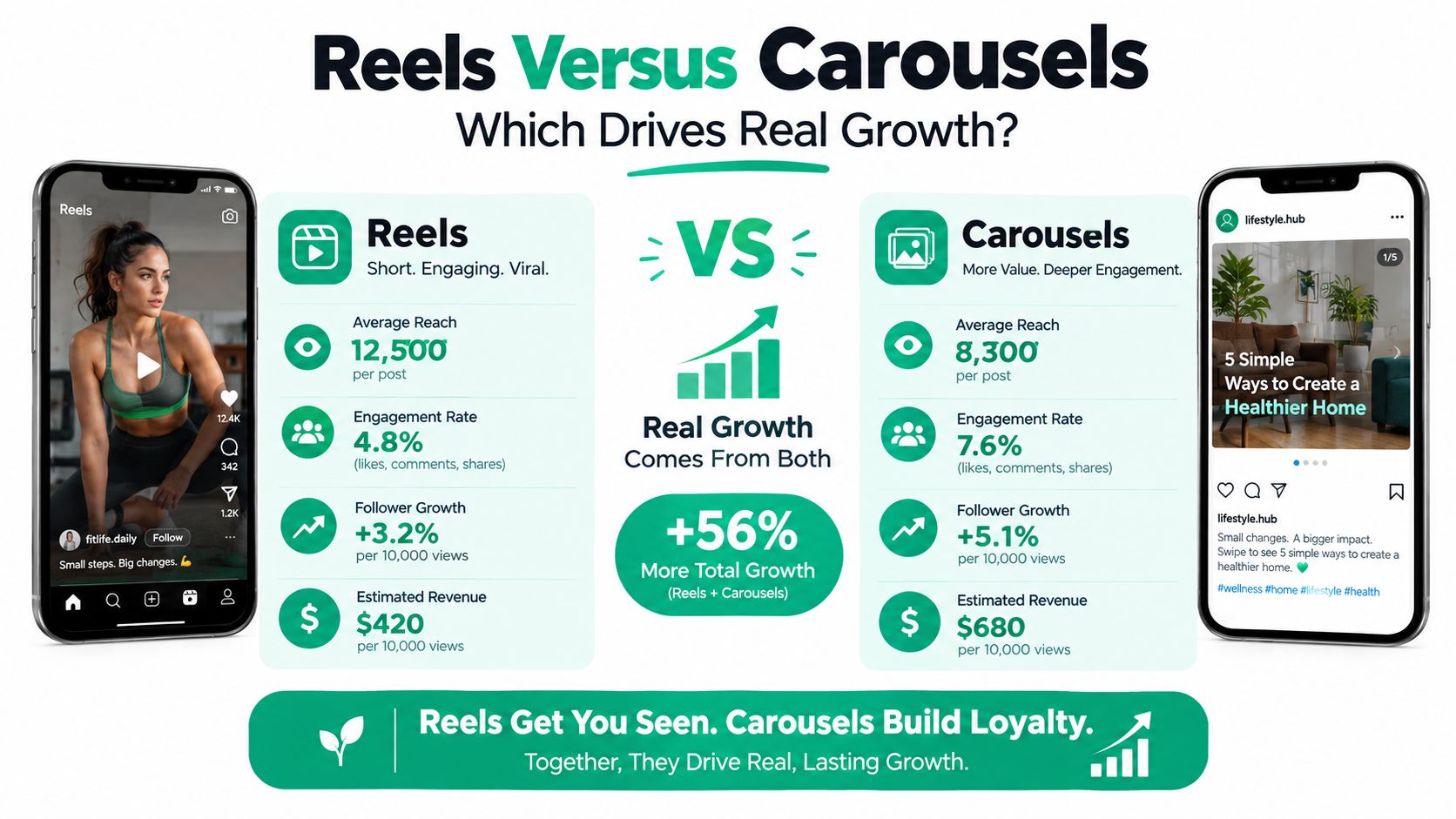
An analysis of more than 4 million Instagram posts found that Reels generated 36% more reach than carousels and 125% more reach than single-image posts, while carousels produced 12% more engagement than Reels (analysis summary). That split explains why Reels often win on visibility while carousels often do more work for trust and repeat attention.
Use each format for a different job
Reels fit the top of the funnel. They help an account show up for people who have never heard of it, which matters when discovery is the bottleneck. Carousels work better when the goal is to slow the viewer down, explain something clearly, and make the account feel worth following.
The better format depends on the problem you are solving. An account can pick up followers faster with Reels, then convert those followers more effectively with carousels once the audience understands the topic and the profile feels credible.
That trade-off shows up even more clearly in smaller accounts. Nano-influencers make up 75.9% of Instagram influencers, and accounts under 10,000 followers can achieve a 20% Reels view rate and Stories reach growth of up to 35% year over year. For a practical production example, how to create reel on Instagram is useful for basic execution, and Instagram Reels in 2026 helps when deciding how much short-form video to prioritize versus educational carousels.
Reach can create opportunity. Relevance is what turns that opportunity into followers who stay.
Accelerating Growth Safely With Proven Tactics
The fastest safe growth comes from tightening the system, not gaming the platform. Accounts that buy followers or lean on automation usually end up with weak engagement, distorted analytics, and more friction later when the content needs real momentum. Organic growth takes longer, but it tends to produce a healthier audience and cleaner data.
The most effective setup work is usually boring, but it pays off. A clear bio, a strong profile image, a visible content promise, and pinned posts that explain what the account stands for can improve conversion after someone lands on the page. If the profile feels vague, the content has to work harder to do the job of the bio.
Prioritize what compounds
Start with one content angle and one repeatable format. Then check which posts drive the best profile visits and follows, not just likes. That tells you where the account is building audience, not just applause.
A few tactical habits matter more than people think.
Publish with intent. Each post should earn its place by teaching, demonstrating, or clarifying something the audience values.
Respond where the audience already gathers. Thoughtful comments and replies place the account in relevant conversations without spammy outreach.
Use collaborations carefully. Shared audiences can speed up discovery when the partner's followers fit the niche.
Review retention points. If viewers drop off early, the opening needs a sharper hook or a cleaner visual sequence.
For quick content experiments, actionable SEO quick wins can be a useful mindset model because the same principle applies here, fix the highest-impact issue first. On the tooling side, some teams use platforms like Gainsty to organize organic growth strategy, targeting, and analytics support without relying on fake followers.
The goal is not maximum activity, it's better conversion from the activity you already have. That's how you shorten the path from visibility to followers without damaging the account.
Setting Realistic Growth Expectations
The accounts that win don't obsess over one finish line. They track smaller milestones that show whether the machine is working. First profile visits matter. Then first 100 relevant followers. Then repeat reach among non-followers. Then a stable conversion from viewer to follower.
That's a more reliable way to answer how long does it takes to grow Instagram followers because it measures progress where growth happens. A post that earns attention but doesn't create profile visits is a reach win, not a growth win. A profile that gets visits but no follows needs stronger positioning. An account that gets steady follows from modest reach is healthy.
Use an eight-to-twelve week baseline
The best planning window is a rolling eight to twelve weeks. That period is long enough to smooth out random spikes, but short enough to show whether changes in content, format, or targeting are paying off. Anything shorter can be misleading, especially when one post outperforms the rest.
A simple monthly check is enough for most teams. Compare new followers minus unfollows against the starting base, then review which formats drove the best conversion. If the same pattern repeats across several cycles, you've found something worth scaling.
Focus on repeatable progress, not heroic weeks. Viral moments can help, but durable growth comes from content that keeps converting after the spike fades.
Organic Instagram growth is a marathon with occasional sprints. The accounts that keep improving are the ones that learn from each cycle instead of waiting for a lucky break.
If you want a more precise growth plan for your account, use Gainsty to map your niche, content format, and conversion bottlenecks into a practical follower-growth strategy. It's built for organic Instagram growth, so you can focus on repeatable audience building instead of shortcuts that hurt long-term performance.