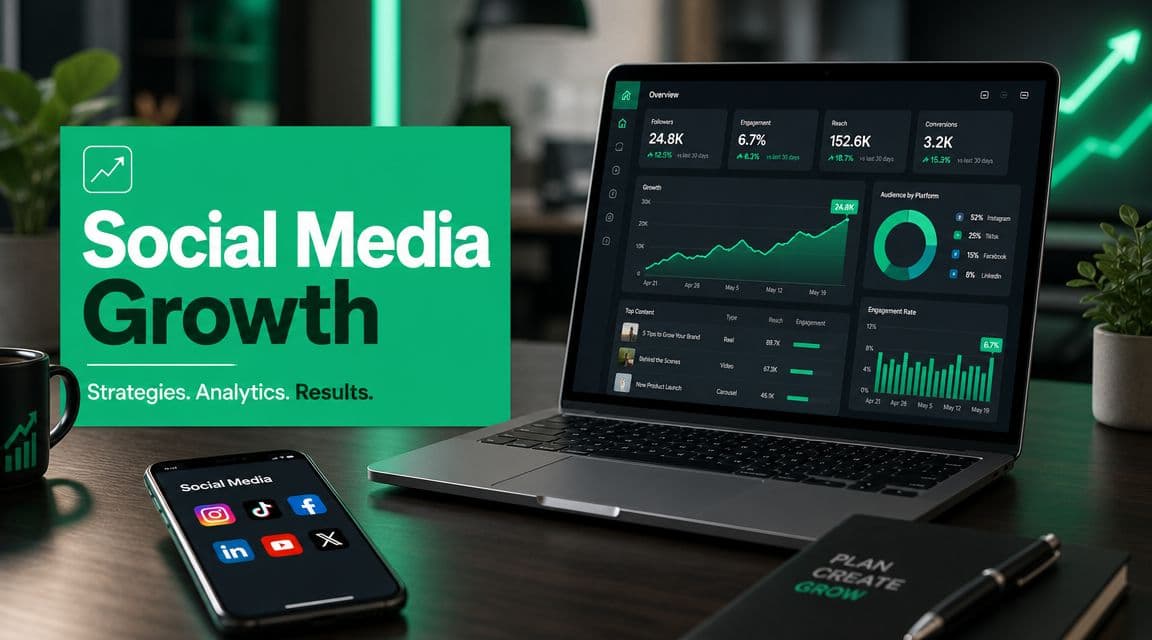
Why Social Media Growth Is a Business Imperative in 2026
More than 5 billion social media user identities are active worldwide, and a large share of buyers now use social platforms to check brands before they buy. By 2026, that makes social presence a revenue issue, not a side project.
Earlier data already established the scale: social platforms are where people research companies, compare credibility, and judge whether a business feels current and trustworthy. Instagram stands out for brand research, but the bigger point is platform-agnostic. Buyers now expect to find proof on social. If they do not, they fill in the gap themselves, and they usually do it in the least generous way.

Social profiles now influence buying decisions
A healthy follower count can help with distribution, but business results come from the quality of attention your account earns. Prospects check your profile, scan recent posts, read comments, open tagged content, and look for signs that real customers pay attention. Every one of those touchpoints shapes trust before a sales call, demo request, or store visit happens.
I have seen this play out with small local businesses and national brands alike. The accounts that underperform usually have the same pattern: months of uneven posting, generic graphics, no clear audience, and captions written to fill a calendar. That does not just suppress reach. It creates hesitation.
A stale account signals operational drift.
That is why social growth deserves the same discipline as email, paid search, or outbound. It affects discoverability, conversion rates, and how expensive it becomes to acquire trust. If your team needs a clearer view of who you are trying to attract before you scale content, start with a structured social media audience analysis framework.
Random activity creates busywork, not growth
Posting more often helps only when the content has a job. Without a system, extra output usually produces vanity metrics, content fatigue, and reporting that looks active without helping the business. I have watched teams spend weeks chasing trending audio, meme formats, and recycled hooks that brought follower spikes but no lift in qualified traffic or sales conversations.
The better approach is repeatable and a little less exciting. Set a clear role for the channel, build content around buyer questions and proof, publish on a cadence your team can sustain, and review performance often enough to catch weak patterns early. That framework transfers across platforms. The execution changes by channel, but the operating system stays the same.
If you want to see how process-driven growth looks in a platform-specific context, a success playbook for X influencers is a useful example. The tactics are specific to one network, but the underlying lesson applies everywhere. Growth improves when teams stop chasing trends and start running a system.
Build Your Foundation with Clear Goals and Audience Insights
Most social accounts underperform for a simple reason. The business never decided what the channel is supposed to do.
A defensible workflow starts with one primary KPI per channel, audience persona mapping before content production, a consistent publishing cadence, and weekly analytics review. Neglecting any of those steps creates measurable waste, according to this guidance on avoiding common social media pitfalls.

Pick one job for each channel
If a business says Instagram is for awareness, community, lead generation, customer support, recruiting, and direct sales all at once, the content usually turns into a mess.
A better setup looks like this:
Instagram for attention: Prioritize reach, profile visits, saves, shares, and click-through rate when traffic matters.
LinkedIn for demand capture: Focus on qualified conversations, clicks to deeper resources, and lead quality.
Facebook for community retention: Track comments, repeat engagement, and service-related interactions.
The key is one primary KPI per platform. You can watch secondary metrics, but one metric should tell you whether that channel is doing its job.
Build an audience persona that someone can actually use
Generic audience definitions are useless. “Women aged 25 to 44 interested in wellness” won't help a content team decide what to post on Tuesday.
Use a smaller, operational persona. A local coffee shop is a good example:
Core customer: Nearby professionals who want a reliable morning stop.
Problem: They're rushed, they want quality fast, and they don't want surprises.
Content triggers: New seasonal drinks, short wait times, workspace atmosphere, neighborhood relevance.
Conversion action: Visit in person, order ahead, or share with a coworker.
That persona gives you content direction immediately. A behind-the-counter Reel about prep speed makes sense. A generic inspirational quote probably doesn't.
For teams that need a more structured process, Gainsty's guide to social media audience analysis is a useful starting point because it helps turn broad demographics into specific audience signals you can build content around.
The audience definition should be specific enough that two different team members would create similar content from the same brief.
Tie goals to business outcomes, not ego metrics
Follower growth can matter. It just can't be the whole story.
Use simple pairings:
Brand awareness – The better KPI to track is reach or impressions, since these show how many people are seeing your content and how widely it is being distributed.
Website traffic – The most relevant KPI is click-through rate (CTR), because it measures how effectively your content turns visibility into actual website visits.
Lead generation – The best KPI is leads or qualified inquiries, since this reflects whether your audience is not just engaging but actively showing interest in your offer.
Sales support – The most useful KPI is conversion-related actions, such as purchases, bookings, sign-ups, or other final-step behaviors that directly contribute to revenue.
If your KPI doesn't connect to a business outcome, you'll end up celebrating movement that doesn't change revenue.
Choose the Right Social Media Platforms for Your Business
Trying to win on every platform is one of the fastest ways to dilute your team. Most businesses don't need more channels. They need a better channel fit.
People spend an average of 2 hours and 21 minutes per day on social platforms, use 6.83 different networks monthly, and 58% of consumers discover new businesses via social media, according to Dreamgrow's 2025 roundup of social media marketing statistics. The implication is simple. Your audience is spread across multiple apps, but your business still has to choose where it can show up well.
Use three filters before you commit
I use three criteria when deciding whether a business should invest in a platform.
First, audience fit. Are the people you want to reach active there in a way that matches your offer?
Second, format fit. Can your team produce the kind of content that platform rewards without burning out?
Third, business-use fit. Does the platform support the outcome you care about most right now?
A B2B consultancy may have a real audience on Instagram, but if the team is strong at expert commentary and weak at visual storytelling, LinkedIn will usually be easier to execute well. A local retail brand may technically have buyers on LinkedIn, too, but visual platforms will often make the product easier to discover.
Platform strengths at a glance 2026
Instagram – Primary audience is consumers, creators, and lifestyle-driven buyers. Key formats include Reels, Stories, carousels, and UGC-style posts. It is best for discovery, trust-building, and generating product interest.
Facebook – Primary audience includes local communities, broad age groups, and repeat customers. Key formats are community posts, short videos, events, and groups. It works best for retention, community engagement, and local awareness.
LinkedIn – Primary audience is professionals, decision-makers, and B2B buyers. Key formats include thought leadership posts, document posts, and short videos. It is strongest for authority building, lead generation, and partnerships.
TikTok – Primary audience is trend-responsive users and interest-based audiences. Key formats are short-form, creator-style videos. It is best for top-of-funnel awareness and fast discovery.
YouTube – Primary audience is search-driven learners and comparison shoppers. Key formats include long-form videos, Shorts, tutorials, and demos. It excels at education, authority building, and long-tail discovery.
X (Twitter) – Primary audience includes news-following users and niche communities. Key formats are short text posts, commentary, and threads. It is best for conversation, niche positioning, and timely visibility.
That table is a starting point, not a rulebook. The right question isn't “Which platform is biggest?” It's “Where can we publish consistently in a format our audience will respond to?”
Don't confuse presence with coverage
A dead account does more harm than no account. If you can only support one or two platforms properly, choose one or two.
Operational advice: A focused channel mix beats a scattered one every time. One strong account teaches you more than four weak ones.
If you're still deciding where your business belongs, this overview of the top social media platforms for business is useful for comparing platform roles before you commit team time.
The practical test is straightforward. Look at your last month of production capacity, not your ambition. Then pick the platform mix your team can sustain without defaulting to filler content.
Develop a Content Strategy That Resonates
Most businesses don't fail because they lack ideas. They fail because they don't have a structure for turning ideas into a repeatable content pipeline.
That gap shows up clearly in SMB behavior. More than three-quarters of SMBs said social media positively impacts performance, yet 54% said they struggle to keep content fresh and stay current with trends, according to Verizon Business and Morning Consult coverage in Marketing Dive. That's the problem content strategy needs to solve.

Build around content pillars, not daily inspiration
A strong social media growth for a business plan usually runs on three to five content pillars. These are recurring themes tied to what your audience cares about and what your business can credibly talk about over time.
For a fitness studio, that might look like:
Education: Quick training tips, common mistakes, recovery basics
Proof: Member stories, class clips, testimonials
Behind the scenes: Coaches, setup, daily studio rhythm
Offer-driven content: New programs, trial invites, seasonal promotions
Pillars solve two problems at once. They make ideation easier, and they stop your feed from becoming random.
Match formats to the message
Not every idea belongs in every format. Teams waste time when they force one content type to do every job.
Use a practical mapping approach:
Teach something quickly – Best fits carousels or short-form videos, because they break information into simple steps and are easy to consume, save, and revisit.
Show personality – Best fits Stories or behind-the-scenes Reels, where informal, real-time, or unpolished content helps audiences connect with the human side of the brand.
Build trust – Best fits customer testimonials, founder videos, or before-and-after visuals, since these provide proof, credibility, and real outcomes rather than claims.
Drive action – Best fits clear promotional posts with a direct CTA, where the message is explicit and guides the audience toward a specific next step, like buying, signing up, or booking.
A lot of weak content isn't weak because the topic is bad. It's weak because the format is wrong. A nuanced explanation might die in a static graphic, but work as a carousel. A product reveal might feel flat in text but strong in a short video.
Create a cadence your team can survive
Consistency matters, but only if it's sustainable. I'd rather see a team keep a realistic schedule for months than sprint for ten days and disappear.
A practical rhythm usually includes:
One recurring educational series, so the audience learns what to expect
One proof format that shows customer results, reactions, or use cases
One lighter format that makes the brand feel human
One conversion-oriented post tied to a specific offer or next step
If your team is constantly asking what to post next, the planning process is broken. MicroPoster's guide to content planning is a solid reference for building a calendar that starts from pillars and cadence instead of scrambling post by post.
Content gets easier when each post has a job. Teach, prove, relate, or convert. If it does none of those, it probably doesn't need to go live.
Mastering Organic Growth and Smart Amplification
Organic growth still works. What doesn't work is passive posting. Businesses publish, wait, and hope the algorithm does the rest. That's not a strategy. That's a lottery ticket.
The accounts that grow tend to combine content quality with active distribution. They don't just publish. They participate, respond, test hooks, revisit winners, and amplify the posts that already earned attention.
Organic growth tactics that still move the needle
A few tactics keep showing up across strong accounts.
Comment where your audience already pays attention: Not generic “great post” comments. Real observations on relevant creators, local businesses, industry pages, and customer-adjacent accounts.
Use collaborations with overlapping audiences: Partner posts, creator walkthroughs, customer features, and co-branded live sessions usually outperform isolated brand broadcasting.
Turn community signals into content: If people ask the same question in DMs, comments, or sales calls, that's a content brief.
Repackage proven topics: If one angle works in video, convert it into a carousel, Story sequence, or short caption post instead of forcing new ideas every day.
Field note: Most businesses are underusing comment sections. Good comments can do audience development, market research, and brand positioning at the same time.
An Instagram playbook that translates beyond Instagram
Instagram is still one of the clearest case studies because it combines discovery, trust, and conversion support in one place. The workflow is simple, but the execution needs discipline.
Start with a profile that answers three questions fast: who you help, what you offer, and why someone should follow. Then build content around a few repeatable assets:
Discovery content
Reels, short educational videos, and visually strong carousels bring in non-followers.Trust content
Stories, customer proof, founder commentary, and FAQs help new visitors decide whether the business feels credible.Action content
Product demos, booking prompts, lead magnets, or direct offers move people off-platform when that's the goal.
The mistake is overloading one post with all three jobs. Awareness content should earn attention. Trust content should remove doubt. Conversion content should ask for action.
For businesses that want help scaling Instagram outreach and audience interaction without fake followers or bot activity, Gainsty is one option. It's an AI-powered Instagram growth service designed around organic follower growth, engagement support, and analytics. Used properly, a tool like that should support an existing strategy, not replace it.
Use paid social as an amplifier, not a rescue plan
Paid promotion works best when it extends organic winners. It works poorly when you use a budget to force weak creative onto an indifferent audience.
A better approach looks like this:
Bad use of paid – Boosting a post simply because it underperformed organically. This usually tries to “rescue” weak content instead of amplifying proven demand.
Better use of paid – Boosting a post that has already shown strong organic signals (saves, shares, comments, or high retention). This works because you’re scaling content that the algorithm has already validated.
Bad use of paid – Running cold ads with no proof assets, meaning there’s no existing social proof or engagement data to support the message. This often leads to higher cost and weaker conversion.
Better use of paid – Building ads from posts that already earned saves, shares, comments, or strong watch time, because they function as validated creative that resonates with real users.
Bad use of paid – Spending money to fix unclear messaging, where the offer, positioning, or value proposition is still confusing. This typically amplifies confusion instead of solving it.
Better use of paid – Investing in ads only after the offer and creative are already proven to resonate organically, ensuring paid spend is used for scaling clarity, not repairing it.
If a post didn't hold attention organically, paid spend usually won't fix the core issue. But when a piece of content clearly connects, paid can help you extend its reach to similar audiences faster and more efficiently.
That's the hybrid model I trust most. Organic tells you what the audience wants. Paid helps you scale that signal.
Measure What Matters and Iterate Your Strategy
Businesses waste a lot of time reporting on follower growth because it is easy to screenshot and hard to challenge. It is still a lagging signal. If reach is weak, engagement is shallow, or clicks never turn into leads, follower count will not explain the problem.
Useful measurement starts with the job each piece of content was supposed to do. A post built to earn attention should be judged differently from a post built to drive inquiries. Teams that use one reporting template for every platform and every objective usually end up protecting vanity metrics and missing the actual bottleneck.

Review the right metrics for the right job
Keep the scorecard simple:
Awareness goal: Reach, impressions, profile visits
Resonance goal: Engagement rate, shares, saves, meaningful comments
Traffic goal: Click-through rate, landing page sessions
Conversion goal: Leads, booked calls, purchases, assisted conversions
This matters more than many teams realize. I have seen Instagram posts with average likes generate strong sales because the comments came from qualified buyers. I have also seen high-reach content bring in the wrong audience and create a reporting win that meant nothing to the business.
Platform context matters too. Instagram often rewards saves, shares, and repeat viewing. LinkedIn may produce fewer public signals while driving stronger direct messages and higher-quality conversations. Comparing them with one success metric usually leads to bad decisions.
Run a weekly review that leads to action
Quarterly reporting is too slow for content. Weekly review is usually enough to spot patterns before a weak format eats a month of output.
Ask five questions:
Which posts attracted the right audience, not just the biggest audience?
Which formats held attention but stalled before the click or inquiry?
Which topics triggered saves, replies, comments, or DMs from qualified prospects?
Which posts took real effort and still failed to perform?
What gets repeated, what gets revised, and what gets cut next week?
The goal is to tighten the loop. Improving a social strategy involves removing underperforming content types quickly and giving more room to proven patterns. That is how you build a repeatable system instead of chasing random spikes.
If you want a niche-specific example of ROI thinking without vanity metric confusion, this comprehensive guide for church social media is useful because the measurement framework applies well beyond churches.
Teams that need cleaner reporting should also review social media measurement tools for business reporting and attribution. Scattered screenshots and memory are a bad operating system.
Social media growth gets more predictable when the process stays tight. Publish. Review. Adjust. Repeat.
If Instagram is a major growth channel for your business, Gainsty can support the operational side of that work with AI-assisted organic growth, engagement support, and analytics. It fits best when you already have a clear audience, a real content system, and the discipline to measure what moves the business.