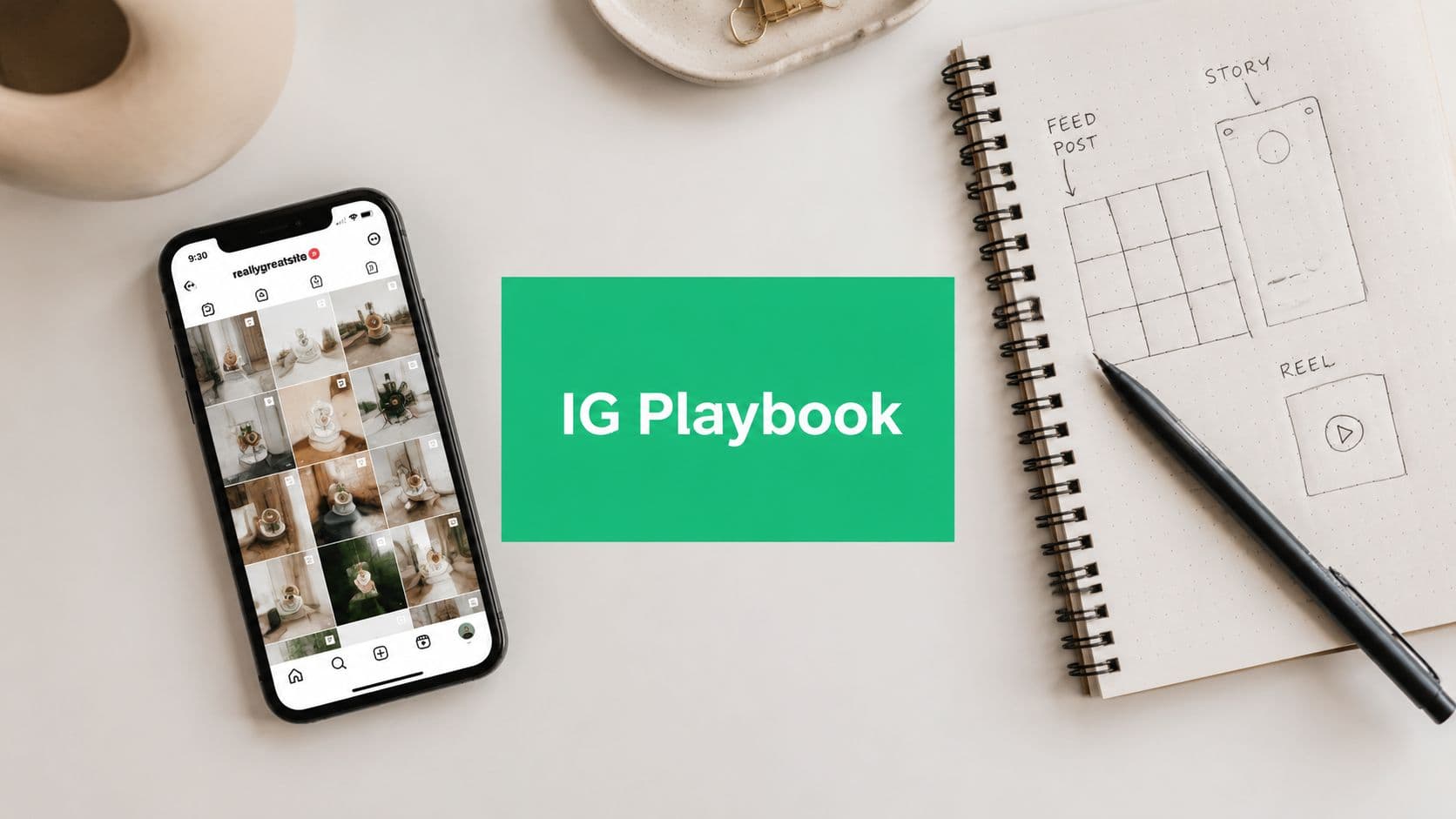
Setting the Foundation Before You Post
Most Instagram plans fail before the first post goes live, because the team starts with ideas instead of decisions. The account gets a mood board, a few topic buckets, maybe a posting goal, and then the calendar begins drifting as soon as one post underperforms. The fix is boring, but it works, a short foundation brief that answers what the account is for, who it's for, what it should look and sound like, and what success means.
Lock one business goal first
“Grow on Instagram” isn't a goal, it's a wish. Pick one north-star metric that matches the business outcome you care about most, then build the rest of the plan around it. If you want discovery, optimize for reach. If you want people to come back and think, save, or DM, optimize for those signals instead.
That single choice changes the whole calendar. It tells you whether a post deserves a hook, a proof point, a CTA, or a conversation starter. It also keeps the team from rewarding every shiny metric equally, which is how accounts end up chasing likes while missing the actions that matter.
Practical rule: if the goal is unclear, the calendar gets noisy fast. If the goal is clear, every post can be judged against it.
Define the follower you're trying to attract
Your ideal follower profile doesn't need a full persona deck. It needs enough detail that the team can tell the difference between content for a curious browser, a ready-to-buy prospect, and someone who will never convert. Write down what they care about, what they already know, and what problem they're hoping Instagram will help them solve.
Then audit the current grid with that profile in mind. Remove off-brand residue, archive posts that confuse the positioning, and note where the feed is too broad or too self-referential. If you want a useful companion while shaping that brief, Contesimal's Instagram follower growth strategies are worth skimming because they reinforce the basics of audience fit and consistent execution.

Write the voice before the captions
A short voice reference doc saves a lot of debate later. Include three things, words the brand uses often, words it never uses, and what the tone should feel like when it's doing well. That keeps captions from sounding like they were written by three different people with three different instincts.
I also like to add a simple “decision rule” to the brief. If a post feels useful but off-brand, it gets rewritten. If it feels on-brand but vague, it gets sharpened before it ships. That one sentence prevents a lot of middle-of-the-road content from going out just because it was already scheduled.
Matching Formats to Real Objectives
A calendar built for Instagram has to start with the job each post is supposed to do. Meta reports that Reels account for more than 50% of the time people spend on Instagram, and external benchmark data shows Reels can generate 36% more reach than carousels and 125% more reach than single-image posts. That makes format choice part of the strategy itself, not just the wrapper around the idea. Buffer's Instagram statistics make the shift clear, Instagram now behaves like a video-first discovery engine, while carousels still matter for interaction and retention.
Use this format when the job is discovery
Reels belong at the top of the funnel. They are the cleanest way to reach people who do not know you yet, so they usually need the sharpest hook, the clearest visual payoff, and the simplest CTA. A small DTC brand might use a product demo, a quick before-and-after, or a “three ways to use this” clip. A creator might use a strong opinion, a process breakdown, or a story that opens fast.
Carousels do a different job. They work better when the goal is to keep attention, earn saves, or walk someone through a point step by step. Static posts still have a place for announcements, trust signals, and polished brand moments, but they should not carry the main growth burden.
Match the format to the customer journey
Stories sit closer to relationship-building than discovery. They are where you add context, show the less polished side, and move people toward replies or DMs. That makes them useful when the audience already recognizes you and needs a reason to care more.
Reels: Primarily designed for discovery and reach. They typically achieve higher reach than carousels and single-image posts, so reach is the key KPI to track.
Carousels: Best for saves and deeper engagement. They often generate stronger engagement than other feed formats, making saves the most useful KPI.
Stories: Focus on relationship-building and DM conversations. They encourage more direct, conversational interaction than feed posts, so replies are the key KPI.
Static posts: Best suited to building brand authority and sharing announcements. They work best when used selectively rather than as the default format, with profile visits as a useful KPI.
Reels win attention, carousels win retention, Stories keep relationships warm, and static posts serve clarity over motion. Weak calendars fail because they treat those jobs as interchangeable. A stronger one assigns each format to the outcome it is most likely to produce.
Building Content Pillars That Earn Their Weight
Teams pick pillars like they're picking menu items, educational, entertaining, behind-the-scenes, community. That's too flat. A pillar should earn a share of the calendar based on what it produces, not on how nice it sounds in a brainstorm. One useful way to think about this is as a portfolio, where each pillar has weight, output expectations, and a reason to stay.
Weight pillars by performance, not by preference
Start with three to five pillars, then assign each one a rough share of the calendar. The weights don't have to be perfect on day one, but they should force decisions. A pillar that drives saves deserves more room in carousel format. A pillar that gets shares may be stronger as a Reel. A pillar that mainly starts replies may belong in Stories or behind-the-scenes content.
A recent guide from Socialz.ai argues that educational, entertaining, or relatable posts can outperform purely promotional posts by 3–5x in reach, and that Reels and carousels have the strongest reach and engagement potential in 2026. The useful part isn't the headline. It's the implication, promotional content should be the smallest share of the mix unless it's carrying conversion on its own.

Kill or reweight what doesn't pull its share
A “tips” pillar sounds safe until the numbers tell a different story. If a 30-day audit shows the tips posts bring reach but not saves, and the proof-of-results posts bring fewer impressions but more DMs, the second pillar is probably worth more weight. That's the kind of rebalancing that makes a calendar smarter over time.
Here's the test I'd use before adding a new pillar:
Does it help a specific audience problem? If it's only a theme, it's too vague.
Can it win in at least one format? If it can't become a Reel, carousel, or Story, it'll be hard to sustain.
Does it have a metric that proves value? Saves, shares, replies, DMs, or profile taps should be attached to it.
Will it crowd out a stronger pillar? If yes, it needs to replace something, not sit beside it.
A pillar is useful only if it can survive contact with the calendar. If it doesn't produce a clear signal, it becomes decoration.
The main mistake is keeping every pillar alive forever. Retiring a weak pillar isn't a failure; it's how the content mix stays honest. A good portfolio gets sharper when you remove dead weight.
Writing Captions and Hashtags That Travel
A strong caption doesn't need to be long. It needs to carry the post after the visual hook has done its job. The best captions I've shipped usually follow the same logic, open hard, add value quickly, prove the point, then ask for one specific action. If the hook is weak, the rest of the caption barely matters.
Use a caption structure that matches the format
For a Reel, the caption should support the video, not repeat it. Start with a line that extends the promise of the clip, then give one useful detail the video couldn't fit, and end with a CTA that fits the audience's stage of awareness. A carousel caption can be a little more explanatory because the post already asked the user to spend time. A static post usually needs the clearest context of all, since the image itself may not carry the whole message.
A simple template works well across pillars:
Hook. State the tension, insight, or outcome in one sentence.
Value. Give the useful part in one to three short paragraphs.
Proof. Add a result, example, or reason to trust the point.
CTA. Ask for a save, reply, click, or share.
For a deeper writing workflow, Gainsty's guide on how to write Instagram captions is a solid reference point if you need a practical starting structure.
Keep hashtags relevant, not bloated
Hashtags still help discovery when they're tight and relevant. The old habit of stuffing the caption with a huge block of tags looks lazy now, and it doesn't make the post more strategic. A small set of highly relevant tags is easier to maintain, easier to research, and easier to connect back to your actual content pillars.
Use a branded hashtag if you want to build a searchable asset over time. Use topic-specific tags when they match the post precisely. Put them in the caption or first comment if your workflow prefers it, but don't use placement as a substitute for relevance.
The best caption checklist is short: hook, one idea, one proof point, one action. If a post needs four CTAs and three topics, it's not a caption yet, it's an outline.
Posting Cadence and the 80/20 Content Portfolio
Cadence advice gets messy fast because people collapse volume, consistency, and strategy into one habit. A daily account does not need the same publishing rhythm as a solo creator, and neither should rely on a calendar built around guilt. The cleaner approach is to treat the feed as an 80/20 content portfolio, where most posts come from proven themes and a smaller slice is reserved for controlled experiments.
Build around proven content first
The strongest calendars start with what the audience already responds to. An 80/20 split keeps 80% of posts on formats and topics already proven with your audience, while 20% stays open for controlled experiments. A 30-day audit of the last 20 posts gives you a useful read on what is carrying saves, shares, and reach, and a weekly review with a monthly reset keeps the mix from drifting. That same guidance also maps out a growth-focused daily rhythm of around 5 Reels, 3 carousels, 2 static posts, and 5–7 Stories per day for accounts publishing at that volume. Influo's Instagram content strategy guide frames posting as an operational system, which is the right lens for turning cadence into a repeatable process rather than a mood-driven habit.
That rhythm is not a universal target. A solo creator can work with fewer posts if each one has a clear job and gets reused well across formats. A brand team with more production capacity can run a fuller cadence without exhausting the audience, as long as the mix still reflects what the account has already earned the right to repeat.
Repurpose one idea across multiple surfaces
The best calendars do not invent a new concept for every slot. They take one strong idea and shape it into several assets. A Reel can carry discovery, a carousel can expand the steps, three Story frames can add context, and a static quote post can work if the line is strong enough to stand on its own.
A practical workflow looks like this:
Start with one proof-backed idea. One customer pain, one insight, or one outcome. -
Make the Reel first. Let it carry discovery and give the idea its widest entry point. -
Split it into support assets. Turn the same idea into Stories, a carousel, and a caption variation. -
Keep experiments limited. Test a different hook, angle, or CTA, not all three at once.
The same guide's save-to-reach ratio is useful as a diagnostic, especially when you want to tell whether content is creating durable value or just a quick spike. If a post gets views but little staying power, the idea may be entertaining without being reusable. That is usually the point where a planner becomes more useful than another brainstorm, and a content calendar template for Instagram planning helps keep the portfolio balanced while you decide which pillars deserve more weight.
The calendar should protect what already works before it tries to reinvent the account.
Gainsty also offers an Instagram content strategy template that covers content pillars, posting schedule, content formats, caption strategy, and hashtag strategy, which makes it a workable tool if you want one place to organize the mix without building the system from scratch.
The Weekly Review Loop That Compounds
The best Instagram calendars don't get smarter because the team posts more. They get smarter because someone reviews what happened and changes one variable at a time. A weekly review is where you stop guessing and start noticing patterns, especially when a pillar, format, or hook style keeps producing the same kind of response.
Run the review like a small experiment
A creator I worked with noticed that saves were flat even when reach looked healthy. Instead of redesigning the whole calendar, we changed one thing, the caption hook length on carousel posts.
Week one was the baseline.
Week two and three tested two tighter versions.
By week four, the account had enough comparison data to tell which hook style was earning more sustained attention.
That's the right scale for testing. Don't change the format, the pillar, the hook, and the CTA all at once. Pick one lever, then read the result in context. If a launch week distorts the average, ignore it. If the sample size is tiny, don't overreact to a single strong post.
For a deeper dashboard view, this Instagram analytics guide for business growth is useful if you need help turning platform numbers into decisions instead of screenshots.
Separate pillar winners from format winners
A 30-day audit of the last 20 posts should tell you two things. First, which pillars are carrying saves, shares, or replies. Second, which formats are making those pillars work harder. A pillar can be strong in carousels and weak in Reels, or vice versa. If you only look at total likes, you'll miss that distinction.
The monthly reset should answer three questions:
What earned the most durable attention? Look for saves, shares, and DM replies.
What got reach without response? That content may be broad but shallow.
What needs to be retired or reworked? If a pillar keeps missing, reduce its weight.
Keep the review simple enough that it happens. Thirty minutes is enough if the rules are clear. The goal isn't to admire the data. It's to make one or two decisions before the next cycle starts.
Your One-Page Instagram Strategy Checklist
A good strategy gets easier to use when it fits on one page. If the plan takes three decks to explain, it will stop being used after the first busy week. The checklist below is the version I'd want taped near a laptop, because it tells you whether the account is still aligned or drifting.

The monthly self-audit
Foundation brief complete. You know the business goal, the audience, the voice, and the current grid gaps. You can tell it's done when a new post idea can be judged against the brief in under a minute.
Four formats mapped to objectives. Reels, carousels, Stories, and static posts each have a clear job. You can tell it's done when no one asks, “Should this just be a Reel?” without checking the objective first.
Three to five pillars defined and weighted. The content mix has shares, not just categories. You can tell it's done when one pillar can be cut or expanded without breaking the calendar.
80/20 portfolio scheduled. Most content is proven, a smaller slice is experimental. You can tell it's done when experiments are deliberate, not random.
Analytics review set. Someone owns the weekly review and the monthly reset. You can tell it's done when performance decisions are made on a schedule, not only after panic.
Watch for three early warnings that the strategy has drifted.
Vanity follower growth with flat saves means the content is reaching people without giving them a reason to keep it.
Rising reach but no DMs means the top of the funnel is working, but the relationship layer isn't.
Beautiful content that doesn't earn shares usually means the work looks polished but doesn't travel.
A strategy only stays useful if it can be re-run. The best one isn't the fanciest version; it's the one a real team can keep using when the week gets busy.
If you want a practical way to turn this into a working Instagram system, visit Gainsty and use it to plan your pillars, content mix, captions, and posting rhythm with less guesswork. It's a useful fit when you need a repeatable structure for organic Instagram growth without turning every calendar into a manual rebuild.
.png&w=1920&q=75&dpl=dpl_34ZXCf12K5qjjdZjPn9snwDRADrB)





.png&w=750&q=75&dpl=dpl_34ZXCf12K5qjjdZjPn9snwDRADrB)