Your Cheat Sheet for the Best Instagram Posting Times
Think of these general guidelines as a fantastic starting point. But finding the perfect time to post for your specific account is all about knowing when your audience is actually online and ready to engage.
It's a bit like a radio station playing a hit song—it doesn't matter how great the song is if no one is tuned in to hear it. The same goes for your content. Posting when your followers are most active gives your content that initial burst of engagement it needs to catch the algorithm's attention and get shown to more people.
Top Engagement Windows Uncovered
Recent data shows some interesting shifts in when people are most active on the 'gram. An analysis of over 9.6 million posts found that evening hours have become a new powerhouse for engagement.
The study pinpointed Wednesday at 12 PM, Wednesday at 6 PM, and Thursday at 9 AM as the absolute peak times for visibility and interaction. On the flip side, most mornings are the worst time to post, with that Thursday morning slot being a key exception.
This chart visually breaks down the top three highest engagement times.
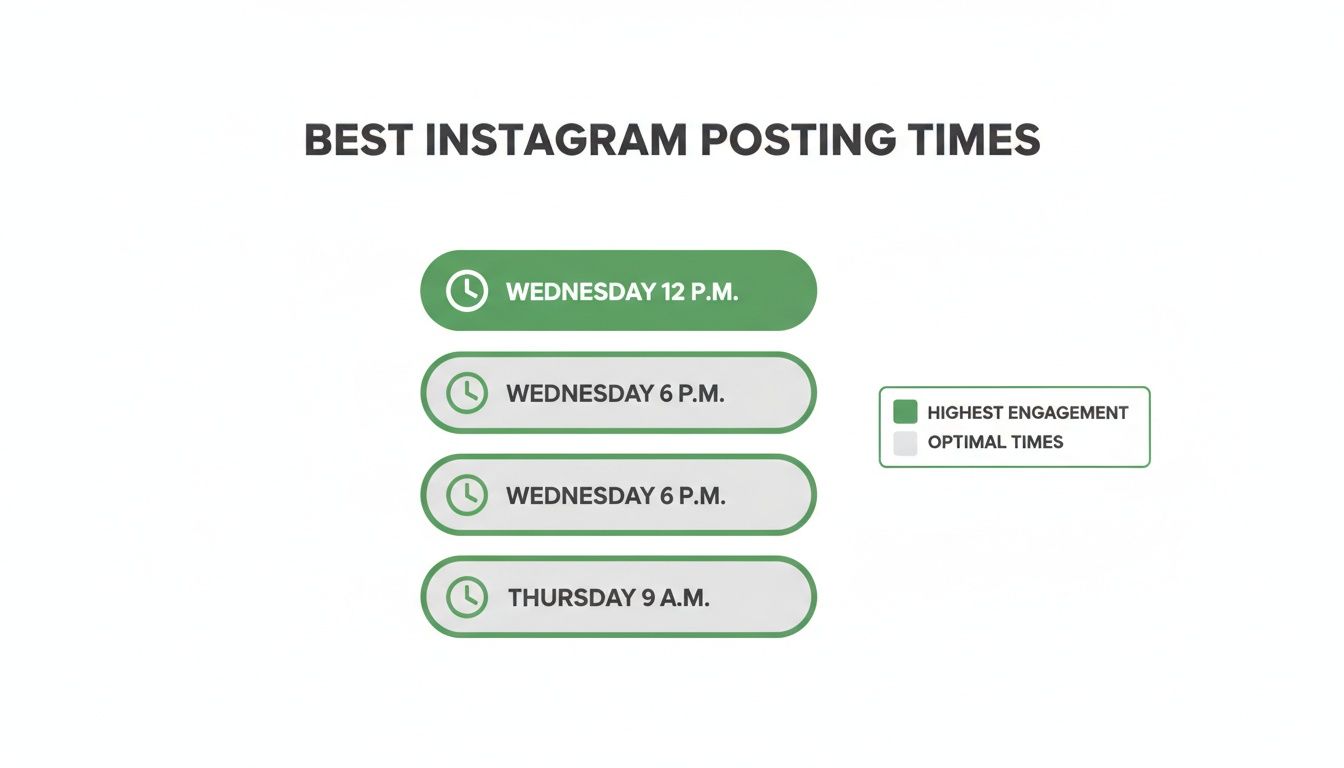
As you can see, Wednesday is a major player, offering two powerful opportunities—one right at lunchtime and another as people head home from work. It’s definitely a day to prioritize in your posting schedule.
To make things even easier, here's a quick summary of those high-traffic windows.
Best Instagram Posting Times at a Glance (Local Time)
Monday: The optimal posting time is around 12 PM, as users are typically catching up on content during their lunch break.
Tuesday: High engagement is most likely at 9 AM and 2 PM, driven by morning check-ins and mid-afternoon breaks.
Wednesday: The best times to post are 11 AM, 12 PM, and 6 PM. Wednesday often delivers peak engagement, capturing lunchtime browsing, end-of-workday activity, and evening scrolling.
Thursday: Strong engagement occurs at 9 AM, 12 PM, and 7 PM, aligning with morning motivation and evening relaxation periods.
Friday: Posting at 11 AM or 12 PM performs well, as users engage during lunch before shifting into weekend mode.
Saturday: The most effective times are 10 AM and 11 AM, when weekend mornings encourage more leisurely scrolling.
Sunday: Engagement peaks around 7 PM and 8 PM, as users unwind and catch up on content before the week begins.
This data-backed approach gives you a solid foundation to build your content strategy on. For a deeper dive, you can explore more insights on what time to post on Instagram for peak engagement.
By scheduling your posts around these proven windows, you can seriously boost your reach and impact. And if you need a hand organizing it all, our ultimate Instagram content calendar template can help you plan everything out.
Why Posting Time Still Matters for the Instagram Algorithm
Since Instagram's feed isn't strictly chronological anymore, a lot of people wonder if "the best time to post" is even a thing. The answer is a definite yes. While the algorithm personalizes what everyone sees, your timing is still one of the most powerful tools you have.
Think about it this way: when you publish a post, the algorithm is watching. It pays close attention to how that very first group of people reacts. Those initial likes, comments, shares, and saves are like a vote of confidence.
If your post gets a flurry of activity right away, the algorithm takes that as a sign that you've shared something great. As a reward, it starts showing your content to more people—even users who don't follow you—on the Explore page and in hashtag feeds. This creates a powerful snowball effect, where that early engagement helps you reach a much bigger audience.
The Launch Window Analogy
I like to compare posting on Instagram to launching a rocket. You could have the most impressive rocket ever built, but if you ignore the launch window, you’ll never get the boost you need to break into orbit.
Timing your post is like choosing that perfect launch window. Publishing when your followers are most active gives your content the initial thrust it needs to escape the "gravitational pull" of a quiet feed and achieve maximum reach.
Posting when your audience is offline or busy is like a launch with no momentum. By the time they log on, your brilliant content is already buried. You can dive deeper into the mechanics of this in our guide explaining how Instagram's algorithm works. That initial push is everything.
Timing as a Strategic Advantage
At the end of the day, finding a good time to post isn’t just about getting on the timeline; it’s a strategic move. You're aligning your content with the natural rhythm of your audience to give it the best possible shot at success.
This strategy has a direct impact on your account's growth. When you learn how to maximize your reach and engagement, you're building a foundation for bigger goals, like learning how to get to 1000 followers on Instagram. It's about playing with the algorithm, not fighting it.
A perfectly timed post captures the attention of your most loyal followers right away, and they’re the ones who will kickstart that wave of interaction. This is the first step in the chain reaction that can help your content take off, proving that when you post is just as important as what you post.
Getting a Feel for Instagram's Daily Rhythms
If you really want to find the best time to post on Instagram, you have to stop thinking about generic time slots. Instead, start thinking about the daily pulse of your audience. User engagement isn't a total crapshoot; it follows a predictable beat that’s tied directly to the structure of a typical week. Every day brings a different routine and a different mindset, which creates unique windows of opportunity for your content to shine.
Think about your audience's week for a second. During the weekdays, their attention is usually split, but you can find them clustered around the natural breaks in their day. These are the moments they grab their phones for a quick mental break from whatever else is going on.
The Morning Commute: People are heading to work or school, scrolling through their feeds to see what they missed.
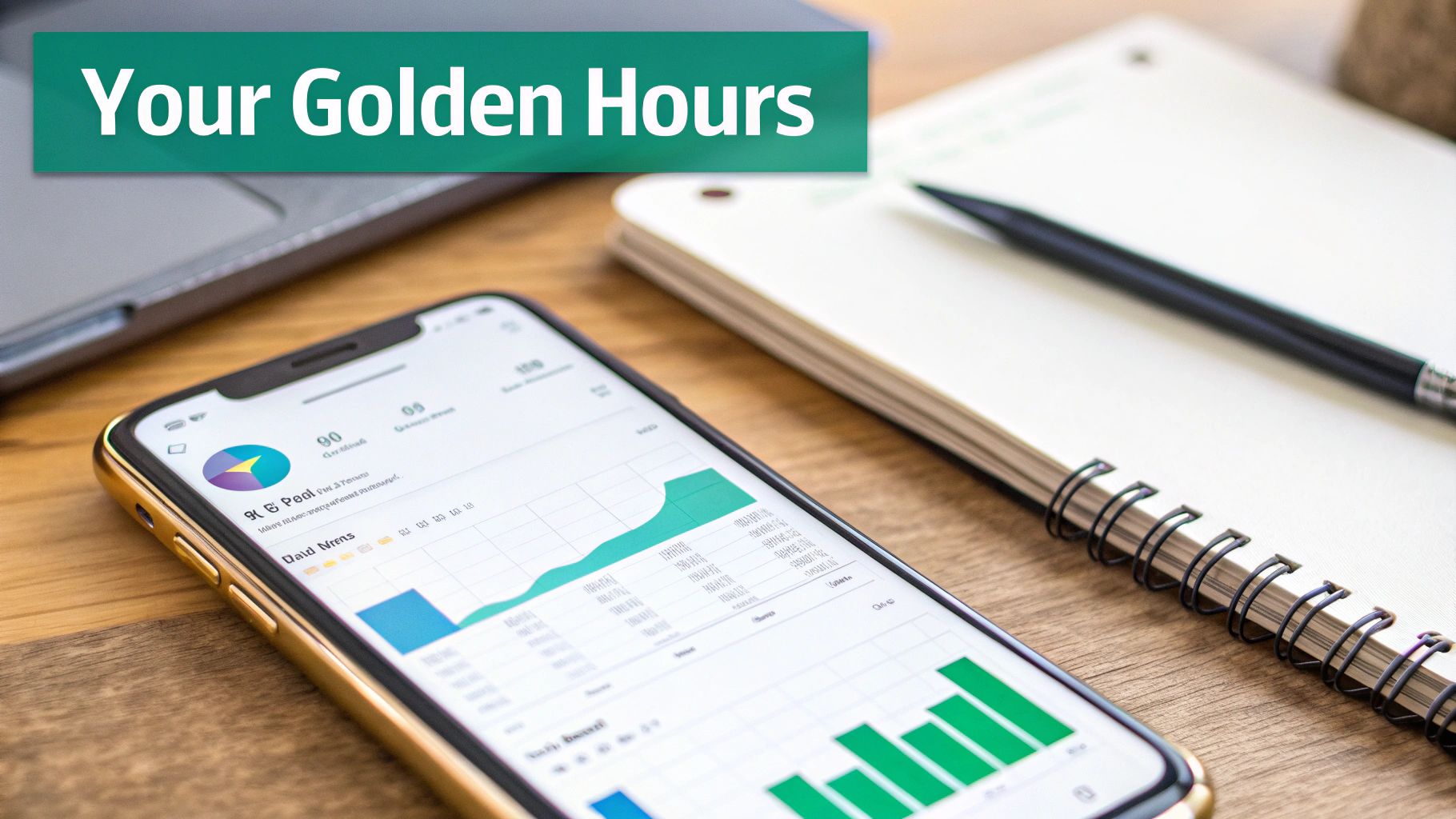
The Lunch Break: This is a golden hour. It’s a dedicated block of time when users are actively looking to be entertained or informed.
The Evening Wind-Down: After the workday is done, people are kicking back and using Instagram for pure entertainment and connection.
This natural rhythm is exactly why weekdays tend to have such consistent, reliable activity.
The Weekday Sweet Spot
You’ll often hear that Tuesday, Wednesday, and Thursday are the best days for engagement, and there's a good reason for that. These days form the core of the workweek when people's routines are at their most stable and predictable. They've settled into a groove, which makes their online habits much easier to anticipate.
Early Tuesday mornings, for example, can be a real sweet spot. The weekend haze has worn off, and people are looking for fresh content to get their day started. But Wednesday, time and time again, proves to be the standout performer.
Recent data consistently shows that Wednesday is often the day with the highest engagement on Instagram. Across the board, weekdays see the most action around noon, 3 p.m., and 6 p.m., with another little bump around 9 a.m. This pattern perfectly mirrors the common schedule of quick morning check-ins, lunch breaks, and that classic post-work scroll. You can dig deeper into these weekly engagement patterns to see how people’s habits evolve from Monday to Sunday.
How the Weekend Changes Everything
Once Friday hits, you can feel the energy start to shift—and your posting schedule should, too.
On Fridays, the usual engagement windows start to slide. As people ease into weekend mode, you’ll find the best times to post often drift a bit later in the day, usually somewhere between 4 p.m. and 6 p.m. This timing catches your audience just as they’re clocking out and figuring out their evening plans.
A late-night Sunday post can be a surprisingly powerful move. As people get ready for the week ahead, they often have one last scroll on Instagram to relax, giving you a great shot at their undivided attention.
Saturday tends to be a bit more traditional, with users most active from late morning through the early afternoon. Sunday, however, has its own unique vibe. While much of the day can be quiet, a post late at night—around 11 p.m.—often does incredibly well. You're catching people during their final scroll before the Monday morning reality sets in.
Getting a feel for these daily rhythms is crucial. It helps you move past a rigid, one-size-fits-all schedule and build a content plan that actually meets your audience where they are, any day of the week.
Adapting Your Schedule for Different Content and Regions
Here's a common mistake I see: treating all Instagram content as if it's the same. It’s a bit like assuming every song works for every occasion. You wouldn't play a high-energy dance track during a quiet dinner, right? The same logic applies here. The perfect time to post a quick, static image often won't be the best time for an immersive Reel.
To really nail this, you need a strategy that considers both what you're posting and who you're trying to reach.
Different content formats are designed for different moments. Someone might glance at a photo while waiting for their coffee, but save a longer video for when they have more downtime. The trick is to align your content with these natural lulls in their day.
Tailoring Times to Content Formats
Think about how people actually use their time. A quick scroll during the morning commute is perfect for a static image or a carousel post—they deliver information fast. Reels, on the other hand, usually demand more focus and are better suited for those moments when people are looking to kick back and be entertained.
Industry data confirms this. While broad engagement windows are a good starting point, different formats have their own unique sweet spots. Reels, for example, tend to do best between 11 a.m. and 2 p.m. and 6–9 p.m. These are classic lunch break and post-work windows when people have more mental bandwidth for video. To get a deeper dive, you can find more details on strategic posting times that can help fine-tune your schedule.
Here’s a quick breakdown of how to think about timing for each format:
Static Images & Carousels: These are ideal for morning slots (7–9 a.m.) and midday breaks (12–2 p.m.). They're easy to digest and perfect for capturing attention during a quick scroll.
Instagram Reels: Aim for the evening hours (6–9 p.m.) when your audience is looking for entertainment. The lunchtime window (11 a.m.–2 p.m.) is another strong bet.
Instagram Stories: Stories are all about immediacy. Posting them during peak activity hours throughout the day keeps your account at the top of your followers' feeds and top of mind.
Here's a table to give you a clearer picture of how these windows stack up.
Optimal Posting Windows by Content Type
Static images and carousels: These perform best during the 7:00–9:00 a.m. time window, with a secondary opportunity for engagement between 12:00–2:00 p.m.
Instagram Reels: The strongest engagement typically occurs in the 6:00–9:00 p.m. window, while a secondary posting period is 11:00 a.m.–2:00 p.m.
Instagram Stories: Engagement peaks during 12:00–3:00 p.m., though Stories can remain effective when posted consistently throughout the day.
Matching your content type to the user's mindset is what separates a good strategy from a great one. A one-size-fits-all schedule is just a missed opportunity.
A one-size-fits-all schedule is a missed opportunity. The best time for a Reel isn't always the best time for a static image. Matching your content type to user mindset is what separates a good strategy from a great one.
Navigating Different Time Zones and Regions
What if your audience is spread all over the world? If you just post based on your local time, you're guaranteed to miss a huge chunk of your followers. A 9 a.m. post in New York is 6 a.m. in Los Angeles and 2 p.m. in London. One of them is likely a dead zone.
Understanding regional daily routines is essential for any international brand. For instance, engagement in the United Kingdom typically spikes during standard commute times (7–9 a.m.), lunch breaks (12–2 p.m.), and after work (6–8 p.m.). It’s a classic workday rhythm.
To manage a global audience effectively, you have to segment your posting schedule. The first step is to jump into your Instagram Insights and identify where your major follower hubs are. From there, you can build a schedule that hits those "golden hours" in each of your main regions. This simple step ensures your content feels timely and relevant, no matter where your audience is scrolling from.
How to Find Your Personal Best Time to Post
While all the global data gives you a fantastic starting point, the real magic happens when you look in your own backyard—your account’s analytics. Think of the big studies as a well-drawn map. To find the treasure, you need your own compass: Instagram Insights. This is where you graduate from generic advice to a strategy that actually works for you.
Every audience has its own unique rhythm. A community of night-owl gamers is going to have wildly different active hours than an audience of early-rising fitness junkies. Relying only on broad statistics is like guessing their favorite song; checking your own data is like asking them directly.
Digging into Your Instagram Insights
If you have a Business or Creator account, Instagram hands you a free goldmine of information about your followers. This is your first and most important stop.
Here’s how to get there: 1. Go to your Instagram profile and tap the Professional Dashboard button. 2. Under "Account insights," tap See All. 3. Select Total Followers and scroll all the way down to the "Most Active Times" section.
This little dashboard shows you exactly when your followers were online over the last week, broken down by both hours and days.
Here’s an example of what that "Most Active Times" chart looks like.
The darker blue bars are your hotspots—they show you the days and specific hours when the highest concentration of your audience is scrolling. These spikes are your starting line. For a more detailed walkthrough, you can learn more about how to navigate Instagram Insights in our complete guide.
Setting Up a Simple Posting Experiment
Now that you have the data, it's time to put it to the test. Don't just start throwing posts out at peak times. You need a structured experiment to get clean, reliable results.
Identify Top Times: Look at your Insights and pick out the top 3-5 time slots where your audience is most active. For example, your data might point to Wednesday at 6 PM, Thursday at 8 PM, and Friday at 12 PM.
Create Similar Content: This is key for a fair test. You need to prepare content that is similar in quality and format for each time slot. Pitting a high-effort Reel against a quick, low-quality photo won't give you accurate data on timing.
Schedule and Post: Over a week or two, post your pieces of content consistently in each of the time slots you chose.
Track Your Results: A simple spreadsheet is your best friend here. Track how each post performs after the first 24 hours.
Your goal isn't to find one single "magic" hour. It's to identify a handful of high-performing windows that you can consistently rely on to give your content the best possible launchpad.
Analyzing the Results Beyond Likes
When you review your experiment, you have to look deeper than just the like count. A double-tap is nice, but true engagement runs much deeper.
Keep an eye on these key metrics:
Comments: Did your post actually spark a conversation?
Shares: A huge indicator that your content was valuable enough for someone to send to a friend.
Saves: This is a massive signal to the algorithm that you created something people want to come back to. It’s gold.
Reach: How many unique accounts saw your post? This tells you how well your timing helped you break through the noise.
After a few weeks of tracking, patterns will start to pop out. You might discover that while your 6 PM posts get more likes, your 12 PM posts generate way more saves and shares. This kind of intel is invaluable, letting you tailor not just when you post, but what you post at those times to hit specific goals.
A Few Lingering Questions About Instagram Posting Times
Even after you've got a handle on the basics, a few questions always pop up when trying to nail down that perfect posting window. Let’s clear up some of the most common ones so you can finalize your strategy and post with total confidence.
What Is the Single Best Day to Post on Instagram?
If I had to bet on just one day for a killer post, my money would be on Wednesday. Across countless studies and my own experience, it consistently delivers the highest engagement, especially around that midday lunch break and again in the early evening.
Of course, Tuesdays and Thursdays are right behind it. They're both powerhouse days with steady activity from late morning straight through the afternoon. Think of these three days as the prime real estate of the Instagram week.
Does Posting Time Matter for Instagram Reels?
Yes, it absolutely does. People often think the algorithm gives Reels a free pass, but that's not the whole story. While Reels definitely have a longer shelf life, that initial burst of engagement is what tells the algorithm, "Hey, this is good stuff, show it to more people!"
The best times for Reels almost always line up with when people are taking a break and looking for a quick dose of entertainment.
Lunch Breaks: Around 11 a.m. to 2 p.m.
Evening Wind-Down: Roughly 6 p.m. to 9 p.m.
These are the moments when your followers are most likely to stop scrolling and actually watch a video.
One word of caution: don't just assume your best time for a static photo is the same for a Reel. The mindset is different. Test your video content separately to see when your audience is in a "watching" mood.
How Do I Handle an Audience in Multiple Time Zones?
This is a great problem to have—it means you're growing! The trick is to stop thinking in terms of your local time and start looking for the overlap. Dive into your Instagram Insights and pinpoint your top two or three audience locations.
From there, you just need to do a little math to find the "golden hours" that work for most people. For instance, posting at 11 a.m. EST hits the East Coast lunch crowd while also catching West Coast followers at 8 a.m. PST as they start their day. It’s all about finding that sweet spot to maximize your global reach.
How Often Should I Re-Evaluate My Posting Times?
Think of your posting schedule as a living document, not a stone tablet. Audience habits change, algorithms get updated, and life happens. I recommend doing a full review of your posting times and performance at least once a quarter.
You’ll also want to take a fresh look anytime there's a big shift, like:
Instagram rolls out a major algorithm update.
You make a big pivot in your content strategy.
You see a sudden change in follower growth or demographics.
Staying flexible is the name of the game. Finding a good time to post on Instagram isn't something you do once; it's an ongoing part of a smart, adaptive strategy.
Ready to turn those insights into real, organic growth? Gainsty uses advanced AI and expert strategies to help you connect with your audience and get more followers, safely and authentically. Stop guessing and start growing. Discover how Gainsty can change your Instagram followers today!

.png&w=1920&q=75&dpl=dpl_D59Qa4oJ5cFQ7dZDLQ1JPQVnqHSs)





.png&w=750&q=75&dpl=dpl_D59Qa4oJ5cFQ7dZDLQ1JPQVnqHSs)