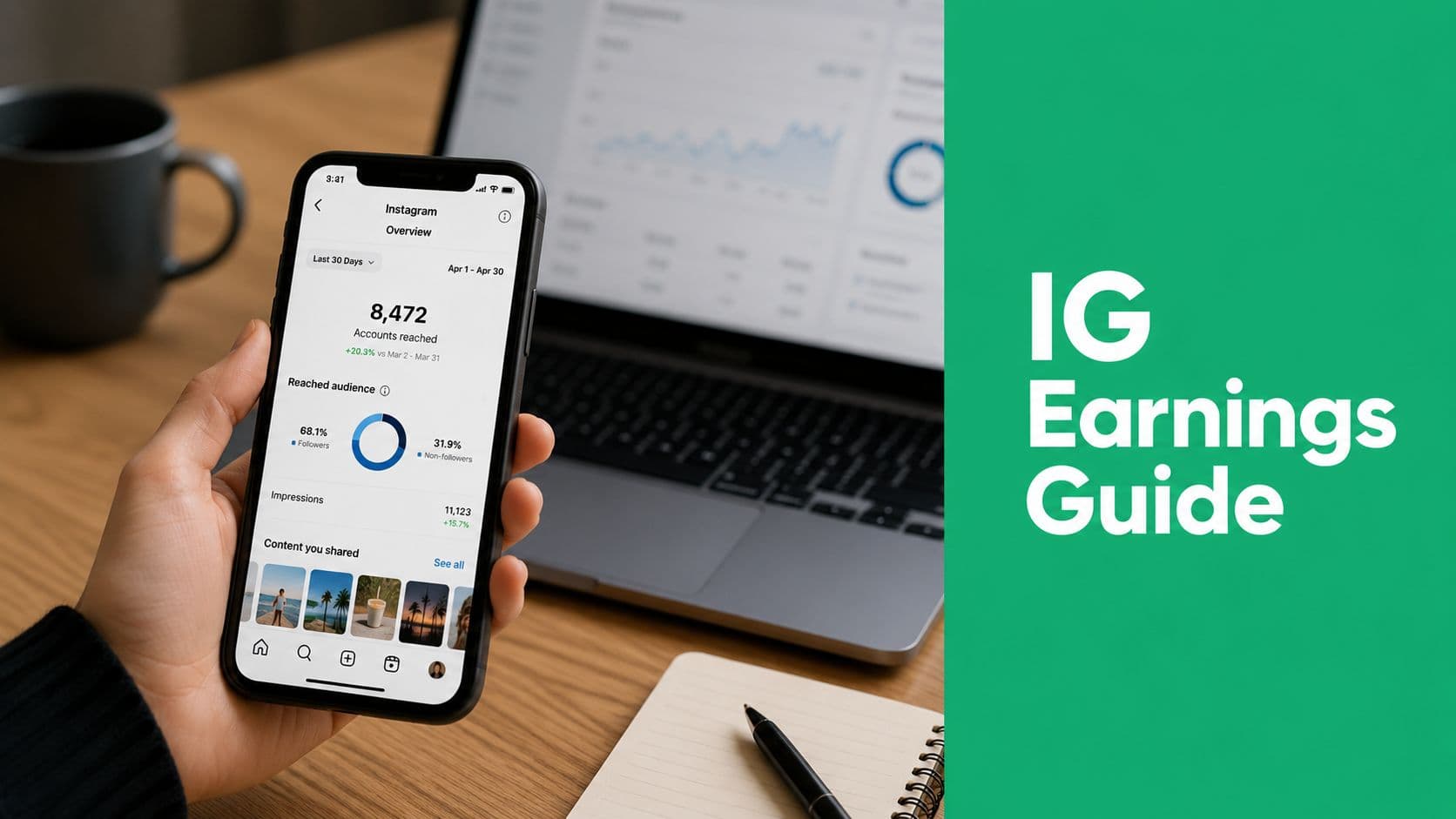
The Honest Answer to Your Instagram Earnings Question
Instagram's own Help Center makes the answer plain. Payouts are tied to specific monetization products and eligibility rules, not a universal pay-per-view system, and payout minimums vary by country, which is why there isn't one clean “Instagram pays X per 1,000 views” number to cite (Instagram Help Center on payouts and eligibility).
That's why chasing a made-up CPM is a dead end. If you're trying to build income on Instagram, you need to think like a creator-business owner, not like someone waiting for a platform to deposit money every time a Reel gets watched.

What actually drives earnings
The practical model looks more like this:
Official monetization tools: Some creators qualify for bonuses, subscriptions, badges, or other in-app programs.
Brand partnerships: Brands pay for access to a specific audience, content style, and creator trust.
Affiliate revenue: You recommend products and earn when your audience buys.
Your own offers: Services, digital products, coaching, memberships, or physical products.
Views still matter. They just matter indirectly.
Practical rule: Treat views as proof of attention, not proof of income.
If a Reel gets traction but your profile is weak, your niche is blurry, and there's no path to conversion, those views won't do much. If the same Reel attracts the right audience and your account gives them a clear next step, the exact same attention can become revenue.
That's the mindset shift most creators need. Stop asking what Instagram owes you for views. Start asking what your content makes possible.
Understanding the Myth of Pay-Per-View on Instagram
The fastest way to kill the myth is to look at a real example. One creator publicly shared earning $18.84 for 1.9 million views, which tells you almost everything you need to know about relying on views alone for income (creator payout example discussed here).
That example shocks people because they assume millions of views must equal serious platform money. On Instagram, that assumption breaks fast.
Why the myth survives
Creators keep searching for a per-view answer because other platforms trained them to think that way. Instagram encourages content creation, shows view counts prominently, and runs monetization products for some creators. From the outside, that looks like a standard ad-share setup.
It isn't.
Instagram monetization is uneven by design. Access depends on product availability, geography, account standing, and whether a creator is eligible for a specific feature. Even when a view-linked bonus exists, it's not a permanent universal rate card.
What views are actually worth
Views are useful in three ways:
Signals reach: Views show how many people your content is reaching, which is important because brands often use this as proof that your content is being seen.
Tests ideas: View performance helps you understand what your audience responds to, since stronger-performing content usually reflects better content-market fit.
Feeds other offers: Higher attention can drive downstream actions like affiliate clicks, inquiries, subscriptions, or sales opportunities.
What views don't do is guarantee platform income.
A Reel with weak commercial intent can get attention and still earn almost nothing.
That's why creators get stuck when they optimize for vanity metrics alone. Viral reach without audience fit is noisy. A smaller but well-matched audience often has more business value.
The better benchmark
Instead of asking “How much does Instagram pay for 1,000 views?”, ask:
Did this content attract the audience I want?
Did people save, reply, click, or ask questions?
Could I show this post to a brand as proof of relevance?
Does this content move people toward an offer?
That's the operating system for Instagram monetization. The platform may reward some creators through specific products, but sustainable income usually comes from what you build around the content, not from the view count itself.
Instagram's Official Monetization Programs
If you want money directly connected to Instagram, start with the tools inside the platform. Just keep your expectations realistic. These products can help, but they're not a stable replacement for a broader monetization strategy.

Reels Play Bonus and other view-linked payouts
The old Reels Play Bonus is the closest Instagram came to an explicit pay-for-views product. It was invite-only, and reports on earnings were all over the place. Published reporting notes $50 to $175 for a few thousand views, and the creator estimates around $600 to $1,200 per 1 million views for eligible accounts (reported Reels Play Bonus ranges).
That tells you two things.
First, Instagram has experimented with view-based payouts. Second, those payouts were variable enough that you couldn't build a reliable business around them.
If you're focusing on Reels, it helps to keep up with how the format itself is changing. This guide on Instagram Reels in 2026 is useful for understanding how creators are adapting content strategy around the format.
Subscriptions and fan-funded features
Instagram has also leaned into creator tools that depend on community support rather than automatic ad revenue. That includes products like Subscriptions, where followers pay for exclusive access, and fan-support features like badges or stars, where available.
These tools work best for creators with a clear relationship to their audience. Education creators, niche commentators, coaches, artists, and community-led pages usually have a stronger shot here than broad meme accounts or trend chasers.
A few practical truths:
Loyalty matters more than reach: A highly engaged core audience is more useful than casual viral traffic.
Exclusive value matters: People won't subscribe just because they like you. They subscribe because they get something distinct.
Consistency matters: Fan support drops when posting becomes erratic.
Native affiliate and commerce features
Instagram also supports monetization tied to products and shopping behavior. Depending on your account and eligibility, that can include native affiliate features or product-linked discovery inside the app.
This model usually outperforms passive view chasing because it gives the audience a direct action to take. They see the content, trust the recommendation, and move toward a purchase.
Working rule: If Instagram offers you a monetization feature, use it. Don't mistake access for a full income plan.
How to approach official programs without getting distracted
Use Instagram's built-in monetization tools as layers, not as your only strategy.
Check your Professional Dashboard: See what's available to your account.
Keep your account in good standing: Policy issues can block eligibility.
Build for repeat engagement: Official tools reward creators who keep people coming back.
Treat bonus income as unstable: Helpful when it's there, risky if it's your whole plan.
That's the right mental model. Native monetization is worth setting up. It's just not where most creators should expect their highest income.
The Real Money Maker Brand Deals and Affiliate Links
For most serious creators, the money conversation gets better when it moves away from platform payouts and toward commercial intent. Brands don't pay you because Instagram feels generous. They pay you because you help them reach a specific audience in a credible way.
Affiliate marketing works on the same logic. You earn because your recommendation moves someone closer to a purchase.
Why brand deals usually beat waiting on Instagram
A sponsored Reel or post is a business transaction. A brand is buying distribution, creative, trust, or all three. If your audience fits their product, your content has value even if Instagram never pays you directly for views.
That's why creators should build a simple media case for themselves:
Your niche clarity: What topic do you consistently own?
Your audience fit: Who follows you, and why do they trust you?
Your content style: Can you teach, demo, review, or entertain in a way that feels native?
Your proof: Save examples of posts that triggered comments, saves, DMs, and product questions.
If you're learning how to position yourself for partnerships, this guide on how to get brand deals is a practical place to start.
Affiliate links are better for some creators than sponsorships
Not every account is ready for paid partnerships. That doesn't mean the account can't monetize. Affiliate links often work well earlier because they reward useful content, not just creator size.
Good affiliate content usually looks like this:
Demonstration content: You show how a product solves a problem.
Comparison content: You explain who a product is for and who it isn't for.
Workflow content: You show the tools you already use in a real process.
Follow-up content: You answer objections people raise in comments or DMs.
This works because the recommendation is attached to the context. Random links under random posts rarely convert well.
What usually works and what usually fails
A creator who gets paid repeatedly isn't just “good at Instagram.” They're good at matching audience intent to an offer.
What tends to work:
Niche-specific recommendations: This works because the offer feels directly relevant to your audience, making brands more confident that your influence will translate into real interest.
Repeatable content formats: This works because brands can easily picture how they would promote them again in future campaigns, not just as a one-off post.
Clear audience trust: This works because followers are more likely to act on your recommendations when they consistently trust your opinions and content.
Strong profile positioning: This works because a brand can quickly understand who you are, what you do, and why working with you would be valuable.
What usually fails:
Taking every deal: The audience notices when the fit is bad.
Selling before building trust: People ignore recommendations from accounts with no authority.
Overvaluing raw reach: A brand often cares more about fit than random exposure.
Posting sponsored content that looks forced: If the ad breaks your normal style, performance usually suffers.
Sponsored content gets easier to sell when it already looks like your normal content, just with a product inside it.
Brand deals and affiliate revenue reward the same core skill. Build an audience that trusts your judgment. Once you do that, the view question stops being the center of the business.
How Instagram Earnings Compare to TikTok and YouTube
The easiest comparison is this. YouTube is built around a more mature ad-sharing system. TikTok has historically pushed creator-fund style thinking more directly. Instagram sits in a middle ground where the platform has a huge ad machine, but creator income often arrives through partnerships and selective monetization products rather than a universal pay-per-view payout.
Instagram's ad economy is massive. It is projected to generate $42.52 billion in US ad revenue in 2026, representing 53.1% of Meta's total US ad revenue, and Reels accounted for 53% of Instagram ad placements in Q4 2025. At the same time, published industry data cited by Sprout Social shows an average Instagram influencer engagement rate of 1.36% in 2025, with Reels at 1.24% and photo posts at 1.04% (Sprout Social's Instagram statistics roundup).

What does that mean in practice
The money is clearly on Instagram. But much of that money is captured through ad placements and brand budgets, not automatically handed to creators because a Reel got views.
That's why Instagram can feel confusing to new creators. The platform is commercially powerful, but the route to creator income is less direct than people expect.
A simple comparison helps:
YouTube: Better if you want a clearer platform monetization framework.
TikTok: Better if your growth strategy depends on rapid short-form discovery.
Instagram: Better if you want to turn audience trust into sponsors, affiliates, subscriptions, and commerce.
If you're also exploring YouTube monetization paths, it helps to compare the platform models before you decide where your main effort should go.
Which platform is “best” for money
There isn't one answer. It depends on how you monetize.
If you want predictable platform-side economics, YouTube usually feels easier to model. If you're strong at branded content, product recommendations, and audience trust, Instagram can be extremely valuable. It gives brands a polished environment, strong commerce behavior, and multiple content formats.
Instagram pays less like a media company and more like a marketplace. Once you understand that, the platform makes more sense.
How to Maximize Your Instagram Earning Potential
The creators who earn the most on Instagram usually don't chase views blindly. They build accounts that are easy to monetize. That means niche clarity, trust, and content that leads somewhere.

Build for commercial relevance, not just reach
A lot of accounts grow and still struggle to monetize because the audience is too broad or the content is inconsistent. Brands don't want mystery. Neither do buyers.
Focus on these fundamentals:
Choose a monetizable niche: You need a topic that attracts people with clear interests or problems.
Create repeatable content pillars: Reviews, tutorials, reactions, comparisons, case breakdowns, and behind-the-scenes workflows.
Make your profile legible: A new visitor should understand what you do in seconds.
Use calls to action that reveal intent: Ask for saves, replies, questions, and DMs. Those signals are often more useful than empty reach.
One practical way to think about Instagram growth is to ask whether your content attracts the kind of follower a brand or affiliate partner would want. Tools can help organize that process. For example, Gainsty's influencer rate card template guide is useful when you're turning content performance into something you can pitch professionally.
Engagement quality matters more than vanity spikes
Not all attention is equal. A broad viral post can inflate your numbers and still leave you with weak buyer intent. A narrower post that attracts the right people can become far more valuable over time.
Look for signs of quality:
Saves: This matters because it shows people found the content useful enough that they want to come back to it later.
DMs: This is a strong signal because it often reflects trust, deeper interest, or even buying intent.
Specific comments: This matters because it shows people are actually engaging with the topic, not just reacting randomly.
Profile actions: This matters because it shows people are interested enough to learn more about you and your content overall.
That's the kind of engagement brands care about, even when they also ask for reach.
Here's a useful walkthrough on tightening your content and growth process:
A simple checklist for creators who want to earn
Stop asking whether a Reel went viral enough to get paid. Ask whether it attracted the right person and gave them a next step.
Use this checklist:
Switch to a professional account if you haven't already.
Audit your bio and pinned content so your value is obvious.
Pick one monetization lane first, such as affiliate offers, subscriptions, or brand-ready content.
Track what causes action rather than what only causes views.
Build a content library that proves your niche authority over time.
That's what moves an account from hobby status to business asset.
Conclusion: From Chasing Views to Building Value
The honest answer to how much Instagram pays for views is unsatisfying if you're looking for a simple rate card. Instagram doesn't work that way. Views alone are a weak income metric on this platform, and creators who build their expectations around a fixed payout usually end up frustrated.
The better model is more useful anyway. Build content that attracts the right audience. Use official monetization tools when they're available. Turn trust into affiliate revenue, subscriptions, product sales, or brand partnerships. That's how creators build income that doesn't disappear when a bonus program changes.
The biggest shift is mental. Stop treating Instagram like a slot machine where views should spit out cash. Treat it like a business channel where attention has to be converted.
If you want a broader framework beyond Instagram alone, this resource on strategies for content monetization is worth reading because it pushes the same core idea. Content becomes valuable when it connects attention to an offer.
Creators who win on Instagram usually aren't the ones asking what one view is worth. They're the ones building an account that makes every qualified view more valuable.
If you're trying to turn Instagram attention into real business results, Gainsty can help you build a stronger foundation with organic Instagram growth, audience targeting, and engagement support so your account is better positioned for brand deals, affiliate revenue, and other monetization paths.
.png&w=1920&q=75&dpl=dpl_C723nkStk4By7P6JWE3DQWUAB8y4)




.png&w=750&q=75&dpl=dpl_C723nkStk4By7P6JWE3DQWUAB8y4)