Your Blueprint for an Unstoppable Content Strategy
Let's cut through the noise. A great content strategy isn't just a fancy content calendar. It’s the game plan that shifts you from "creating stuff" to producing content that genuinely connects with people and drives your business forward. It’s about building a reliable system from the ground up.
Think of this guide as the high-level map for that journey. We'll walk through the entire process, from figuring out who you're really talking to, all the way to tracking the metrics that signal real, sustainable growth on Instagram. By the end, you'll have a clear framework to build upon.
The Core Phases of Content Strategy
At its core, the entire process is a continuous loop with three distinct phases: you research, you create, and you measure. It's that straightforward.
This isn't a one-and-done task. It's a cycle. You're constantly learning from your audience and refining your approach based on real data.
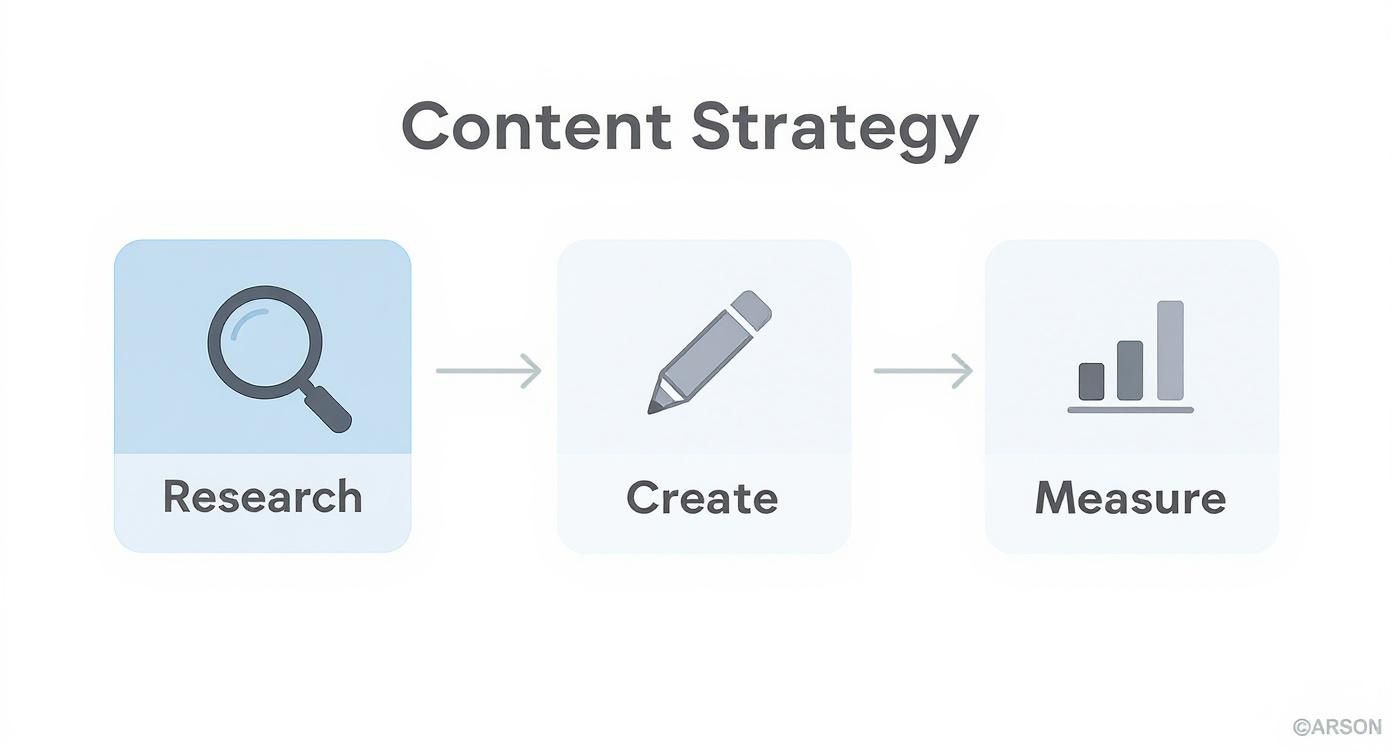
The idea is to build a solid foundation first. You can see how other brands put these ideas into action by checking out these content strategy examples from different niches. Once you’ve got the basics down, you can layer on more advanced content marketing best practices to really scale your efforts.
> A great content strategy provides direction, purpose, and structure to your content marketing efforts, making them more effective and aligned with overall business goals. It transforms content creation from a reactive, piecemeal approach to a proactive initiative that drives business growth.
To help you visualize the path ahead, I've broken down the entire framework into a simple table. Think of it as your cheat sheet for the journey we're about to take.
The Content Strategy Development Framework at a Glance
Research & Foundation: This phase focuses on understanding your audience and setting clear goals. It includes building audience personas, analyzing competitors, and defining the objectives you want to achieve.
Planning & Creation: This phase is all about building a consistent and efficient content system. It involves establishing your content pillars, creating a content calendar, and setting up a smooth production workflow.
Measurement & Growth: This phase ensures you’re tracking what matters and improving over time. It includes monitoring key performance indicators, analyzing data, increasing engagement, and refining your overall strategy based on results.
With this structure in mind, you have a clear model for building, launching, and growing your presence. Now, let's dive into the details of each phase.
Get to Know Your Audience and Define Your Mission
Posting on Instagram without a clear audience in mind is basically like shouting into a void. Before you even think about your next post, you have to nail down two critical questions: who are you actually talking to, and what do you want them to do? This is the absolute foundation of any content strategy that gets real results.
Your mission is to go way beyond surface-level details like age and location. Of course, that stuff helps, but the real gold is in understanding the psychographics of your ideal follower. What keeps them up at night? What are their biggest dreams? What problems are they desperately trying to solve that you can help with?
Digging Deeper with Audience Personas
Think of an audience persona as a semi-fictional character who represents your perfect follower. This isn't just a boring list of traits; it's a story. For example, instead of saying your audience is "millennial women," you could create a character like "Creative Carla."
Who is she? Carla is a 28-year-old freelance graphic designer living in a big city.
What are her struggles? She’s having a tough time landing high-paying clients and feels creatively drained by all the admin work that comes with being a freelancer.
What does she want? Her dream is to land a project with a major brand. She also wants to find a community of other creatives so she doesn't feel so isolated.
See how that changes things? Suddenly, you're not just posting generic design tips. You're creating content that speaks directly to Carla’s burnout and helps her figure out how to find better clients.
You don't need a huge budget to gather this kind of insight. Start by looking at your current followers. Dive into the comments on your competitors' posts. Hang out in the online communities where your ideal audience is already talking. For a more structured approach, our guide on how to identify your target audience breaks it down with practical, step-by-step methods.
Setting Goals That Actually Matter
Once you know who you’re talking to, you need to decide what success actually looks like. Vague goals like "get more engagement" are useless because you can't measure them. Your goals need to be specific and tied directly to what you want to achieve for your business. This is where the SMART framework (Specific, Measurable, Achievable, Relevant, Time-bound) is a lifesaver.
Let’s compare a vague goal with a SMART one:
Vague Goal: Increase brand awareness.
SMART Goal: Increase our Instagram profile reach by 20% over the next quarter by focusing on shareable Reels content.
> The difference is accountability. A SMART goal gives you a clear target and a deadline, forcing you to be strategic about the content you create to hit that number. It’s your benchmark for success.
This whole process ensures that every single piece of content has a job to do. Trying to drive traffic to your website? Your key metric is link clicks. Want to build a thriving community? Then you’re watching comments and DMs like a hawk.
Connecting this deep audience understanding with sharp, measurable goals is the bedrock of a powerful Instagram strategy. It moves you from just posting randomly to running a focused campaign where every post has a purpose, inching you closer to your real business objectives. This is what separates the brands that fizzle out from the ones that see consistent, predictable growth.
Establish Your Core Content Pillars
Once you’ve figured out who you’re talking to, it's time to decide what you’re going to talk about. Just posting whatever comes to mind is one of the fastest ways to confuse your audience and kill your growth. You need a thematic foundation.
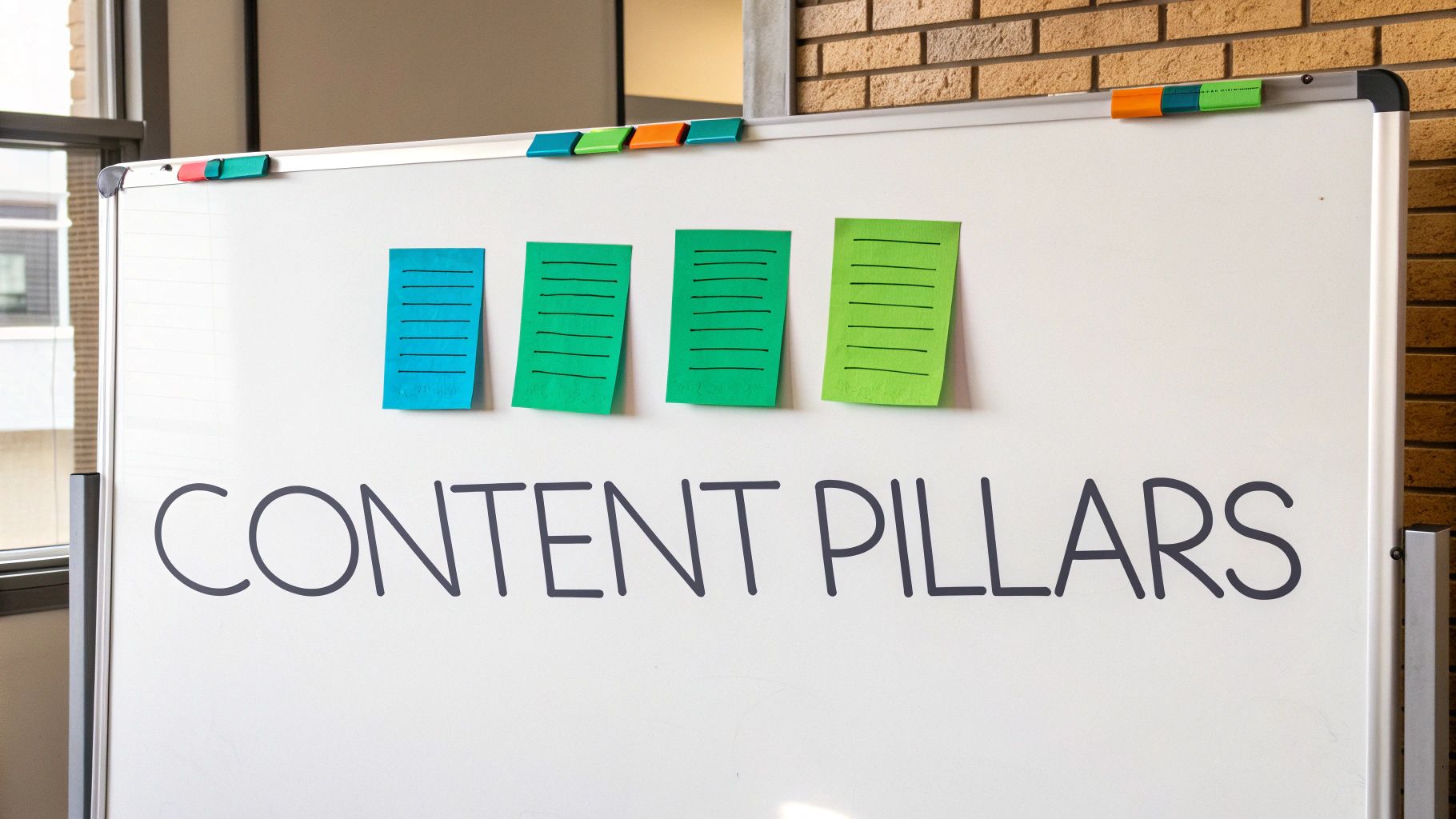
This is where content pillars come in. These are the 3-5 core topics or themes your brand will own and talk about, time and time again. They're the backbone of your entire content strategy.

Think of pillars as the main aisles in your content supermarket. They bring order to the chaos, keep your message consistent, and make coming up with new ideas a whole lot easier. Instead of staring at a blank screen wondering, "What do I post today?" you'll ask a much better question: "What's a fresh take on my 'Productivity Hacks' pillar?" This simple switch turns content creation from a daily headache into a focused, strategic exercise.
Your pillars should live at the intersection of what your audience is dying to know and what your brand knows best. They have to be broad enough to fuel a constant stream of fresh ideas but specific enough that you can carve out a real niche for yourself.
How To Choose Your Pillars
Picking your pillars isn't complicated, but it does require some real thought. Start by grabbing all that great research you did on your audience. What are their biggest questions, their most frustrating challenges, and their ultimate goals?
Now, make another list: what are your areas of expertise? What is the core value your business delivers? The sweet spot where those two lists overlap—that’s where you’ll find your strongest content pillars.
Let’s run through a quick example. Imagine you’re a B2B software company selling a project management tool to small business owners. Your audience research told you they’re constantly fighting the clock, struggling to find new leads, and trying to get their small teams to work together effectively.
Based on that, you could easily land on pillars like these:
Productivity Hacks: Actionable tips that genuinely save entrepreneurs time and cut down on stress.
Client Spotlights: Real stories showing how other small businesses used your software to solve a specific problem and get tangible results.
The Future of Work: Your take on industry trends that matter to small businesses, positioning you as a forward-thinker.
Team Collaboration Blueprints: Practical frameworks and best practices for improving communication and efficiency.
> I see a lot of brands make the mistake of choosing pillars that are way too broad, like "Marketing," or painfully narrow, like "How to use our new button." The magic is in finding a topic that provides standalone value while still pointing back to the problem your product solves.
Once you have a list of ideas, it's time to get ruthless and narrow it down to the best 3-5. For each potential pillar, ask yourself:
Can I easily brainstorm 10-15 unique post ideas for this?
Does this directly support my business goals?
Is this something my audience actually* cares about?
Answering those questions honestly will give you a rock-solid foundation that can support your content strategy for months, if not years. If you want to go even deeper, our guide on social media content pillars has more examples and frameworks to help you nail this down.
Putting Your Pillars into Action
With your pillars defined, they become the blueprint for your content calendar. The goal is to rotate through them, creating a balanced diet of content that hits on each theme regularly. This keeps things interesting for your audience while constantly reinforcing what you're all about.
For instance, your weekly rhythm might look something like this:
Monday: A quick Reel on a 'Productivity Hack.'
Wednesday: A detailed carousel post breaking down a 'Client Spotlight.'
Friday: A thought-provoking text post on 'The Future of Work.'
This structured rhythm doesn't just make your life easier; it creates a cohesive and predictable experience for your followers. They start to understand what you stand for and what to expect from you, which is how you build trust and give them a reason to stick around. Over time, that consistency is what turns casual viewers into a real community and transforms your Instagram from just another profile into an indispensable resource.
Build an Efficient Content Production System
A brilliant strategy is just a document until you have a system to bring it to life, day in and day out. Your content pillars tell you what to post, but a solid production system answers the how and when. This is where the rubber meets the road—we’re moving from high-level plans to the practical, get-it-done work of creating and scheduling.
The real goal here is to build a workflow you can actually stick with. One that doesn't lead to burnout but still keeps your quality high. Without a system, you're constantly in a reactive state, scrambling for last-minute ideas. That chaos almost always leads to rushed, subpar posts that just don't land with your audience.
Embrace the Power of Batching
If there's one "hack" that truly works, it's content batching. It's a simple but profound shift in how you work. Instead of trying to create a single post from scratch every day, you group similar tasks together and knock them out in dedicated blocks of time. This cuts down on the mental friction of switching between different types of work and helps you find that creative flow state.
So, what does that look like in practice for a month's worth of content? It might be broken down like this:
Week 1 (Ideation & Scripting): You’ll brainstorm all your post ideas for the next month, making sure they align with your content pillars. After that, you'll sit down and write all* the captions, carousel copy, and video scripts.
Week 2 (Visual Production): Time to get in front of the camera. Film all of your video content in one or two sessions. In another block of time, design all your graphics and carousels.
Week 3 (Editing & Assembly): Now you put it all together. Edit the videos, pair the final visuals with their approved captions, and get everything prepped for scheduling.
Week 4 (Scheduling & Engagement): Load everything into your scheduling tool. With content handled, your time is now freed up to focus on engaging with your community and analyzing what's working.
Suddenly, content creation isn't a frantic daily chore. It’s a structured, predictable project.
Constructing Your Content Calendar
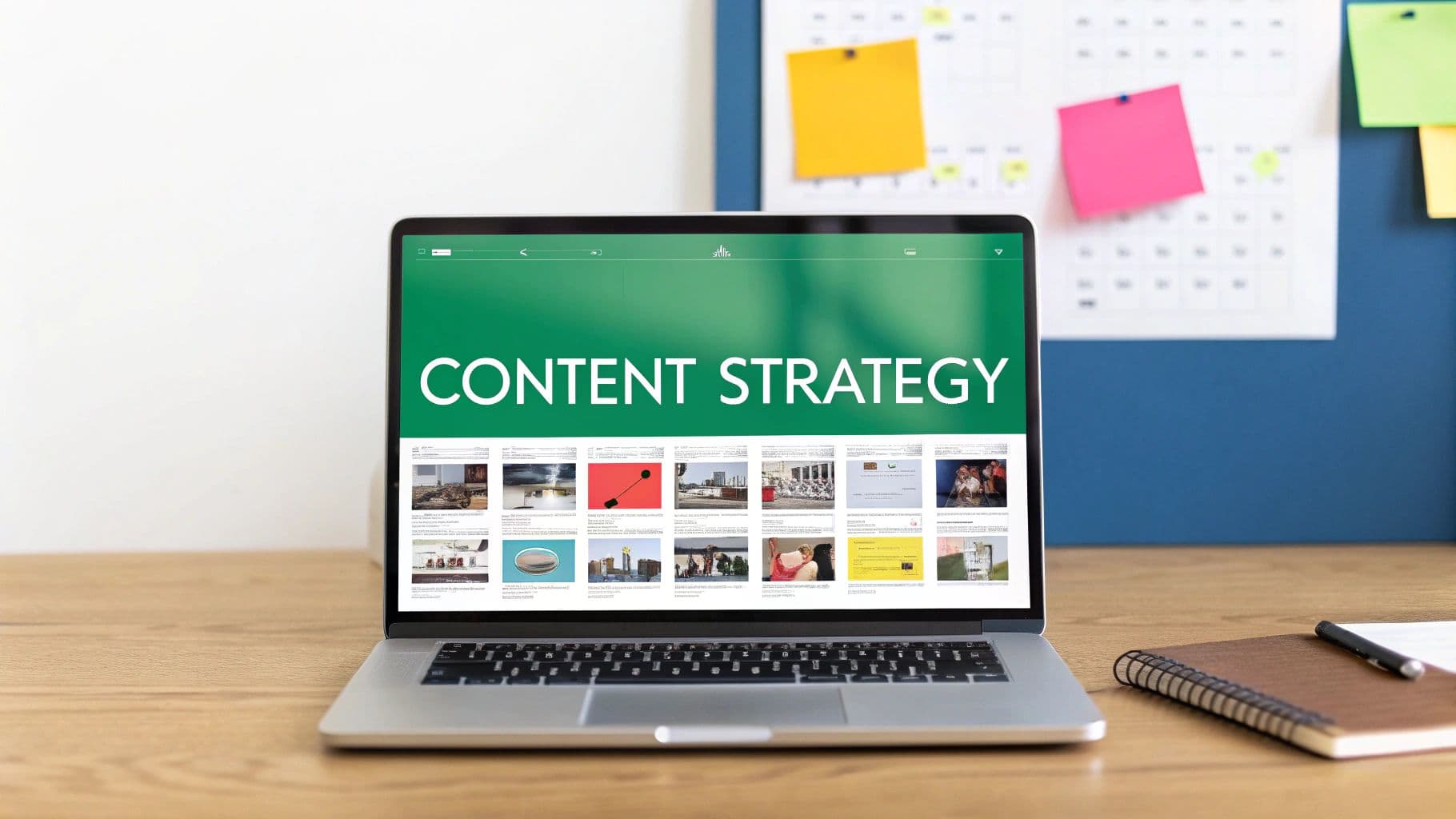
Think of your content calendar as the command center for your entire operation. It's the visual heartbeat of your strategy, ensuring you have a healthy mix of content pillars, formats, and promotional posts going out at just the right times. It’s so much more than a schedule—it’s a strategic tool.
A great calendar isn't just a list of topics. It needs to hold all the critical information in one place to keep everyone aligned and the whole process running smoothly.
Essential Calendar Components:
Publish Date & Time: This indicates the exact day and hour your content will go live. It matters because posting when your audience is most active maximizes visibility and helps you maintain a consistent presence.
Content Pillar: This shows which core theme the post belongs to. It’s important because it ensures your content stays aligned with your strategy instead of drifting into unrelated topics.
Content Format: This identifies the type of media you’re using, such as a Reel, Carousel, or Story. Tracking this helps you diversify your content and reach people based on how they prefer to consume information.
Status: This reflects the current stage of the post in your workflow. It gives you a clear overview of where everything stands—whether it’s just an idea, in progress, ready for review, or fully scheduled.
Caption & Visuals: This includes the final written caption and a link to the visual assets. Keeping these together in one place makes review and scheduling much easier and prevents you from having to hunt for files.
You don't need to overcomplicate this. A simple Google Sheet or a Trello board can work perfectly. The specific tool matters far less than the discipline of using it consistently.
> Your content calendar is the bridge between your strategy and your execution. It turns your well-researched pillars and audience insights into a tangible, actionable plan that your team can follow every single day.
Streamlining with the Right Tools
While a good process is foundational, the right tech can be a massive accelerator. Manual workflows are a fine place to start, but smart tools can dramatically speed things up and elevate the final product. Design platforms like Canva, for example, have made it possible for anyone to create professional-looking graphics with user-friendly templates.
For video, countless mobile apps can help you quickly cut together engaging Reels without needing a film degree. And when it comes to the written word, a whole suite of tools can help you polish captions for clarity and impact. If you really want to get ahead, you can even explore the best AI content creation tools for video, text, and imagery to produce great material at scale.
By combining a smart workflow like batching with a strategic calendar and the right set of tools, you create a powerful, sustainable content engine. This system not only ensures you’re posting consistently but also frees up your most valuable assets—time and mental energy—to focus on what really drives growth: engaging with your community and optimizing your strategy based on real data.
Amplify Your Content and Engage Your Community
Hitting 'publish' can feel like the finish line, but in reality, it’s just the starting gun. A brilliant piece of content is useless if no one ever sees it. To get real traction, you need a solid plan for getting your work in front of the right people and starting conversations that matter.
This means you have to stop thinking like a content creator and start thinking like a content distributor. The numbers don't lie: brands with a documented distribution strategy are 3 times more likely to see strong results than those who just publish and pray. If you're curious, you can see more content marketing statistics that show just how much a planned approach pays off.

Optimize for Organic Discoverability
Before you spend a dime on promotion, you have to give your content its best shot at being found organically. On Instagram, this boils down to a few key elements that work together to tell the algorithm what your post is about and who it’s for.
Think of it as putting up signposts. Without them, your content is lost on a digital backroad. With them, you’re directing traffic straight to your profile.
Here’s how to do it:
Use Hashtags Strategically: Don't just slap on the most popular tags and call it a day. Use a smart mix of broad, niche, and branded hashtags. For a post about a new productivity app, you might use
#Productivity(broad),#SmallBizHacks(niche), and#YourBrandTips(branded).Write Keyword-Rich Captions: Your captions should sound natural, but you also need to include words your audience would actually search for. Ditch "New post up!" and try something like, "Here are three project management tips to help your freelance business thrive this quarter."
Fill Out Your Alt Text: This is such an easy win for accessibility and SEO. Describe what’s in your image using relevant keywords. It helps people using screen readers and gives the algorithm more context about your content.
Spark and Sustain Meaningful Engagement
Engagement is more than just a vanity metric; it’s a direct signal to Instagram that people find your content valuable. High engagement gets your posts shown to a wider audience, which creates a powerful feedback loop. But it has to be genuine.
Your goal is to build a community, not just collect a passive audience of lurkers. This means you have to be an active participant in the conversation, not just a broadcaster.
> Responding to comments is non-negotiable. And a simple "Thanks!" just doesn't cut it. Ask a follow-up question. Tag the person. Turn a simple comment into a real conversation. This not only makes that person feel valued but also shows everyone else that you're present and engaged.
To really turn up the dial on interaction, build participation into your content from the get-go.
Use polls and question stickers in your Stories for quick feedback.
Run a fun "caption this photo" contest in your feed.
Ask direct questions in your captions that invite more than a one-word answer. Instead of "Do you agree?" ask, "What’s the one productivity tool you can’t live without and why?"
Smart Content Amplification
Beyond organic reach, a little smart amplification can give your best content an extra push. I'm not talking about risky, black-hat tactics that could get your account flagged. This is about strategically investing to get your content in front of new, highly relevant audiences.
A great place to start is by boosting a post that's already doing well on its own. If a Reel is getting an unusual number of shares and saves, that's a clear sign you've struck a chord. Putting a small, targeted budget behind it can introduce it to a "lookalike" audience—people who have similar interests to your existing followers.
Collaborations are another fantastic option. Partnering with a non-competing brand or creator who serves a similar audience can be incredibly effective. A joint Instagram Live or a collaborative post exposes your expertise to an entirely new, yet highly relevant, group of people. This approach builds social proof and drives qualified followers back to your profile, amplifying your reach in a way that feels authentic and adds value to both communities.
Measure Performance and Refine Your Strategy
So you've created all this amazing content. What now? The hard truth is that creation is only half the job. So many brands stumble here—they get caught up in the creative process but completely forget to check if any of it is actually working.
A solid content strategy isn't something you "set and forget." Think of it as a living, breathing plan that you’re constantly tweaking based on what the real-world data is telling you.
The goal is to stop obsessing over vanity metrics like follower counts and likes. Sure, they provide a nice little ego boost, but they don't paint the full picture. You need to dial in on the Key Performance Indicators (KPIs) that signal a real connection with your audience and, more importantly, impact your business. This feedback loop—measure, learn, refine—is what turns a decent content plan into a powerful engine for organic growth.
Identifying Your Most Important KPIs
To figure out what's truly landing with your audience, you need to track the metrics that show how people are really interacting with your content. These KPIs give you a direct line of sight into the health of your strategy and the strength of your community.
These are the core metrics you should be watching like a hawk:
Reach: This is the total number of unique accounts that saw your post. It’s the most basic measure of your content’s discoverability and tells you if you're successfully breaking out to new audiences.
Engagement Rate: This is calculated as (Likes + Comments + Shares + Saves) / Reach x 100. It’s a simple percentage that tells you how compelling your content actually is. A high engagement rate is a massive signal to the Instagram algorithm that your content is worth showing to more people.
Shares & Saves: Honestly, these are the powerhouse metrics. A share is a personal endorsement—someone found your content so good they had to send it to a friend. A save is even better; it means your content is so useful that someone wants to come back to it later. That’s a huge sign you’re creating truly valuable stuff.
Website Clicks: If driving traffic is one of your main goals, this one is non-negotiable. It's the clearest bridge between what you're doing on Instagram and your business objectives, like generating leads or making sales.
Translating Data into Actionable Insights
Pulling the data is easy. The real magic happens when you interpret it to make smarter decisions. Your Instagram Insights are a goldmine, but only if you know which patterns to look for.
Think of your analytics as a direct conversation with your audience. They're telling you exactly what they want to see more of. All you have to do is listen.
> Don't get lost in the numbers. The goal isn't just to report on data; it's to extract actionable stories from it. Ask yourself, "What is this metric telling me about my audience's behavior, and how can I use that to serve them better next time?"
Let's walk through a real-world scenario. Imagine you're a fitness coach. You look at your last month's data and spot a glaring pattern: your short Reels demonstrating proper exercise form consistently get 3x more saves than anything else you post. Meanwhile, your pretty carousel posts with motivational quotes get plenty of likes, but almost no one shares or saves them.
This isn't just interesting data; it's a strategic roadmap.
The Insight: Your audience relies on you for practical, educational content they can use during their actual workouts. The motivational stuff is nice to see, but it’s not what makes you indispensable to them.
The Action: It's time to double down on what works. You decide to turn "Form Fix" Reels into a weekly series and pull back on the generic quote carousels. This simple, data-driven pivot aligns your content perfectly with what your audience truly values.
Creating a System for Continuous Improvement
This whole process of analyzing and refining shouldn't be a random, once-in-a-while thing. To make it stick, you need a simple, repeatable system. You don’t need fancy software—a basic spreadsheet will do the trick.
Just set aside a little time at the end of each week or month to run through a quick content review.
Your Monthly Content Review Checklist
Identify Top Performers: Review your top 3–5 posts based on the KPIs that matter most to you—such as saves, shares, or reach. The goal is to spot the patterns: which topics, formats, or hooks actually resonated with your audience.
Analyze Bottom Performers: Look at the 3–5 posts with the lowest engagement or reach. Be honest about what didn’t work. The goal here is to understand what fell flat—maybe the topic wasn’t interesting, the hook was weak, or the visual didn’t stand out.
Review Audience Growth: Check your net follower change for the month and note any specific posts that caused noticeable spikes. The goal is to identify which strong-performing posts not only did well—but also brought new people into your community.
Set Next Month’s Goals: Use everything you learned to create a clear, measurable goal for the coming month. The goal is to turn insights into action, such as: “Increase average Reel saves by 15% by posting more step-by-step how-to content.”
This kind of structured review turns measurement from a boring chore into your biggest strategic advantage. You stop guessing what your audience wants and start using their feedback to make your content smarter and more effective every single month.
Frequently Asked Questions About Content Strategy
As you start piecing together your content strategy, some questions almost always pop up. Let's clear up a few of the most common ones I hear from creators and brands.
How Often Should I Post New Content?
Honestly, there's no magic number. The real key is consistency over quantity. I've seen far more success from accounts that post three truly great pieces of content per week than from those that scramble to post seven mediocre ones.
The best approach? Figure out what you can realistically produce without burning out. Then, dive into your Instagram Insights to see when your audience is actually online and engaging. Marrying your production capacity with your audience's activity is the sweet spot for making a real impact.
What's The Difference Between a Strategy and a Plan?
This one trips a lot of people up, but getting it right is fundamental to staying organized and on track.
> Your content strategy is the big-picture "why." It's your blueprint, defining who you're talking to, your ultimate goals, your brand voice, and the core topics (pillars) you want to be known for. Your content plan, on the other hand, is the tactical "how, what, and when." This is your calendar, detailing the specific posts, formats, and publishing dates to execute that strategy.
Think of it like building a house. The strategy is the architect's blueprint; the plan is the day-to-day construction schedule.
How Long Until I See Real Results?
This is the big one, and it requires a bit of patience. Building an audience with organic content is a marathon, not a sprint. While you'll likely see small wins in engagement and reach within the first few weeks, the real business impact takes time.
Typically, you can expect to see significant, measurable results—like a steady stream of leads or a noticeable bump in sales—within 6 to 12 months of consistent execution. Keep an eye on leading indicators like shares and saves. These early metrics are your proof that you're heading in the right direction long before the major results roll in.
Ready to accelerate your Instagram growth safely and effectively? Gainsty uses advanced AI and expert insights to help you get more real, engaged followers without bots or risks. Start growing with Gainsty today.

.png&w=1920&q=75&dpl=dpl_34ZXCf12K5qjjdZjPn9snwDRADrB)






.png&w=750&q=75&dpl=dpl_34ZXCf12K5qjjdZjPn9snwDRADrB)