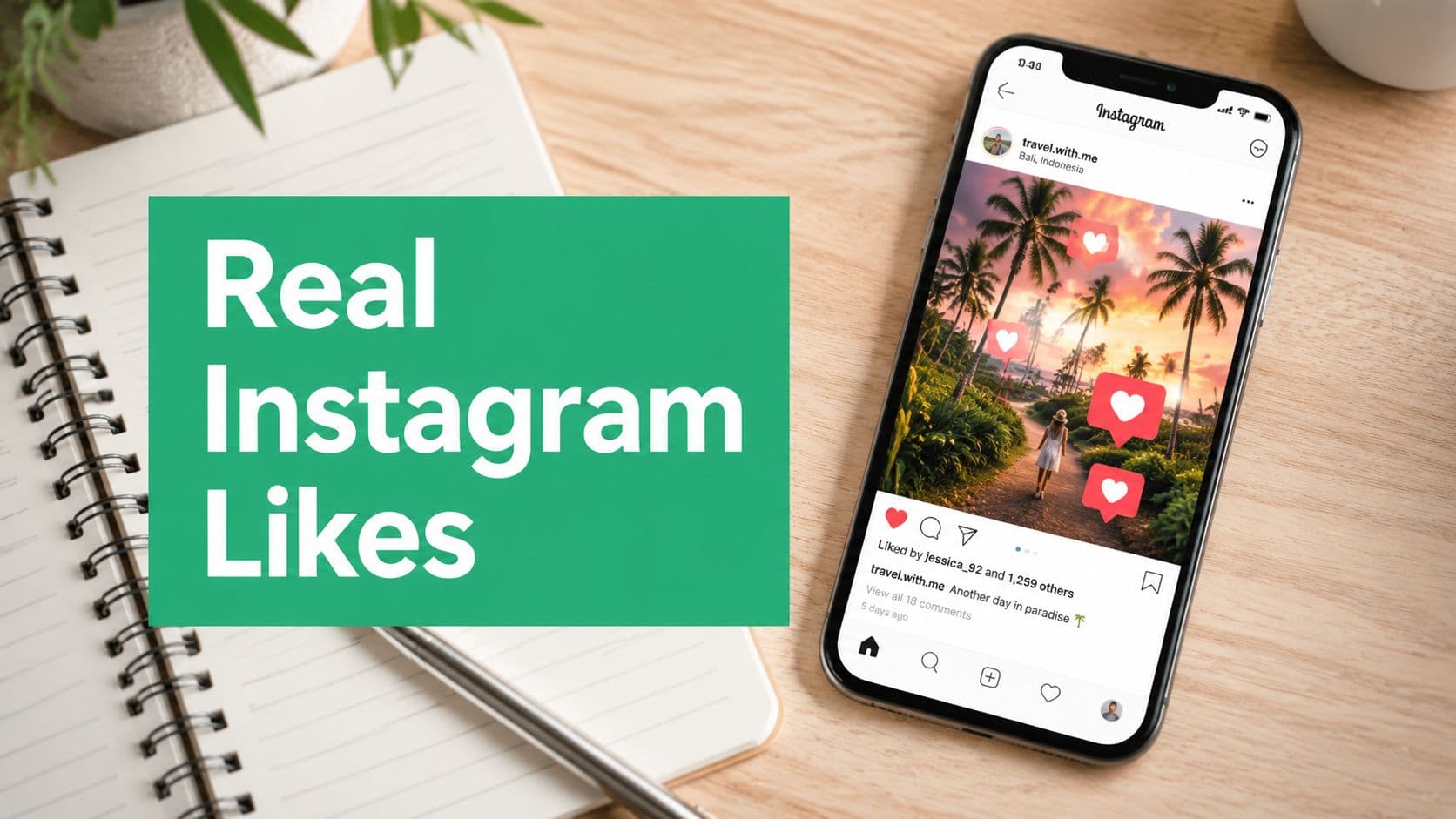
Why Instagram Likes Are Harder to Earn in 2026
Instagram likes are harder to win now because the platform is crowded, distribution is less forgiving, and people can respond in ways that never show up as a heart tap. Benchmark data shows the average engagement rate at 0.48% and then 0.45% in a later 2026 update, with carousels averaging 0.50%, reels 0.48%, and single images 0.33%. That gap matters because small format choices can decide whether a post gets skipped or gets traction.

Likes now function as a fit signal
The old model treated likes like a public scoreboard. The current model is closer to a relevance check. Recent guidance on Instagram engagement says likes are the weakest engagement signal in the algorithm, while saves, shares, watch time, and DM sends matter more LeadResponse's Instagram engagement statistics. That does not make likes irrelevant. It makes them a leading indicator that the post matched the right people.
Small accounts can benefit from that pattern. Benchmark summaries cited in 2026 show nano accounts at roughly 4% to 6% engagement, while larger accounts above 1 million followers can sit around 0.5% to 2% InfluenceFlow's 2026 engagement benchmark guide. In plain terms, tighter audience overlap often beats raw size.
Practical rule: if a post earns genuine likes from people who already care about the topic, it is doing more than collecting attention. It is showing that your content, your hook, and your audience are lined up.
That is the real shift in 2026. Likes still matter, especially as a quick read on content-market fit, but the strongest posts usually earn more than likes alone. They bring saves, shares, profile visits, and follow-through from people who actually want the next post too.
Choosing the Right Content Format for More Likes
Format choice is the fastest lever you can pull if your goal is likes. Socialinsider's benchmark data shows carousels outperform single images, and Buffer's analysis of 52+ million posts found carousels average 6.90% engagement by reach versus 3.31% for Reels Inman's summary of the Buffer analysis. That doesn't mean Reels are useless. It means the format should match the job.
Use Reels for immediacy, carousels for depth
Reels work best when the hook is immediate, and the point is obvious fast. If the value needs explanation, a carousel usually earns likes more reliably because people can pause, swipe, and process the idea at their pace. Single images still make sense for polished photography, brand visuals, and fast-moving memes, but they're not the format I'd pick when the brief is “get the most likes.”
Here's the decision framework I'd use before publishing:
Reels are best for fast hooks, motion, personality, and trend-aware content. Their like rate can be strong when the first second earns attention, and they also have a high watch time impact.
Carousels are best for tutorials, listicles, frameworks, and story-led education. They are usually the strongest format for predictable likes, with a medium watch time impact.
Single images work best for photos, portraits, posters, and meme-style posts. Their average like rate is lower, but they can still perform well when the visual idea is sharp. Their watch time impact is low.
Stories are useful for soft engagement and relationship building. They tend to support likes indirectly later, with a low watch time impact.
Lives are best for building deep community trust and real-time interaction. They support loyalty more than direct likes, but their watch time impact is high.
A carousel doesn't need to be long to work. In practice, 5 to 8 slides is usually enough to create a clear hook, one idea per slide, and a closing slide that invites a save or share without turning the post into a lecture. Reels can win too, especially when the opening frame does the heavy lifting, but they're a worse fit for layered teaching.
If you want a straightforward resource with more context on format choices, actionable tips for Instagram marketing can be helpful because it frames Story likes as a softer layer of engagement rather than a standalone growth tactic.
The format should do the first round of persuasion for you. If the structure is wrong, even strong copy has to fight uphill.
The easiest weekly mix is to alternate formats instead of locking yourself into one style. Test a few Reels, then a carousel, then a single image. Your audience will usually tell you which format earns the most likes from the right people.
Writing Captions and Hashtags That Earn Likes
Captions don't create likes by themselves, but they can nudge a reader from passive scrolling to intentional engagement. The opening line matters most. A good first line is usually a question, a contrarian take, or a sharp observation the audience recognizes immediately.
Keep the caption structure simple
A caption that performs well usually follows a plain three-part structure: a hook, value or story, and a closing line. The hook gets attention, the middle delivers the point, and the close should signal the action you want. If you want likes, the close should reinforce resonance. If you want saves, the close should point to utility.
A clean caption might look like this in structure, not necessarily in wording:
Hook: a line that stops the scroll
Value or story: one or two short paragraphs that explain the idea
Closing line: a specific prompt tied to the content, not a generic “like if you agree”
Line breaks help. Short paragraphs are easier to scan, and they make the caption feel more conversational. Emoji use should support the rhythm of the copy, not clutter it. When people can read the caption quickly, they're more likely to stay long enough to tap the like button.
Hashtags should be tight and relevant. In 2026, 3 to 5 highly relevant hashtags are usually a better move than stuffing a caption with broad tags. I'd place them in the first comment for cleanliness, then rotate sets weekly instead of copy-pasting the same block every time. That keeps the post's metadata aligned with the content without making the caption feel industrial.
For a deeper walkthrough on structure and tone, how to write Instagram captions is worth reviewing because the strongest captions feel like they were written for a human, not for a keyword checklist.
Simple filter: if the caption can work under a different post without changing much, it's too generic.
Captions that earn likes usually feel specific, immediate, and on-topic. Captions that chase likes without substance tend to sound like engagement bait, which people notice fast.
Finding Your Best Posting Time and Frequency
Posting time matters, but only relative to your audience's habits. A universal “best time” is too blunt to be useful. A 2026 synthesis of major studies found that Buffer's massive post dataset highlighted Thursday 9 a.m., Wednesday 12 p.m., and Wednesday 6 p.m. as top slots, while Sprout Social's analysis of nearly 2 billion engagements pointed to especially strong midweek windows SocialKit's best time to post summary. The common thread is clear, midweek and lunch-to-evening hours tend to be the strongest band.
Localize the timing before you trust it
The process I trust is simple. First, open Instagram Insights and find the three 60-minute windows when your followers are most active. Then post inside one of those windows for 3 to 4 weeks and compare like-rate per impression against your normal time.
A practical cadence is to stay active without flooding the feed. A lot of accounts do better with 4 to 6 feed posts and 4 to 7 Reels weekly, but the answer depends on how much high-quality content you can sustain. For a fuller planning lens, how often you post on Instagram is useful because it treats frequency as a consistency problem, not a volume contest.
For a small account, a practical cadence is 3 to 5 feed posts per week, 3 to 5 Reels per week, daily Story support, and 1 to 3 carousels per week.
For a growing account, a practical cadence is 4 to 6 feed posts per week, 4 to 7 Reels per week, frequent Stories, and 2 to 3 carousels per week.
For an established account, a practical cadence is 4 to 6 feed posts per week, 4 to 7 Reels per week, frequent Stories, and 2 to 4 carousels per week.
If your audience is spread across time zones, pick the geography that matters most commercially and post to that region first. Scheduling helps reduce friction, but live posting can still make sense when you want to react to a cultural moment or keep the response window tight.
For a more detailed timing framework, the best time to post on Instagram gives a good reference point. The key is not copying someone else's schedule. It's building one that matches your followers' actual behavior.
Building Engagement Through Community and Collaborations
The first hour after a post goes live is where a lot of the social proof gets built. If people comment and you respond quickly, the thread looks active, and active posts tend to get more attention from the people who arrive later. I've seen this play out often enough to treat it as a standard operating habit, not a nice-to-have.
Make the comment thread work for you
Reply to every comment you can within the first 30 minutes. Ask a follow-up question when the reply is natural, because that extends the conversation instead of closing it too early. Pin the strongest response if it adds credibility, emotion, or a useful angle that reinforces the post.

DMs matter too, but not as a broadcast channel. If someone replies to a Story or asks a thoughtful question, move the conversation into DMs and keep it human. That relationship often shows up later as stronger public engagement, because people are more likely to like posts from accounts they recognize.
Collaborations are the fastest way to borrow trust without faking it. Shared Reels, carousel takeovers, niche-adjacent live rooms, and comment-to-collab seeding all work when the audiences overlap naturally. If the overlap is weak, the post can still get exposure, but likes usually soften because the viewers don't feel the content was made for them.
A good collaborator usually passes a simple check:
Audience fit: their followers care about the same problem or topic
Tone match: their content style won't clash with yours
Value exchange: both sides can contribute something specific
Consistency: they post often enough that the collaboration won't feel random
Collaborations work best when both audiences can understand the point in one glance. If the partnership needs a long explanation, the like rate usually suffers.
The goal isn't to collect random visibility. It's to place your content in front of people who are already predisposed to care. That's where likes compound.
Testing and Measuring What Actually Works
If you don't measure likes the right way, you'll optimize the wrong thing. The most useful metric is like-rate per reach or per impression, not raw like count. A post with fewer total likes can still outperform another post if it reached a smaller, more relevant audience.
Track the right signals every week
The weekly dashboard should include four things, likes per impression, saves per impression, profile visits, and reach from non-followers. That mix tells you whether the content is resonating, whether people want to keep it, and whether it's reaching beyond your existing audience.
Use a simple A/B test when you want a clean read. Change only one variable, either the hook or the CTA, then post two near-identical pieces a week apart and compare the results over a 7-day window. If each variant gets at least 1,000 impressions, the signal is usually cleaner. A 20% lift is a meaningful threshold, while anything smaller can easily be noise.
For teams that want deeper reporting or API-based workflows, enterprise Instagram API options can help centralize data collection without turning measurement into a manual grind.

A rolling 30-day log is better than a one-off read because it shows what repeats. Export Insights once a week, drop the numbers into one spreadsheet, and mark the post format, hook style, posting time, and CTA. For a more detailed analytics workflow, Instagram analytics business complete guide driving growth is useful as a reference point.
Don't overreact to a single good post or a single flop. Patterns matter more than spikes.
The true win is learning which combination of format, hook, and timing consistently earns likes from the audience that matters.
Common Mistakes to Avoid and a 30-Day Organic Workflow
The fastest way to kill like-rate is to treat Instagram like a shortcut machine. Buying likes from cheap vendors, joining engagement pods, recycling watermarked clips, overposting without rest, and copying trending audio without adapting the hook all send weak signals to your audience. They may create movement on the surface, but they don't create trust, and trust is what keeps likes coming back.
What usually backfires
Cheap likes and pods distort the account. The numbers look busy, but the audience quality drops and the post-to-post ratio gets uglier over time. Watermarked clips from other platforms make the feed feel borrowed, and borrowed content rarely earns sustained engagement.
A simple organic workflow keeps the account moving without turning it chaotic:
Week 1: audit content. Review your last posts, note which format earned the most genuine likes, and identify the strongest hooks. 2.
Week 2: test two hook styles on Reels. Keep the topic the same and change only the opening. 3.
Week 3: launch a carousel series and a collaboration. Use one format built for depth and one partner to extend reach. 4.
Week 4: review analytics and double down. Keep the best-performing format, then cut the pieces that clearly underperformed.
You don't need a complicated system to stay consistent. A daily checklist works better:
Check comments and reply fast
Look at one metric, like likes per impression
Post with one clear goal
Log the result before moving on
If you want a platform that treats organic growth seriously, Gainsty helps users plan Instagram growth around authenticity, engagement, and analytics rather than fake followers or bot activity. It's a practical fit for creators and businesses that want better likes because the content is stronger, not because the numbers were padded.
.png&w=1920&q=75&dpl=dpl_2si4hWs7xtpQVmrY6d8xhJ1wLJZL)



.png&w=750&q=75&dpl=dpl_2si4hWs7xtpQVmrY6d8xhJ1wLJZL)