Building Your Foundation for Monetization
So many creators make the same mistake: they jump straight into selling stuff without laying any groundwork. It’s a surefire way to stall out before you even get started. Before you can earn that first dollar, you need a solid foundation. This is the unsexy but absolutely critical part of the process—it’s about building a system that doesn't just attract followers, but brings in future customers.
This all starts with finding a niche you're genuinely passionate about that also has real earning potential. The sweet spot for a long-term creator business is always at the intersection of what you love, what you're good at, and what people are actually willing to pay for.
Defining Your Niche and Audience
Choosing a niche isn't just about picking a topic. It's about finding a specific group of people and dedicating yourself to solving their unique problems. Are you a fitness coach for new moms? A financial advisor for freelancers? A home decor expert for people in tiny apartments? The more specific you get, the easier it is to pull in a loyal crowd.
Once you’ve got your niche, the next step is to get inside your audience's head. You need to go way beyond basic demographics and figure out what they really need and what keeps them up at night.
What are their biggest challenges? Pay attention to the questions they're asking in comments, on forums, and in other communities.
What are their goals and dreams? Your content needs to be the bridge that gets them from where they are now to where they want to be.
What kind of content are they already binging? Look at what works. Is it tutorials? Behind-the-scenes vlogs? Motivational pep talks?
Getting this part right is the secret to creating content that actually converts. A strong grasp of content monetization strategies is what will help you turn these audience insights into actual income.
The goal isn't just to rack up followers. It's to attract the right people—the ones who will become your future customers and biggest advocates. They're the engine of your entire monetization machine.
Optimizing Your Profiles for Monetization
Think of your social media profile as your digital storefront. It needs to scream value and professionalism the second someone lands on it. That means every single element needs to be optimized to make you money.
For example, a great bio should instantly answer three questions: who you are, who you help, and how you help them. It also needs a clear call-to-action (CTA), whether that’s a link to your products, a free download, or your services page. For a much deeper dive on this, check out our guide on building a brand on social media.
Your visual branding—profile picture, color scheme, font choices—has to be consistent everywhere. This consistency builds trust and makes you instantly recognizable. It’s like creating a killer first impression that signals you mean business.
Instagram, in particular, is a massive commercial playground, with around 2 billion monthly active users. The platform’s ad engine is a beast, pulling in about $66.9 billion in revenue for Meta. For creators, this scale opens up a direct path to monetization.
To get a clearer picture of which monetization methods might work best for you, let's break down the most common options.
Choosing Your Social Media Monetization Path
This compares the most common monetization methods, outlining their typical requirements, earning potential, and the effort needed to succeed, helping you choose the best fit for your goals and audience size.
Brand Sponsorships: Best suited for influencers with 10k+ followers (micro-influencers). Offers high earning potential and requires medium effort to manage partnerships and deliverables.
Affiliate Marketing: Works well for accounts with 1k+ followers (nano-influencers). Provides a medium income with low effort, as it mainly involves sharing referral links or promo codes.
Selling Your Own Products: Ideal for communities with 5k+ engaged followers. Can generate very high income, but demands high effort for product creation, fulfillment, and marketing.
Selling Your Services: Suitable for those with 1k+ followers in a niche. Offers high earning potential, requiring high effort in service delivery and promotion.
Memberships/Subscriptions: Works for creators with 2k+ loyal fans. Provides medium-high earnings with medium effort, focusing on recurring content or perks.
Platform Ad Revenue: Best for accounts with 10k+ followers, though it varies by platform. Typically brings low-to-medium income and requires low effort once set up.
Each path has its own pros and cons. Selling your own products, for instance, offers the highest potential reward but also demands the most work. Affiliate marketing, on the other hand, is a great entry point with less heavy lifting. Consider where you are now and where you want to go before committing to a strategy.
Alright, you’ve laid the groundwork. Now comes the fun part: deciding how you’re actually going to get paid.
Think of your monetization strategy like an investment portfolio. Putting all your eggs in one basket is a recipe for disaster. The real goal here is to build a mix of income streams that feels right for you, your brand, and the people who follow you.
This isn’t about jumping on every trend. It's about being selective and choosing methods that feel authentic and genuinely help your audience. Let's break down the best ways to do it.
Brand Sponsorships and Collaborations
When people think about making money on social media, brand deals are usually the first thing that comes to mind. It’s pretty straightforward: a brand pays you to create content that features their product or service. This can be incredibly lucrative, but it hinges on having an engaged audience that trusts what you have to say.
The secret to killer sponsorships? Authenticity. Only work with brands you truly use and believe in. If you're a vegan food blogger, promoting a steakhouse is going to torpedo your credibility in a heartbeat. It just doesn't make sense.
To land your first deals, you can:
Pitch brands directly. Create a sharp, professional media kit that shows off your audience stats and best work.
Sign up for influencer marketing platforms. These act as matchmakers between creators and brands looking to collaborate.
Build a killer portfolio. Even without paid deals, create high-quality content that shows brands what you’re capable of.
Just look at the sheer scale of opportunity on a platform like Instagram.
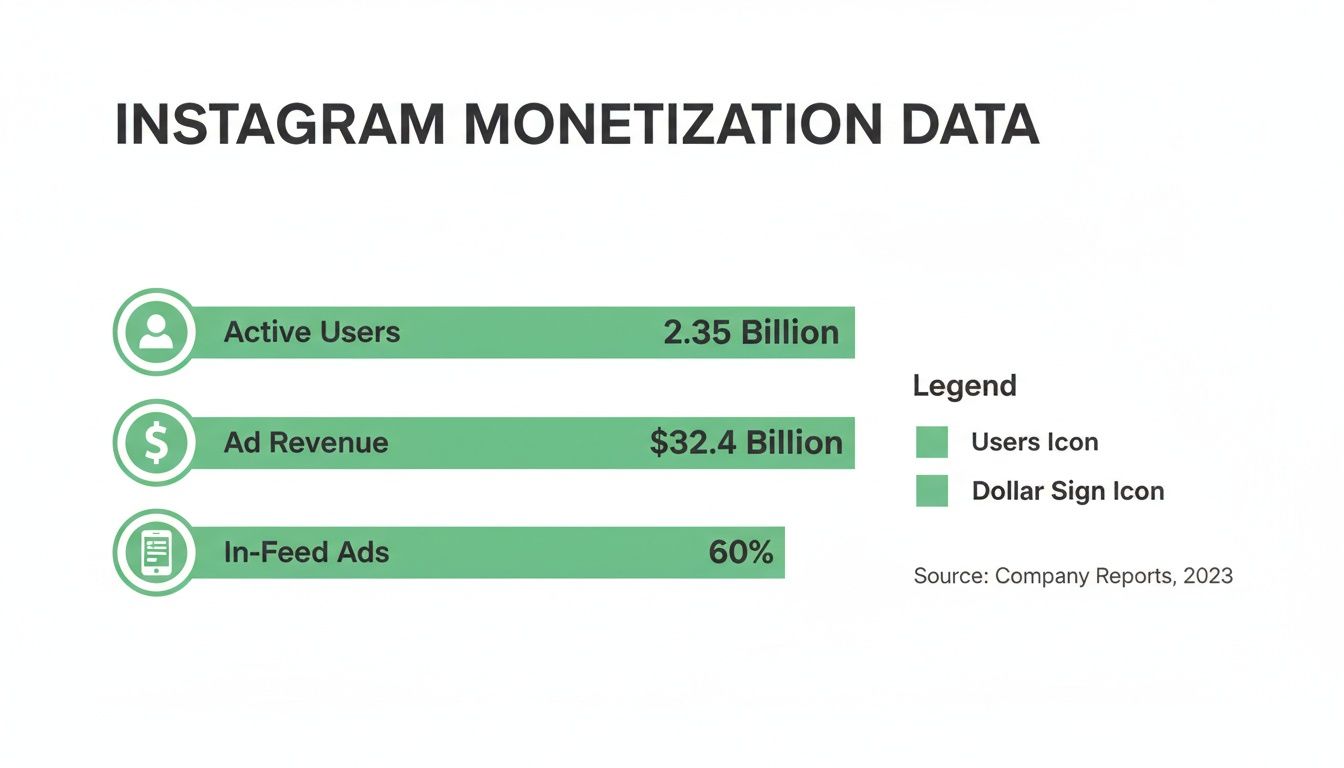
The numbers don't lie. A huge, active audience creates a massive playground for advertising and creator income.
Affiliate Marketing: Your Trusted Favorites
If you're just starting, affiliate marketing is one of the easiest ways to dip your toes in the water. You simply promote a product or service you love using a unique link, and you get a cut of every sale that comes through it. It's way less work than creating a product from scratch and lets you earn from the content you're already making.
Again, this all comes down to trust. Your audience is smart, and they can spot a disingenuous cash grab from a mile away. Only recommend products you can personally vouch for.
Pro Tip: Don't just spam your links. The best approach is to create content that solves a problem for your audience and naturally positions the affiliate product as the perfect solution. Think detailed tutorials, honest reviews, or "top 5" roundups—they work way better than a lazy post that just says, "Buy this!"
Selling Your Own Products and Services
This is the holy grail. When you create your own products or services, you call the shots. You’re not at the mercy of a brand’s budget or a platform’s commission rates, giving you maximum control and earning potential. The sky's the limit here.
Here are a few ideas to get the wheels turning:
Digital Products: Think ebooks, templates, photo presets, or online courses. The beauty of digital is the high-profit margins and the fact that you can sell them an infinite number of times.
Physical Products: This could be anything from branded merch to handmade goods. It takes more logistical work, but it forges a real, tangible connection with your community.
Services: Offer what you know best. Coaching, consulting, social media management, or other freelance work is a fantastic way to monetize your skills for high-ticket clients.
While you're building your own empire, brand deals can still be a huge part of the equation. Nano-influencers (1K–10K followers) can pull in around $55 per post, but that number skyrockets for macro-influencers with over a million followers, who can command $75,000+ for a single post. But remember, brands are increasingly looking at engagement over raw follower count. They’ll pay a premium for creators who can prove they drive real action, which on Instagram averages around a 1-2% conversion rate. If you want to dive deeper into these numbers, Sprout Social’s Instagram statistics are a great resource.
Memberships and Exclusive Content
Got a hardcore, loyal following? A subscription or membership model can create a predictable, recurring revenue stream. Platforms like Patreon or even native features like Instagram Subscriptions give your biggest supporters a way to back you directly.
This model only works if you’re offering something special that people can’t get for free.
Think about providing:
Behind-the-scenes access
Early releases of your videos or podcasts
Exclusive Q&As or tutorials
Access to a private community chat
The right mix of these methods is going to look different for everyone. My advice? Start with one or two that feel like a natural fit, really nail them, and then gradually layer in more to build a resilient and profitable creator business.
Creating Content That Actually Converts
A massive follower count looks great on paper, but it's just a vanity metric if your audience never actually does anything. If you're serious about monetizing, you have to stop throwing random content at the wall and start building a strategic system. This system is designed to gently guide your followers from being casual viewers to becoming loyal customers.
This is where a content funnel becomes your best friend.
Think of it as a journey you're taking your audience on. Not everyone who stumbles across your profile is ready to pull out their wallet. Your content needs to meet them where they are, building trust and showing your value every step of the way. When you do this right, promotions feel natural and helpful, not pushy or salesy.
Mapping Your Content to the Funnel
The classic content funnel is usually split into three main stages. A healthy, profitable social media strategy has a good mix of all three. This ensures you’re always attracting new people while also nurturing the audience you already have.
Top of Funnel (Awareness): This is all about discovery. The job of this content is to grab the attention of new people, entertain them, and introduce them to what you're all about. Think highly shareable, relatable content that solves a broad problem or just sparks curiosity.
Middle of Funnel (Consideration): Okay, you have their attention. Now you shift from broad appeal to deeper value. This content is where you educate your audience, establish your expertise, and show how you solve their specific problems. You start to hint at your products or services as the ultimate solution.
Bottom of Funnel (Conversion): This is the final nudge. The content here is direct, clear, and action-oriented. Its only purpose is to get someone to take a specific action—buy the product, book the call, or sign up for the newsletter.
By intentionally creating content for each stage, you build a repeatable machine that grows your community and your bank account at the same time.
The most effective monetization strategies don't feel like selling at all. They feel like helping. When you consistently offer value at every stage of the funnel, the conversion becomes the natural next step for your audience.
Platform-Specific Content Examples
Let's get practical. The principles of the funnel are universal, but how you execute them changes from platform to platform. Here’s what this looks like on Instagram, plus a few ideas for how to adapt it for other channels.
Instagram Content Funnel
Awareness Stage: Use viral Reels and Carousels. Example: A short, funny Reel showing “3 Mistakes Everyone Makes at the Gym” to grab attention and reach new audiences.
Consideration Stage: Use educational Carousels and Stories. Example: A carousel breaking down the “5 Best Exercises for Glute Growth” to educate your audience and build trust.
Conversion Stage: Use Stories with links and direct posts. Example: An Instagram Story featuring a client testimonial with a direct link to purchase your workout plan, encouraging immediate action.
See how that works? The same logic applies everywhere. On TikTok, your Awareness content would be quick, trend-based videos. On YouTube, it might be a searchable "how-to" guide. The key is to adapt the format to fit the platform's culture while sticking to the funnel's purpose. Creating a solid plan for converting followers to customers is what turns a social hobby into a real business.
Turning Organic Growth Into Real Income
Building your audience organically is the most cost-effective way to build a monetization engine. You're not just saving money on ads; you're building a long-term, sustainable asset. The path from organic reach to real revenue is clearer than ever.
Take creator subscriptions, for example. Even if you have just 1,000 subscribers paying $2.99/month, that’s nearly $2,990 in recurring monthly income (before platform fees, of course). It proves that a small, dedicated audience can be incredibly valuable.
And don't forget direct commerce. With about 29% of Instagram users making purchases directly on the platform, building funnels that turn followers into shoppers is a proven money-maker. The game has changed, though. It’s crucial to track the right metrics. Platforms like Instagram now prioritize things like watch time and shares, which directly impact your organic reach and, ultimately, your earning potential.
How to Price Your Work and Pitch Brands

Let's be honest: asking for money can be the most nerve-wracking part of this whole thing. It feels personal and kicks up a massive case of imposter syndrome. But if you can't learn to confidently state your value, you will always leave money on the table.
You have to shift your mindset. You're not just "posting a picture." You are giving a business a direct, trusted line to their ideal customer. That has real, tangible value, and it’s time to get paid for it.
Setting Your Rates with Confidence
No magic formula fits everyone. Your rates will be a cocktail of your follower count, engagement rate, niche, and exactly what a brand is asking for. But we can build a solid pricing structure from the ground up.
A great place to start is the 1% rule: charge $100 per 10,000 followers for a single, standard in-feed post. So, if you have 30,000 followers, your starting point for one post is $300. Think of this as your baseline, not the final number.
Now, let's adjust that baseline with the stuff that really matters:
Engagement Rate: If your engagement is consistently beating the 2-3% industry average, you need to be charging a premium. High engagement is proof that your audience isn't just there—they're listening. That's what brands are paying for.
The "Ask" (Deliverables): Is it one post? A carousel? A Reel? A few Stories? Each piece of content is a separate line item because each takes time and creative energy. A well-produced Reel, for example, is easily worth 1.5x to 2x more than a static photo.
Usage Rights: This is a big one. If a brand wants to use your content in their own ads (often called whitelisting) or on their website, that costs extra. You're essentially licensing your work to them, and that should be priced separately from the initial creation fee.
Crafting the Perfect Pitch
Once you know your numbers, it's time to reach out. Cold pitching feels intimidating, I get it, but a sharp, well-researched email can unlock some incredible partnerships. The goal is to be professional, direct, and prove you've done your homework.
Keep your pitch email short and to the point. Introduce yourself, but immediately pivot to why you love their brand. Get specific. Mention a product you actually use or a campaign of theirs you admired. It shows genuine interest, not a copy-and-paste blast.
Then, quickly hit them with your value. Mention your key audience demographics and that killer engagement rate. You want them to instantly see that you have access to the exact people they want to reach. Wrap it up with a clear call-to-action—maybe suggest a specific collaboration idea or ask if they can share their campaign brief.
Don’t just tell a brand you have followers. Tell them you have their customers. Frame your entire pitch around solving their marketing goals, not just getting a sponsorship for yourself.
To pull this all together professionally, you need a media kit. It’s your creator resume. It should include a short bio, your key stats (followers, engagement, audience data), and a menu of your services. Using a solid influencer rate card template is a great way to make sure it looks clean and is easy for brands to understand.
Navigating Negotiations Like a Pro
Getting a "yes" is just the start. The negotiation is where you iron out the details and make sure the compensation is fair. Don't ever be afraid to stand your ground and explain why your rates are what they are.
A classic brand objection is a tight budget. If they say they can't meet your price, don't just slash it in half. Instead, try adjusting the scope of the project. You could offer fewer deliverables for their proposed budget—say, one post instead of a post and three Stories.
And please, always get everything in writing. A formal contract protects both you and the brand. It needs to clearly outline all deliverables, deadlines, usage rights, payment terms (like Net 30), and FTC disclosure requirements. This simple document prevents so many headaches and ensures you get paid on time for your hard work. When you treat it like a business discussion, you position yourself as a professional partner, not just another influencer.
Understanding the Legal and Ethical Rules
Making money on social media goes way beyond just creating cool content and signing brand deals. You're stepping into a world that comes with serious responsibilities. One wrong move can shatter the trust you’ve worked so hard to build with your audience and, in some cases, even get you into legal hot water.
If you want to build a lasting business, you have to build it on a solid ethical and legal foundation. It's simply not optional.
The golden rule here is transparency. Your followers have a right to know when they're looking at an ad. This is why official bodies like the Federal Trade Commission (FTC) in the United States have clear guidelines for influencers and endorsements.
FTC Guidelines and Proper Disclosure
The whole point of the FTC's rules is to stamp out deceptive advertising. If you have any kind of "material connection" to a brand—meaning you're getting paid, receiving free products, or have any other kind of valuable relationship—you absolutely must disclose it. Clearly and conspicuously. Ambiguity is your worst enemy.
Here's a look at the FTC's own guidance, which spells it out perfectly.
This screenshot gets straight to the point: your disclosure needs to be impossible to miss. Burying a hashtag in a long list or hiding it "below the fold" where people have to tap "more" just doesn't cut it.
So, how do you make sure you're playing by the rules? Keep your disclosures simple and upfront.
Use Obvious Hashtags: Start your caption with #ad, #sponsored, or #BrandPartner. Everyone knows what these mean.
Put Disclosures Front and Center: Place your disclosure right at the beginning of your caption or video. Don't make people search for it.
Leverage Platform Tools: Instagram and Facebook have a "Paid Partnership" feature for a reason. It adds a clear label to your content, so use it whenever you can.
When it comes down to it, the logic is simple: if you have to ask yourself whether you need to disclose a partnership, the answer is almost always yes. It's far better to be overly transparent than to risk misleading your audience and facing the consequences.
The Importance of Contracts
Handshake deals might feel casual and friendly, but they're a recipe for disaster when money is involved. A formal contract is your best friend—it protects both you and the brand by making sure everyone is on the same page from the get-go. Before you jump into any partnership, it's also smart to get a handle on the rules of the platform and any local regulations. A great place to start is understanding essential terms and conditions.
A solid contract should always nail down a few key clauses to protect you:
Scope of Work (Deliverables): This section needs to be crystal clear. It should spell out exactly what you’re creating (e.g., 1 Instagram Reel, 3 Stories, 1 static post), what those posts will contain, and any specific talking points or calls to action the brand wants.
Payment Terms: Be specific about the money. State the exact compensation, how you'll be paid, and when the payment is due (e.g., "Net 30," which means they have 30 days to pay you after you send the invoice).
Usage Rights: This is huge. The contract needs to define how the brand can use the content you create. Can they repost it on their own social media? Use it in paid ads? Put it on a billboard? Each level of usage is a separate negotiation and should come with a higher fee.
Exclusivity Clause: Watch out for these. An exclusivity clause might prevent you from working with competing brands for a certain period. If you agree to one, make sure the timeframe is reasonable and that you're being paid enough to make up for the other opportunities you'll be missing.
Navigating these rules isn't about creating more work for yourself. It’s about building a professional, sustainable, and trustworthy business as a creator.
Your Top Social Media Monetization Questions, Answered
Jumping into social media monetization is exciting, but it definitely brings up a lot of questions. It's so easy to get fixated on huge follower counts and eye-popping income reports you see online, but building a real, sustainable business as a creator is a different story. Let's cut through the noise and tackle the questions I hear most often from creators who are just starting.
This section is all about giving you direct, no-fluff answers to manage your expectations and help you build a realistic plan to start earning.
How Many Followers Do I Actually Need to Make Money?
This is the big one, isn't it? Everyone wants to know the magic number. The honest answer? There isn't one. You can genuinely start earning with as few as 1,000 true fans, especially if you're in a very specific niche. This is often the point where things like affiliate marketing or selling your own services become viable.
The real game-changer is focusing on community quality, not just follower quantity. A small, dedicated group of people who trust you is infinitely more valuable to brands—and to your own sales—than a massive, indifferent audience.
1k - 10k Followers (Nano-influencer): Your superpower here is your tight-knit community and sky-high engagement rates. This is the perfect stage to dip your toes into affiliate marketing, pitch smaller brands for gifted collaborations, or sell a specialized service like 1:1 coaching.
10k - 50k Followers (Micro-influencer): Once you hit that 10k milestone, more doors start to open. Brands begin to take you more seriously for paid sponsorships, and you have a solid enough audience to launch a small digital product, like an ebook or a set of templates, with real success.
The bottom line is to stop obsessing over the follower count and start pouring your energy into building genuine connections. That trust is what you'll actually be monetizing down the line.
How Long Does It Realistically Take to See Any Income?
Here’s where a little patience goes a long way. While you’ll see stories of creators earning money in their first month, it's far more realistic to give yourself a 6- to 12-month runway before you start seeing a small, semi-consistent income. It just takes time to build an audience that trusts you enough to buy from you or to attract the attention of brand partners.
How quickly you get there really depends on a few key things:
Your Niche: Some spaces, like personal finance or B2B software, tend to monetize faster than broader categories like lifestyle or general entertainment.
Your Content Strategy: A creator with a clear plan and content that guides followers toward an action will see results much faster than someone posting at random.
Your Commitment: If you treat this like a real business from day one—even just a few dedicated hours a week—you will dramatically speed up the process.
Think of your first year as building the foundation. You're defining your brand, growing an engaged community, and figuring out what content works. The income is the reward for doing that work well.
How Do I Deal with an Inconsistent Income?
Welcome to the creator life! Unlike a predictable paycheck, your income will almost certainly have peaks and valleys, especially when you're starting. You might land a great brand deal one month, and the next month might be crickets. The key to surviving—and thriving—is diversification.
Putting all your eggs in one basket, like relying solely on brand sponsorships, is a recipe for anxiety. The smarter move is to build a monetization "stack" with several different layers of income.
Think about it this way: some income streams you control, and others you don't. Some are recurring, and others are one-offs.
Brand Deals: Low consistency because they are project-based, and low control since you rely on brands saying yes.
Affiliate Marketing: Medium consistency, as it can be steady, with medium control depending on the products you promote.
Your Own Products: High consistency since you run the sales, and high control because it’s your asset.
Memberships: Very high consistency due to recurring revenue, with high control since it’s your platform.
By mixing these up, you create a much more resilient business. When sponsorship talks go quiet, your affiliate links and product sales can carry you through. It’s like building a financial safety net for your brand, and it's absolutely crucial for long-term stability.
Monetization Quick-Start Checklist
Feeling a bit overwhelmed? That's totally normal. This checklist breaks down the most important first steps from this guide into a simple, actionable to-do list. Just work your way down the list to get your monetization engine running.
Define a specific niche & target audience: To Do – Consider who you are serving and what problem you solve.
Set a 90-day income goal: To Do – Example: “Earn my first $100 from affiliate links.”
Select 1-2 primary monetization methods: To Do – Start with affiliate marketing and/or offering a service.
Optimize your social media bios with a clear CTA: To Do – Add a link to an affiliate product or waitlist.
Create a simple content calendar (4 weeks): To Do – Plan posts that naturally lead to your offer.
Identify 5 small brands to pitch: To Do – Research brands that align with your values.
Sign up for 2-3 relevant affiliate programs: To Do – Examples: Amazon Associates, ShareASale.
Draft your media kit and rate card: To Do – Even a simple one-page version is a good start.
Set up a system to track your income: To Do – A simple spreadsheet works perfectly.
Once you check these off, you won't just be a creator with a following—you'll be a creator with a business plan.
Ready to stop guessing and start growing? Gainsty uses advanced AI and real Instagram experts to help you attract the organic followers who will become your future customers. Build a high-quality audience and accelerate your monetization journey today. Get started with Gainsty.
.png&w=1920&q=75&dpl=dpl_34ZXCf12K5qjjdZjPn9snwDRADrB)





.png&w=750&q=75&dpl=dpl_34ZXCf12K5qjjdZjPn9snwDRADrB)