Building Your Foundation for Social Media Success
Jumping straight into content creation without a plan is like building a house without a blueprint. You might end up with something, but it won't be stable, and it certainly won't take you where you want to go. A strong foundation ensures every piece of content is strategic, intentional, and moves you closer to your actual business goals.
Let's be honest, follower counts are a vanity metric. Real success is tied to tangible business outcomes. The first question you need to ask is: What do I want social media to do for my brand? Are you trying to drive more traffic to your website? Generate qualified leads? Or maybe build a tight-knit community of loyal fans? Each objective demands a completely different content strategy.
Define Your Goals and Target Audience
The first step is to connect your social media activity directly to your bigger business objectives. This is how you turn your social channels from a simple broadcasting tool into a powerful engine for growth.
The list below breaks down how to translate broad business objectives into specific, measurable social media goals.
Connecting Business Objectives to Social Media KPIs
Increase Brand Awareness: The social media goal is to grow your reach and impressions. You can measure success using KPIs like follower growth rate, post reach, and the number of shares.
Drive Website Traffic: The objective here is to increase clicks to your website. Key metrics include click-through rate (CTR) and website referral traffic.
Generate Leads: This focuses on capturing contact information from your audience. Measure it with conversion rate and cost per lead (CPL).
Build Community: The goal is to boost interaction within your audience. Track success using engagement rate (likes, comments) and mentions.
Increase Sales: Here, the aim is to drive actual product purchases. KPIs to track include social media conversion rate and revenue generated per post.
This framework helps ensure every post you create has a quantifiable purpose tied to your bottom line.
Once your goals are locked in, you have to get laser-focused on who you're talking to. Creating detailed audience personas is an absolute game-changer. Don't just list their demographics; get into their heads. What are their biggest frustrations? What motivates them? What kind of content do they actually enjoy seeing in their feed?
A successful content plan speaks to a specific audience, not at a general one. Understanding your audience’s needs and online behaviors is the shortcut to creating content that resonates and builds real trust.
Analyze Your Niche and Competitors
You aren't operating in a vacuum. Your competitors are already out there, and they're a goldmine of information. A thorough competitive analysis helps you understand what’s working in your industry, what’s falling flat, and where you can carve out a unique space for your own brand.
Take a look at their top-performing content. Are videos getting all the love? Are educational carousels killing it? Or is it the raw, behind-the-scenes Stories that get the most replies? Make note of the formats, posting cadence, and the overall voice they use. The goal here isn't to copy them—it's to find gaps and opportunities to serve your shared audience better. For more on this, check out this actionable guide to social media marketing for small businesses.
This whole foundational process—understanding your audience, setting clear goals, and checking out the competition—is what separates the pros from the amateurs.
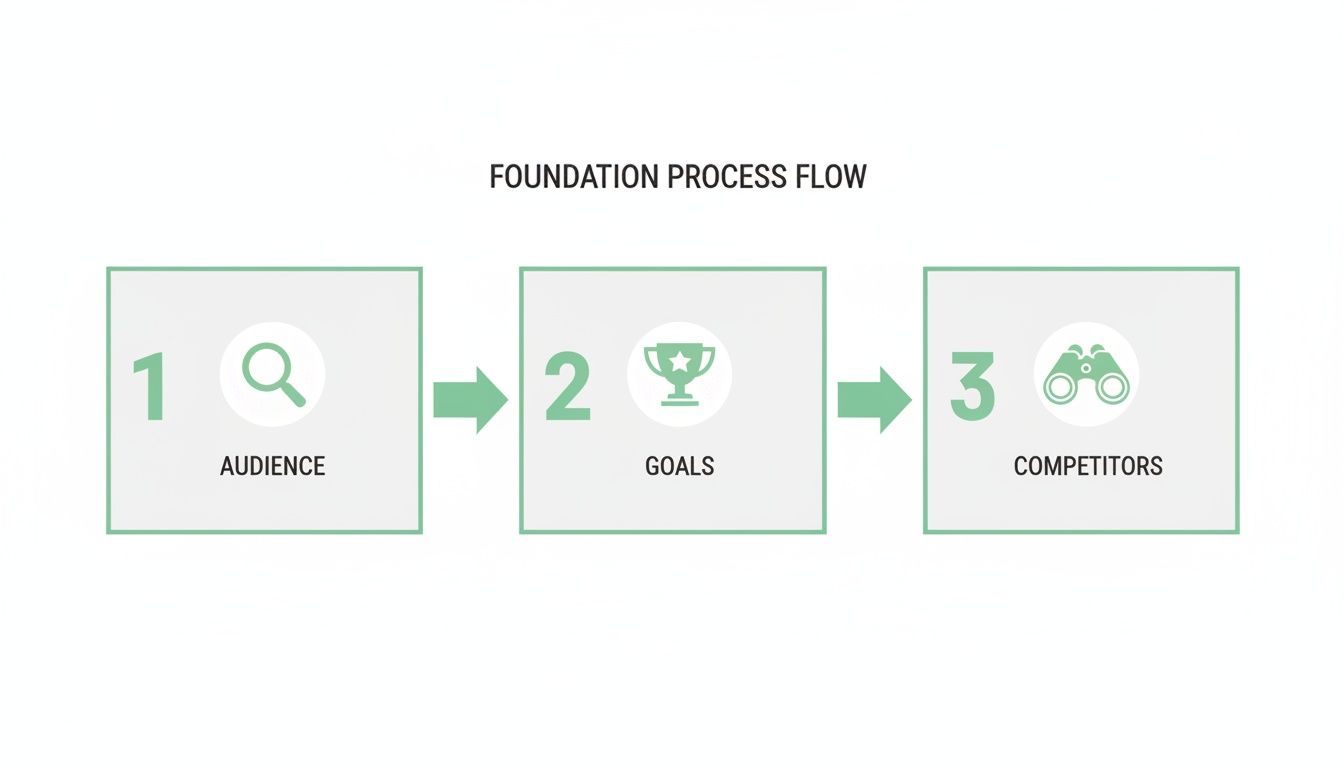
Get these three steps right, and you'll have a strategic filter for every content idea you ever have, ensuring everything you post is perfectly aligned with your brand's direction.
Choose Your Platforms Wisely
Finally, you have to be ruthless about where you spend your time and energy. You can't be everywhere at once, and trying to will only lead to burnout and mediocre results. It’s far better to dominate one or two channels than to have a weak presence on five.
Recent trends show social media is becoming the 'new search engine,' with nearly 60% of consumers using Instagram and 54.5% using TikTok to research products. Pick the platforms where your target audience is already active and searching. This strategic focus is the final piece of your foundation, setting you up for sustainable growth right from the start.
Creating Content Pillars That Actually Work
If you've got your goals and audience figured out, it's time to stop what I call "random acts of content." Just throwing spaghetti at the wall to see what sticks is a waste of your time and, frankly, it just confuses your followers.
The antidote to this chaos is building your strategy around content pillars. These are the 3-5 core themes or topics your brand will own and talk about, day in and day out. Think of them as the recurring columns in a magazine you're creating just for your audience. They give you structure, keep your message consistent, and make planning so much easier. You’re never starting from a blank page again.
Brainstorming Your Core Themes
So, where do these pillars come from? They live at the intersection of three simple things:
Your Expertise: What are you genuinely an expert on? What unique perspective can you offer that no one else can?
Your Audience's Pain Points: What keeps them up at night? What problems are they desperately trying to solve?
Your Brand's Solutions: How does what you offer directly solve those problems?
Let's run through a quick example. Imagine a local coffee shop. Their pillars could be something like: "Expert Brewing Guides," "Behind-the-Scenes at the Roastery," and "Local Community Stories." See how that works? These themes show off their expertise, answer common customer questions, and build a real connection with their neighborhood.
If you're feeling stuck, we've put together a more detailed guide with tons of examples to get your own ideas flowing. Check out our deep dive into social media content pillars.
Turning Pillars Into a Content Backlog
Once you have your pillars, the real fun begins. It's time to break each one down into a backlog of specific, individual post ideas. This is how you turn a broad theme into a concrete to-do list, making sure you're never scrambling for something to post.
Let's take our coffee shop's "Expert Brewing Guides" pillar and see what that looks like in practice:
Reel: A quick 30-second tutorial showing the perfect French press technique.
Carousel Post: A swipe-through graphic detailing how to choose the right grind size for different brew methods.
Instagram Story: A live Q&A with the head barista answering questions about home espresso machines.
Static Post: An eye-catching graphic highlighting the top 3 mistakes people make with their pour-over.
Content pillars are what shift your strategy from being reactive to proactive. You stop asking, "What on earth do I post today?" and start choosing from a bank of great ideas you already know will connect with your audience.
This method also naturally creates a healthy mix of content that entertains, educates, and inspires. Remember, not every single idea has to be some big, polished video production.
That said, you can't ignore video. It's still the most influential format out there, driving the best ad recall and overall effectiveness. People want quality, not just quantity, so focus on authentic, niche videos that tell a real story. It's incredible, but simple "slice-of-life" scenes have been shown to boost purchase intent by 1.5 times. This is why your pillars need to support strong visual storytelling, especially on platforms like Instagram, where a tool like Gainsty can help you target and grow organically. Hootsuite's research has some great data on the impact of video if you want to dig deeper.
Designing a Realistic Content Calendar
You've defined your content pillars and have a backlog of great ideas. Awesome. But an idea is just a thought until it's on the schedule. Now it's time to build a content calendar that actually works for you, not against you, turning that high-level strategy into a real-world roadmap.

The whole point here is to create a system that stops the last-minute scramble and prevents burnout. It’s all about finding a rhythm that lets you create high-quality, purposeful content instead of just posting to fill a slot.
Choosing Your Calendar Tool
Let's be clear: you don't need some complex, expensive platform to get started. The best tool is the one you'll actually use every day. Your choice really boils down to your team size, how you like to work, and your budget.
Here are a few options I've seen work well for different teams:
Google Sheets: Simple, free, and endlessly customizable. A well-organized spreadsheet can be a powerhouse for solo creators or small teams. You can easily set up columns for date, platform, content pillar, caption, visuals, and status.
Trello or Asana: If you're a visual person, these project management tools are fantastic. Their Kanban-style boards let you drag content from an "Idea" column all the way to "Published," which is incredibly satisfying. The free versions are often more than enough.
Dedicated Social Media Platforms: For a more integrated approach, you might look into essential social media content management tools. These platforms often bundle scheduling, planning, and analytics together, which can be a huge time-saver.
No matter which tool you pick, a logical structure is everything.
Establishing a Realistic Posting Cadence
So, how often should you post? Honestly, there's no magic number. Consistency will always beat frequency. A brand that puts out three genuinely engaging posts a week will always outperform one that spams its audience with seven mediocre ones.
The data shows a pretty wide range—about 23% of marketers post 3-4 times a week, while 20% aim for 5-7 times. The key is to find a pace you can sustain without sacrificing quality. Take a hard look at your resources and your analytics to figure out what’s realistic.
This is where strategic marketers separate themselves from the pack. Only 38% plan their content a week ahead, but a much savvier 14% plan three months or more in advance. Getting ahead like this can improve your workflow efficiency by up to 35%. Start with a manageable goal, like three posts a week, and only scale up when you know you can keep the quality high.
Finding Your Best Times to Post
You've probably seen those infographics about the "best time to post." They're a decent starting point, but your audience is unique. The most powerful way to plan is by digging into your own data.
Jump into your platform-specific analytics—like Instagram Insights or TikTok Analytics—and see when your followers are actually online and active.
Look for patterns. Are your best-performing posts all going live on a certain day or around a particular time? That data is your secret weapon for maximizing reach. Schedule your most important content for those peak windows to get it in front of as many people as possible.
Your content calendar is more than a schedule; it’s a strategic document that aligns your content pillars with your audience's behavior and your team's capacity. It’s the bridge between your high-level strategy and your day-to-day execution.
Finally, map out key dates that matter to your brand. This means major holidays, of course, but also industry events, product launches, or company milestones. Planning for these moments well ahead of time ensures you can create something thoughtful and relevant instead of scrambling at the last minute. This proactive approach keeps your feed feeling fresh and timely, which is exactly what builds a lasting connection with your audience.
Escape the Daily Grind with a Content Batching Workflow
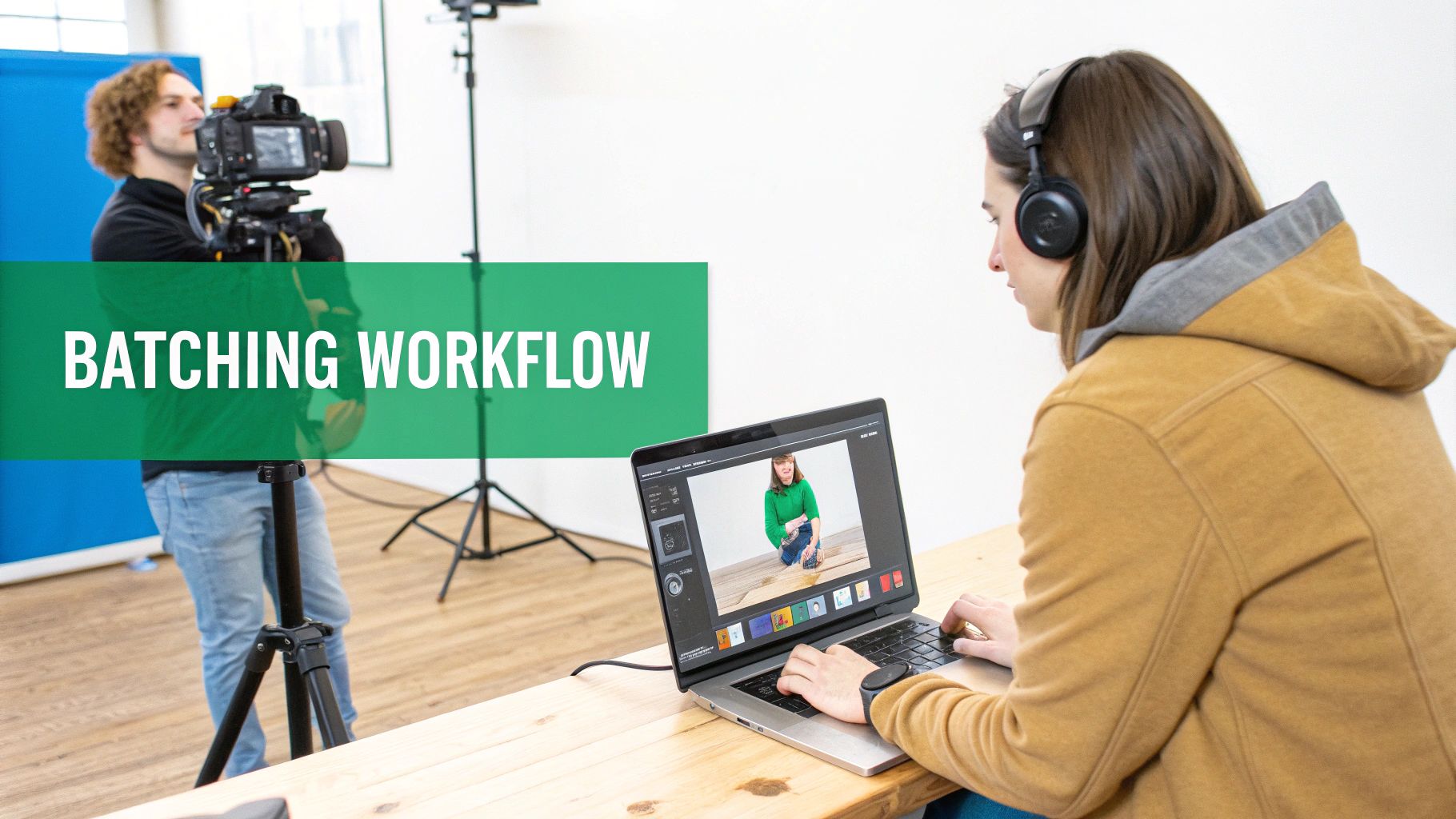
If the idea of creating social media content every single day feels exhausting, you're not alone. The secret to staying consistent without burning out isn't about working harder; it’s about ditching the chaotic, post-by-post scramble. This is where content batching completely changes the game, shifting your workflow from reactive to proactive.
Imagine setting aside one block of time—a morning, an afternoon—to create an entire week's worth of content. Instead of trying to brainstorm, shoot, edit, and write captions daily, you knock out all similar tasks at once. This approach is a massive efficiency booster because it lets you stay in one creative zone, minimizing the mental drain of switching between different types of work.

When it's time to post, everything is already done. You’re free to focus on what really matters: engaging with your community, knowing your content pipeline is full and ready to go.
How to Build Your Batching Process
A solid batching system breaks down the entire creative process into themed days or sessions. This lets you get into a deep state of focus on one specific task, which almost always leads to better work in less time.
Here’s what a sample weekly schedule could look like:
Monday is Video Day: This is when you film everything. Reels, TikToks, maybe even a longer YouTube video. Get your lighting and camera set up just once, then power through all your scripts in a single go.
Tuesday is Design Day: Fire up Canva or your favorite design tool and create all your static graphics. This is your time for carousels, infographics, and quote cards. You can also edit any photos for your feed during this block.
Wednesday is Writing Day: Now, you write. All of it. Captions, headlines, and calls-to-action for every post you've just created visuals for. With the visuals done, you can craft copy that fits them perfectly, without any other distractions.
Thursday is Scheduling Day: Time to put it all together. Upload your finished assets and copy them into your scheduling tool. Add your tags, choose your hashtags, and schedule every single post for its designated time slot.
This system turns what feels like a relentless daily chore into a manageable weekly project. You'll find you build momentum as you go, creating a library of on-brand, ready-to-publish content.
Work Smarter: Repurpose Everything
Batching isn’t just for creating new stuff efficiently; it's also the perfect time to plan how you'll reuse it. A single, solid piece of long-form content can fuel an entire week’s worth of posts across all your platforms. This is how you maximize your creative energy and get your core message in front of more people.
Repurposing is the ultimate content multiplier. Instead of creating ten different ideas, create one great idea and find ten different ways to package and present it.
Let's say you just finished a 20-minute video interview with an expert in your field. Don't just upload it to YouTube and call it a day. Break it down.
Podcast Clip: The full audio is a natural fit for a podcast episode.
Short-Form Videos: Pull out 3-5 of the best soundbites or key insights to create punchy Reels or TikToks. Add captions and maybe some trending audio to give them a boost.
Carousel Post: Turn the main takeaways into a digestible carousel for Instagram or LinkedIn. Use pull quotes from the interview to make it visually engaging.
Instagram Stories: Share some behind-the-scenes photos from the interview. Use polls and question stickers to get your audience involved in the conversation.
Blog Post: Get the interview transcribed and expand it into a detailed blog post for your website. You can even embed the full video right in the article.
By building batching and repurposing into your content planning, you create a sustainable system that doesn't just save you time—it fuels consistent, meaningful growth.
Using AI for Smarter Content Planning
Let's be clear: artificial intelligence isn't here to steal your creative spark. Think of it as the ultimate co-pilot for any serious social media manager. It’s the tool that handles the tedious, data-heavy tasks, freeing you up to focus on what really matters—strategy, creativity, and connecting with your audience.
Bringing AI tools into your workflow is one of the smartest moves you can make to level up your content planning. It makes the entire process faster, more strategic, and backed by actual data, not just gut feelings.
Speed Up Your Brainstorming and Ideation
We've all been there, staring at a blank content calendar, waiting for inspiration to strike. This is where AI immediately proves its worth. Instead of struggling, you can plug your content pillars directly into an AI tool and get a flood of relevant post ideas in seconds.
Say one of your content pillars is "Sustainable Small Business Tips." An AI assistant could instantly spin up ideas like:
A quick Reel showing "5 Eco-Friendly Packaging Swaps."
A carousel post that breaks down the ROI of energy-efficient office upgrades.
An Instagram Story Q&A session with a local, sustainable supplier.
The goal isn't to have the AI write the post for you. It's about having a brainstorming partner that can instantly give you a dozen different angles, helping you build a much richer and more varied content calendar than you might come up with alone.
AI tools don't just spit out random ideas; they generate targeted ones. By analyzing what already works with your audience, they suggest topics and formats with a higher chance of success, taking a lot of the guesswork out of the creative process.
Make Creative Decisions Backed by Data
Beyond just brainstorming, AI injects hard data into almost every creative decision you make. This shifts your thinking from "I think this will work" to "The data suggests this will work." It's a small change in mindset that can have a huge impact on your results.
For example, if you’re unsure how to start a video script, you can ask an AI to generate five different hooks for the same topic. It might give you a question, a controversial statement, a surprising statistic, a storytelling intro, and a problem-solution opening. From there, you can test them or just pick the one that feels most authentic to your brand.
It's no surprise that 83% of social marketers say AI helps them create way more content. The most common uses are for generating captions (32%), repurposing content across different platforms (23%), and spotting new trends (21%), according to Planable's social media statistics report. This productivity jump means you can spend more time on big-picture strategy while the tech handles the execution.
Optimize and Predict Performance
This is where things get really interesting. The most advanced AI tools can now analyze and even predict how your content will perform before you publish it, giving you a chance to make improvements.
This can look like a few different things in practice:
Sentiment Analysis: Getting a read on how your audience might emotionally react to a certain caption or topic.
Trend Identification: Spotting trending audio on TikTok or Instagram before it peaks, giving you a window to jump on it while it's still relevant.
Hashtag Optimization: Recommending the right mix of niche and broad hashtags based on real-time data, not just old, static lists.
Platforms like Gainsty are built around these capabilities, helping you target the right people with the right message to create a clear runway for organic growth. When you make smarter decisions during the planning phase, every piece of content you create has a much better shot at succeeding.
If you want to see what else is out there, check out our guide on the best AI tools for content creators. This is how you stop just making content and start creating content that consistently drives results.
Analyzing Performance to Refine Your Strategy
Your content plan shouldn't be a "set it and forget it" document. It’s a living, breathing guide that needs to adapt. The real magic behind long-term social media growth comes from creating a feedback loop: you post, you analyze the performance, you understand the story the data tells, and you use those insights to get smarter.
This is how you stop throwing content at the wall to see what sticks. It's the shift from simply posting to strategically publishing content you know has a great shot at hitting the mark.
Key Metrics to Actually Track
It's easy to get lost in a sea of numbers. To truly refine your social media plan, you have to focus on the metrics that tie directly back to the goals you set in the first place. Sure, a high follower count is nice, but it's a vanity metric that doesn't paint the full picture.
Instead, let's zero in on the data points that show you how your audience is actually behaving and how effective your content really is:
Engagement Rate: Think of this as your content's quality score. When a post gets a high rate of likes, comments, shares, and saves, it’s a clear sign that it genuinely connected with your audience. Keep an eye on this for every post and track it over time to spot which topics and formats are home runs.
Reach and Impressions: While not the end-all, be-all, these numbers tell you how many unique people saw your content and how many times it was shown. If you see a sudden drop, it could be a signal that the algorithm has shifted or your content isn't inspiring as many shares.
Click-Through Rate (CTR): If driving traffic to your website is one of your goals, this metric is non-negotiable. It shows the percentage of people who saw your post and actually clicked the link. This is a direct measurement of how powerful your call-to-action is.
Audience Growth Rate: Don’t just stare at your total follower count. Track the rate of growth. This tells you if your content is consistently attracting new people into your community, which is a much healthier sign of progress.
Setting Up a Monthly Review Process
You don't need a complicated system to learn from your data. A simple monthly check-in is all it takes to stay agile and responsive. This formal review process ensures you're consistently learning from what you're putting out there.
During your monthly review, sit down and ask a few pointed questions:
Which content pillar drove the most engagement? Find the theme that consistently sparked the most interaction and make a plan to lean into it more next month.
Which format performed best? Did Reels crush your carousels? Did a simple text-only post on LinkedIn generate more conversation than a polished graphic? Double down on what your audience is showing you they love.
What was our top-performing post, and why? Really dissect this one. Was it the hook? The visual? The caption? Maybe it was the specific topic. Use this post as a blueprint for what to create next.
Your analytics aren't just numbers on a dashboard; they are direct messages from your audience. Listening to what they're telling you through their clicks and comments is the single fastest way to improve your content and grow your account.
Now, turn those insights into concrete actions for the next month's calendar. For instance, if you discovered that "behind-the-scenes" videos are your star players, schedule more of them. If you noticed a specific call-to-action boosted your CTR by 20%, start weaving it into more posts.
This simple cycle—plan, execute, measure, refine—is the engine that will power your entire social media strategy. It ensures your content plan evolves right alongside your audience, keeping you relevant and effective.
Common Questions About Content Planning
Even the most seasoned social media managers run into questions when the rubber hits the road. Moving from a beautiful strategy doc to daily execution is where the real work begins. Let's tackle some of the most common hurdles you might face.
How Far Ahead Should I Plan My Content?
This is a classic question, and the honest answer is: it depends. But if you're looking for a solid starting point, aim to plan one month.
This gives you enough breathing room to create thoughtful, high-quality content without feeling the constant pressure of "what do I post today?" It's the ideal balance between being proactive and staying nimble.
Of course, for bigger moments like a product launch or a major seasonal campaign, you'll want to zoom out and plan an entire quarter. The key is to build a system that's mostly planned but leaves about 10-20% of your calendar open. That way, you have space to jump on a trending topic or share something spontaneous without derailing your entire strategy.
What Are the Best Free Tools for a Content Calendar?
You don't need a pricey subscription to get organized. Seriously. The best tool is the one your team will actually use day in and day out.
Here are a few powerhouse options that cost nothing to get started:
Google Sheets: Don't underestimate a good spreadsheet. For solo creators or small teams, a well-organized Google Sheet is a simple, infinitely customizable, and totally free way to map everything out.
Trello: If you're a visual thinker, Trello is a game-changer. Its Kanban-style boards let you drag and drop content ideas from "To Do" to "In Progress" to "Published," which is incredibly satisfying.
Asana: Similar to Trello, Asana's free version is fantastic for tracking the entire content production process, making it easy to see who's doing what and when it's due.
How Can I Consistently Find New Content Ideas?
The fear of running out of ideas is real, but inspiration is everywhere once you know where to look. The golden rule? Start with your audience.
Your followers are an endless well of content ideas. Pay close attention to their questions, listen to the problems they're trying to solve, and you'll build a content queue that resonates deeply because it's built just for them.
Use Instagram Story polls and question stickers to flat-out ask them what they want to see. Dive into forums like Reddit or Quora to see what real people in your niche are asking. And when you feel stuck, always go back to your content pillars—they are your strategic North Star, designed to keep you on track and overflowing with relevant ideas.
Ready to stop guessing and start growing? Gainsty uses advanced AI to help you plan smarter, target better, and achieve real organic growth on Instagram. See how we can transform your content strategy.

.png&w=1920&q=75&dpl=dpl_D59Qa4oJ5cFQ7dZDLQ1JPQVnqHSs)






.png&w=750&q=75&dpl=dpl_D59Qa4oJ5cFQ7dZDLQ1JPQVnqHSs)