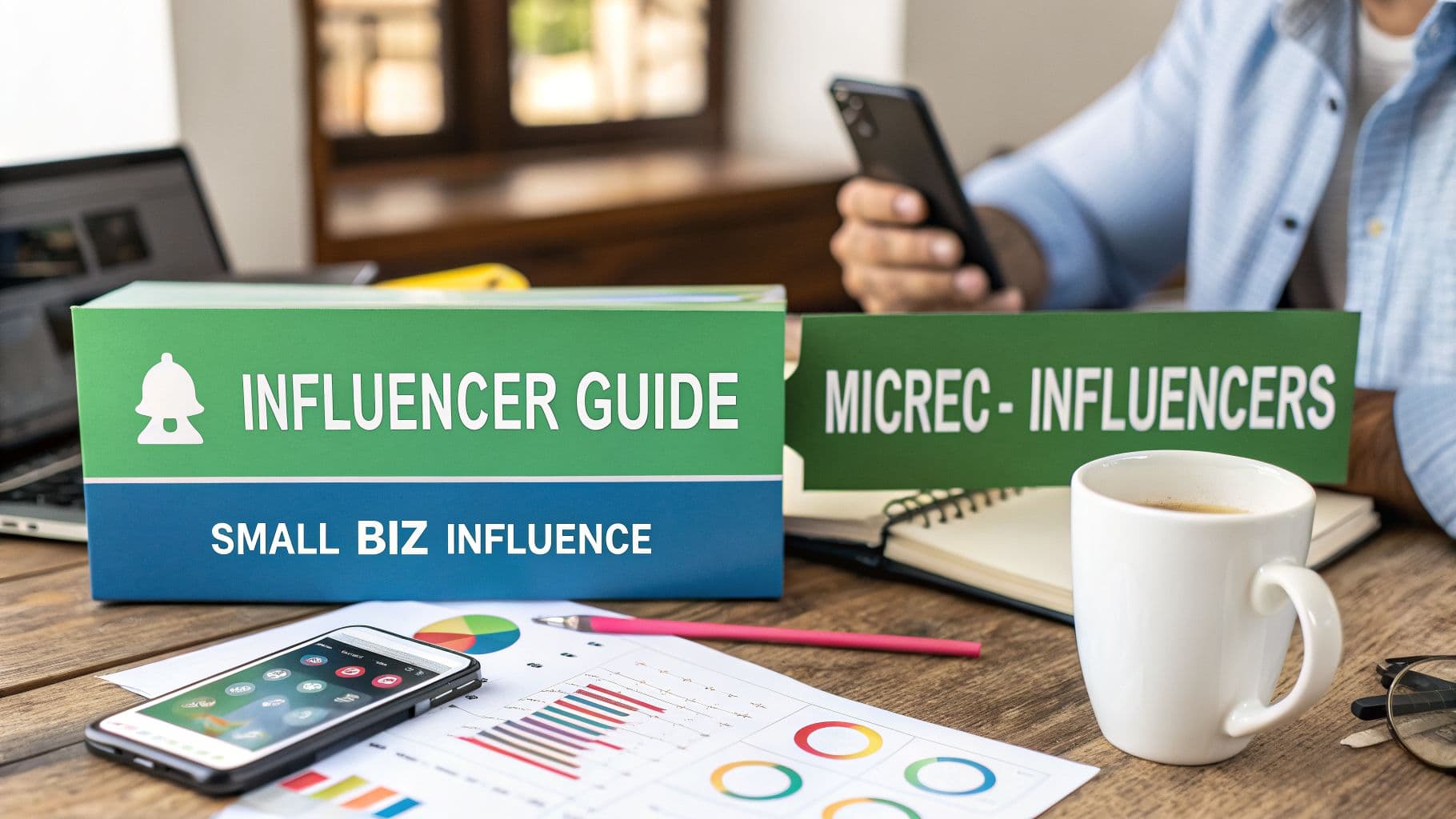
Why Influencer Marketing Is a Game-Changer for Small Businesses
Let’s be honest: people are tired of being sold to. They trust recommendations from real people far more than they trust a polished advertisement. That’s the simple truth at the heart of influencer marketing.
This is where micro-influencers come in. These are creators with smaller, but incredibly dedicated, followings. They’ve become the secret weapon for savvy small businesses for a few key reasons:
Real Authenticity: Their followers see them as peers, not celebrities. A recommendation from them feels like getting advice from a trusted friend.
Sky-High Engagement: Smaller audiences lead to more intimate conversations. That means more comments, shares, and genuine interactions with your brand.
Budget-Friendly: Working with micro-influencers is far more affordable. This allows you to partner with several creators at once, reaching different niche audiences without breaking the bank.
The Numbers Don't Lie
This isn't just a passing fad; it's a massive shift in how marketing gets done. The global influencer marketing industry blew past the $30 billion mark in 2026. And since 2021, a whopping 71% of companies have consistently upped their influencer marketing spend.
The real magic of influencer marketing is letting authentic people tell your brand’s story in their own voice. It builds a kind of trust and credibility that you just can't buy with conventional advertising.
Before you jump in, it’s smart to get familiar with what actually works. Brushing up on 10 Influencer Marketing Best Practices will help you build a solid foundation.
And if you're looking for some real-world inspiration, we've broken down some fantastic successful influencer marketing campaigns to show you what’s possible.
How to Find and Vet the Right Micro-Influencers
Let's be clear: your entire campaign lives or dies by the partners you choose. This isn't about chasing the biggest follower counts—that’s a rookie mistake. It’s about finding authentic creators whose audience is a perfect mirror of your ideal customer. Forget vanity metrics. We’re focused on what actually drives sales and builds a loyal community.
I've seen countless small businesses get this wrong. They think bigger is better. The real secret is finding a genuine brand fit (the art) and then digging into the data to prove that fit is backed by real, engaged people (the science).
This is where you have to decide between nano- and micro-influencers. Each serves a different purpose, and your choice depends entirely on your goals.

As you can see, nano-influencers are your go-to for hyper-niche markets where you need to build deep trust. Micro-influencers, on the other hand, give you that sweet spot of broader reach while still maintaining really strong engagement.
Digging for Influencer Gold
So, where do you actually find these people? You might be surprised to learn that the best place to start is often right under your nose. Your most powerful advocates could already be in your community. Start by looking at who’s already tagging your brand or showing off your products on Instagram.
Once you’ve looked internally, it’s time to start searching on Instagram itself.
Hashtag Hunting: Get specific with hashtags related to your niche, location, and what your customers care about. For example, a local coffee shop in Austin shouldn't just look at
#coffee. They should be searching for things like #austincoffee, #austinfoodie, or even #atxblogger to find creators embedded in the local scene.Location Tagging: This is a goldmine for brick-and-mortar businesses. Check out posts tagged at your business location, or even in your city or neighborhood. It’s a direct line to hyperlocal influencers who can genuinely drive foot traffic.
Competitor Recon: Take a look at which influencers your competitors or even complementary brands are working with. This gives you a pre-vetted list of creators who are already active and trusted in your space.
These are just starting points. For a much more detailed playbook on discovery, check out our complete guide on how to find micro-influencers for your brand.
Vetting Potential Partners Like a Pro
Finding a list of potential influencers is the easy part. Now comes the real work: vetting. This is the single most important step that separates a wildly successful campaign from a complete waste of money. You have to look far beyond the profile picture and follower count.
I can't stress this enough: don't get distracted by a high follower count. True influence is measured by engagement, authenticity, and audience alignment. An influencer with 10,000 truly engaged followers is infinitely more valuable than one with 100,000 who are barely paying attention.
Mastering the art of finding micro-influencers who click with your audience is what makes this strategy work for small businesses.
Here’s a practical checklist I use for every potential partner:
Check the Engagement Rate: The magic number here is at least 3%. To figure this out, add up the likes and comments on their last 10-12 posts, divide by the number of posts, then divide that by their total follower count, and multiply by 100. If it's below 3%, I'm usually wary.
Actually Read the Comments: Are people having real conversations, or is it just a wall of fire emojis and "Great post!" from other influencers? You're looking for genuine discussion, not just robotic feedback.
Audit the Audience Quality: Be on the lookout for red flags like fake followers. Telltale signs include tons of accounts with no profile pictures, bizarre usernames, or a follower graph that shows a sudden, massive spike out of nowhere.
Assess Content and Brand Fit: Does their photography style and tone of voice feel like a natural extension of your brand? And most importantly, ask yourself: Does this person seem like someone who would actually use and love our product? If the answer isn't a clear "yes," then it's a pass. Authenticity is non-negotiable.
The data backs this up. Micro-influencers consistently deliver 60% higher engagement than their larger counterparts. We're talking an average engagement rate of 3.86% on Instagram for micro-influencers, compared to a paltry 1.21% for mega-influencers. For a small business, smaller is almost always mightier.
Figuring Out Your Budget and Nailing the Outreach
Let's get straight to the big question every small business asks: "So, how much is this influencer thing actually going to cost me?" There’s no simple price tag. The real answer depends entirely on what you want to achieve. Are you chasing brand awareness, trying to drive direct sales, or just looking to get your product into the right hands?
For most small businesses just dipping their toes in, the best starting point is often the simplest one: product gifting. This is a low-risk, high-return way to get started. You send your product to a handful of carefully chosen nano- and micro-influencers with no strings attached. If they genuinely love what you sent, they’ll often post about it organically. Just like that, you’ve earned authentic content and a powerful testimonial.
Once you’re ready to move beyond gifting, you can start exploring more formal compensation. Here are the most common models I see work well for small businesses:
Flat-Fee Payments: This is straightforward. You pay a fixed price for specific deliverables, like one Instagram Reel and three Stories. It’s predictable, which makes it incredibly easy to budget for.
Commission-Based (Affiliate): With this model, you give the influencer a unique discount code or affiliate link. They earn a cut of every sale they generate. This is a pure performance-based approach that directly ties your spending to revenue—a perfect setup when cash flow is tight.
Hybrid Model: This is a fantastic middle ground. You offer a smaller flat fee for the creator's time and effort, plus a commission on any sales they drive. It gives the influencer some guaranteed income while still motivating them to push for conversions.
Three Ways to Budget for Your First Campaign
To help you visualize what this looks like, here are a few common budget scenarios. Think of these as starting points you can adapt to fit your own goals and resources.
Sample Budget Models for Small Businesses
Brand Identity – This defines the overall look and feel of your brand, creating a recognizable and consistent visual and tonal signature across all platforms. You need it because it makes your brand instantly familiar in a crowded feed, helping people remember and recognize you quickly.
Brand Voice – This represents the personality and communication style your brand uses when interacting with its audience. It is important because it humanizes your brand, making your content feel more genuine and helping build a stronger emotional connection with your audience.
Content Pillars – These are the main themes or topics your brand consistently focuses on in your content. You need them to ensure your posts stay relevant and valuable, preventing random or inconsistent content that confuses your audience.
Visual System – This includes your colors, fonts, imagery, and overall aesthetic guidelines. It is essential because it creates a cohesive and professional appearance, reinforcing your brand identity at a glance.
Audience Targeting – This defines exactly who your content is meant for. It is crucial because it ensures your efforts are focused on the right audience, leading to better engagement, stronger connections, and improved results.
Remember, these aren't rigid rules. You might spend more on a single, perfectly aligned influencer than on five smaller ones. It all comes back to your specific campaign goals.
How to Craft an Outreach Message That Actually Gets Read
Once you have a budget in mind, it's time to reach out. This is where so many brands stumble. They send generic, copy-and-paste DMs that scream "spam" and get ignored immediately.
You have to remember that good influencers get dozens of these pitches every single day. To stand out, you need to show them you’ve actually done your homework. Personalization is everything.
Your first message, whether it’s an email or an Instagram DM, should be short, sweet, and respectful. Introduce yourself and your brand, but then quickly pivot to why you think they, specifically, are a perfect fit. Reference a post of theirs you loved. Mention how their vibe or audience seems to align with your brand's mission.
Pro Tip: Whatever you do, don't open the conversation by asking for their rates. It's the fastest way to make the interaction feel cold and transactional. Focus on building a real connection first. Show them you're interested in a partnership, not just a purchase.
What to Put in That First Message
Your only goal with that initial email or DM is to start a conversation. You're not trying to close a deal on the spot. Here’s a simple checklist to make sure your message hits the right notes:
A Personal Subject Line: Something like “Collaboration Idea: [Your Brand] x [Influencer's Handle]” works perfectly.
A Genuine Compliment: Don't fake it. Find something you actually admire about their content and mention it. "I loved your recent Reel on..." shows you're paying attention.
The "Why": Briefly explain why this partnership would make sense for both of you.
A Clear, Low-Pressure Ask: End with something simple, like, "Would you be open to hearing a bit more about a potential collaboration?"
This thoughtful approach immediately sets a professional and respectful tone, and believe me, it dramatically increases your chances of getting a positive reply.
The data backs this up. With 74% of marketers planning to increase their influencer budgets, it's clear this strategy works. When done right, Instagram campaigns can bring in over $4 for every dollar spent. You can dig into more numbers on the effectiveness of influencer marketing to see just how powerful it can be.
Creating a Campaign Brief That Gets Results

I've seen more promising influencer collaborations go off the rails due to a vague or confusing brief than for any other reason. This document is your campaign’s roadmap. When done right, it eliminates the guesswork and makes sure everyone is on the same page.
Think of it this way: without a clear brief, you're just hoping the influencer reads your mind. You risk getting content that misrepresents your brand, misses the point, or just falls flat. A great brief, on the other hand, is the foundation for a professional, smooth-running partnership.
What Goes Into a Killer Brief
Your campaign brief doesn't need to be a 20-page document. It just needs to be clear. The goal is to provide guardrails, not a creative straitjacket. You want to give the influencer enough direction to succeed while still letting their own style and voice come through.
Here are the absolute must-haves I include in every brief:
Campaign Goals: What does a "win" actually look like? Get specific. Is it driving 100 clicks to your new product page? Boosting your Instagram followers by 5%? Or maybe it’s tracking sales from a unique creator discount code.
Key Messaging: What are the one or two things the influencer must* mention about your product? Maybe it’s your eco-friendly packaging or a special feature no one else has. Give them these as talking points, not a rigid script they have to read word-for-word.
Content Deliverables: Be painfully clear about exactly what you need. For example: "One Instagram Reel between 60-90 seconds, plus a three-slide Instagram Story with a link sticker on the final slide." Any ambiguity here will cause headaches later.
Creative Guidelines (The Dos and Don'ts): This is where you set your brand safety rules. A "Do" could be, "Please shoot in bright, natural light." A "Don't" might be, "No competitor products can appear in the video."
Putting this information on paper from the start saves so much time and prevents the endless back-and-forth that can sour a partnership.
A well-structured brief is an act of respect for the creator's time and talent. It shows you're a professional partner who has thought through the campaign, which builds trust and encourages their best work.
Managing the Partnership Like a Pro
The brief is where it starts, but your management throughout the campaign is what builds a strong, lasting relationship. This is a huge part of successful influencer marketing for small businesses.
First, lock in a clear timeline for content drafts, your feedback, and the final go-live date. When you give feedback, be specific and constructive. "I don't like it" isn't helpful. Instead, try something like, "This looks great! Could we get one more shot that shows the product's texture up close?" That gives the creator something concrete to work with.
Finally, make sure your agreement clearly states how you can use the content they create. Can you repurpose their Reel for your own social media ads or use their photos on your website? Defining content usage rights from the get-go prevents misunderstandings and potential legal issues down the road.
Measuring Your Results and Scaling Up Your Influencer Program

So, your campaign is live. The content looks fantastic, and the likes are pouring in. That’s great, but what does it actually mean for your business? If you want influencer marketing for a small business to become a reliable growth channel, you have to prove its value. This is where we move past the feel-good vanity metrics and get down to the data that really impacts your bottom line.
A high like count is encouraging, but it doesn't pay the bills. The real questions are: Did we get in front of new potential customers? Did those people actually visit our website? And, the big one: did they buy something? Answering these questions just takes a simple but smart tracking system.
Tracking What Truly Matters
To really measure success, you have to connect an influencer's post directly to an action on your website. This is much easier than it sounds, and you don’t need any fancy or expensive software to do it.
Here are the most effective ways I've seen to track campaign performance:
UTM Codes: Think of these as little tracking tags you add to the end of a URL. They let tools like Google Analytics show you exactly where your website traffic is coming from. Give each influencer their own unique UTM link, and you can trace every single click they send your way.
Unique Discount Codes: This is one of the simplest and most powerful methods for tracking sales. Just assign a specific code to each influencer, like "SARA15." When a customer uses that code at checkout, you know precisely who to thank for that sale.
Affiliate Links: These are trackable links that function a lot like UTMs but with the added bonus of automatically calculating commission. This setup is perfect for performance-based partnerships where influencers earn a cut of the sales they generate.
These methods provide hard data on clicks, conversions, and, most importantly, revenue. Armed with this info, you can finally calculate your Return on Investment (ROI). For a closer look at the numbers, our guide on how to use a social media ROI calculator can walk you through it.
From Data to Decisions: Scaling Your Program
After you’ve run a few campaigns, the data will start to paint a clear picture. You’ll quickly see which influencers drive real engagement, who converts the most sales, and what kind of content hits home with your audience. This is the moment you can shift from running one-off campaigns to building a scalable, long-term influencer program.
Now, scaling isn't about frantically trying to work with hundreds of influencers at once. It’s about being strategic.
The goal is to double down on what works. Identify your top-performing 2-3 influencers and focus on building long-term, ongoing partnerships with them. These creators evolve into true brand ambassadors who deliver consistent results.
Instead of constantly being on the hunt for new faces, invest in these key relationships. Give them more creative freedom, let them in on new product launches, and make them feel like an essential part of your marketing team. This approach creates a powerful and predictable engine for growth.
As you build out this core group of partners, you can then use platforms like Gainsty to organically grow your own brand's audience. This turns your Instagram profile itself into a valuable asset that naturally attracts even more high-quality collaborators down the road.
Common Questions About Influencer Marketing
If you're just getting started with influencer marketing, you probably have a ton of questions. That’s completely normal. Getting clear on a few key points right from the beginning can be the difference between a fumbling first attempt and a campaign that genuinely moves the needle for your business.
Let's walk through some of the questions I hear most often from small business owners who are ready to take the plunge.
How Many Influencers Should I Start With?
Don't try to boil the ocean on your first go. For your very first campaign, stick with a small, hand-picked group of 3 to 5 micro-influencers. This is a far smarter approach than trying to juggle a dozen collaborations right out of the gate.
Working with a small group lets you give each creator the personal attention they deserve, which is how you build real, lasting relationships. It also turns your first campaign into a low-risk learning lab. You can see what’s working, what isn't, and which personalities truly click with your brand before you even think about scaling up. This is a foundational principle of effective influencer marketing for small businesses.
What Are the Biggest Mistakes to Avoid?
I see this one all the time: choosing an influencer just because they have a massive follower count. A huge audience means nothing if it’s full of bots, unengaged followers, or people who have zero interest in what you sell. Chasing vanity metrics is the quickest way to waste your budget.
Another common pitfall is fumbling the creative brief. Some brands are so vague that the creator has no idea what to do, while others are so restrictive that they suffocate all the authenticity out of the content.
You need to find that sweet spot. Give your creators the key messages and non-negotiables, but then trust them to speak in their own voice. Their audience follows them for a reason, and a genuine recommendation is always more powerful.
Finally, try to break out of the "one-and-done" campaign mindset. The real magic—and the best ROI—happens when you build long-term partnerships. Turning an influencer into a genuine brand advocate pays dividends for years.
Can I Do Influencer Marketing with No Budget?
Yes, you absolutely can, especially if you have a great product. This is where a "product seeding" or gifting strategy comes into play. You simply send your product for free to a carefully selected list of nano- or micro-influencers (usually those with fewer than 10,000 followers).
There's no contract or guarantee they'll post. But if they genuinely fall in love with your product, many will share it with their followers just because they want to. It's a fantastic, low-cost way to get authentic content, spark some early buzz, and test the waters with potential partners for future paid collaborations.
How Do I Handle Influencer Contracts and Payments?
Even if you're just gifting a product, it’s wise to have a simple agreement in writing. This doesn’t have to be some scary, 20-page legal document. A straightforward email that outlines the expectations—what you’re sending, what you hope they'll create, and how you’re allowed to use their content—is often enough to keep everyone on the same page.
For any paid work, a formal agreement is non-negotiable. It needs to spell out the payment terms, including the amount, method (PayPal and bank transfers are common), and schedule. Some creators require 50% upfront and the rest on completion. Nailing down these details from the start prevents misunderstandings and ensures the entire partnership feels professional for both you and the creator.
Ready to stop guessing and start growing? Gainsty uses advanced AI and real Instagram expertise to attract genuine, organic followers who are ready to engage with your brand. Build an audience that truly cares about what you do. Find out more about our organic growth tools.
.png&w=1920&q=75&dpl=dpl_D59Qa4oJ5cFQ7dZDLQ1JPQVnqHSs)



.png&w=750&q=75&dpl=dpl_D59Qa4oJ5cFQ7dZDLQ1JPQVnqHSs)