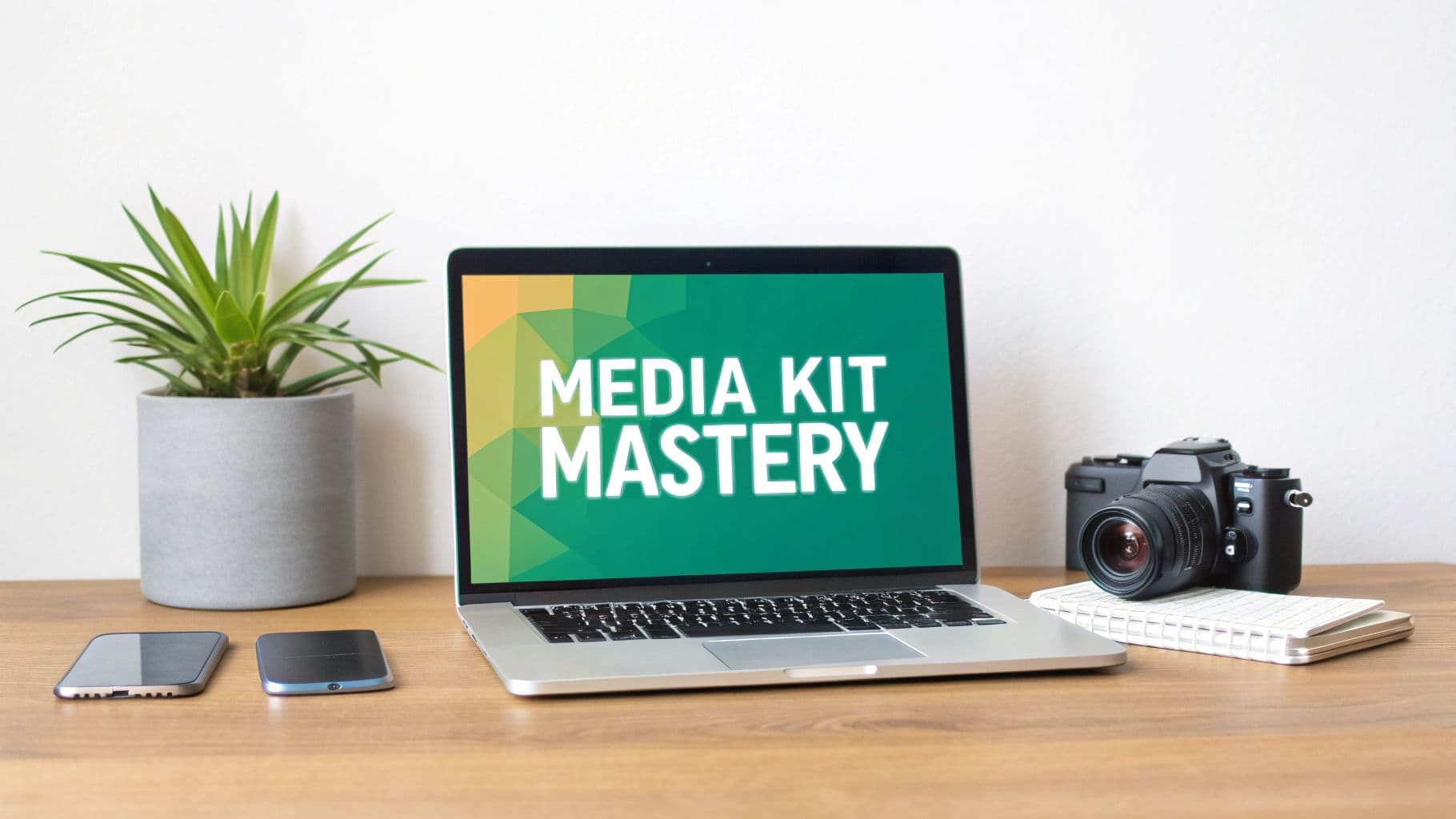
What Is an Influencer Media Kit and Why It Matters

Let's be clear: a media kit is far more than a list of your social handles. It’s a carefully crafted pitch that makes a killer first impression. It’s what separates creators who treat their platform as a business from those who treat it like a hobby.
When a brand is looking to partner with someone, they don't have time to scroll endlessly through your feed. They need a single, professional document that gives them the essential information, fast.
The influencer space is crowded. For every one campaign slot, a brand might be looking at 10-15 different creators. A sharp, compelling media kit is often the tiebreaker that lands you the deal. It moves beyond a simple bio, providing the hard data that proves your value and makes you look like the professional you are.
Building Credibility and Trust
A polished media kit immediately builds trust. When you present clean, verified analytics alongside your brand story, you're showing transparency from the very beginning.
This one document can turn a cold outreach into a genuine conversation about a partnership. It signals to brands that you understand what they're looking for—measurable results—and that you're ready to deliver.
A great media kit answers a brand's questions before they even have to ask them. It communicates your value, defines your audience, and proves your track record, making it an easy 'yes' for them.
Before we dive deeper, let's quickly summarize what every brand wants to see. A winning media kit isn't just a data dump; it's a strategic summary of your brand.
Key Components of a Winning Influencer Media Kit
Professional bio: This component is critical because it immediately communicates your niche, personality, and overall brand mission to potential partners.
Audience demographics: Including them helps brands quickly determine whether their followers align with their target customer profile.
Key metrics and analytics: These metrics provide concrete evidence of your reach, engagement, and overall influence, giving brands data-driven confidence in your value.
Past collaborations: Showcasing previous partnerships serves as social proof, highlighting your experience and demonstrating successful brand collaborations.
Services and pricing: Clearly outlining your services and pricing helps brands understand how to work with you and the level of investment required.
Nailing these five areas is the foundation for a kit that gets you noticed and, more importantly, hired.
What Makes a Media Kit Effective
An effective kit doesn’t just list numbers; it tells a compelling story about your brand. It should clearly and quickly articulate:
Who you are: What's your unique voice? What niche do you own?
Who you reach: Go beyond follower count. Where do they live? What are their interests?
Your performance: Showcase key metrics like your engagement rate, average reach, and impressions.
Your experience: Highlight your best work with examples and testimonials from past brand partners.
To really dig in and learn how to present yourself in the best possible light, checking out a guide on building the perfect Content Creator Media Kit is a fantastic next step. It's the groundwork for securing better, higher-paying brand deals.
Telling Your Story with a Compelling Creator Bio
Your metrics and analytics are essential, but let's be honest—they don't tell the full story. The numbers show a brand you reach, but your creator bio is where you show them your heart. This is your moment to shift from being a set of statistics to becoming a real, relatable human they’ll be excited to partner with.
Think of your bio as your professional elevator pitch. It’s where you quickly define your niche, showcase your unique personality, and highlight the core values that drive every piece of content you create. This is how you help a busy brand manager instantly see why your mission and their goals are a perfect match.
For instance, "I'm a fashion influencer" is forgettable. But what about this? "I explore the world of sustainable, ethically-made fashion for conscious consumers. My content empowers my audience to build a wardrobe that looks good and does good." See the difference? The second version immediately communicates your niche, values, and who you're talking to.
What's Your Unique Value Proposition?
What really sets you apart from the thousands of other creators out there? Your bio is the prime spot to spell out your unique value proposition. This isn’t about having the biggest follower count; it's about the distinct quality and focus of the community you’ve built.
Let’s say you’re a gaming creator. One who focuses exclusively on indie horror games offers a completely different—and for the right brand, far more valuable—audience than a generalist who plays whatever’s trending. Your bio needs to make that distinction crystal clear.
Your bio’s goal is to make a brand manager think, "Yes, this person doesn't just have followers—they have the right followers, and they know how to connect with them."
To really nail this down, it helps to solidify your core identity. Drawing insights from a good social media branding guide can help you sharpen the message you want your media kit to send.
Crafting a Bio That Truly Connects
To write a bio that sticks, lean into what makes you, you. Let your personality shine through, whether you’re naturally witty, deeply inspirational, or the go-to expert in your field. A generic, robotic-sounding bio is a guaranteed way to get overlooked.
Try weaving these elements into your story:
Your Mission: What’s the "why" behind your content? Are you here to inspire creativity, educate on a complex topic, or just make people laugh?
Your Audience Focus: Give a quick snapshot of who you serve. Something like, "I create simple, gourmet recipes for busy professionals who love to cook but are short on time."
Your Specialization: What do you do better than anyone else? Maybe it’s your cinematic photography, your brutally honest product reviews, or the way you foster such an engaged community.
Ultimately, your bio sets the stage for everything else in your media kit. It gives your numbers the context and meaning they need, turning you from just another influencer into an irresistible partner for the right brand.
The Metrics That Actually Seal the Deal
Your personal story opens the door, but solid data is what gets you the signed contract. When a brand invests in you, they're really investing in the community you've built. They need to see cold, hard proof that your audience is real, active, and responsive.
Let's be clear: your follower count is just the starting point. It’s the tip of the iceberg. What brands really care about is the activity happening beneath the surface. They’ll glance at your reach and impressions to get a feel for potential visibility, but the real star of the show is your engagement.
This breakdown shows how you can frame your creator profile by defining your niche, voice, and values. It gives important context to the numbers that follow. When you clearly define these pillars, you're showing brands not just what your metrics are, but why your audience is so connected to you.
Let’s Talk About Your Engagement Rate
Engagement rate isn't just a buzzword; it's the metric brands obsess over. I’ve seen brands choose a creator with a 12% engagement rate on an 8,000-follower account over someone with 50,000 followers and crickets in the comments. Why? Because that 12% signals a tight-knit, trusting community that actually listens.
High engagement means your followers are paying attention, responding, and taking action—and that's exactly what a brand is paying for. A micro-influencer with a loyal, active following is often a much safer and more effective bet than a macro-influencer with a passive audience.
Don't just slap a percentage on the page. Tell the story behind it. Explain why your audience is so active. Is it your niche expertise? Your authentic, no-filter connection? The Q&As you run every Friday? Give them the 'why'.
Calculating this number is straightforward. Pick a recent period, like the last 30 days, and use this formula:
(Total Likes + Comments + Shares + Saves) / Total Followers / Number of Posts = Engagement Rate
For a deeper dive into the numbers that matter, check out this guide on the essential Instagram performance metrics brands are looking at.
The Other Key Numbers to Include
Beyond engagement, a great media kit presents a well-rounded snapshot of your performance. You don't need to throw every single analytic at them—that's just overwhelming. Instead, curate a clean, scannable dashboard of your most compelling data.
Here’s what I recommend including:
Average Reach per Post: This is the number of unique accounts that see your content. It gives a realistic estimate of your visibility.
Average Impressions per Post: This tells brands the total number of times your content was displayed, which includes people seeing it more than once.
Story Views & Completion Rate: If you’re big on Instagram or TikTok Stories, this is crucial. Show your average story views and, if you can, the percentage of people who watch all the way to the end. A high completion rate is gold.
Follower Growth Chart: A simple line graph showing your growth over the last 3-6 months is powerful. It demonstrates momentum and proves your community is expanding.
You can pull all of this straight from your platform's native analytics. To make it even easier, a tool like Gainsty can help you track and visualize this data, so you can just plug the accurate, up-to-date numbers right into your media kit. When you present these specific metrics, you’re speaking a brand’s language and showing them you’re ready to deliver real results.
Proving Your Value with Audience Data and Past Wins

Sure, big engagement numbers catch a brand’s eye, but it's the audience data that truly proves you're the right partner. Having a massive following is one thing; having the right following is what really matters. This is your chance to pivot the conversation from "how many people you reach" to "exactly who you reach."
Think about it from their side. Brands have incredibly specific customer profiles they need to connect with. When a UK-based skincare company targeting women aged 25-40 sees that 65% of your audience fits that exact description, you’ve just made their decision for them. This data transforms you from just another influencer into a direct channel to their ideal customer.
Give Them a Snapshot of Your Audience
You don't need to overwhelm brands with a massive data spreadsheet. What they need is a clean, visual snapshot of the demographics that matter most. The good news is that most social platforms offer this right in their native analytics dashboards.
Make sure your influencer's media kit clearly shows:
Gender Breakdown: A simple pie chart or percentage split is perfect.
Age Brackets: Highlight the dominant age ranges (e.g., 18-24, 25-34).
Top Locations: List your top 3-5 countries or cities to showcase your geographic reach.
Key Interests: If your platform provides it, list a few core interests of your community (like Beauty & Wellness, Tech Gadgets, or Outdoor Adventures).
Presenting this information in a table or a simple graphic makes it far more impactful than a dense paragraph. For a great primer on where to find and how to interpret this info, understanding your Instagram audience demographics is the perfect starting point.
Here's an example of how you could lay out this data so a brand can see the value in seconds:
Age range: The majority of the audience—68%—falls between the ages of 25 and 34.
Gender: The audience is predominantly female, with 72% identifying as women.
Top country: Most followers are based in the United States, accounting for 55% of the total audience.
Top U.S. cities: The largest concentrations of followers are located in New York, Los Angeles, and Chicago.
Key interests: The audience shows strong interest in fashion, sustainable living, and travel.
A clean list like this immediately tells a brand if your community is their community.
Key Takeaway: Your demographics are the bridge connecting your creative content to a brand's business goals. This is the hard data that proves you haven't just built an audience—you've cultivated a community of their target customers.
Showcase Your Wins with a Killer Case Study
While demographics show potential, case studies deliver proof. This is where you put your money where your mouth is and show how you've delivered real, tangible results for brands you've worked with before. A solid case study can be the single most persuasive element in your media kit.
Don’t just drop a list of logos of brands you've partnered with. Instead, pick one or two of your most successful campaigns and tell a quick, compelling story about them.
Here’s a simple but effective way to structure it:
The Goal: Start with the partner and their objective. (e.g., "Partnered with a sustainable coffee brand to generate buzz for their new product launch.")
My Approach: Briefly explain what you created. (e.g., "I produced 2 Instagram Reels and 4 Stories that showed how the product fit authentically into my daily morning routine.")
The Results: This is the knockout punch. Use hard numbers to show your impact. (e.g., "Exceeded impression goals by 20%, drove over 300 clicks to their product page, and the Reels hit a combined 9.5% engagement rate.")
This simple formula turns a past collaboration into undeniable proof that you deliver a return on investment. It tells a potential partner not just what you've done, but what you can do for them.
Setting Your Rates and Designing Your Service Packages
Let's talk about the part that makes a lot of creators sweat: the money. It can feel awkward putting a price on your work, but this is exactly what separates a hobby from a business. When you lay out your services and rates clearly in your media kit, you’re not just showing a price list—you're showing brands you’re a serious professional who knows your worth.
Forget just listing a single flat fee for a post. The real magic is in creating tiered packages. This simple shift in thinking makes a huge difference. A brand might come to you for one simple post, but when they see they can get a Reel, a few Stories, and content usage rights for a bit more, the value becomes impossible to ignore. It’s the easiest upsell you’ll ever make.
Calculating Your Rates with Confidence
So, what should you charge? It’s not a number you just pull out of thin air. Your pricing is a mix of hard data and the unique value you bring to the table. There isn't a single magic formula, but there are definitely some core factors you need to look at.
Think about these things when building out your pricing structure:
Your Engagement Metrics: This is your secret weapon. A smaller, highly engaged audience is often far more valuable than a massive, passive one. If you have a 10% engagement rate, you're in a much stronger negotiating position than a creator with ten times the followers but only 1% engagement.
The Complexity of the Work: Not all content is created equal. A quick photo for an Instagram post takes a fraction of the time and skill needed to script, shoot, and edit a cinematic-style Reel. Your pricing should absolutely reflect the effort involved.
Industry Benchmarks: Do a little homework. Check out what other creators in your niche with a similar following and engagement are charging. This isn't about copying them, but about getting a feel for the market to make sure your rates are competitive.
Structuring Your Service Packages
Instead of making brands pick from a list of one-off services, bundle them into packages. This makes the decision-making process so much easier for them and shows you're thinking strategically about their goals. A tiered structure is a classic for a reason—it works.
Here’s a simple example of how you could structure three different tiers:
The Spark: This package includes one static Instagram feed post and three Instagram Stories with a link sticker. It is best suited for brands seeking a quick, focused feature or an initial product seeding opportunity.
The Glow-Up: This package consists of one Instagram Reel, one static feed post, and five Instagram Stories. It is ideal for brands that want a multi-format campaign designed to significantly boost reach and engagement.
The Spotlight: This package includes two Instagram Reels, one blog post review, and 30-day content usage rights. It is best for brands planning a major launch or those looking for a deeper partnership with long-term impact.
Pro Tip: Don't ever forget to be crystal clear about content usage rights. State upfront how and where a brand can use your content, and for how long. Can they use it on their website? In paid ads? Getting this sorted from the beginning saves so many headaches later on.
By presenting your services this way, you’re not just a creator for hire; you’re a strategic partner. You're guiding the conversation.
If you really want to get this part right, our guide on creating an influencer rate card template goes into even more detail. Ultimately, a thoughtful services section is what transforms your media kit from a resume into a powerful sales tool.
Designing and Pitching Your Media Kit Like a Pro
You've done the heavy lifting—you’ve dug into your analytics, pulled all the key data, and figured out what makes you unique. Now comes the fun part: turning all that raw information into a polished influencer's media kit and getting it into the right hands.
This is where your story truly comes to life. Your media kit's design is the first thing a brand manager will see, and it sets the tone before they even read a single word about your engagement rate. A clunky, unprofessional layout can completely derail an otherwise amazing profile. The good news? You don't need a degree in graphic design to make something incredible.
I always recommend starting with a tool like Canva, which has a ton of templates built specifically for media kits. The trick is to pick a layout that's clean and easy to scan. Make sure you customize it with your own brand colors and fonts so it feels like you, not just a template.
Crafting a Pitch Email That Actually Gets Opened
With your media kit polished and saved as a PDF, you're ready to start your outreach. Think of your pitch email as the cover letter for your media kit—it needs to be good enough to make someone want to open the attachment. My advice is to always keep it personal, short, and focused on what you can do for them.
Whatever you do, don't send a generic blast to a hundred brands. It never works. Take a few minutes to find the right person. A quick LinkedIn search for a social media manager or influencer marketing lead at the company is your best bet.
Here’s a simple structure I’ve seen work time and time again:
A personalized subject line: Ditch the boring stuff. Try something like, “Collaboration idea from a [Your Niche] creator” or “A potential fit for [Brand Name]’s next campaign.”
A genuine intro: In one or two sentences, tell them who you are and why you're a real fan of their brand. Mentioning a specific product you love shows you've actually done your homework.
The "Why You?" statement: This is your value proposition. Connect the dots for them. Explain exactly why your audience is the perfect match for their ideal customer. For example, "I saw you're promoting your new hiking boot, and 72% of my audience are outdoor enthusiasts between 25-40."
A clear call to action: Wrap it up by saying you've attached your media kit with more details and suggest a quick chat to explore ideas.
Remember, the person on the other end is busy. Your email needs to immediately answer their unspoken question: "Why should I care?" Make the value obvious from the first sentence.
The Art of the Follow-Up (Without Being Annoying)
Okay, you sent the email. Now what? The waiting game can be tough, but the follow-up is a critical—and delicate—step. My rule of thumb is to wait about a week before sending a friendly nudge.
A simple check-in is all you need. You're not demanding a response; you're just gently bumping your email back to the top of their inbox. Something like, "Just wanted to quickly follow up on my email from last week and see if you had a chance to look over my media kit," is perfect. It's professional, polite, and shows you're organized. More often than not, it's that little bit of persistence that turns a cold pitch into a real conversation.
Ready to grow your audience and make your media kit metrics even more impressive? Gainsty uses advanced AI and expert strategy to help you gain real, engaged followers organically. Start growing your Instagram with Gainsty today.
.png&w=1920&q=75&dpl=dpl_34ZXCf12K5qjjdZjPn9snwDRADrB)





.png&w=750&q=75&dpl=dpl_34ZXCf12K5qjjdZjPn9snwDRADrB)