Is Your Instagram Growth Stuck in Neutral
A familiar pattern shows up in client calls. The owner says the team is posting consistently, trying to stay current with trends, and spending too much time in DMs. Yet growth feels uneven, the content calendar keeps slipping, and the account looks busy without creating much business momentum.
That frustration is valid. Instagram rewards consistency, responsiveness, and format fluency. It also asks for a lot at once. You need strong creative, clear positioning, steady publishing, and quick community management. If one part slips, the results usually flatten.
For some brands, the first symptom is stalled reach. For others, it's churn. If your audience seems to rise and fall unpredictably, this guide on why brands stop losing Instagram followers is a useful reality check because it separates content issues from audience mismatch and posting fatigue.
Most struggling accounts don't have a motivation problem. They have an operating problem.
That's where management services can make sense. A solid provider doesn't just take tasks off your plate. They create structure around what gets posted, when it gets posted, who gets targeted, how replies are handled, and which actions move people toward a business outcome.
The biggest shift I've seen is psychological as much as operational. Once a business stops treating Instagram as a side task and starts managing it like a revenue-adjacent channel, better decisions follow. Content gets tied to offers. DMs get treated like sales or support conversations. Reporting gets judged against outcomes, not applause.
The Five Pillars of Professional Instagram Management
The difference between mediocre and effective instagram account management services is breadth. Weak providers focus on posting. Strong providers manage the whole system around the account.

Strategy comes before content
If a provider starts by asking how many posts you want each week, they're starting too low in the stack. The first job is to define what Instagram needs to do for the business. That might be product discovery, local lead flow, creator partnerships, thought leadership, or customer support.
Instagram is worth managing well because attention there is still unusually strong. Instagram's average engagement rate is 0.50% to 0.70%, compared with Facebook at 0.15% and X at 0.05%, according to Sprout Social's Instagram stats. That same source notes nano-influencers can reach 5.6% engagement, which is one reason smaller, sharply targeted accounts can outperform larger, unfocused ones.
A strategist should turn those realities into a usable plan:
Business objective first. Are you trying to drive inquiries, warm up buyers, or improve retention through customer care?
Content pillars second. Educational, proof-driven, behind-the-scenes, product, and opinion content each do different work.
Offer mapping third. Every account needs a path from attention to action.
Without that order, content turns into filler.
Content creation has to match platform behavior
Professional management isn't just graphic design and captions. It's matching the message, format, and audience intent. A service should know when a Reel is the right vehicle, when a carousel should do the heavy lifting, and when Stories should handle urgency or trust-building.
For teams trying to improve short-form creative, this breakdown of actionable advice for viral Reels engagement is useful because it focuses on execution, not vague hype.
A good provider also builds variation into the feed. That matters because different formats do different jobs:
Reels often support discovery.
Carousels help with explanation and save.
Stories support immediacy, FAQs, and lower-friction conversation.
Static posts can still work when the message is sharp, and the brand is visually disciplined.
Scheduling should be informed by data, not habit
Many brands still publish when the team happens to be free. That's convenient, but it's not a strategy.
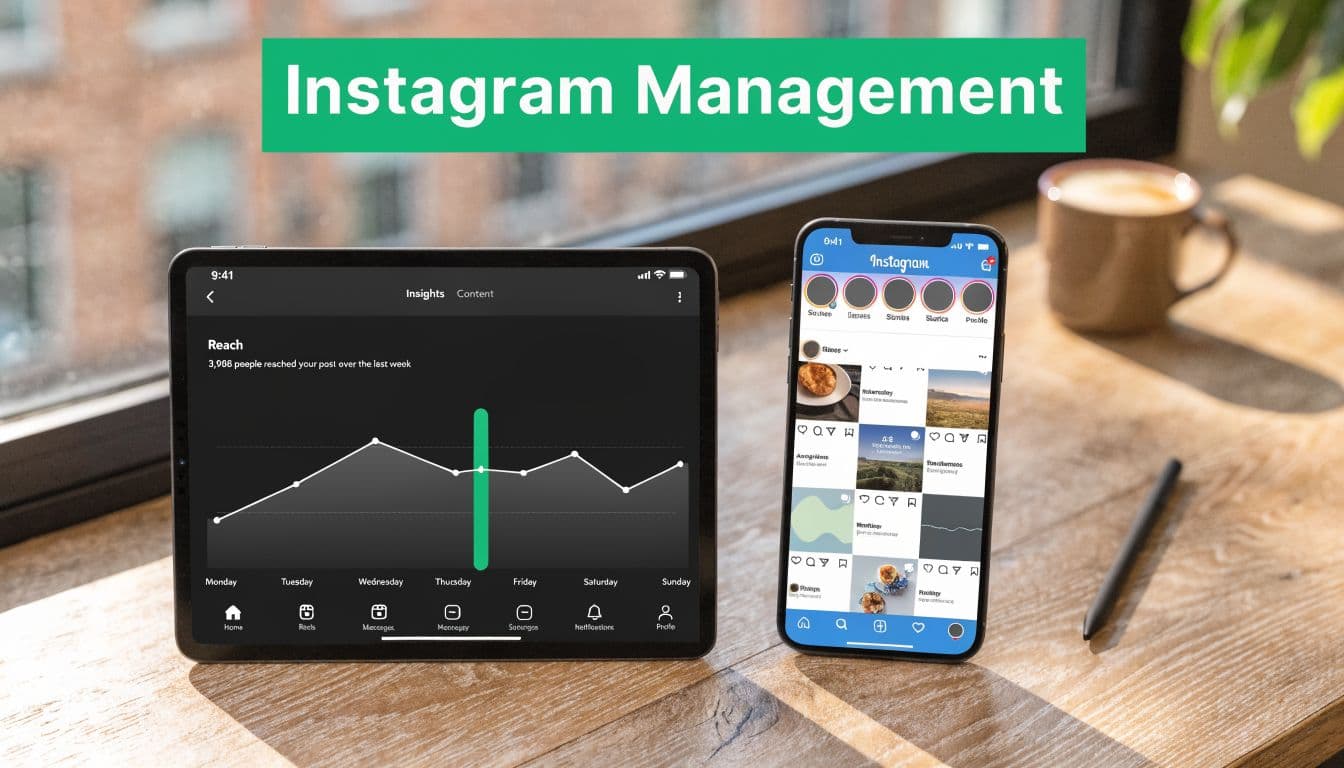
Professional services usually combine Instagram Insights with tools like Iconosquare or Sprout Social to identify audience-active windows, compare content performance over time, and preserve historical context that the native app handles less thoroughly. In practice, this means posting schedules can be adjusted based on what earns reach, saves, replies, or follow-through.
Practical rule: If an agency can't explain why it chose your posting cadence and timing, it's guessing.
This is one area where software matters. Scheduling tools make consistency possible, but the better providers use them diagnostically, not just operationally.
Community management is where trust gets built
A surprising number of businesses underestimate this pillar. They treat comments and DMs as cleanup work instead of conversion work.
On Instagram, community management includes:
Reply handling. Comments, story replies, and direct messages need tone control and speed.
Escalation rules. Sales questions, complaints, and partnership requests shouldn't all get the same treatment.
Relationship building. Outbound engagement with relevant accounts can support visibility without drifting into spammy behavior.
Many low-cost services fail in this regard. They can schedule posts, but they cannot represent your brand well in a live conversation.
Reporting should change decisions
The fifth pillar is analytics, but not the vanity version.
A competent provider tracks what happened, why it likely happened, and what changes next. That includes metrics like reach, engagement, content-level performance, follower quality, and inquiry patterns. It should also connect those signals to actions such as link clicks, DM volume, lead conversations, or offer interest.
One provider worth noting in this category is Gainsty, which combines AI-assisted targeting and scheduling with dedicated account management and analytics. That's useful if you want help operating the account while keeping growth organic rather than bot-driven.
Beyond Vanity Metrics: How to Budget and Measure Success
Most buyers ask the wrong first question. They ask, “How much will it cost?” before they ask, “What exactly will we measure?”

The pricing conversation is usually incomplete
Instagram management is commonly sold as a monthly retainer or a scoped project. Retainers tend to cover ongoing strategy, publishing, engagement, and reporting. Project work usually covers one campaign, a content sprint, or a launch period.
The problem is that many proposals bundle activity without tying it to outcomes. You'll see deliverables like content calendars, caption writing, posting, hashtag sets, inbox support, and reporting. Those are useful. But they don't answer the only budget question that matters: what business result should this help produce?
That's why businesses run into what 1Digital Agency describes as an ROI measurement crisis in Instagram management. Agencies often emphasize follower growth and engagement while failing to connect those metrics to revenue. Their practical recommendation is the right one: demand transparent reporting tied to business outcomes through UTM parameters and platform-specific conversion funnels.
What to track instead of follower count
Follower count has context value, but it's a weak primary KPI. If you want a cleaner framework, track Instagram in layers.
Attention metrics
Reach, impressions, profile visits, and content interactions.Intent metrics
Link clicks, story replies, DM starts, saves, shares.Business metrics
Qualified inquiries, booked calls, purchases, repeat support conversations, and customer questions resolved.
A simple way to operationalize that is to define one primary conversion path before hiring anyone. If you sell services, that path might be profile view to bio link, click to form fill. If you sell through DMs, it might be Reel view to DM inquiry to sales conversation.
For teams that need a starting framework, this social media ROI calculator guide is a practical way to think about campaign measurement without defaulting to vanity metrics.
If a provider reports activity but not business movement, you're paying for motion, not results.
What success should look like
Success should be defined in advance and reviewed monthly. Not with inflated promises, but with plain questions:
Did more qualified people enter the funnel?
Did Instagram create more sales conversations or support resolutions?
Did the provider show which content themes led to those actions?
Did reporting help you decide what to do next?
If the answer is no, it doesn't matter that the account “grew.”
A Practical Checklist for Evaluating Providers
Buying instagram account management services gets easier when you stop judging the pitch and start judging the process. A provider should be able to explain how they think, how they work, and how they'll prove value.
Questions worth asking in the first call
Start with the basics, but make the provider get specific.
Ask about strategy. What's your process for aligning Instagram work with lead generation, ecommerce, or customer care goals?
Ask about content production. Who creates the content, who approves it, and how do you prevent generic output?
Ask about growth methods. How do you attract relevant followers without bots, purchased engagement, or risky automation?
Ask about community management. Who handles DMs and comments, and what gets escalated back to our team?
Ask about reporting. Which metrics do you report on, and how do you tie them to business outcomes?
A provider that answers in broad slogans is telling you they don't have a disciplined operating model.
Provider evaluation checklist
Strategy – “How do you define success for an account like ours?”
A green flag answer focuses on understanding offers, audience quality, sales process, and operational capacity before talking about posting volume. A red flag is when they only mention followers, reach, or vague brand awareness without tying it to business outcomes.Content – “How is content planned and approved?”
A strong provider explains a structured workflow involving content pillars, briefs, drafts, revisions, and approvals. A weak response relies on generic templates with little adaptation to your specific niche.Growth methods – “How do you grow accounts?”
A good answer emphasizes organic targeting, audience fit, engagement quality, and strategic positioning. A red flag is when they suggest guaranteed follower growth or vague “network-based” methods.Community management – “How do you handle comments and DMs?”
A strong answer includes clear response rules, escalation paths, and tone of voice guidelines. A weak answer treats community management as an optional or secondary task.Reporting – “What will monthly reporting tell us?”
A good provider connects performance to clicks, inquiries, leads, and funnel outcomes. A red flag is reporting that only shows surface-level engagement metrics without business context.Tools – “Which platforms do you use?”
Strong answers explain why specific tools are used (e.g., Sprout Social, Iconosquare, scheduling and inbox systems). Weak answers rely on vague “proprietary systems” without transparency.Fit – “Who is not a good client for you?”
A trustworthy provider can clearly define who they are not suited for. A red flag is claiming they are a fit for everyone regardless of goals, budget, or readiness.
Red flags buyers miss
Some warning signs are obvious. Others hide behind polished sales language.
“We guarantee fast follower growth” is usually a warning, not a benefit.
Watch for these patterns:
Guaranteed volume promises. Any commitment to specific follower counts should make you question the method.
No discovery depth. If they don't ask about your margins, sales cycle, or support workflow, they can't measure ROI properly.
One-size-fits-all packages. Real estate, ecommerce, coaching, and local services don't use Instagram the same way.
Reporting without recommendations. Data alone doesn't improve accounts.
No discussion of risk. A credible provider should talk plainly about platform safety, account access, brand voice, and approval controls.
If you're deciding whether to build internal capacity or hand it off, this guide to outsourcing social media management helps frame the operational trade-offs.
How to read case studies without getting fooled
Don't look for dramatic screenshots. Look for causality.
A useful case study explains the starting problem, the changes made, the audience targeted, the content approach, and the business impact measured. Even when a provider can't disclose sensitive numbers, they should still show a clear chain between action and result.
If all you see is “more engagement,” keep digging.
How Different Niches Win with Instagram Management
The mechanics of good management are consistent. The application changes by niche.

Real estate
A real estate agent usually doesn't need broad visibility. They need local visibility with trust. Strong management here means geo-aware content, listing walkthroughs, neighborhood context, and consistent Story activity that keeps the agent top of mind.
Instagram matters because it supports both discovery and service research. 83% of users discover new products and 81% research services on Instagram, and over 150 million users engage in monthly conversations with businesses, according to Heymarket's Instagram business messaging statistics. For agents, that often translates into inquiries that begin in DMs long before a formal lead form gets filled out.
DTC ecommerce
A skincare or apparel brand wins differently. It needs a creative approach that reduces hesitation. That often means mixing product education, user-generated content, founder presence, and reply handling that answers objections quickly.
The service provider's role isn't just publishing attractive posts. It's spotting which product questions keep appearing in comments and DMs, then turning those into content and response scripts. That creates a loop between marketing and conversion.
Coaches and experts
A coach, consultant, or educator often uses Instagram as a trust-building channel. Reels can establish voice. Carousels can organize ideas. Stories can handle objection management and invite direct conversation.
For this niche, the inbox is part of the funnel. A good management service knows when to encourage conversation, when to route someone to a booking link, and when to keep nurturing through content rather than forcing a pitch too early.
The same platform. Three very different jobs.
Comparing DIY Management with Professional Services
DIY can work. Hiring help can also work. The right choice depends on what your business can afford to ignore.

Where DIY makes sense
DIY is sensible when the budget is tight, the founder still has direct access to customer language, and the business is in an early learning phase. Handling your own content can teach you what resonates, what objections come up, and which messages earn replies.
The hidden cost is time. Not just posting time, but planning time, editing time, monitoring time, and the mental load of staying current with platform behavior. DIY also breaks down fast when inbox volume rises or when several people need to approve content.
Where professional services make sense
Professional management makes more sense when Instagram has already become operationally important. That usually means one of three things: it drives real inquiries, it requires daily community care, or it has become too inconsistent to support the business properly.
The value isn't magic. It's process, tooling, and execution discipline. A strong provider helps you keep pace without making the account feel outsourced in a bad way.
The trade-off in plain language
DIY provides you with control and low direct cost. Professional services provide you with an advantage and structure.
The wrong agency adds expense. The right one removes bottlenecks your team can't solve consistently on its own.
If your team already has strategy and creative skill but lacks bandwidth, outsourcing execution may be enough. If the bigger issue is unclear positioning, weak measurement, or scattered response handling, then you need a service partner that can do more than publish content.
Why an AI-Powered Organic Approach Wins in 2026
The old split was simple. You either managed Instagram yourself or hired an agency. That's no longer the most useful comparison.
The better question is whether your approach can combine scale with authenticity. Purely manual management often can't keep up with analysis, scheduling, and audience targeting. Bot-heavy growth tactics can scale, but they create platform risk and weak audience quality.
That's why an AI-powered organic approach is increasingly practical. AI can help identify posting windows, surface performance patterns, assist with segmentation, and support workflow speed. Human operators should still handle strategy, brand judgment, creative direction, and sensitive community interactions.
If you want a broader view of how agencies are applying these methods, this overview of social media AI automation strategies is worth reading because it frames AI as an operating layer, not a replacement for marketing judgment.
The strongest modern setups usually share the same traits:
Organic-first growth methods that avoid fake followers and risky shortcuts
AI-assisted planning and analysis to reduce manual waste
Human oversight for tone, approvals, and conversion-sensitive replies
Reporting tied to outcomes rather than dashboard theater
For teams exploring that model, Gainsty's guide to how to use AI for social media marketing is a practical next step.
If you're evaluating whether to hand Instagram off, start with clarity on outcomes, not content volume. Then choose a partner that can connect strategy, execution, and measurement without relying on vanity metrics or risky shortcuts. If you want an option built around organic growth, AI-assisted operations, and account management support, take a look at Gainsty.

.png&w=1920&q=75&dpl=dpl_34ZXCf12K5qjjdZjPn9snwDRADrB)






.png&w=750&q=75&dpl=dpl_34ZXCf12K5qjjdZjPn9snwDRADrB)