Why Most Instagram Account Management Tool Reviews Get the Decision Wrong
My recommendation is to reject any comparison that treats every Instagram account as the same buying problem. A solo creator needs a manageable workflow. An established brand needs oversight. An agency needs separation between clients. Buying the most elaborate platform doesn't automatically solve any of those problems.
The commercial opportunity is substantial. DataReportal estimated Instagram's potential advertising reach at 1.74 billion people in January 2025, up 5.5% year over year, using Meta's advertising-planning data. That's an advertising-reach estimate, not a monthly-active-user count, an important distinction in DataReportal's Instagram analysis.
That scale doesn't mean you need enterprise software. It means you should make the purchase against a business objective rather than an impressive demonstration.
The right tool is the smallest system that supports your account legitimately, solves your actual bottleneck, and lets you leave without losing operational control.
Separate operational help from growth help
Before discussing vendors, decide what you're buying:
Publishing assistance: You create the strategy and content; software organizes execution.
Decision support: You need clearer evidence about what deserves more attention.
Managed execution: You want someone else to handle a defined part of audience development.
Team coordination: You need approvals, ownership, and accountability across people or accounts.
Those aren't interchangeable purchases. A scheduler won't supply a positioning strategy. A growth service shouldn't be assumed to include editorial approvals. A reporting suite won't rescue content nobody has time to produce.
My buying order is account fit, acceptable operating methods, workflow fit, then price. Treat security as a rejection criterion, not a feature that earns bonus points.
Don't accept either extreme: third-party software isn't automatically unsafe, and an attractive compliance badge isn't proof that every promised action is appropriate. Ask the provider to demonstrate the actual connection and explain its scope. If the answer is evasive, stop the evaluation.
The Five Tool Categories You Are Actually Choosing Between
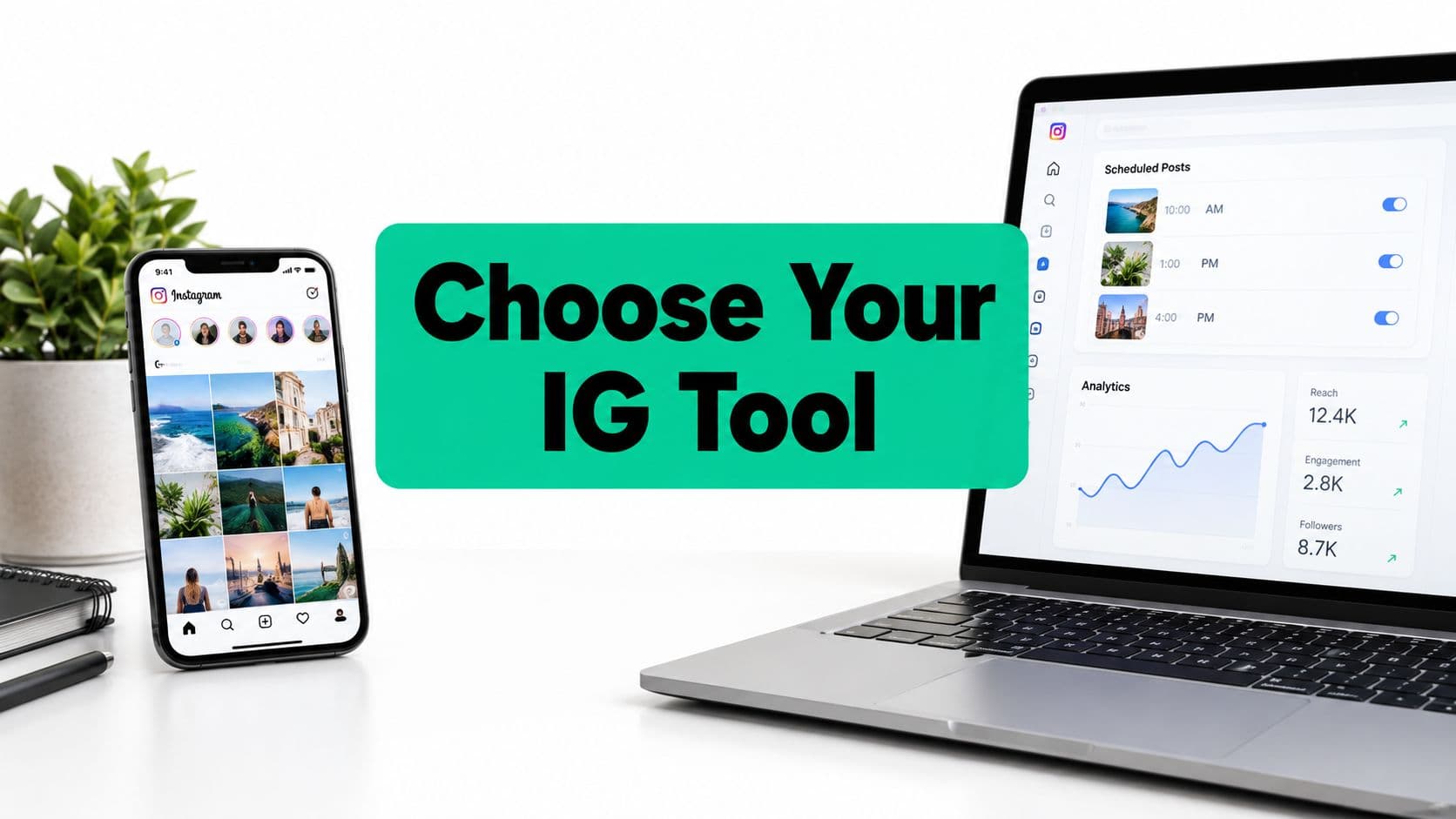
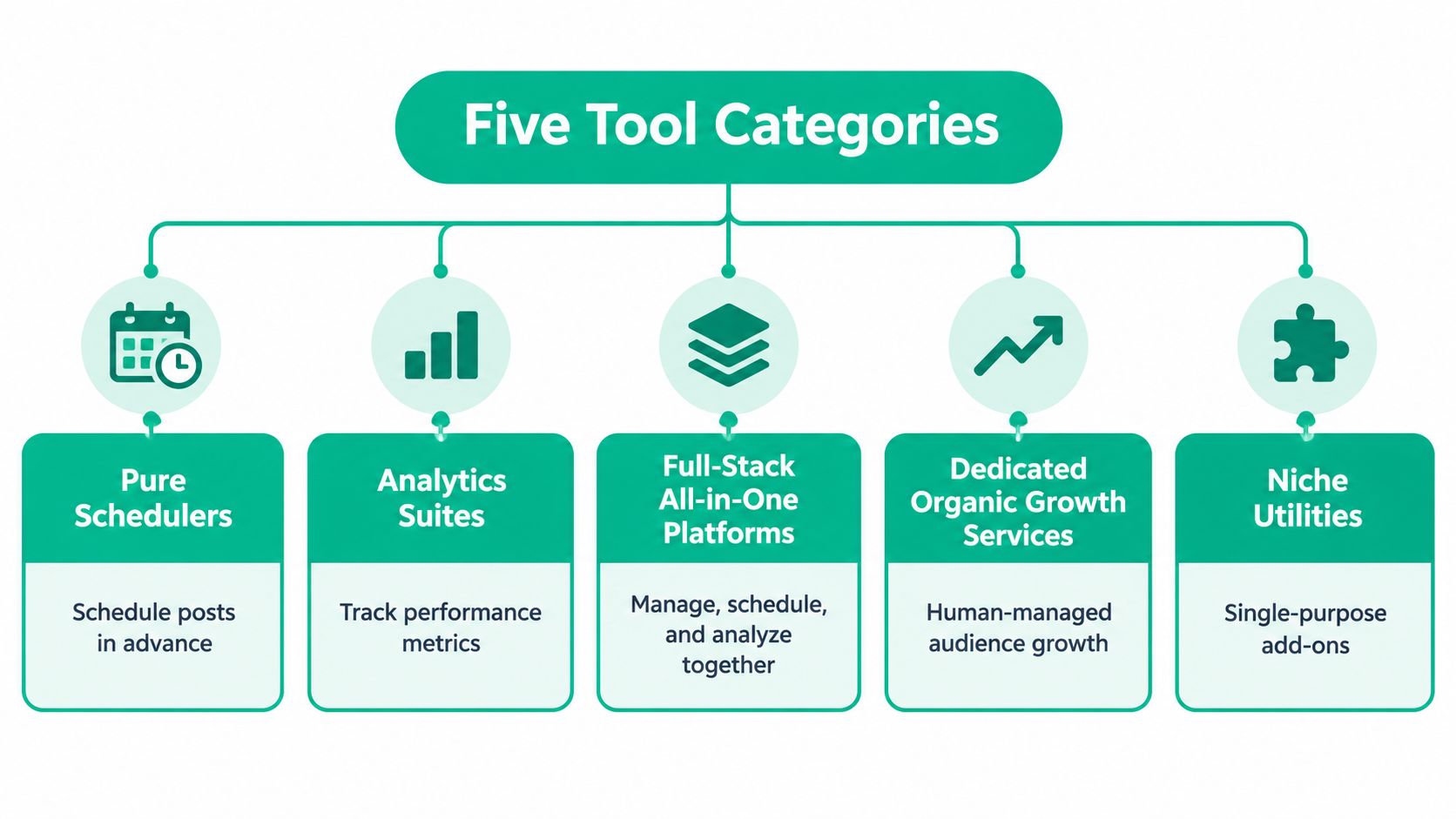
Choose the operating model before choosing the brand. This early comparison is a buying map, not a claim that every vendor includes the same capabilities.
Pure scheduler: Buy it when publishing consistency is the bottleneck. You still own strategy and execution.
Analytics suite: Buy it when you need better content decisions. Interpreting the findings remains your responsibility.
All-in-one platform: Buy it when a team needs a shared workspace. Expect more setup and administration.
Organic growth service: Buy it when audience development needs dedicated attention. You give up some direct control over execution.
Agency platform: Buy it when client separation and approvals matter. Expect more operational complexity.
The category diagram also includes niche utilities. Treat those as optional add-ons rather than substitutes for your core operating system.
Pick the responsibility you want to retain
Pure schedulers fit creators and small businesses that already know what they want to publish. Buy calendar convenience, not the expectation that a queue will create demand.
An analytics suite fits a content-led operator who can act on findings. If nobody will change creative direction based on the reports, don't pay for deeper reporting.
All-in-one platforms make sense when publishing, community work, and review involve different people. Their value should come from fewer handoffs, not more dashboard widgets.
Distinguish service delivery from team software
A dedicated organic growth service is a different contract. You're evaluating people, methods, targeting decisions, and accountability alongside software.
An agency-grade platform should be evaluated around client boundaries: who can approve, publish, export, and disconnect each account. Don't select it merely because it advertises support for a large portfolio.
For a local operator still deciding which responsibilities to keep internally, Boocoo's resource on Brisbane business social media help is a useful starting point for that discussion.
My advice: write down the task you want to stop doing, then identify the category designed to take it over. If your answer is "Instagram," your scope is too vague to buy well.
The Five Evaluation Criteria Every Buyer Should Score Vendors On
Use pass, needs proof, or reject rather than assigning arbitrary numerical scores. A security failure must remain a rejection even when the publishing interface looks excellent.
Test reliability and evidence
Scheduling and publishing reliability comes first in the demonstration. Ask the vendor to show a scheduled item moving through submission, confirmation, and failure recovery. A calendar entry isn't evidence that Instagram accepted the post.
Ask: What happens after a rate-limit response, and how do you prevent duplicate publishing during retries?
Meta documents Instagram Graph API calls per app-user pair within a rolling 24-hour window, using a formula of 4,800 calls multiplied by impressions, with throttling when applicable limits are exceeded. Its rate-limit documentation makes quota handling a legitimate procurement question, not an obscure engineering detail.
Analytics depth and freshness should be demonstrated through an actual report. Ask the vendor to identify the origin, update time, and calculation behind a metric. Reject demonstrations that substitute attractive charts for definitions.
Examine targeting, access, and methods
For the remaining criteria, ask questions that force operational answers:
Audience targeting: Can the provider explain how your niche, geography, and customer profile influence its recommendations or work? Distinguish editorial guidance from actions performed on your behalf.
Account security and API compliance: Which permissions does each function require? Ask for the authorization flow, access-revocation process, and a clear explanation of any activity outside the API integration.
Growth methodology: What exactly happens after onboarding? Ask whether the approach includes purchased followers, artificial interactions, engagement exchanges, or automated account actions.
Targeting should describe a relevant audience, not imply control over who will follow you. Likewise, “organic” is a label until the provider explains the work behind it.
Procurement rule: Require proof of dependable execution, interpretable data, relevant targeting, controlled access, and an acceptable growth method.
Finally, ask for a failure scenario. A credible vendor should explain what you'll see when authorization expires, publishing fails, or reporting becomes unavailable. The useful answer includes notification, ownership, recovery, and a fallback workflow, not just reassurance that support will help.
How the Leading Tools Stack Up Across Those Criteria
Don't treat an old vendor roundup as a current product specification. Without verified plan-level documentation, declaring Buffer, Iconosquare, Hootsuite, Sprout Social, or Sendible the winner would be false precision.
Use those names as candidates to investigate, not as evidence of current compatibility. The comparison below states what to evaluate in each category, rather than pretending every product delivers it.
Tool Category Comparison Across Key Criteria
Pure scheduler: Test its publishing queue and failure recovery, and require usable post reports. Assess its planning guidance and verify how it connects to your account. Your team remains responsible for content and community work. Request pricing that includes accounts and users.
Analytics suite: Confirm whether scheduling is included. Test metric definitions, exports, and audience interpretation, then review data permissions. The insights should inform your own work. Ask about reporting history and export costs.
All-in-one platform: Test approvals and publishing, check shared reporting, and clarify what its targeting features actually do. Inspect team roles and request a quote for your complete workflow. Your team remains responsible for execution.
Organic growth service: Don't assume scheduling is included. Require outcome reporting, examine how the provider selects your niche, and inspect its operating methods. Ask for a documented growth approach and pricing that spells out the service scope and exclusions.
Agency platform: Test client-specific publishing queues, separate reports, per-client controls, and account isolation. Growth depends on your agency's delivery model. Get a quote covering clients, users, and approvals.
Match demonstrations to real work
For a solo Creator account, I'd investigate a scheduler candidate such as Buffer before commissioning a complex platform evaluation. The acceptance test is straightforward: demonstrate your required content workflow on your actual account type, including what requires manual completion. Don't buy based on a generic product tour.
For an established Business account, an analytics-focused candidate such as Iconosquare deserves consideration only if the reporting answers a decision you can name. Ask the vendor to demonstrate how you would compare content themes, distinguish distribution sources, and export the findings. If the answer is another follower chart, keep looking.
For a brand team or agency, candidates such as Hootsuite, Sprout Social, and Sendible should face the same operational exercise. Have a contributor prepare content, a reviewer request changes, and an authorized publisher approve it. Then test whether an unrelated client remains inaccessible.
These are evaluation recommendations, not verified feature endorsements. Require each vendor to confirm Business or Creator support, available functions, and plan restrictions in writing.
For pricing, compare complete quotes against the same workflow. Include users, connected accounts, reporting history, approvals, onboarding, and cancellation terms. A cheaper subscription isn't cheaper if your staff must rebuild the missing process elsewhere.
Account Type and API Compatibility – The Pre-Purchase Checklist
Your account configuration belongs in the purchase decision before the contract. Meta's Instagram developer infrastructure supports professional Business and Creator accounts, with authorized capabilities including publishing, insights, and comment management, as described in its Instagram API overview.
If you're using a Personal account, don't assume a vendor's Instagram logo means its professional-account integration will work for you. Review the differences between Instagram account types before considering a change.
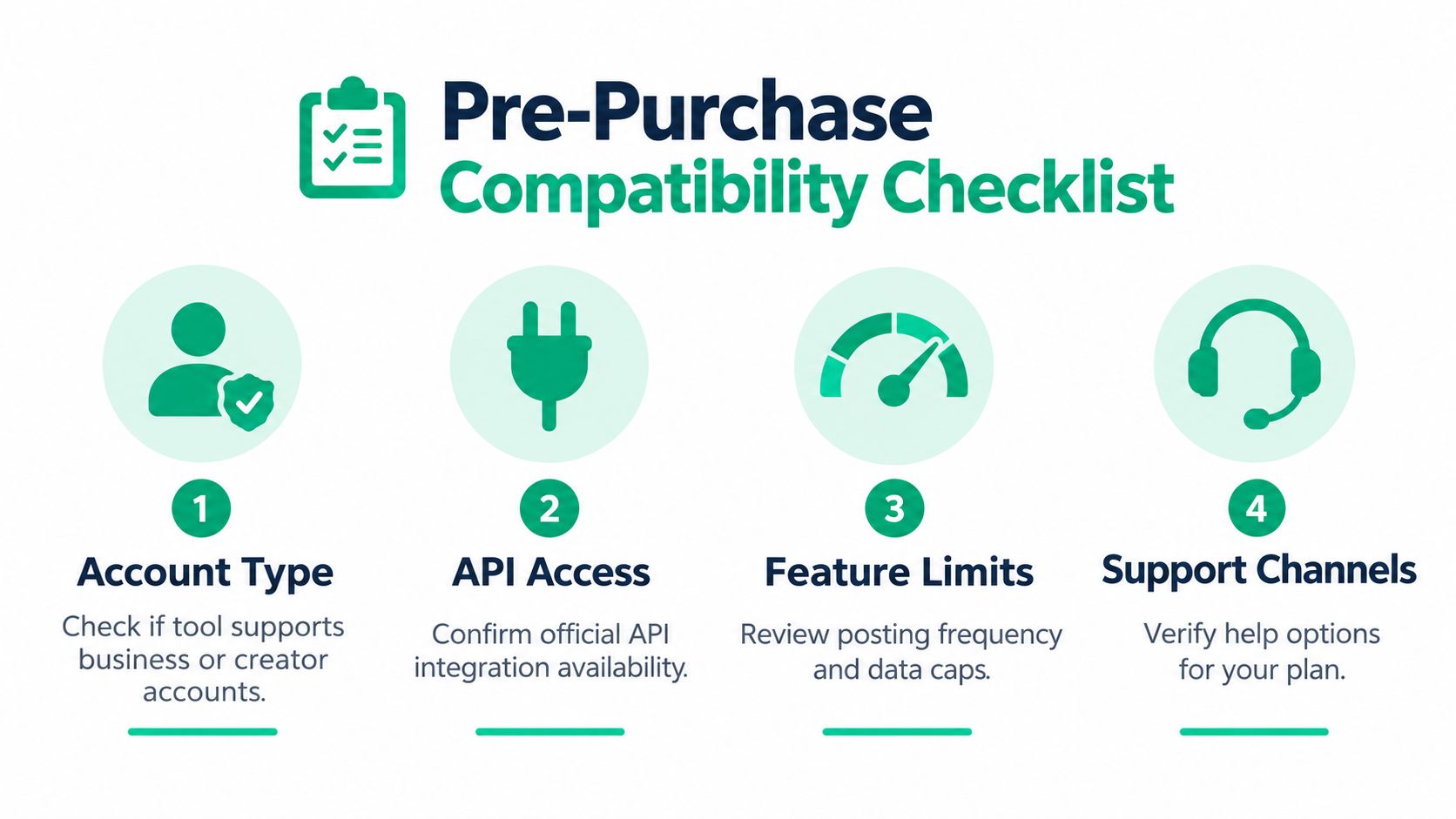
Use this checklist during the demonstration, not after payment.
Verify the connection on your account
Confirm account type: Ask the vendor to identify your configuration and demonstrate the functions available to it. Don't accept a demonstration using a different account type as sufficient proof.
Map permissions to work: Require an explanation of why publishing, reporting, messaging, or moderation needs each requested permission. Remove functions you don't intend to use.
Check configuration dependencies: Have the vendor document any asset-linking or administrative requirements for its particular integration. Don't assume every connection method has identical prerequisites.
Test the exit: Request an export, inspect its contents, and establish who owns the content calendar and historical reports.
Require an integration-maintenance plan
A documented example of migration risk is the 2025 API endpoint changes with deadlines extending into 2026, described in this Instagram API migration summary. Treat that as a reason to request current implementation evidence, not proof that a particular vendor remains affected.
Ask which integration the provider uses today, what it has migrated, and what happens when a supported feature changes. The answer should identify who contacts you and which work can continue.
Also establish the support route for connection failures. Billing support and integration troubleshooting aren't the same responsibility.
My preference is portability over unused breadth. I'd rather buy a narrower platform with understandable limitations than depend on a provider that promises everything but won't explain its authorization, exports, or recovery procedures.
Reading the Analytics Layer Correctly Before You Trust It
A dashboard can look complete while the underlying evidence isn't. Before changing your content strategy, distinguish an observed result from unavailable information.
Use the reporting screen as an inspection surface, not a verdict.

Establish whether the data is usable
Some insights are unavailable below 100 followers, demographic reporting may cover only the top 45 performers, and reporting can be delayed by up to 48 hours; unavailable metrics may return an empty dataset rather than zero, limitations associated with Meta's API reporting changes and guidance.
That distinction matters most for a new account. If a dashboard substitutes zero for missing data, you could reject a content approach without having evidence that it failed.
Require clear labels for:
Observed data: Returned by the connected reporting system.
Calculated metrics: Derived from a stated formula and denominator.
Delayed information: Awaiting a reporting update.
Unavailable information: Not accessible for that account or reporting period.
Compare like with like
A 2026 engagement benchmark compilation reports median rates of 3.42% for accounts with 1,000–10,000 followers, 2.15% for 10,000–50,000, 1.53% for 50,000–100,000, 1.12% for 100,000–500,000, and 0.81% above 500,000.
Use those figures as context, not targets guaranteed to fit your niche. Check the calculation before comparing them with a dashboard that uses reached accounts as its denominator.
A follower-based engagement rate and a reach-based engagement rate answer different questions. Don't compare them as though they're interchangeable.
Separate organic distribution from paid distribution. Then examine saves, shares, profile visits, and relevant conversion activity alongside audience growth.
A sudden follower increase without corresponding reach or interaction deserves investigation, not an automatic accusation of artificial growth. Review the underlying content and acquisition activity first.
For implementation, use this business Instagram analytics guide to connect reporting with decisions. Pay for analytics when it changes what you do, not merely because it expands what you can see.
When a Managed Organic Growth Service Beats a Self-Serve Tool
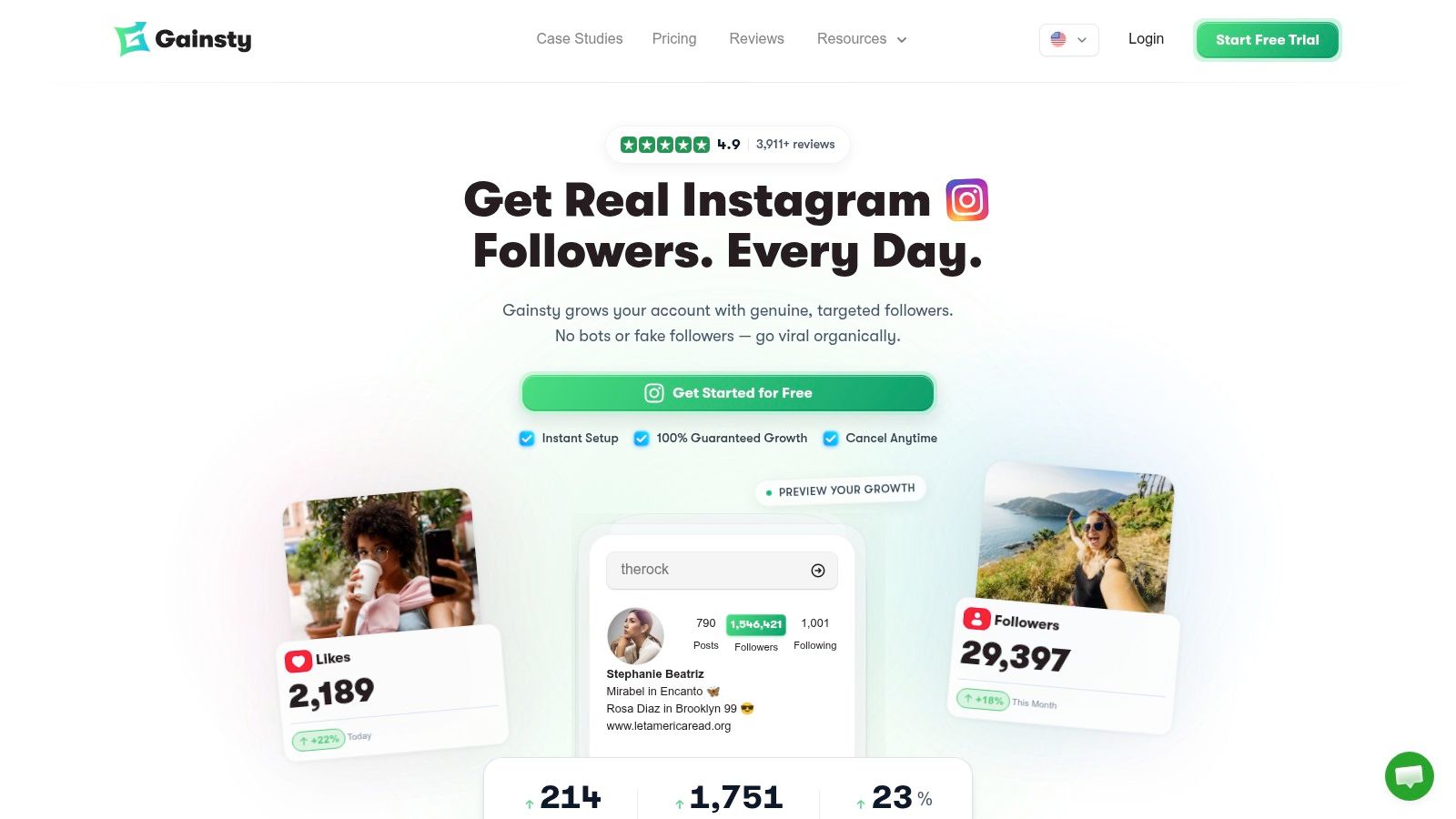
Consider a creator who publishes consistently but has no appetite for additional audience-development work. Another scheduler doesn't address that constraint. A managed service may be the more sensible purchase because the creator needs execution capacity, not another interface.
The service interface below provides context for this different buying model.
Buy help for the work you cannot sustain
For a startup without an internal social team, managed audience development can be worth evaluating once someone owns the content and offer. Outsourcing attention won't clarify a confusing product proposition.
A real estate professional presents another useful hypothetical. Relevant local attention matters more to that operator than an impressive global follower total. I'd ask a prospective service how it defines relevance, documents activity, and reports whether the audience matches the business.
These are buying scenarios, not customer results or promises of superior performance. A service only deserves preference when its scope addresses the actual constraint.
Review this video alongside the provider's written explanation of its methods.
Keep ownership of the relationship
Managed help introduces trade-offs:
Execution visibility: Agree on what the provider will report about its work.
Creative boundaries: Decide which messages, content decisions, and interactions remain yours.
Responsiveness: Establish how you request changes or pause activity.
Outcome alignment: Evaluate relevance and business intent, not just audience size.
Use this explanation of an organic Instagram growth service to define the questions you want answered before onboarding.
Keep the work self-directed if you enjoy audience development, need close control over every interaction, or haven't established a content direction. Consider managed help when you can articulate the audience and maintain the content, but can't sustainably handle the additional work.
Don't assume a managed provider replaces publishing software. They solve different problems, and combining them only makes sense when responsibilities don't overlap.
Matching the Right Tool Category to Your Situation
Choose against your present operating constraint, not the organization you hope to become.
Solo influencer: Choose a pure scheduler if you already own your content direction.
Small business or startup: Start with a scheduler and consider selective managed help, provided someone remains accountable for the offer and content.
Established brand: Consider an all-in-one platform, with deeper analytics if needed, when several people share execution and review.
Marketing agency: Choose an agency-grade platform when client permissions and delivery processes need separation.
For a Creator account, prioritize a workflow you can maintain without administrative overhead. For a Business account, prioritize the path from content to customer action. For either professional type, make the final decision conditional on the demonstrated compatibility established earlier.
Questions worth resolving before payment
How long does organic growth take?
Don't accept a universal timetable. Ask the provider to define early indicators, review points, and the conditions that would justify changing the approach. A promised follower outcome isn't a substitute for an explained process.
How should I evaluate security claims?
Request a live connection demonstration, written permission scope, and an exit procedure. Marketing language about safety doesn't establish how the provider operates, and no provider should be treated as offering a risk-free guarantee.
Should a small account buy professional analytics?
Only when the available data supports a decision worth paying to make. Start with a specific reporting question. If account-level limitations prevent an answer, a more expensive dashboard won't necessarily resolve it.
Your next step is to book a demonstration using your account type and your workflow. Bring a publishing task, a reporting question, and an access-removal request. Buy only after the provider handles all of them clearly.
Gainsty offers AI-assisted organic growth support that pairs Instagram experts with targeting tools and around-the-clock support, without bots or fake followers. If audience development is the missing part of your Instagram account management setup, visit Gainsty to discuss your niche, account configuration, and the work you want help handling.