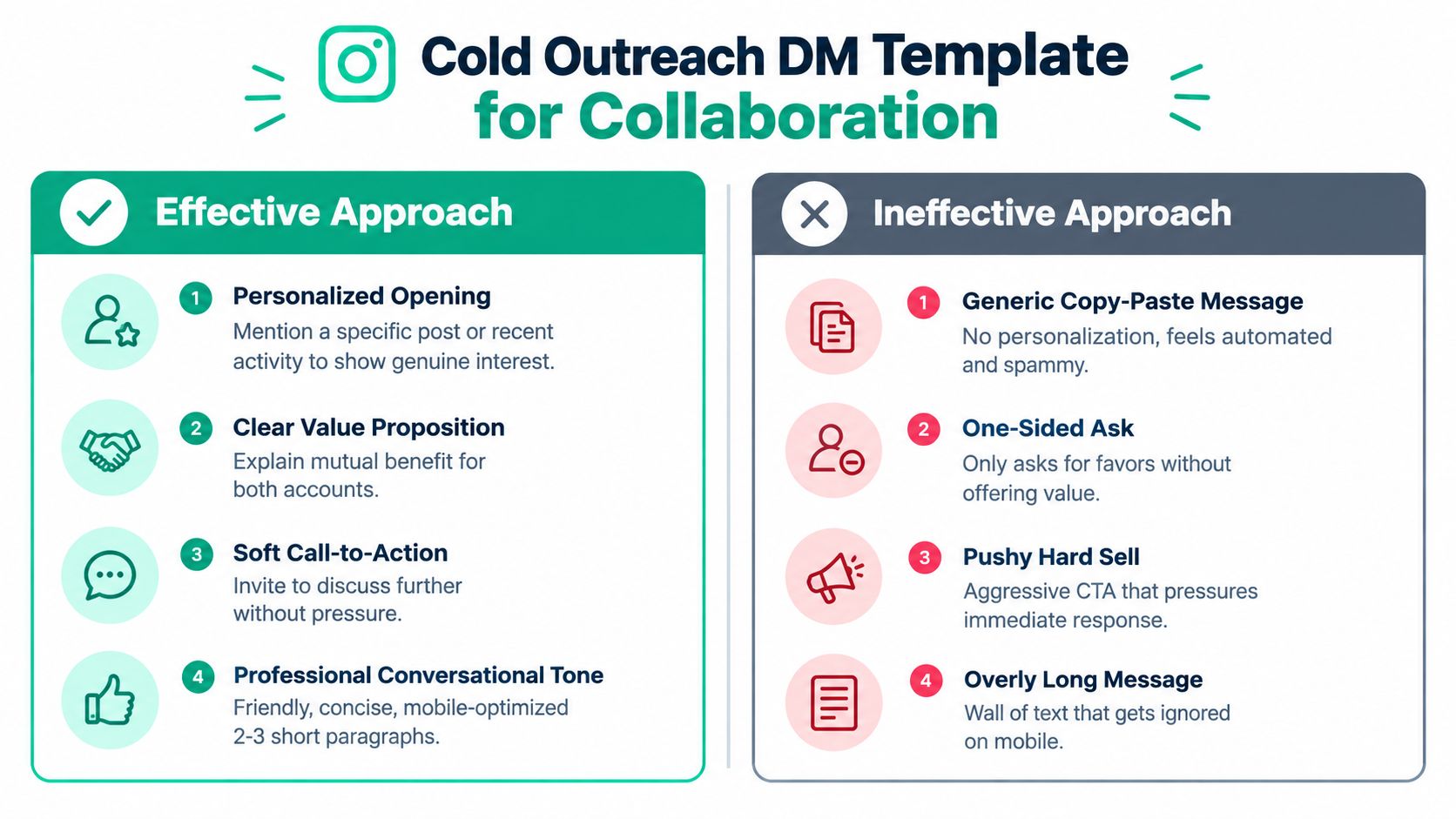
1. Cold Outreach DM Template for Collaboration
Collaboration DMs fail when they read like mini proposals. They work better when they open a door.
Use this when you want to start a partnership with a complementary creator, local business, niche page, or brand account. Think micro-influencers supporting a product launch, a real estate agent partnering with a local interiors page, or a SaaS founder connecting with a creator who teaches workflow systems.
Template
Hi [Name], loved your recent post about [specific topic]. I think our audiences overlap in a useful way. Open to a simple collab idea? Happy to DM details if you're interested.
That's enough for a first touch. Don't front-load deliverables, rates, or links unless they've already shown interest.
Where this works and where it breaks
This works when the other person can immediately tell why you chose them. Mention a Reel, carousel, Story angle, or audience fit. “Love your content” is filler. “Your reel on first-time home staging had a smart hook” sounds real.
It breaks when you ask for too much in message one. Requests like “Can you post, tag us, review the product, and hop on a call?” create friction before trust exists.
Practical rule: In cold collaboration outreach, ask for interest first, not commitment.
For a useful framework on how to approach partnership asks, EmailScout's collaboration guide is a solid companion to DM work.
Personalization and safe sending
Keep the opening short and account-specific. Follow the account before messaging if the collaboration is legitimate. That doesn't guarantee a response, but it makes the outreach look less transactional.
Recent compliance-focused guidance also stresses that templates are only safe when paired with careful sending behavior, because identical high-volume outreach can trigger automated flags even if the message itself seems acceptable. That same coverage recommends rotating variants and keeping initial outreach under roughly 150 words in Repli's guide to Instagram DM templates. In practice, that means writing three or four versions of this message, spacing sends out, and changing the opening line based on what you saw on their profile.
2. Lead Generation and Sales DM Template
Sales DMs should feel like guided relevance, not a brochure dropped into someone's inbox.
Use this after someone has engaged with your content, replied to a Story, clicked around your profile, or followed after seeing a niche-specific post. E-commerce brands can use it to offer a product suggestion. Coaches can use it to invite a discovery step. Service businesses can use it to move from casual interest to a clearer sales conversation.
Template
Hey [Name], saw you were looking at my post on [topic]. If you're working on [specific goal], I can send the simplest next step I'd recommend. Want me to send it here?
That's the warm-up. If they reply yes:
Thanks. Based on what you shared, I'd start with [specific recommendation]. If you want, I can send the link to [offer/resource/product] that helps with that.
What makes this convert
One industry analysis found that well-crafted Instagram DM pitches to relevant prospects typically achieve 18 to 24% response rates, compared with 2 to 5% for cold email, and that personalization can raise response rates by 3.2x. The same analysis recommends keeping DMs to 2 to 3 sentences so the exchange feels immediate and low-friction, as explained in InfluenceFlow's Instagram DM pitch guide.
That matches what works in sales inboxes. Short messages get read. Specific benefit statements get replies. Long explanations usually get ignored.
A good next step is a single action. Reply with a keyword, view one product, answer one qualifying question, or book one call. If you need a broader strategy around outreach and sequencing, Instagram DM marketing tactics can help you map the message to the funnel stage.
Trade-offs and segmentation
The trade-off is speed versus quality. A broad sales script scales faster, but your replies get weaker. A segmented script takes more setup, but the conversation starts closer to the buyer's intent.
Try splitting prospects into simple buckets:
New followers: Offer orientation, not a pitch.
Post engagers: Reference the specific content they engaged with.
Story repliers: Continue the exact thread they opened.
Past buyers or leads: Skip the intro and focus on the next logical offer.
Urgency can help, but only when it's real. False scarcity is easy to spot in DMs.
3. Community Building and Engagement DM Template
Not every DM should sell something. Some of the best ones deepen the relationship.
Use this when someone consistently reacts to Stories, leaves thoughtful comments, shares your posts, or shows up repeatedly in your niche. Creators use this to turn followers into recognizable community members. Brands use it to surface stories, opinions, and inside language they can't get from analytics alone.
Template
Hey [Name], I've seen you popping up on my posts and wanted to say thanks. You always seem tuned into [topic]. What are you working on most right now in that area?
This kind of message works because it acknowledges behavior first. It doesn't force a transaction.
Why this message feels human
The best community DMs are open-ended but still anchored in something specific. If you say “How are you?” you'll often get no reply. If you say “You always leave sharp thoughts on creator pricing. Are you freelancing or building your own thing right now?” you make it easier to answer.
Recent guidance on workflow-specific DM automation also points to a structure that converts better across use cases: acknowledge the user's action, deliver immediate value, and end with a low-friction next step. That shift from “perfect wording” to intent-based design is outlined in CreatorFlow's breakdown of Instagram DM automation templates by niche.
If you're shaping these conversations into a broader retention system, community engagement strategies for Instagram can help tie DMs to posts, Stories, and audience rituals.
The strongest community DMs often have no ask attached. That's why people answer them.
Trade-offs and follow-through
This approach doesn't produce instant revenue. It produces trust, language, and pattern recognition. Over time, that improves every later message, because you understand what your audience cares about.
The downside is operational. If you start many genuine conversations, you need to continue them. That means replying quickly, remembering details, and noting who mentioned a launch, a job change, a move, or a current struggle. Without that follow-through, a community DM starts to feel performative.
4. User-Generated Content UGC Request DM Template
A good UGC DM gives the recipient one clear idea to respond to. If the ask is broad, people hesitate, postpone, or send something you cannot use.

This template fits audience actions that involve showing, documenting, or demonstrating. A fashion brand can ask a customer to style one item. A coffee shop can request a quick photo from a regular. A fitness brand can invite a progress update tied to a specific milestone. A software team can ask for a screenshot and a short note about one workflow that saved time.
Template
Hey [Name], we saw your post about [product/brand/context] and liked the way you showed [specific detail]. We're collecting a few customer examples around [theme]. If you're open to it, could you share a [photo/video/Story] showing [specific prompt]? Tag [account] or send it here by [timeframe]. If we feature it, we'll credit you.
How to make the ask easy to act on
The strongest UGC requests remove guesswork. People are far more likely to contribute when they know exactly what to make, where to send it, and what happens next.
Include four things:
A narrow prompt: Ask for one moment, one result, or one use case.
A defined format: Request a Story, Reel, photo, screenshot, or written testimonial.
A clear submission path: Tell them to tag you, reply in DM, or use a campaign hashtag.
A realistic incentive: Offer credit, a repost, early access, or a small reward if that fits your process.
Personalization matters here. Refer to something they posted, bought, or said. “Show how you pack this for weekend travel” will usually outperform “share your experience,” because the recipient can picture the content before they start. For more examples of how brands turn customer posts into usable assets, see how to use user-generated content.
Trade-offs and safe use
UGC creates proof from real customers, but it also gives up some control. The quality will vary. The framing may not match your campaign. That is why the prompt has to do more work than it does in a collaboration DM or community message.
Set boundaries before you send anything at scale. Decide what qualifies for reposting, how you will request permission, and whether credit alone is enough or compensation is more appropriate. If you are asking for content that looks like an ad, say that plainly.
Follow-through is where teams often slip. If you promise a feature, keep that promise. If someone sends content you cannot use, thank them anyway. A respectful decline keeps future participation possible.
5. Newsletter and Content Announcement DM Template
How do you share new content in DMs without sounding like you pasted the same promo into fifty inboxes?
This template works best when the recipient has already raised their hand in some way. They asked a question, replied to a Story, commented on a post, or subscribed and then engaged around a specific topic. That prior signal changes the message from interruption to follow-up, which is the whole point.
Template
Hey [Name], you asked about [topic] a little while ago, so I wanted to send you the new [article/newsletter/video] I just published on [specific angle]. It covers [clear outcome]. Want the link?
The permission step does real work here. It keeps the DM conversational, gives the other person an easy out, and helps you avoid the “mass announcement in a private channel” problem.
Best use cases
Use a content announcement DM when the audience action is clear and recent enough to reference.
Story responders: Send the resource that answers the question they replied with.
Commenters on a specific post: Follow up with content that goes deeper on that exact point.
Newsletter subscribers on Instagram: Share a bonus, recap, or companion piece, not the same generic signup pitch.
Warm leads: Send educational content that removes one buying objection, instead of jumping straight to an offer.
The trade-off is simple. Relevance goes up, but scale goes down. That is usually a good exchange for DMs, because inbox quality matters more than volume.
Personalization steps that actually matter
The strongest version of this message uses one concrete reference, not a long biography of the recipient. Mention the post they commented on, the problem they asked about, or the topic they keep returning to. Keep it short.
“Since you asked about pricing pages last week, I thought this new breakdown might help” will usually perform better than “I think you'd love my latest content.” One proves why they are getting the message. The other sounds generic.
Business-focused guides increasingly frame templates as flexible starting points instead of fixed scripts. A cited example is a 2024 Sked Social guide described in AiInfluencer's roundup of Instagram message templates. That approach fits announcement DMs well, because the right opener changes based on the audience action that triggered the send.
Safe implementation guidance
Do not drop the link into the first message unless the person already asked for it directly. Ask first. Send second. If they do not reply, leave it there.
Pacing matters too. A content DM should feel like a useful follow-up, not the start of a nurture sequence they never agreed to. If someone says yes and clicks through, you can continue the conversation later. If they ignore it, treat that as a signal that this topic, timing, or format was not strong enough for them.
One more caution. Send content that matches the relationship stage. Educational posts fit warm leads. Product-heavy announcements fit existing customers or subscribers who already expect updates. Mixing those up is where announcement DMs start to feel pushy instead of helpful.
6. Event, Webinar, and Exclusive Access DM Template
An event DM needs to answer one question fast. Why should this person care enough to register right now?
This works well for webinar invites, local event reminders, beta access, private trainings, launch waitlists, and member-only sessions. A fitness coach can invite Story responders to a live workshop. A real estate agent can invite local followers to a private viewing. A creator can offer early access to a small group before a public release.
Template
Hey [Name], I'm opening a small [event/webinar/session] on [date] for people working on [goal]. We'll cover [specific outcome], and I thought it might be relevant for you based on [context]. Want the registration link?
Why timing and clarity matter
The message has to remove basic uncertainty. Include the date, what they'll get, and why they're hearing from you. “I'm hosting something exciting soon” is too vague.
For DM automation sequences tied to actions like Story replies or keyword triggers, a 2026 benchmark reports click-through rates of 12 to 18%, with 15 to 25% described as strong performance and under 5% as a sign that the sequence needs work. A separate benchmark in the same source says Instagram DMs can reach 85 to 90% open rates when automated and targeted properly, which is why segmentation, keyword filtering, and a clear CTA matter so much in CreatorFlow's Instagram DM automation benchmark.
Trade-offs and event flow
Exclusivity helps, but exaggeration hurts. If it's limited, say why. Small Q&A format, portfolio review cap, local seating limit, beta feedback group. Those are believable reasons.
One caution: If your event requires too many steps after the DM, registrations drop. Keep the path simple.
A good event sequence usually has three stages. Invite. Reminder close to the event. Follow-up with replay, notes, or next step. If you only send the first message, you leave a lot of intent uncollected.
7. Feedback and Survey Request DM Template
Feedback DMs work when they feel easy to answer and clearly useful.
If you're a creator planning your next content series, a brand choosing between product angles, or an agency refining campaign direction, direct messages can surface language and preferences that comment sections miss. The key is to avoid vague prompts like “Any thoughts?” and ask something narrow enough to answer from a phone.
Template
Hey [Name], I'm improving my [content/product/offer] and would value your input because you've engaged with [topic]. Quick question. Which is more useful for you right now, [option A] or [option B], and why?
That's usually enough. If you need more than two short questions, use a form after they opt in.
Better questions get better answers
Keep the request light. Two or three questions at most. If you need longer feedback, say so plainly and explain what they'll get in return, such as early access, a feature, or a behind-the-scenes summary.
Good DM survey prompts often ask for preference, confusion, or priority. Those are easier to answer than broad evaluations.
Preference question: “Would you rather see breakdowns or live examples?”
Confusion question: “What still feels unclear about this process?”
Priority question: “What would help most right now?”
For prompt ideas that fit customer research workflows, Formbricks customer voice templates are useful inspiration.
What to do after replies come in
Act on the responses visibly. If people take time to answer and nothing changes, future participation drops.
A simple follow-up message goes a long way: “Thanks, that helped. I'm using this in the next round.” That closes the loop and shows the DM wasn't just a token engagement play.
People answer feedback DMs more often when they can see their input will change something specific.
8. Re-engagement and Win-Back DM Template
Some followers don't dislike your account. They just drifted.
This happens after a long posting gap, a niche shift, a product relaunch, or a change in content style. A re-engagement DM gives inactive followers a simple reason to pay attention again without guilt-tripping them for disappearing.
Template
Hey [Name], it's been a while since we've connected here. I've recently been sharing more about [new focus], and I thought it might be relevant if you're still interested in [related topic]. If you want, I can send the best recent post to start with.
Why this works better than a generic comeback post
The message acknowledges change without blaming the recipient. It gives context, offers a curated entry point, and keeps the action easy.
This is especially useful for creators returning from hiatus, brands relaunching with a sharper positioning, or businesses that narrowed their niche. If someone followed you for broad lifestyle content and you now focus on creator business systems, don't pretend nothing changed. Say it directly.
Personalization and pacing
Reference a past interaction when you can. Maybe they used to reply to your Q&As, purchased a past offer, or commented often on a certain topic. That detail turns a cold reactivation into a warmer reminder.
The trade-off is that re-engagement lists can be tempting to over-message. Don't do that. One message, one useful starting point, one follow-up only if they respond or engage again. Win-back DMs should feel like a reopened door, not a retention campaign dropped into a private inbox.
Instagram DM Templates, 8-Point Comparison
The cold outreach DM template for collaboration is best suited to influencers, startups, and brands. Its core strengths are a personalized opening, clear mutual value, and a soft call to action. It is generally highly effective, especially when the message is tailored to the recipient, and it works well as a low-cost way to build partnership-driven organic reach.
The lead generation and sales DM template fits e-commerce brands, agencies, and service businesses. It works best when it leads with value, creates real urgency, and points to a simple next step like a booking link or product page. It tends to convert well with warm leads and is one of the strongest options for direct revenue and measurable return.
The community building and engagement DM template is useful for content creators, influencers, and community-focused brands. It centers on two-way conversation, genuine interest, and a low-pressure tone with no immediate ask. While it may not create instant revenue, it performs strongly for long-term retention, loyalty, and stronger audience signals.
The user-generated content request DM template is a strong fit for retail, lifestyle, DTC brands, and creators. Its main advantages are clear guidelines, simple incentives, and direct instructions for tagging or submitting content. It is highly effective for generating social proof and organic reach, and it does so at relatively low cost.
The newsletter and content announcement DM template works well for podcasters, bloggers, and course creators. It relies on a concise hook, a relevant content angle, and a clear next step. Its performance is usually strongest when the audience is segmented well, and it is most useful for driving traffic and growing subscribers.
The event, webinar, and exclusive access DM template is designed for experts, educators, and premium service providers. It performs best when it includes specific event details, a strong reason to attend, and a simple registration path. This format often converts well for exclusive offers and is especially valuable for lead capture and authority building.
The feedback and survey request DM template is a good match for creators, product teams, and brands. Its value comes from short, specific questions, a clear reason for asking, and an optional incentive when appropriate. Response rates can vary, but it is a low-cost way to gather audience insight and guide product or content decisions.
The re-engagement and win-back DM template is most useful for established accounts and returning creators. It works by acknowledging the past connection, explaining what is new, and offering a soft next step. While it can be slower to scale, it is still an effective low-cost option for reviving inactive followers and improving engagement.
Choose the Right DM Before You Send
The biggest improvement teams can make with Instagram direct message templates isn't better wording. It's better matching. Send collaboration outreach when you want a partnership. Use sales messages for warm prospects who already showed interest. Use community DMs when the goal is a stronger relationship, not an immediate conversion.
UGC requests work best when you need social proof and fresh audience content. Announcement DMs fit engaged followers who've already shown interest in a topic. Event messages are for registrations and reminders. Feedback requests help you collect audience insight with less friction than a formal survey. Win-back messages are for inactive followers who need a relevant reason to re-engage.
The practical rule stays the same across all eight. Personalize the opening. Keep one objective per message. Respect the recipient's intent. If they replied to a Story, continue that conversation. If they liked a post but never spoke to you, don't act like you already have a relationship. If they ignored your first message, don't force the second one unless you have a real contextual reason.
It also helps to review replies before you scale anything. A template that looks clean in a document can still fail in a real inbox. Look at where people stop responding, what kinds of openings get ignored, and which CTAs create confusion. Then rewrite from those patterns. Recent guidance increasingly frames templates as modular systems rather than fixed scripts, and that's the right way to think about them. The template should support the conversation, not flatten it.
If you're building an Instagram growth system around these conversations, tools and services can help with targeting, workflow, and consistency. Gainsty is one relevant option for people focused on organic Instagram growth. Even then, the core principle doesn't change. Authentic conversations still do the heavy lifting. Templates just make those conversations easier to start, repeat, and improve.
If you want more structure behind your Instagram DMs, Gainsty offers support around organic Instagram growth and audience engagement workflows. That makes it relevant when you're trying to turn better conversations into a repeatable system without losing the human side of outreach. Visit Gainsty to see how it fits your Instagram process.
.png&w=1920&q=75&dpl=dpl_34ZXCf12K5qjjdZjPn9snwDRADrB)




.png&w=750&q=75&dpl=dpl_34ZXCf12K5qjjdZjPn9snwDRADrB)