Why Instagram Remains Essential for Small Businesses
A dog groomer posts a polished before-and-after photo, then checks the account between appointments. The post receives likes, but few people tap the profile or ask about availability. The useful question is not whether the photo attracted attention. It is whether the account made the next customer action clear.
Instagram functions as a commercial marketplace for small businesses, local shops, freelancers, and direct-to-consumer brands. The platform has over 350 million business accounts, and about 65% belong to small businesses, freelancers, local shops, and direct-to-consumer brands, according to Instagram business account statistics. A small company is therefore joining an active buying environment, where people already look for products, services, recommendations, and visual proof of quality.
Visibility needs a business purpose
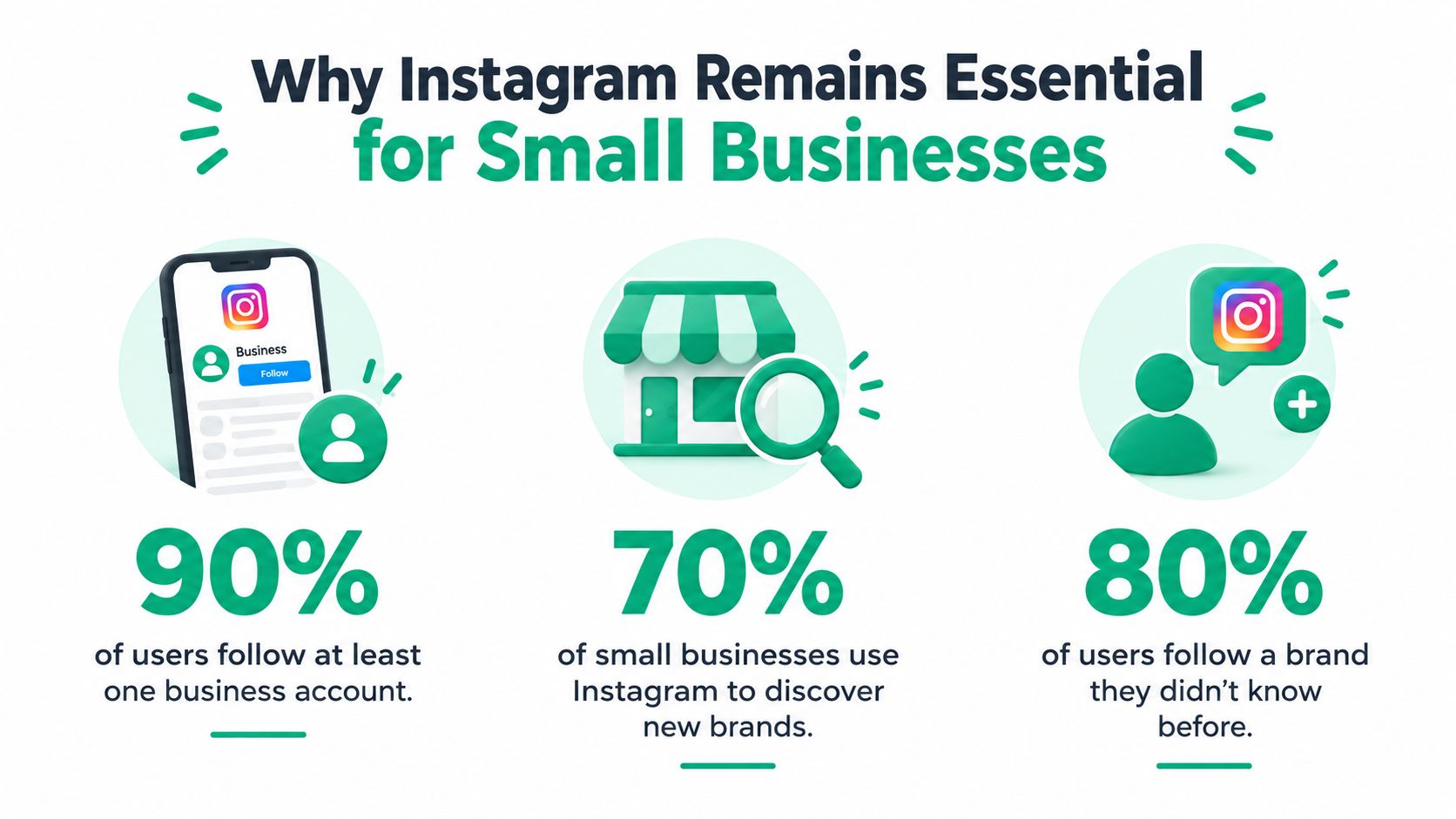
About 90% of Instagram users follow at least one business account, while roughly 50% engage with brands regularly, according to Instagram user and business behavior data. For a small business, those figures point to discovery intent. Someone may encounter a post, inspect the profile, watch a Story, tap a product tag, or send a direct message before deciding whether to buy. Reach matters because it creates these opportunities, not because attention alone pays the bills.
A profile with many followers can still produce few inquiries if visitors cannot tell what to do next. A smaller account can work harder when its posts answer customer questions and lead naturally to booking, shopping, messaging, or a visit.
Practical rule: Define the action a post should encourage before choosing its format, then measure that action instead of judging success by virality.
This approach also protects a small team's time. A florist with limited production capacity may choose repeatable Stories that answer delivery questions, while a maker may reserve carefully produced Reels for products that need visual demonstration. Data should guide that choice: keep formats that support useful actions and fit the work required to create them.
For a closer look at account features and practical setup considerations, review these Instagram business account benefits. A business account creates access to useful tools, but intentional interaction and conversion design create a working business channel.
Setting Up Your Digital Storefront
Your Instagram profile works like a shop window. A passerby should understand what you sell, who you serve, and what to do next without having to investigate every post.
Start with the profile name and bio. Use the name field for words customers might search, not only your legal business name. A residential electrician, for example, could make the profile name communicate both the business and the service area. The bio can then answer three practical questions:
What do you provide? State the product or service in plain language.
Who is it for? Identify the customer, location, or use case.
What should visitors do? Invite them to book, shop, call, or send a message.
Build one obvious conversion path
A profile with five competing calls to action creates hesitation. Choose the action that best matches your business model. An appointment-based service may prioritize booking, while a custom maker may want product inquiries through direct messages.
Your link should support that priority. If you use a link-in-bio page, place the most valuable destination first and label every option clearly. “Book a discovery call” is more useful than “Click here.” “View handmade candles” tells visitors what they'll find before they tap.
The profile photo should remain recognizable at a small size. A simple logo works for an established brand, while a clear portrait may suit a consultant or local service provider. Use Highlights to answer recurring questions, show proof of work, explain the process, and make important information available after Stories disappear.
One independent audit of 50 Instagram accounts found a recurring problem: businesses had reasonable content and engagement, but no clear conversion path, while the bio, recent posts, and profile layout failed to explain what the business did or who it served, according to this Instagram audit of conversion problems. That finding points to a practical diagnostic. Ask someone unfamiliar with your business to view your profile and describe the offer. If their answer is vague, revise the profile before publishing more content.
Align the storefront with the offer
Your grid doesn't need identical templates, but it should feel connected. Use repeatable visual decisions, such as a small color palette, consistent lighting, or recognizable typography. The objective isn't perfection. It's reducing uncertainty.
For product businesses, make the path from post to purchase easy to follow. Instagram's shopping features can support product discovery when your catalog and product information are properly connected. Learn the fundamentals of the Instagram shoppable feature, then make sure each product post answers a customer's likely question about use, size, availability, or delivery.
Review the profile as a customer would. Can they identify the offer immediately? Can they find proof? Can they contact you without guessing? If not, fix the storefront before worrying about follower growth.
Choosing Content Formats That Fit Your Capacity
A small business shouldn't copy the publishing volume of a national brand. The right format mix depends on what you can produce consistently and what your audience needs before taking action.
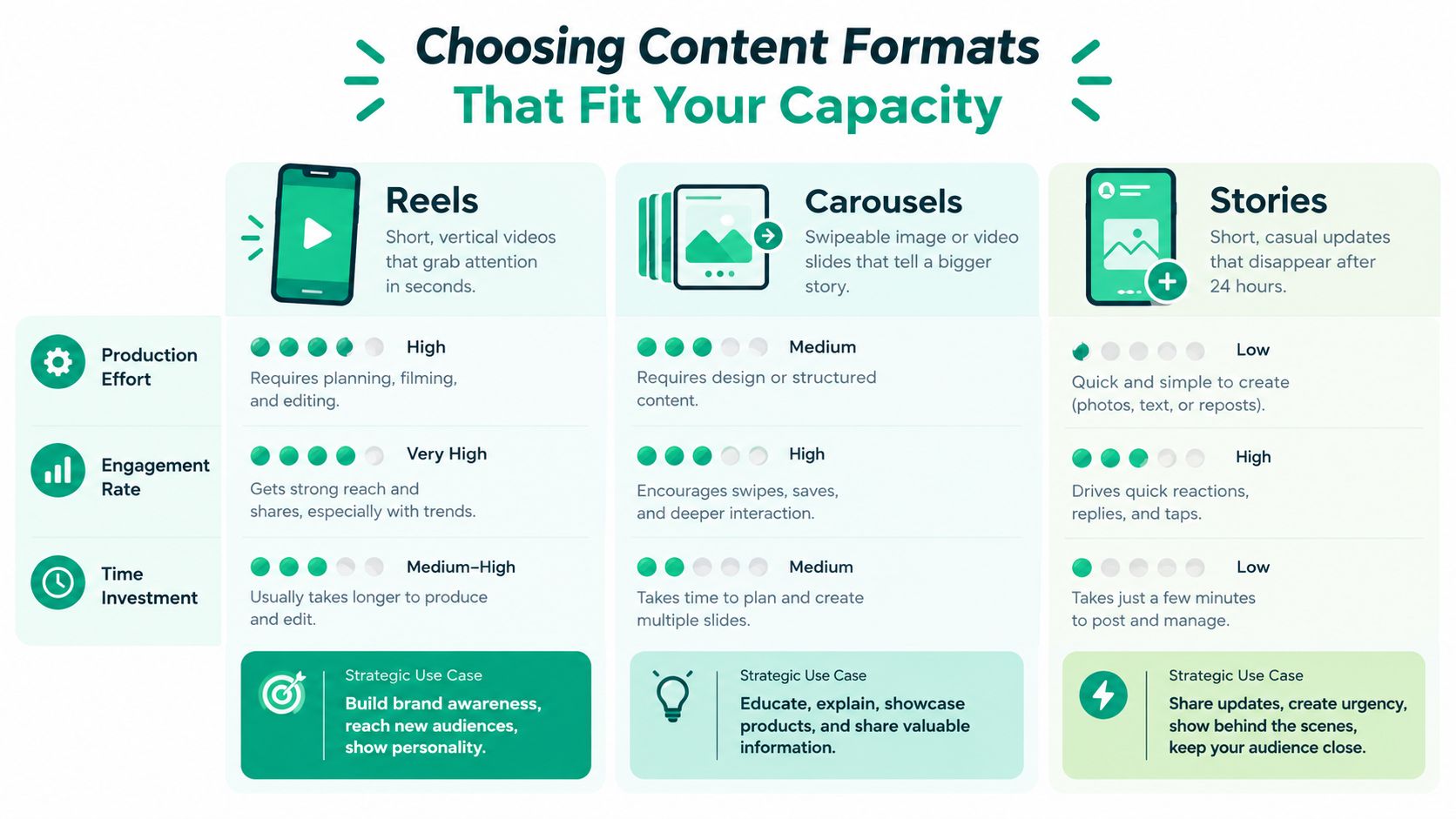
Reels can help people discover a business beyond its existing audience, particularly when the video demonstrates a process, answers a question, or shows a transformation. Carousels can organize education, comparisons, product details, or step-by-step guidance. Stories are useful for timely updates, informal interaction, and direct replies.
Match the format to the job
Think of each format as a different tool rather than a ranking.
Reels for discovery: Record a short demonstration, a before-and-after sequence, a packing process, or a quick answer to a common customer question. You don't need cinematic production. Clear sound, useful context, and a strong opening matter more than elaborate effects.
Carousels for explanation: Use the first slide to identify the problem, then build the answer across the remaining slides. A personal trainer might explain how to prepare for a first session. A baker might show how to store a product properly.
Stories for conversation: Share availability, behind-the-scenes work, customer questions, polls, and reminders. Stories can feel more personal because they don't need the same polish as a permanent grid post.
For product businesses, strong composition can make a simple item easier to understand. A resource on flat lay photography that sells can help you plan backgrounds, spacing, props, and visual hierarchy without turning every shoot into a large production.
Use engagement data without worshipping it
Benchmark summaries place typical business-account engagement around a 0.30% median and 0.48% average per post, while nano-accounts under 10,000 followers often report 2.5% to 6% engagement, and micro-accounts with 10,000 to 50,000 followers often reach 2% to 4%, according to Instagram engagement rate benchmarks. These figures aren't targets you can guarantee. They illustrate why a smaller, relevant audience may interact more densely than a much larger one.
A useful content system starts with a few durable themes. Define your educational, proof, product, and relationship topics in a way that reflects your offer. This guide to Instagram content pillars can help you organize those themes before you choose formats.
Then build around production capacity. If video takes too long, record one useful demonstration and adapt its ideas into a carousel and Stories. If you work alone, choose formats you can create during normal business activity. Consistency becomes easier when content captures real work instead of requiring a separate production day.
The sustainable format is the one you can make well enough, often enough, to learn from the results.
Organic Growth Versus Paid Distribution
Organic content and paid distribution solve different problems. Organic publishing helps customers understand your personality, process, expertise, and standards. Paid distribution helps you place a proven message in front of people who don't already follow you.
Treating them as rivals creates unnecessary confusion. A service business might use organic Stories to answer questions and show current work, then put paid support behind a clear booking message once the content earns meaningful profile visits or direct responses. An online shop might test several product angles organically, then promote the creative that generates the strongest product interest.
Instagram's paid distribution remains capable of reaching a very large audience. One benchmark reports ad reach of about 1.99 billion people in April 2026, while another estimates that Instagram ads reached 28.8% of adults aged 18 and over globally in January 2025, or roughly 1.74 billion potential recipients, as summarized in this Instagram advertising reach benchmark. Large potential reach doesn't mean every small business should spend heavily. It means paid distribution can extend beyond the limits of an existing follower base.
Give each channel a clear role
Organic work should answer questions that paid targeting can't solve:
Trust: Who runs the business, and what does the experience feel like?
Proof: What does the finished work look like, and how does the process operate?
Relevance: Does this business understand the customer's specific problem?
Conversation: Can a prospect ask a question and receive a useful answer?
Paid campaigns should have a narrower job. Promote a specific offer, lead magnet, product collection, event, or booking route. Avoid sending cold audiences to a vague profile with no obvious next step. If the profile doesn't convert organically, paid reach will just deliver more visitors to the same confusion.
Start with evidence, not assumptions
A sensible paid workflow begins with organic observation. Look for content that produces meaningful signals, such as saves, shares, replies, profile visits, product interest, or qualified messages. A high like count can be encouraging, but it isn't enough to justify promotion if nobody takes the next business action.
Define the audience in practical terms. Location may matter more than broad interest categories for a local shop. A consultant may prioritize a specific professional problem rather than trying to reach everyone in an industry. Keep the creative consistent with the landing page or profile destination, so the promise in the ad matches what visitors see after tapping.
Set a clear stopping rule before spending. If the campaign attracts attention but no relevant visits or inquiries, change the message, audience, or destination instead of assuming that more budget will solve the problem.
Measuring What Actually Matters
A profile can attract attention without producing business. Follower count is a window display, not a sales record. Track whether the right visitors understand the offer, take the next step, and become inquiries, bookings, or customers.
Instagram supports business discovery and interaction, so measurement should follow movement from attention to action rather than repeat audience-size percentages. Users can encounter a business through a post, visit its profile, send a question, or tap toward an offer. This Instagram business engagement data provides useful context for why those stages deserve separate attention.

Connect metrics to decisions
Use Instagram Insights to compare content by format and topic. Give each metric a job:
Reach and views: Did the content reach people beyond the regular audience?
Saves and shares: Did it offer enough usefulness for someone to keep or recommend?
Profile visits: Did the post create interest in the business?
Link clicks: Did visitors move toward a website, catalog, booking page, or inquiry form?
Direct messages: Did the content start a conversation with commercial potential?
Bookings or sales: Did attention produce the outcome the business requires?
Engagement rate helps compare posts with different audience sizes, but it is a diagnostic measure, not the finish line. A tutorial may earn saves, a customer story may bring profile visits, and a focused offer may generate messages. Judge each format by the decision it was designed to support.
A simple tracking sheet can include the post date, format, topic, call to action, reach, meaningful interactions, profile visits, clicks, and inquiries. Review patterns across several posts. If educational carousels earn saves but few profile visits, strengthen the final slide and its next step. If behind-the-scenes Stories receive replies, use that format to invite service questions.
Measure the next customer action, not just the last visible interaction.
Real-World Success Strategies by Niche
A local florist, an online clothing shop, and a B2B consultant can all use Instagram successfully, but they shouldn't publish the same content.
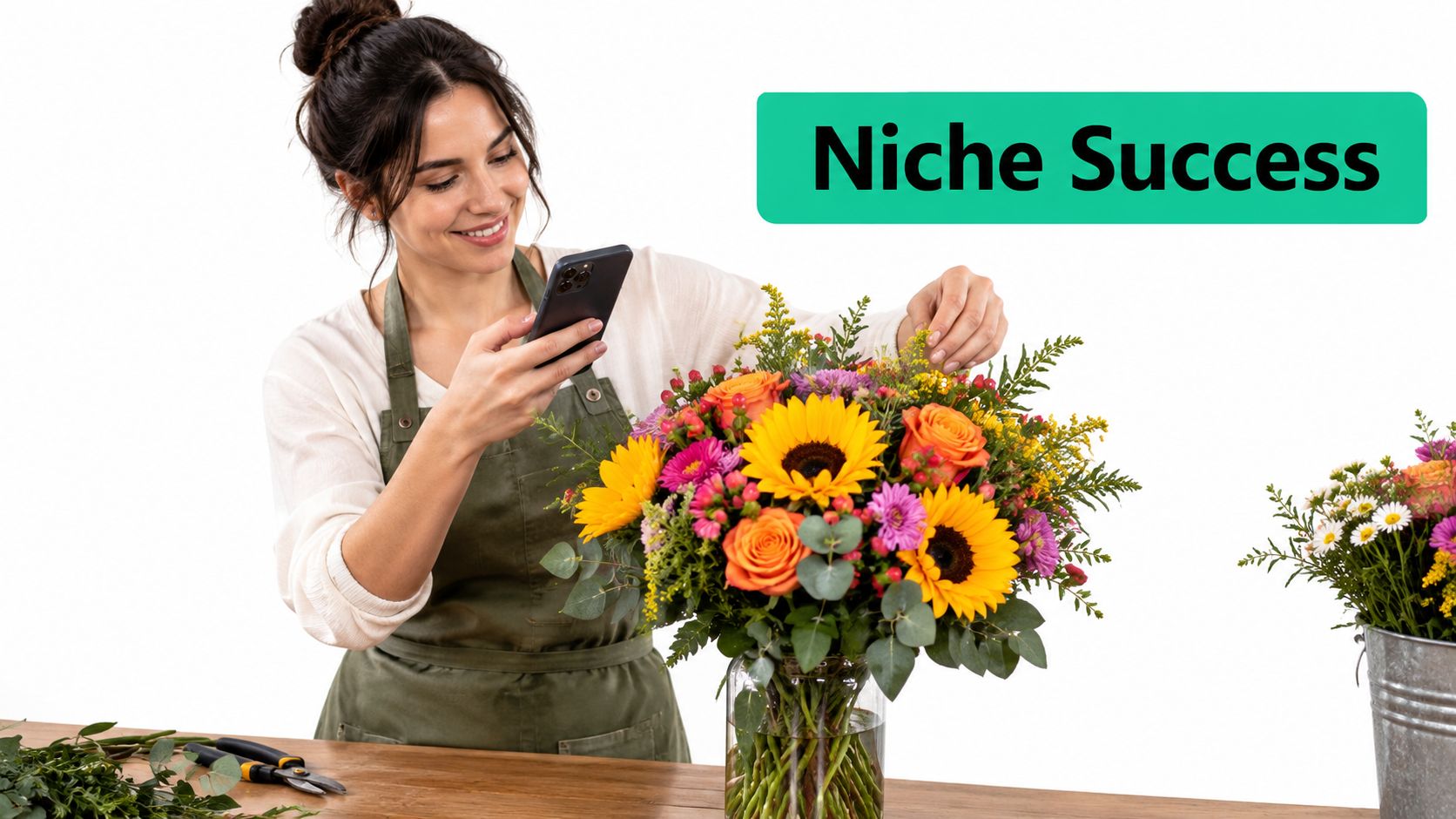
The florist's profile should make the service area, ordering process, and occasion clear. Reels can show an arrangement taking shape, while Stories can highlight today's flowers or invite customers to ask about delivery. A carousel can explain how to choose flowers for a wedding, birthday, or sympathy arrangement. The call to action should lead to an order inquiry, not merely a request to follow.
An independent plumber or electrician needs trust before a visitor makes contact. Their content can show completed work, explain common maintenance questions, introduce the person who arrives at the customer's home, and clarify the booking process. A before-and-after post becomes more useful when it explains the problem, the work completed, and the next step for someone with a similar issue.
An online product shop can use close-up demonstrations, customer questions, packaging content, and comparison carousels. Each post should remove a buying hesitation, such as uncertainty about fit, material, use, care, or delivery. Product tags and a clear profile link can shorten the route from discovery to purchase.
A B2B consultant doesn't need to imitate a lifestyle creator. Short videos can answer one client question, while text-led carousels can unpack a decision framework. The bio should name the business problem solved and direct qualified prospects to a consultation or message.
The format changes by niche, but the principle stays consistent: show the offer in use, explain the value, and make the next action obvious.
Next Steps for Sustainable Growth
Start by rewriting your bio so a first-time visitor understands your offer and next step. Then choose a manageable mix of Reels, carousels, and Stories based on your production capacity, not another brand's publishing volume. Track profile visits, clicks, replies, and inquiries alongside reach and engagement.
Review those signals regularly and adjust one variable at a time, such as the hook, topic, format, or call to action. An AI-powered social assistant can help with planning, audience targeting, and account management, but it should support authentic activity rather than replace customer relationships. Sustainable Instagram growth comes from a clear storefront, useful content, and disciplined measurement.
Gainsty offers organic Instagram growth support with audience targeting, engagement assistance, analytics, and account management without bots or fake followers. If you want a more consistent way to build relevant attention around the storefront and content system you've created, visit Gainsty and explore the available options.
.png&w=1920&q=75&dpl=dpl_34ZXCf12K5qjjdZjPn9snwDRADrB)




.png&w=750&q=75&dpl=dpl_34ZXCf12K5qjjdZjPn9snwDRADrB)