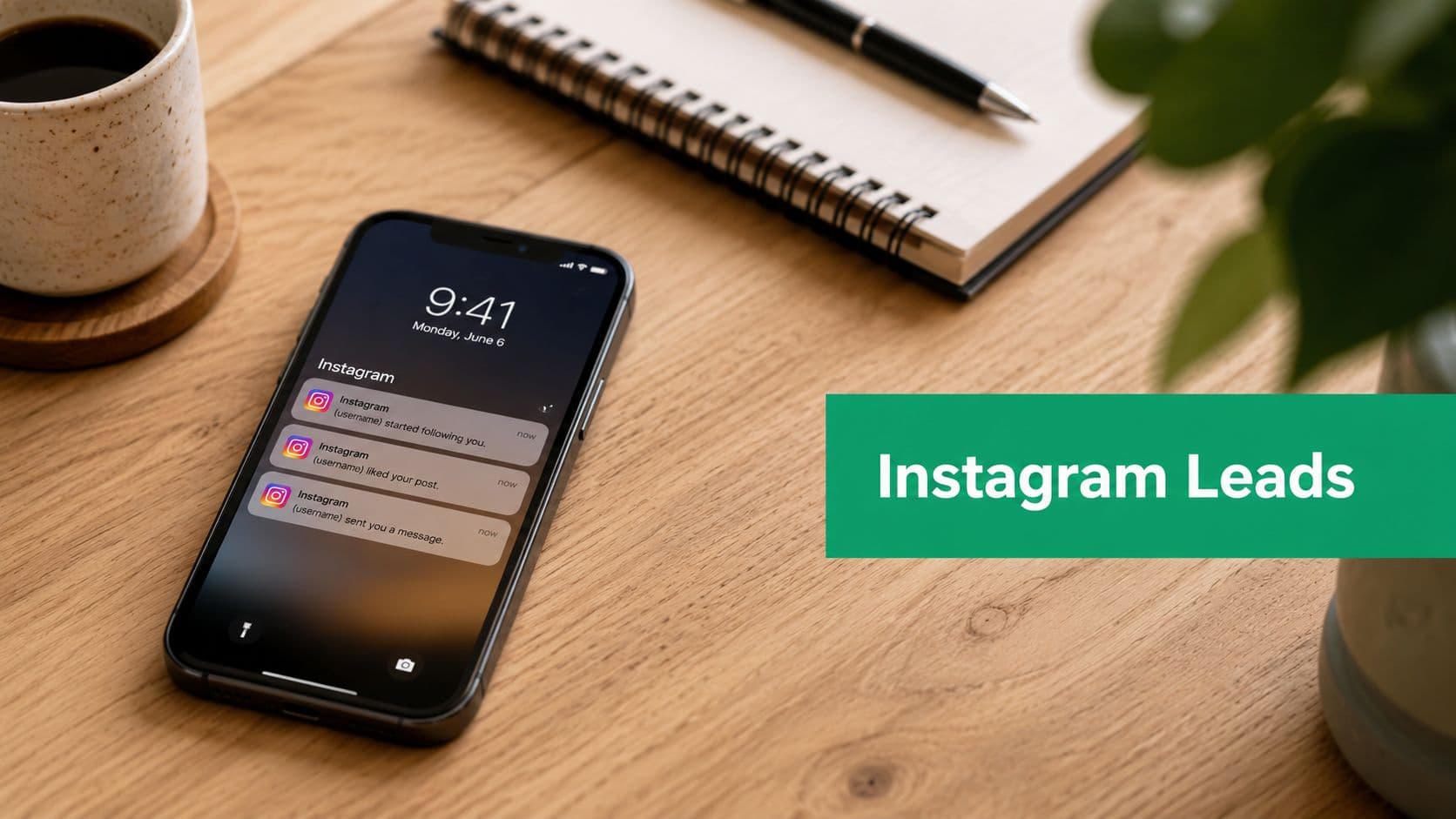
From Follower Growth to Business Growth
A familiar pattern shows up in client accounts. Reels pull solid reach, Stories get replies, the audience grows, and the sales team still says Instagram is sending weak leads. The account looks healthy from the outside, but there is no clear path from attention to conversation.
That happens when brands ask every post to do five jobs at once. Reach, authority, engagement, leads, and sales each need different creative, different calls to action, and different follow-up. If the action you want is not obvious, people consume the content and move on.
The goal is business growth, not audience activity.
What changes results
Accounts that generate leads well answer three questions within seconds of a profile visit:
Who is this for
What do I get if I engage
What should I do next
If one of those answers is vague, interest stays passive. People may watch, like, save, or react to a Story without ever becoming a real opportunity.
Practical rule: Every piece of Instagram activity needs one clear next step. DM, form fill, email opt-in, call booking, or site visit. If the next step is missing, the post may still help awareness, but it is not doing lead generation work.
The shift most accounts need
The biggest improvement usually comes from changing how the funnel is built, not from posting more often.
A solid Instagram lead gen system includes:
A profile that pre-qualifies visitors before they click
Content that creates intent instead of collecting broad engagement
DM flows that feel personal and move people toward a decision
Paid campaigns that scale offers already working organically
The weak point for a lot of brands is the DM layer. Fully automated replies can increase volume, but volume is not the same as qualified demand. In client accounts, the strongest results usually come from a hybrid setup: automation handles the first routing step, then a human takes over once intent shows up. That handoff improves trust, gives better qualification notes, and surfaces objections that bots tend to miss.
If your current strategy still centers on vanity metrics, this guide on converting followers to customers is a useful reference for tightening the path to revenue. If you also want your website to support that trust-building process, it can help to embed Instagram widgets so visitors see recent content and social proof without leaving the page.
What stops growth
A few patterns underperform again and again:
Posting broad motivational content: While this type of content can attract likes and views, it often reaches a wide audience with little interest in your products or services. As a result, engagement may increase without generating qualified leads or customers.
Sending everyone to “link in bio”: Using the same generic call to action for every post creates unnecessary friction. If the destination isn’t directly relevant to the content or doesn’t clearly address the viewer’s intent, many people won’t take the next step.
Automating every DM: Automation can save time and increase response volume, but relying on it for every conversation may make interactions feel impersonal. This can reduce trust, lower lead quality, and discourage meaningful conversations with potential customers.
Running traffic ads to a weak page: Paying to drive visitors to a landing page that has an unclear offer, weak messaging, or poor follow-up wastes advertising spend. It’s more effective to strengthen the page and conversion process before investing heavily in traffic.
Instagram can produce a strong pipeline. It just rewards clear offers, fast qualification, and conversations that feel human. Brands that treat it like a content showcase usually stall out. Brands that treat it like a conversion system get better leads from the same attention.
Building Your Lead Generation Foundation
A prospect lands on your profile from a Reel, taps around for ten seconds, and decides whether to reply, click, or leave. That decision usually comes down to three things. Is this account relevant to me, can I trust it, and is the next step obvious?

Instagram gives you reach. Your profile has to convert that attention into intent.
I've seen this play out across service brands, coaches, local businesses, and ecommerce accounts. A profile can look polished and still leak leads if the positioning is vague, the link path is messy, or the account pushes people toward automation before they trust the brand. For lead generation, the foundation is simple. Clear offer, clear audience, clear next action, and a DM path that still feels human once someone raises a hand.
Write a bio that earns the click or reply
A weak bio usually sounds broad, inspirational, or self-focused. That costs conversions because visitors should not have to guess who the account helps or what happens next.
A strong bio handles three jobs fast:
Names the audience
States the result or problem solved
Tells people what to do next
For example, “Helping founders grow” is too vague. “Helping SaaS founders book more demos from Instagram. DM ‘audit' for a funnel review” gives a visitor enough context to act.
Clarity beats clever wording here.
If your audience still feels too broad, fix that before rewriting the profile. This guide on how to find your target audience on Instagram is a strong starting point.
Tighten the profile elements that shape first impressions
Small profile details change conversion rates because they either remove friction or add it.
Name field: Add searchable keywords if your brand name alone does not describe what you sell.
Profile photo: Use a clean headshot for a personal brand or a simple, high-contrast logo for a company.
Category and contact buttons: Turn on the options that support the action you want. Leave off the ones that create extra choices.
Highlights: Organize these like a short sales path. Start with offer, proof, FAQs, and client results.
Pinned posts: Pin the three posts that answer a new visitor's biggest questions: what you do, who it's for, and what result people can expect.
This is also where a lot of teams skip the research step. They update the bio before they understand the language their audience already uses. If you are doing deeper audience research, it helps to review options for comparing social media scraping tools so you can collect better market signals before rewriting your positioning.
Choose one primary conversion path
Too many profiles ask visitors to make too many decisions. That slows people down.
For most lead gen campaigns, one primary path works best. Either send people to a dedicated landing page, or invite them into a DM conversation with a specific prompt. Which one works better depends on the offer and the sales process.
A landing page usually wins when you need attribution, more context, or a form that captures structured details. A DM prompt often wins when the offer is trust-sensitive, custom-priced, or easier to sell through conversation.
The mistake is trying to force every lead into automation. A keyword DM can start the process, but the handoff matters. Once someone shows intent, human replies usually qualify better, surface objections faster, and produce cleaner notes for sales. That hybrid setup has outperformed fully automated flows in a lot of the funnels I've managed, especially for higher-ticket services.
Build the account around the next step
Your profile should support one action, not five competing ones.
Use a dedicated landing page when:
You are promoting one lead magnet or campaign
You need tighter message match from post to page
You want cleaner attribution in your analytics
The visitor needs more information before converting
Use a link hub when:
You serve different audience segments
You regularly promote several offers
You need separate paths for booking, newsletter, content, and resources
Instagram is one traffic source inside a broader content system
Neither option is always better. The right choice is the one that reduces friction for the buyer you want now.
Audit the profile before you spend more on reach
More traffic rarely fixes a weak foundation. It usually exposes it.
Use this quick check before you push harder on content, partnerships, or paid traffic:
Bio: A conversion-ready bio clearly states who you help, the outcome you provide, and what visitors should do next. It should immediately communicate your value and include a clear call to action.
Link path: Instead of sending people to multiple destinations, use one primary link that supports one specific offer or goal. This reduces confusion and increases the likelihood that visitors will take action.
Highlights: Your Highlights should answer the most important questions a new visitor has by covering your offer, customer proof, frequently asked questions, and common objections. Together, they should build trust and make it easier for people to decide whether to work with you.
Pinned posts: Pin the content that gives the best first impression—typically an introduction to your brand, your strongest social proof, and your clearest offer. These posts should quickly show visitors why your account is worth following.
DM prompt: Make it easy for people to start a conversation by giving them one simple keyword or question to send you. A straightforward prompt reduces friction and encourages more meaningful inquiries.
Visual consistency: Your profile should have a recognizable and credible visual style across posts. Consistent colors, layouts, and imagery help reinforce your brand without making the feed feel repetitive or disjointed.
A profile does not need to be perfect. It needs to remove doubt and make the next step easy.
That is the foundation. If the profile is clear, the offer is specific, and the first conversation feels human, the rest of the funnel has a much better chance of turning attention into qualified leads.
Creating Content That Captures Leads, Not Just Likes
A post gets 40,000 views, a few hundred saves, and a spike in follower count. The client is happy for about a day. Then the real question shows up: how many qualified conversations did it create?
That is the standard content should be held to if Instagram is supposed to generate leads. Reach helps. Saves help. But content that brings in the wrong audience, or gives people no clear next step, turns activity into noise.

The job of lead gen content is simple. Give the right person a useful insight in public, then give them a reason to continue the conversation in private. That second step matters more than many brands admit. A lot of Instagram content plans are built for visibility first and lead quality second. In practice, the accounts that convert best usually do less broadcasting and more intent filtering.
Match content format to funnel stage
Each format creates a different kind of response, so the post type should match the action you want.
Reels: Pull in new people by naming a pain point, exposing a mistake, or showing a fast before-and-after.
Carousels: Build trust by teaching a process, breaking down a decision, or giving a practical checklist.
Stories: Create replies. Polls, sliders, question boxes, and short prompts are often the fastest route to a DM.
Pinned posts: Help new profile visitors understand who the account is for, what result it helps with, and what to do next.
Interactive content usually beats passive content for lead capture because it asks for a small action. That action gives you intent. A Story poll that asks, “Want the script?” tells you more than a like ever will.
Use micro-offers to bridge attention and action
Cold followers rarely jump straight to a sales call. They need a smaller yes first.
That is where micro-offers work well. They solve one narrow problem and make the next step feel low risk.
Examples:
A checklist
A short guide
A script
A free audit
A comparison sheet
A workshop replay
Specific offers convert better than broad ones. “Free marketing guide” is vague. “DM ‘AUDIT' for the landing page checklist we use before running Instagram lead ads” sets a clear expectation and attracts people with a real use case.
I have seen this pattern repeatedly across client accounts. The narrower the promise, the better the lead quality. Broad offers get more responses, but they also pull in more freebie seekers and lower-intent contacts.
Write CTAs that start a conversation
Weak CTAs ask for attention. Strong CTAs ask for action.
These tend to underperform for lead generation: - Link in bio - Let me know your thoughts - Follow for more
These create clearer intent:
DM me “GUIDE” and I'll send it over
Comment “CHECKLIST” if you want the template
Reply to this Story with “QUOTE” if you want pricing details
The best CTA feels easy to act on and easy to qualify. It should tell the user exactly what to do, what they will get, and why it is worth the effort.
There is a trade-off here. Comment triggers and Story replies usually create more volume. DM keyword CTAs often create cleaner handoffs into qualification because the conversation starts in a private channel. Which one works better depends on team capacity and how much human follow-up you can handle well.
Build content for human-first follow-up
At this stage, many Instagram funnels break. The content does its job, but the handoff is built like a vending machine.
A better approach is to create posts that invite a DM, use automation to handle the first response if needed, and then move qualified people into a real conversation quickly. That hybrid model tends to outperform fully automated flows because people ask messy questions. They want nuance, context, and reassurance. Content should be designed with that reality in mind.
So instead of writing a CTA only around delivery, write it around conversation potential. “DM ‘PLAN' and I'll send the template” is decent. “DM ‘PLAN' and I'll send the template. I'll also tell you which version fits your offer” gives the prospect a reason to reply again.
Keep production efficient without losing intent
A lot of teams burn time on content production and then rush the strategy. That is backwards.
Use repeatable formats, a short list of proven hooks, and clear CTA patterns. If you want help speeding up ideation and packaging, this guide to AI content creation is useful for turning rough ideas into publishable Instagram assets faster. Just do not let AI flatten the message. The best-performing posts still sound like a person with a point of view, not a template library.
A simple content map that converts better
This framework is practical because each format has one job.
Problem-focused Reel: The main purpose of this type of Reel is to attract the right audience by addressing a specific problem they face. The next step is to encourage viewers to send a DM with a keyword to receive more information, a resource, or the next step.
Educational Carousel: An educational carousel is designed to build authority by teaching something valuable and making a topic easier to understand. The next step is to prompt readers to leave a comment or click a link for additional resources, offers, or related content.
Story poll: A poll helps identify audience interests and segment followers based on their responses. The next step is to follow up with personalized DMs or relevant content based on how people voted.
Testimonial post: Testimonials build trust by showing real customer experiences and reducing skepticism about your product or service. The next step is to direct interested viewers to your booking page, contact form, or another conversion-focused destination.
FAQ Story sequence: An FAQ Story sequence addresses common questions and objections before someone reaches out. The next step is to encourage viewers to reply directly to the Story so you can continue the conversation and help them move closer to a decision.
Content should not try to do everything at once. One post can attract. Another can teach. Another can prompt the DM. That is usually a stronger system than trying to force every post to sell on its own.
Mastering the DM Funnel for High-Intent Leads
A prospect comments on your Reel, DMs the keyword, gets the free resource, and then goes quiet. The automation fired correctly. The lead still went nowhere.
That is the gap a lot of Instagram lead generation advice misses. The problem usually is not speed. It is what happens after the first automated reply.

According to Sked Social's Instagram lead generation analysis, automated DMs by themselves get a much lower reply rate than human-led follow-ups in the first 10 minutes, and hybrid flows where AI starts the exchange and a person takes over can produce 2.3x more qualified leads. That lines up with what I have seen across client accounts. Automation gets the conversation started. A person gets the prospect to explain their actual problem, ask better questions, and agree to a next step.
Why pure automation stalls out
Keyword automation still has a job. It delivers the promised asset fast, captures clear intent, and keeps inbox response time close to zero. That matters.
But the weak point shows up as soon as the conversation needs context. If every follow-up reads like a canned sequence, people stop responding. They got the checklist, template, or guide they asked for. They did not get help deciding what to do next.
That trade-off matters more than teams admit. A bot can handle volume well. It does a poor job of reading buying signals, adjusting to edge cases, or spotting when someone is ready for a quote instead of another link.
What a high-converting hybrid DM funnel looks like
The strongest DM funnels I have built use automation for speed and humans for qualification.
Send the first reply instantly. Deliver the promised resource or next step as soon as someone comments or messages the keyword.
Ask one qualifying question, sometimes two. Keep it short enough to answer in a sentence. Ask about goal, timing, offer type, or the blocker they are trying to solve.
Hand off warm leads fast. If someone replies with budget, urgency, team size, a sales problem, or a request for help choosing, move them to a human reply as quickly as possible.
Advance to one clear business action. That can be a call, form, quote request, voice note, or booking page. Pick the action that matches buyer intent.
If your team cannot respond quickly, keep the automation narrower. Sending five bot messages in a row does not create momentum. It just delays the actual conversation.
Qualifying questions that feel natural in DMs
A good DM funnel should feel like support, not an intake form.
Use prompts like these:
What are you trying to fix right now?
Is the priority more leads, better conversion, or a clearer content plan?
Are you managing this yourself or with a team?
Want me to recommend the best next step based on your setup?
These questions work because they lower friction. The prospect does not need to fill out a form or commit to a call yet. They just need to answer one useful question.
DM scripts that keep the conversation moving
Use automation for delivery:
Thanks for reaching out. Here's the guide I promised. If you want, reply with a quick summary of what you're working on and I'll point you in the right direction.
Then switch to a human reply once they engage:
Just saw your message. Quick question so I send you the right option. What result are you trying to get from Instagram right now?
If they share a specific issue:
Got it. Based on that, I'd look at two options. I can explain the difference here, or send you the page that fits your situation better.
The point is not to sound clever. It is to sound useful. Prospects reply more often when the message reads like real guidance from a person who understands the problem.
Where DM funnels usually break
The same failure points come up again and again:
Slow human response: When someone has to wait too long for a real reply, their interest often fades before the conversation begins. Responding promptly helps maintain momentum and increases the likelihood of converting an interested prospect.
Too many automated messages: While automation can improve efficiency, relying on it too heavily can make conversations feel scripted and impersonal. This may reduce trust and discourage people from continuing the interaction.
Weak qualifying question: If your initial questions don’t gather enough useful information, you’ll receive replies without the context needed to understand the person’s needs. Asking clear, relevant qualifying questions makes it easier to provide the right response or recommendation.
No priority routing: Treating every inquiry the same means highly interested prospects can end up waiting alongside low-intent conversations. Prioritizing warm leads helps ensure they receive faster attention while their interest is still high.
The operating rules that keep quality high
For client accounts with higher volume, I keep the system simple:
Every keyword DM gets the promised asset immediately
Replies that mention urgency, pricing, team needs, or a clear business problem get flagged
A human responds while the conversation is still warm
Each lead gets tagged by intent, offer fit, and next action
That is where Instagram starts producing sales conversations instead of vanity metrics. The automation handles speed. The human follow-up handles trust, nuance, and conversion.
Scaling with Instagram Lead Ads and Landing Pages
A common scaling mistake looks like this: an offer gets solid DM replies organically, the team turns on lead ads, volume jumps, and close rate drops within a week. The problem usually is not Instagram. It is weak handoff, loose qualification, or sending paid traffic into a form that was never designed for sales follow-up.

Paid Instagram works best after the organic offer has already proven it can start real conversations. I scale ads only after the message, call to action, and follow-up path are converting in DMs. That reduces guesswork and gives the algorithm cleaner signals.
Start with the right campaign settings
Choose a campaign setup built for lead capture, not cheap clicks. If you optimize for traffic, Meta will often find people who tap fast and disappear faster. If you optimize for leads, the system has a better chance of finding users who will submit information.
Keep the setup disciplined:
Use a lead-focused objective
Give the campaign enough time to stabilize before making major changes
Use an attribution window that matches how your team closes leads
Watch frequency so the same audience does not get overexposed
Teams that need more clarity on attribution and reporting should review this Instagram analytics guide for business growth before they scale budget.
Native form or landing page
This choice affects both cost per lead and lead quality.
Use native Instagram lead forms when:
The offer is simple to understand
Speed on mobile matters
You want to test hooks and audiences fast
Your sales team can qualify quickly after submission
Use a landing page when:
The buyer needs more context before opting in
You want stronger filtering before the lead reaches sales
You need custom tracking, retargeting logic, or page-specific messaging
The offer includes pricing nuance, case studies, or multiple service paths
Native forms usually produce more volume at a lower friction point. Landing pages usually produce fewer leads, but often with better context. For higher-ticket services, I usually prefer the extra friction if it helps the team spend more time on serious buyers.
Build forms for the next human step
Form quality shapes lead quality more than many teams expect.
A short form is not automatically better. If the only fields are name and email, the sales team has no context and the follow-up gets generic fast. If the form asks for eight fields, completion rate usually drops before the conversation starts. The right form collects only what helps a human respond with relevance.
A practical checklist: -
Lead objective selected: Use lead generation, not awareness or traffic
Questions tied to qualification: Ask for the detail your team uses, such as budget range, business type, or primary goal
Thank-you screen written with intent: Tell the lead what happens next and how quickly your team will reply
CRM integration active: Route leads to the right person immediately
DM or email follow-up mapped: Every submission should trigger a useful next touch, not a generic autoresponder
Keep the ad and the conversation connected
The best-performing paid funnels do not stop at the form. They carry the same promise from the ad into the thank-you screen, then into the first human message.
That matters even more on Instagram because people expect a conversational buying experience. A hybrid approach usually wins here. Let automation capture the lead, tag it, and route it. Let a person handle the reply when the prospect shows buying intent, asks a specific question, or needs help choosing the right option.
That is usually the difference between scaling lead volume and scaling revenue.
Tracking Your Success and Optimizing for ROI
A campaign can look healthy on Instagram and still lose money. I have seen accounts post strong reach, steady follower growth, and cheap lead volume, then fall apart once those leads hit the inbox because nobody measured quality, response time, or close rate.
That is the true scorecard. Track what happens after the click, form submit, or DM start, and Instagram becomes much easier to improve.
Track the metrics tied to revenue
Start with the numbers your sales team cares about:
Cost per qualified lead
Lead-to-customer conversion rate
Sales-qualified lead rate
DM-to-booked-call rate
Time to first human response
Close rate by source, campaign, or offer
These metrics usually live in different places. Instagram Insights shows content performance. Meta Ads Manager shows delivery and lead cost. Your CRM shows whether those leads turned into pipeline or revenue. Website analytics fills in the gaps on landing page behavior. If your reporting still stops at reach and engagement, this guide to Instagram analytics for business growth can help you build a cleaner measurement setup.
One warning from practice. Do not lump all leads together. A lead from a comment-to-DM funnel often behaves differently from a lead ad submission, and both behave differently from someone who clicked through to a landing page and booked a call. If you merge them into one number, you lose the context that tells you what to scale.
Likes show interest. Revenue shows fit.
Use AI to support judgment, not replace it
AI is useful here, but only in the right part of the process.
Use it to tag leads, score intent signals, sort conversations by urgency, and surface patterns a busy team might miss. Do not hand over the entire qualification process and assume the funnel will sort itself out. On Instagram, buying intent often shows up in nuance. A hesitant question, a budget clue, a specific objection, or a timing issue can be the difference between a cold lead and a sales opportunity. A human rep catches that faster than a bot running a fixed script.
That hybrid model usually produces better ROI than full automation. Automation handles speed and organization. People handle judgment, context, and conversion.
Run a simple optimization loop
You do not need a giant dashboard. You need a review rhythm your team will keep.
Offer: Ask yourself whether your offer attracts people with a genuine need or primarily appeals to those looking for free resources. A strong offer should bring in prospects who are likely to become customers, not just people seeking something at no cost.
Creative: Evaluate whether your content or ads are attracting the audience you actually want. High reach or inexpensive clicks aren’t enough if the people engaging have little interest in your product or service.
Form or DM flow: Review each step of your lead capture process to identify where people stop responding or lose interest. Look for questions, forms, or actions that create unnecessary friction and simplify them where possible.
Lead quality: Don’t focus only on the number of leads generated. Instead, assess whether your sales conversations are becoming more productive, whether prospects are a better fit, and whether they’re moving through your pipeline more effectively.
Response handling: Consider how quickly a real person joins the conversation after someone shows clear buying intent. Prompt human follow-up helps maintain momentum, builds trust, and increases the likelihood of converting qualified leads.
Review this weekly if lead volume is moderate to high. Monthly is too slow for most active campaigns. By the time you notice a quality problem in monthly reporting, you have usually paid for a lot of weak leads.
What to test first
Start close to the conversion point:
CTA wording
Offer framing
First human follow-up message
Form length and qualification questions
Creative angle
Change one meaningful variable at a time. Then watch lead quality, not just lead count.
Many teams find themselves misled. A cheaper lead is not better if your sales team cannot use it. In several client accounts, the highest-volume ad set was the weakest revenue driver because the promise was broad, the form was too easy, and the follow-up had no context. A narrower offer with a stronger first DM produced fewer leads, but more booked calls and better close rates.
Optimize for downstream results. That is how Instagram lead generation turns into actual ROI.
FAQ Your Instagram Lead Generation Questions
How many leads can I realistically expect per month?
There's no honest universal number. Lead volume depends on your audience quality, offer strength, follow-up speed, and whether you're using organic, paid, or both. A better question is whether the leads you're getting are qualified and moving toward revenue.
Do I need an Instagram Business account for lead generation?
Yes, in practice, you should. It gives you access to business features, ad tools, contact options, and better performance visibility.
How do I handle low-quality or spam leads from my ads?
Tighten the offer, review the form, and add better qualification. If volume is high but quality is poor, switch from low-friction capture to a higher-intent path and make follow-up more selective.
What's the best budget to start with for lead ads?
Start with a budget you can support with actual follow-up. There's no point paying for leads your team can't respond to quickly. A smaller, controlled test with strong handling beats a larger budget with poor response discipline.
Should I automate all my DMs?
No. Automation is useful for speed and delivery. It usually underperforms when it tries to replace human qualification. The better model is hybrid. Let automation start the conversation, then let a person take over when intent is clear.
If you want more organic visibility before you pour more effort into conversion, Gainsty can help you grow an Instagram audience with a more strategic, human-centered approach. That gives your lead generation system a larger pool of the right people to convert, without relying on fake followers or risky shortcuts.
.png&w=1920&q=75&dpl=dpl_34ZXCf12K5qjjdZjPn9snwDRADrB)




.png&w=750&q=75&dpl=dpl_34ZXCf12K5qjjdZjPn9snwDRADrB)