Why Your Instagram Reels Target Audience Is Broader Than You Think
The biggest targeting mistake on Reels is assuming the format belongs to college-aged users and nobody else. That assumption sounds safe because Reels does have a strong youth bias, but it breaks down the moment you look at how real audiences behave across age bands and markets. Excluding 24 to 34-year-olds is one of the fastest ways to undercut a good Reels strategy.
The better frame is simple. Reels is not a teen-only channel, it's a young-adult discovery surface with overlap across life stages, buying power, and content tastes. That matters because a Reel that resonates with a 27-year-old buyer may look different from one that lands with a 19-year-old viewer, even if both fall inside the same broad short-form audience.
Practical rule: define the audience you need to win, not the audience that sounds trendy in social media chatter.
The workflow I use is built for that reality. Start with research, then define a short-form persona, then shape the creative, distribution, and testing around that persona. By the end, you should be able to say exactly who the Reel is for, why they should stop scrolling, and what signals tell you the fit is working.
Who Actually Watches Instagram Reels in 2026
The age story is younger, but not narrow
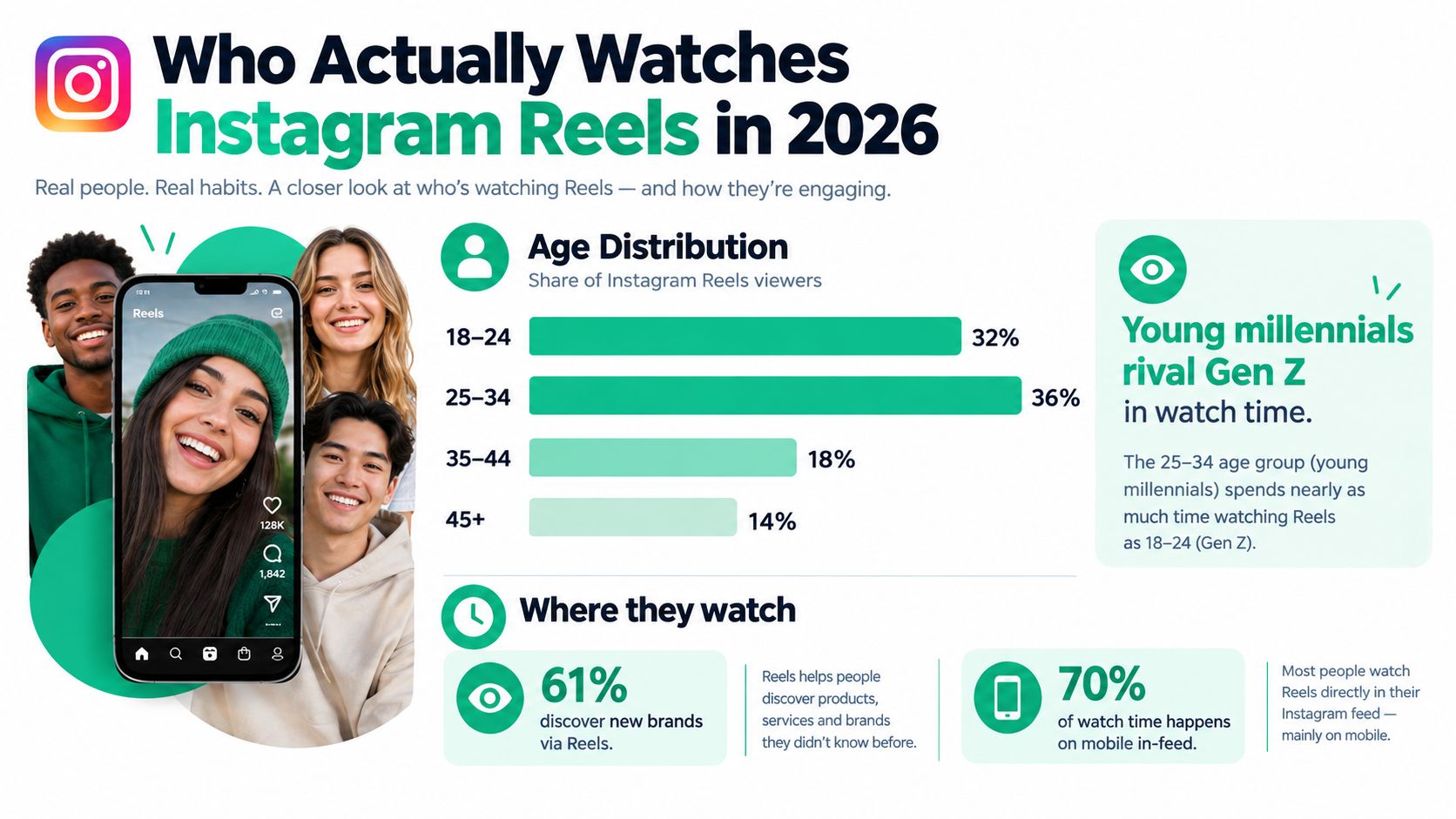
Recent audience summaries show that about 74% of Reels users are ages 18 to 34, with the 24 to 34 group and the 18 to 24 group each taking a large share of the audience, and another dataset splitting viewers almost evenly between 25 to 34 and 18 to 24. The point is not that Reels belongs to one age band. It sits inside a young-adult cluster. Zebracat's Reels audience summary makes that clear, and for a fuller picture of where the format is heading, see Instagram Reels in 2026.
That matters for targeting. Brands selling to early-career professionals, young parents, and first-time buyers should not treat Reels like teen-only territory. If your offer fits someone building a household, choosing services, or making purchase decisions for the first time, Reels can still be a strong fit.
Geography changes the targeting math
The audience is also concentrated in major markets. One source reports India as the largest Reels market with 362.9 million users, followed by the United States with 169.65 million and Brazil with 134.6 million, while another reports more than 2 billion monthly active Reels users overall. Outfame's Reels statistics round-up shows why you can't treat Reels as one universal English-speaking channel.
Before you plan a single Reel, decide which of these markets you are competing in.
A brand cannot just ask, “Is this global?” The better question is, “Which market is dense enough to justify a specific content angle, creator partnership, or language variant?” Some campaigns should prioritize the biggest pools of viewers. Others should prioritize the market where the content and offer convert more cleanly.
Consumption intensity matters too
The platform's audience is not just younger, it is also highly active on mobile. Industry reporting on Reels behavior suggests that discovery and retention depend heavily on immediate viewer response, captioning, and short-form pacing, not on length alone. Hootsuite's algorithm guidance is useful here because it reinforces a practical truth: the right viewer keeps watching, and the wrong viewer drops off fast.
For targeting, the audience is defined by age, market, device behavior, and willingness to engage quickly. That is the cluster you are trying to reach.
How to Research and Define Your Reels Audience
Start with your own Instagram data before you borrow ideas from anyone else. Open Instagram Insights, check who already follows you, and compare that audience to the person you want to attract with Reels. The gap between those two groups is often where the strategy lives.
Build the persona from evidence, not vibes
Pull three things from Insights. First, the age and location mix. Second, the times your existing audience is most active. Third, which posts already bring in non-followers. That gives you a rough map of where your current audience overlaps with your desired Reels audience and where it doesn't.
Then audit competitors. Don't copy their formats blindly, look at which of their Reels seem to attract your ideal viewer and why. A real estate agent, for example, may find that market-update Reels pull the right local buyers, while a fitness creator may notice that beginner-form tutorials earn better saves than trend-led clips. A B2B marketer often learns that educational talking-head Reels attract the right professionals, even when they don't look flashy.
If you want a structured way to gather outside signals, Captapi's audience research tools are worth reviewing alongside your manual research. The value isn't in automating judgment, it's in making the raw audience scan less messy.
Practical rule: separate the audience you already have from the audience you need. If those groups are different, your Reels should be built for the second group.
Write a one-page Reels persona
Keep the persona tight. Name one primary viewer, their age range, location if relevant, their main problem, the content format they trust, and the result they're trying to get. That's enough to guide hooks, captions, hashtags, and posting times.
A useful shortcut is to combine this with your existing audience diagnostics in Instagram audience insights. Treat that as a working reference, not a finished strategy. The point is to make your Reels choices easier, not to produce a document that nobody uses.
If you have a mismatch between current followers and desired viewers, say it plainly. That honesty keeps you from designing content for the wrong crowd just because they already know your name.
Turning Audience Insights Into Hooks and Creative Formats

The audience persona only matters if it changes the first two seconds of the Reel. That's where most clips win or die. If your viewer is a young homeowner, a new manager, or a first-time buyer, your opening has to sound like their problem, not your brand statement.
Match the hook to the viewer's problem
A strong hook is specific, not clever for the sake of being clever. A fitness creator might open with, “If you keep quitting after week two, this is the fix.” A B2B marketer could say, “This is why your Reels aren't getting the right leads.” A real estate agent might lead with, “Three mistakes first-time buyers make in this neighborhood.” Those hooks work because they mirror an existing concern.
The creative format should also follow the audience. Talking-head Reels work well when trust and clarity matter. Tutorials fit viewers who want utility. Before-and-after clips are strong when the result is visible. Trending audio can help, but only when it doesn't bury the message. If your viewer needs to understand the value fast, don't hide it under a gimmick.
For a useful reference on hook structure and audio choices, Nereo's Reels best-practices guide is a solid companion to your own testing. Use it as a checklist, not a script.
Keep the edit honest
Captions matter because they make the clip easier to scan and easier to understand without sound. Original, non-watermarked content is safer for discovery than recycled clips that look borrowed. And for most accounts, keeping Reels around 90 seconds or less is a sensible ceiling, even though Instagram allows longer uploads.
Here's the part many creators miss. Retention is also an audience-fit signal. If the wrong people click in and bail early, the platform learns that the Reel isn't holding attention. If the right people keep watching, that's a distribution signal worth repeating.
Choosing Hashtags and Posting Times That Match Your Audience
Hashtags are not a vanity accessory anymore. They're a topic signal, which means they help Instagram understand where your Reel belongs and who it might interest. The mistake is treating them like a reach hack instead of a relevance cue.
Build tag sets around audience intent
If your viewer is local and service-driven, your hashtags should reflect geography, service type, and problem language. If your viewer is niche and interest-led, the tags should cluster around use case and category. Repeating the same generic block on every Reel usually makes your content look lazy, and chasing trending tags with the wrong audience can attract viewers who never intended to buy.
Use your own active-time data instead of copying generic posting charts. The right posting time is the time your audience is online, not the time a general guide calls “best.” That matters more when your viewers are spread across time zones or when your market is concentrated in one region and your brand is posting from another.
For a deeper view on tag structure, Gainsty's hashtags guide for Instagram Reels is useful alongside your own testing. If you're trying to treat social like a revenue engine, Stimulead's perspective on social as a revenue engine adds the right strategic lens without turning hashtag work into superstition.
Local service business
Hashtag approach: Mix location, service, and problem-based tags
Timing logic: Post when your local audience is most active in Insights
Niche creator
Hashtag approach: Use category and interest clusters, not broad viral tags
Timing logic: Post during the active window for your core followers
B2B brand
Hashtag approach: Prioritize role, challenge, and industry terms
Timing logic: Align with workday attention patterns from your own data
Multi-market brand
Hashtag approach: Split tags by market or language set
Timing logic: Schedule around time-zone spread, not one global clock
The common mistake is over-indexing on “popular” tags. Popular tags can bring the wrong viewer. Relevant tags bring the viewer who's more likely to stay, save, and follow.
Testing and Measuring Audience Fit With Analytics
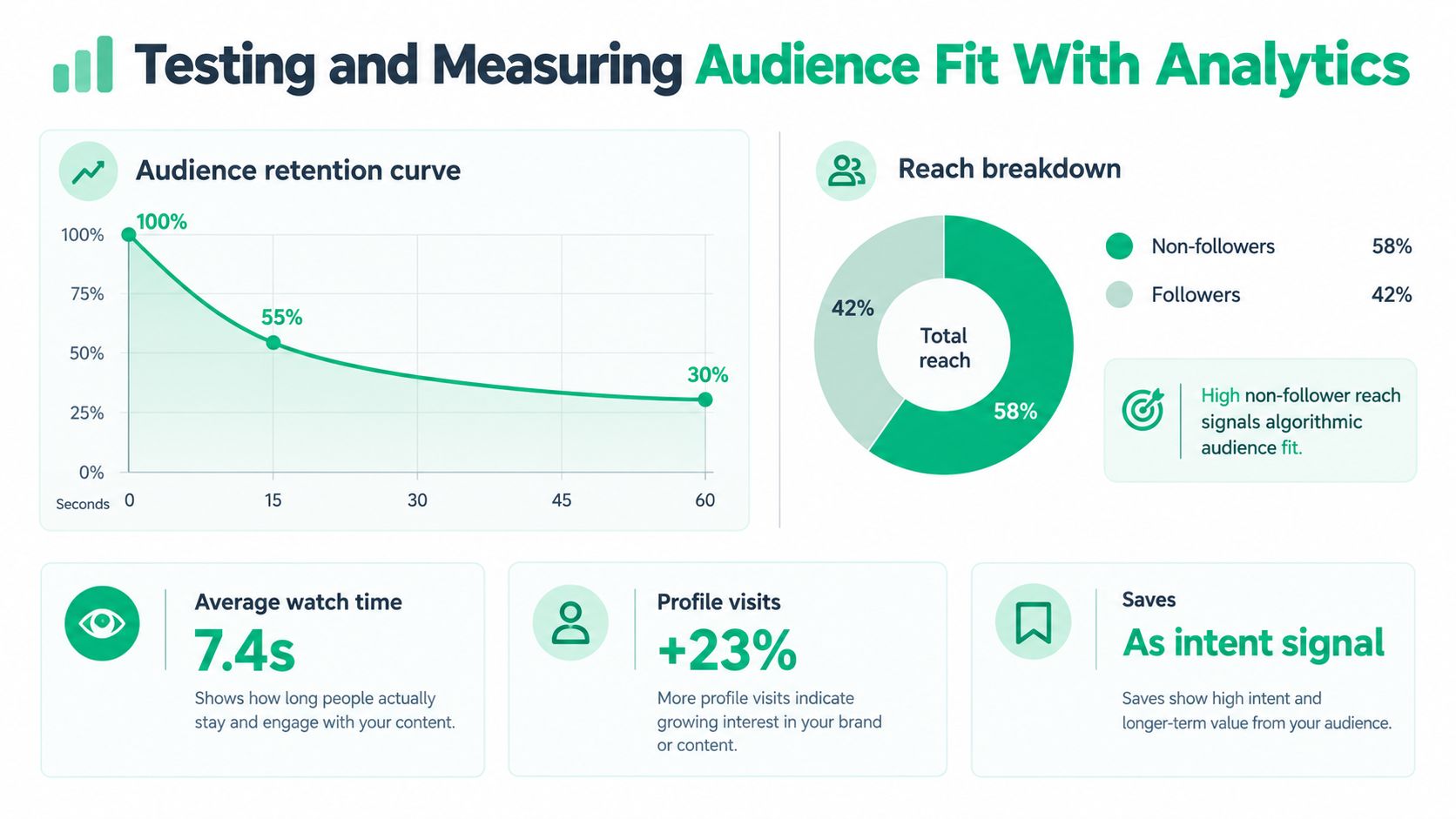
Analytics tell you whether your targeting is doing its job. Don't look at one vanity metric and declare victory. Read the pattern across retention, non-follower reach, and save behavior.
Read the signals in context
A Reel that reaches the wrong people often gets weak early retention. A Reel that reaches the right people tends to hold attention longer, even if it's not flashy. High non-follower reach is especially useful because it suggests Instagram is testing your content outside your existing base and finding a fit.
That's where niche benchmarking matters. A Reel can look average on a platform-wide basis and still be strong for your industry. Compare your performance to your vertical, not just to some broad average that ignores category behavior.
Run simple tests, not endless experiments
Change one variable at a time. Test the hook first, then the format, then the caption style. If you change all three at once, you won't know what moved the audience.
Useful check: if the clip attracts views but the retention curve drops fast, the topic may be broad but the targeting is off.
The goal isn't to “win” one post. It's to build a repeatable loop. Publish, check who watched, compare against your niche baseline, adjust the persona or hook, then post again. That weekly cycle is usually enough to tell you whether the Instagram Reels target audience is fully aligned or still blurred.
Your Reels Targeting Action Plan and Final Tips
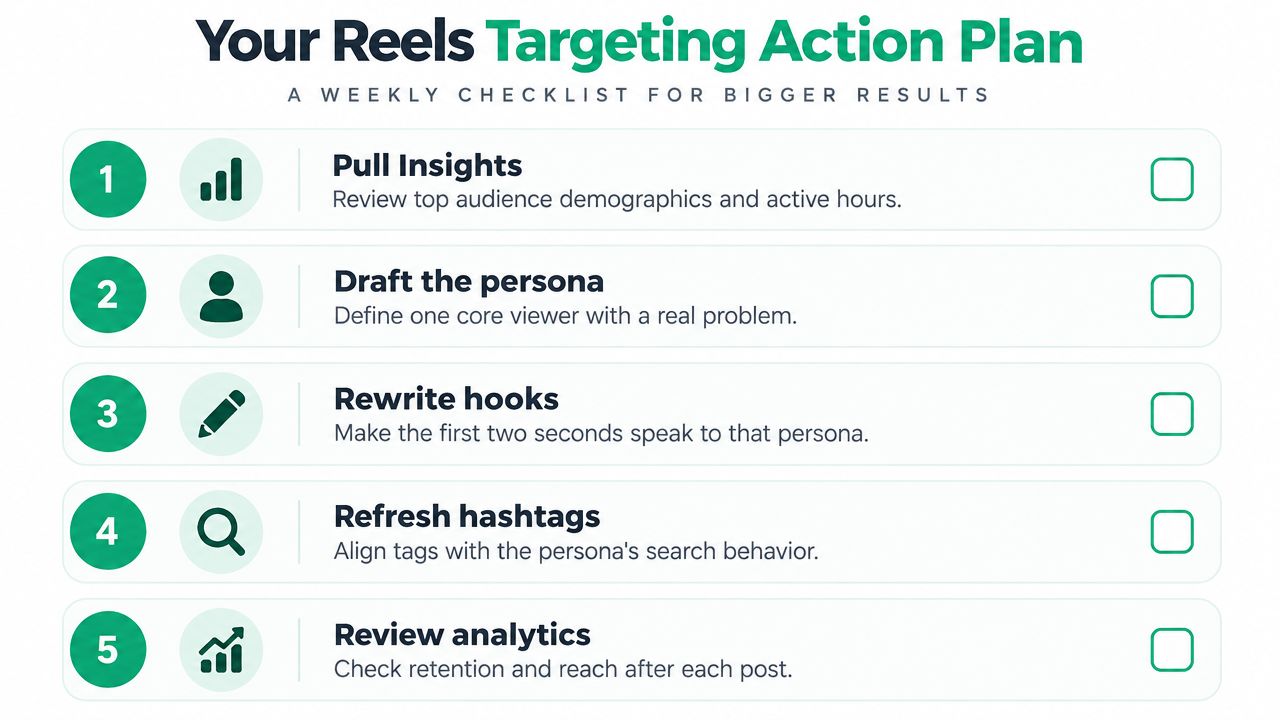
The fastest way to improve Reels is to stop guessing and start tightening the audience brief. Pull Insights, write one persona, rewrite the hook for that person, refresh the hashtags, then schedule against the times your audience is already active. After that, run one benchmarked test cycle and look at retention and non-follower reach, not just likes.
Ignore follower count as a targeting metric. It tells you size, not fit. Also ignore the temptation to overreact to one underperforming Reel, because one weak post usually says more about execution than about your audience.
Bottom line: audience fit beats raw reach when you want Reels to bring in the right people, not just more people.
If you want help turning that process into a repeatable system, Gainsty offers AI-powered Instagram growth support with targeting, analytics, and niche-aware recommendations. It can complement manual audience research by helping you spot who's responding and where your Reels are landing. Visit Gainsty if you want a practical layer of support while you tighten your Reels targeting.

.png&w=1920&q=75&dpl=dpl_34ZXCf12K5qjjdZjPn9snwDRADrB)





.png&w=750&q=75&dpl=dpl_34ZXCf12K5qjjdZjPn9snwDRADrB)