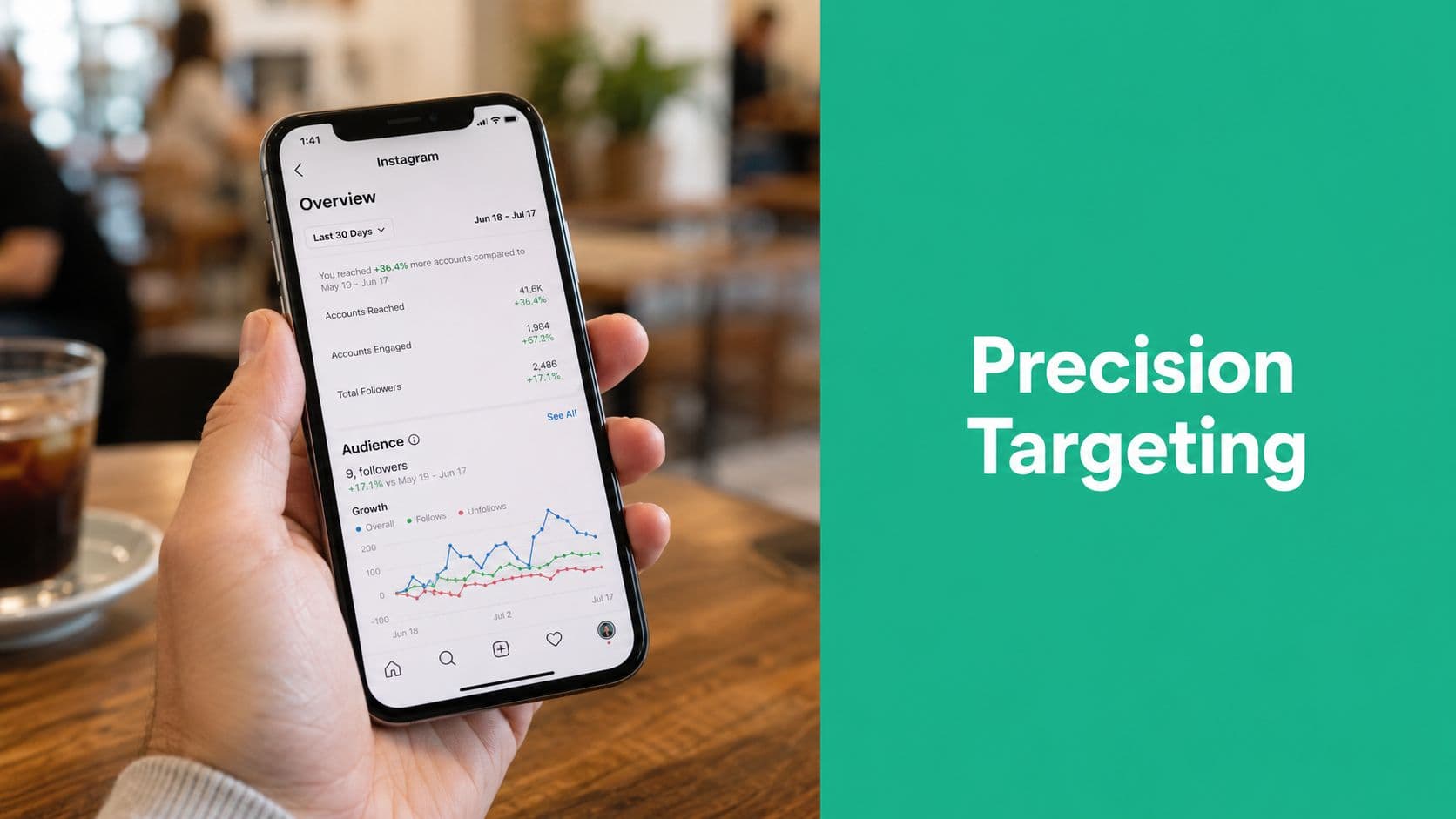
Why Your Great Content Is Not Enough
A lot of teams treat Instagram like a creative problem. They brainstorm better hooks, sharper visuals, stronger captions, and more frequent posting. All of that helps. None of it fixes a targeting mismatch.
The platform rewards relevance. If your account talks to everyone, Instagram has a harder time understanding who should get your content first. If your ad set is built too loosely, you pay to show up in front of people who were never a fit. In both cases, the symptom looks the same. Low response, weak momentum, and a feeling that the algorithm is working against you.
Relevance beats volume
The mistake I see most often is assuming more content automatically solves reach problems. It usually doesn't. More content shown to the wrong people just creates more weak signals.
A better way to think about Instagram targeting options is this:
Organic targeting helps Instagram classify your account through the topics, communities, and conversations you attach yourself to.
Paid targeting lets you define who should see a campaign before the platform starts optimizing delivery.
Combined targeting gives you the strongest position because your organic signals inform your paid decisions, and your paid results sharpen your organic strategy.
Practical rule: If a post underperforms, don't just ask whether the content was good. Ask whether the audience match was clear enough.
Instagram has matured far beyond broad demographic delivery. Advertisers can now work with audience structures that support prospecting, retargeting, and layered segmentation. Creators and brands can also shape organic reach through community signals, niche relevance, and repeated engagement patterns.
That shift changes the job. You're not only making content anymore. You're choosing distribution paths.
The Two Paths to Your Audience: Organic versus Paid
Organic and paid Instagram targeting solve different problems. People often compare them like they're substitutes. They're not. They're two different delivery systems with different strengths, costs, and limits.
Organic reach is like hosting a neighborhood gathering. You attract the right people by showing up consistently, speaking their language, and participating in the same spaces they already care about. Paid reach is closer to renting controlled placement. You choose audience parameters, launch the campaign, and buy visibility.

What the organic path gives you
Organic targeting works through signals rather than direct media buying. Your hashtags, geotags, collaborations, comments, saves, shares, and recurring topic choices all help Instagram place your content in context.
That gives you a few advantages:
Trust builds naturally because people discover you through content and interactions, not only through ads.
Audience quality is easier to read since comments, DMs, and profile visits tell you what resonates.
Content compounds over time when your niche becomes clear and repeatable.
The trade-off is speed. Organic growth takes repetition, patience, and active community work. You can influence it, but you can't command it.
What the paid path gives you
Paid targeting gives you control that organic reach can't. Instagram ads now sit inside Meta's broader audience architecture, with options including Saved Audiences, Custom Audiences, and Lookalike Audiences, plus filters for location, age, gender, language, interests, behaviors, and connection-based signals, as outlined in Sotrender's overview of Instagram ad targeting options.
That means you can decide whether you want to speak to a local audience, a broad interest group, warm traffic that already knows you, or new people who resemble your existing customers.
Organic earns attention. Paid rents it with more control.
The real trade-off
The decision usually comes down to this table in your head:
Speed: Organic growth is typically slower, while paid strategies deliver faster results.
Cost structure: Organic relies more on time and labor, whereas paid growth depends on budget and creative spend.
Control: Organic offers lower control over distribution, while paid allows higher control through targeting, budgeting, and campaign setup.
Perceived authenticity: Organic growth is often seen as more authentic, while paid outcomes depend heavily on how well campaigns are executed.
Scalability: Organic growth is less predictable at scale, while paid strategies are generally more predictable when campaigns are properly structured.
Neither path wins on every metric. Strong brands usually use both. Organic creates credibility and message fit. Paid creates reach and repeatable distribution.
Mastering Organic Reach and Targeting Tactics
Organic targeting on Instagram isn't passive. If you post and wait, you're leaving discovery to chance. The accounts that grow steadily usually do three things well. They make themselves easier to categorize, easier to discover, and easier to trust.
Build a hashtag mix that reflects intent
Hashtags still matter when they help classify the content clearly. The mistake is stuffing a caption with broad tags that attract low-intent traffic or no meaningful traffic at all.
A better setup uses a mix:
Broad category hashtags to signal your larger niche
Specific niche hashtags to connect with tighter communities
Branded hashtags to organize your own content and user submissions
If you manage a Pilates studio, “fitness” is too broad to carry much targeting value on its own. Tags tied to reformer classes, local wellness, or beginner mobility work are often more useful because they sharpen context.
The point isn't volume. The point is fit.
Use location signals on purpose
Geotags are underused by brands that depend on local discovery. Restaurants, salons, gyms, real estate teams, clinics, and event businesses should treat location data as part of targeting, not decoration.
Use location in feed posts when the place matters. Use it in Stories when you want to appear in local viewing behavior. If your content is tied to a neighborhood, venue, or city, say so directly in the caption too. That extra clarity helps both people and the platform understand where you belong.
Practice engagement-based targeting
This is the organic tactic that separates active operators from passive posters. If your ideal audience already follows competitor accounts, niche creators, or community pages, you can learn where they gather and participate there.
That usually means:
Identify adjacent accounts that your audience already watches.
Study comment sections to see what language, pain points, and objections appear repeatedly.
Engage like a real person by adding useful comments, answering questions, and joining relevant conversations.
Reflect those insights in your own content so visitors immediately recognize relevance when they land on your profile.
If your team needs better creative support for this part, PhotoMaxi has a useful breakdown of proven content strategies that can help sharpen engagement quality instead of just chasing more output.
A strong organic account doesn't only publish well. It shows up in the right conversations often enough for the right people to notice.
Keep the profile aligned with the target
A common failure point is mismatched signals. The Reel targets one audience, the bio speaks to another, and the grid looks like three different brands touched it. Organic targeting falls apart when the profile doesn't confirm who it's for.
Audit these pieces together:
Bio clarity so the audience knows they're in the right place
Pinned posts that reflect your priority topics
Story highlights that support the same audience profile
Recent content that repeats recognizable themes
If you need a practical framework for tightening that audience definition, this guide on how to find your target audience on Instagram is worth reviewing before you change your posting plan.
Unlocking Precision with Paid Instagram Ad Targeting
Paid Instagram targeting works best when it follows a clear order. Start broad enough to learn, then narrow based on signals you own. Teams that skip that sequence usually end up with overfiltered ad sets, weak delivery, and expensive clicks.

Paid gives you control that organic cannot always provide. That makes it useful for launches, retargeting, local offers, and campaigns where timing matters. It also comes with a trade-off. You can pay to reach the right people faster, but a poor audience setup burns budget quickly and hides weak positioning instead of fixing it.
Core audiences are your testing ground
Core targeting is the starting point for cold traffic. You set the basic conditions for who should see the ad, then watch which combinations produce efficient reach and qualified actions.
That usually includes:
Location based on where the offer can be fulfilled
Age and gender, if the product clearly performs better with a defined group
Language when creative, and landing pages depend on it
Interests and behaviors that suggest a real connection to the offer
Meta's own audience setup options for ads cover demographic, interest, and behavior-based targeting, which is why core audiences are still useful for early testing even if they are less precise than first-party data from your business. The point is not to pile on filters. The point is to create a reasonable starting hypothesis.
A local med spa, for example, should not target the entire country just because the budget allows it. A digital product with broad appeal should not be trapped inside a tiny local radius either. The audience has to match the buying reality.
Better targeting comes from cleaner logic
New advertisers often stack interests because each one sounds relevant on its own. The result is a cramped audience with no room for the algorithm to learn.
Use combinations that reflect the buying context instead:
Interest plus role such as skincare and salon ownership
Topic plus behavior such as fitness content and online shoppers
Location plus life stage for services tied to moving, weddings, school decisions, or new parenthood
Each filter should earn its place. Ask a simple question before adding one. Does this improve relevance, or does it just make the audience look smarter on paper?
Custom audiences are where paid starts to get efficient
Custom audiences let you stop guessing. You can target people who visited your site, engaged with your Instagram account, opened your app, or already exist in your customer data.
These audiences often come from:
Website visitors
App activity
Customer lists
Instagram or Meta engagement signals
This is usually the first place I look when an account says paid social is too expensive. In many cases, the problem is not the channel. The problem is that all spending is going to cold prospecting while warm audiences get ignored.
Retargeting works because the person has already shown intent. They clicked, watched, visited, saved, or engaged. That does not guarantee a conversion, but it usually gives you a cheaper and cleaner path than asking a cold audience to trust you on first contact.
For a better read on which signals to review before building these segments, use this guide to Instagram audience insights.
Lookalike audiences scale patterns that already work
Lookalikes are useful once you have a solid source audience. That source might be purchasers, qualified leads, repeat customers, or high-intent engagers. Meta then looks for similar users.
The quality of the source decides a lot here. A mixed list with weak buyers, old leads, and random engagement creates messy expansion. A tighter source built from strong customers or high-value actions usually performs far better.
That is the strategic split between paid and organic in practice. Organic helps you learn who responds, what language resonates, and which content attracts the right people. Paid helps you distribute that learning faster through core, custom, and lookalike audiences. Used together, they are much stronger than either path on its own.
Don't expect a lookalike audience to rescue a vague offer or poor source data. It can only model the signals you give it.
Choosing Your Strategy: When to Use Organic versus Paid
The right strategy depends less on platform preference and more on business context. A local bakery, a personal brand, a software company, and an e-commerce shop shouldn't use the same mix. Their timelines, margins, and goals aren't the same.
Organic is usually the right starting point when you need trust, category clarity, and consistent brand signals. Paid is usually the right choice when timing matters, distribution needs to be controlled, or the audience is too specific to be reached reliably through posting alone.
Use organic when the goal is relationship depth
If your business depends on credibility, repeat attention, or community presence, organic targeting does more than acquire reach. It establishes identity.
That matters for:
Creators and coaches who need people to trust their voice before buying
Local businesses that benefit from repeat visibility inside a known area
Brands are refining their message before putting money behind larger campaigns
Organic also makes sense when the budget is limited, but time and attention are available. You can learn a lot from comments, DMs, saves, profile visits, and recurring audience questions before you spend on ads.
Use paid when timing and scale matter
Paid targeting is the stronger option when you need immediate distribution. Product launches, seasonal offers, event promotion, waitlist building, and retargeting campaigns all benefit from more control.
The risk is going too narrow too fast. Augmun highlights an important issue with hyper-specific targeting. Overfitting can happen when the audience becomes so small that delivery suffers, costs rise, and the same people see the same creative too often, as discussed in Augmun's analysis of specificity versus scale in Instagram ad targeting.
That's why many campaigns improve when you widen one layer instead of stacking filters endlessly.
Narrow enough to be relevant. Broad enough to let the platform find room.
Organic vs. Paid Targeting Use Cases
Build trust in a niche: Use an organic approach because repeated content and ongoing engagement help create familiarity, authority, and long-term credibility within a specific audience.
Promote a time-sensitive offer: Use a paid approach because it allows you to control audience targeting and ensure the offer is delivered quickly to the right people within a limited timeframe.
Validate messaging: Start with organic first since audience reactions help you understand what resonates before investing more heavily in paid distribution.
Retarget warm prospects: Use paid strategies because people who have already interacted with your brand are easier to convert when you re-engage them intentionally.
Grow local awareness: Use a combined organic and paid approach where organic builds community presence and paid helps expand reach within a specific location.
Reach a new but defined segment: Use a paid approach because it allows you to test audience assumptions directly without waiting for organic discovery to build over time.
If you're deciding between the two at a broader strategic level, this comparison of organic vs. paid social media is a useful companion.
Advanced Targeting Strategies for 2026
Once the fundamentals are working, small targeting improvements can matter more than creating another campaign from scratch. Consequently, advanced Instagram targeting options become less about features and more about restraint.

Use Advantage+ when the account has enough signal
Advantage+ audience shifts a lot of the targeting burden from the advertiser to Meta's automation. Instead of defining every rule tightly, you provide guidance and let the system optimize based on conversion and engagement patterns.
That only works well when the account gives the system enough recent feedback. Industry analysis suggests 30 to 50 conversions per week gives Advantage+ enough signal to optimize more efficiently, according to WordStream's guidance on Instagram ad targeting and Advantage+ audience usage. If your account doesn't produce that kind of steady conversion volume, manual targeting or focused retargeting often gives cleaner control.
In practice, I'd use Advantage+ for accounts with stable conversion behavior, clear event tracking, and enough spend to support learning. I wouldn't use it as a shortcut for an account that still has weak creative, loose attribution, or inconsistent conversion data.
Add exclusions before adding more audience detail
Exclusions are one of the cleanest optimization levers and one of the most ignored. If someone has already bought, already converted, or already belongs in a retention flow, prospecting ads don't need to chase them.
Good exclusion habits help you:
Protect the budget from waste on existing customers
Reduce message mismatch between acquisition and retention campaigns
Keep reporting cleaner by separating audience intent stages
Segment by angle, not only by demographics
A more advanced move is segmenting around motivation. Two people in the same age band and location can respond for completely different reasons.
You can test audience logic, such as:
Problem-aware vs. aspiration-driven messaging
Beginner vs. experienced user framing
Interest overlap vs. direct purchase intent targeting
If you want a practical outside perspective on how AI can support this kind of audience refinement, AdStellar AI has a helpful piece on how to boost Instagram ad targeting with AI.
Better targeting often comes from removing mismatched people, not endlessly describing the perfect person.
Achieve Smarter Organic Growth with Gainsty
A familiar Instagram problem looks like this. The content is strong, the posting cadence is steady, and engagement still comes from the wrong people or from too few of the right ones. At that point, organic growth stops being only a content question and becomes a targeting and workflow question.
Manual organic targeting is possible, but it is slow. Someone has to map adjacent creators, study competitor followers, watch which posts pull qualified engagement, and keep testing audience signals through comments, DMs, Stories, and profile positioning. Paid ads can speed up audience matching, but they add media spend, creative testing pressure, and campaign maintenance. For teams that want to grow without making Instagram ads the whole plan, the gap is usually the process.
Gainsty fits that gap by giving teams more structure around organic targeting. It uses audience inputs such as competitor accounts, age, location, gender, and language to help narrow who you want to attract before the account starts pushing out more content. That matters because organic growth usually breaks down at the targeting stage, not the publishing stage. Teams post plenty. They just do not always engage in the right places or shape the profile around a clear audience.

Used well, a tool like this helps with three practical problems that came up earlier in this guide. First, it reduces the guesswork around adjacent audiences, so outreach and engagement are less scattered. Second, it gives teams a repeatable way to use competitor signals without manually rebuilding target lists every week. Third, it supports safer organic growth by keeping the focus on real audience fit rather than inflated vanity metrics.
That trade-off is important. Paid targeting gives you speed and clear delivery controls. Organic targeting gives you trust, better community signals, and a stronger foundation for long-term engagement, but only if the process stays disciplined. Gainsty is useful when a brand has already chosen the organic path and wants to run it with more consistency instead of treating growth like a series of one-off experiments.
The broader AI conversation matters here, too. If you want a wider view of how teams are using automation for audience research, content support, and campaign planning, Armox Labs has a useful overview of generative AI strategies for marketing. The practical takeaway for Instagram is narrower. AI works best when it improves targeting decisions and saves manual time, not when it tries to fake community building.
That is the role Gainsty can play. It helps teams organize organic targeting inputs, spend less time on repetitive audience research, and build a more systematic growth process around real people and real engagement. If the goal is to reach the right audience on Instagram without relying only on ad spend, Gainsty is worth evaluating.
.png&w=1920&q=75&dpl=dpl_2si4hWs7xtpQVmrY6d8xhJ1wLJZL)




.png&w=750&q=75&dpl=dpl_2si4hWs7xtpQVmrY6d8xhJ1wLJZL)