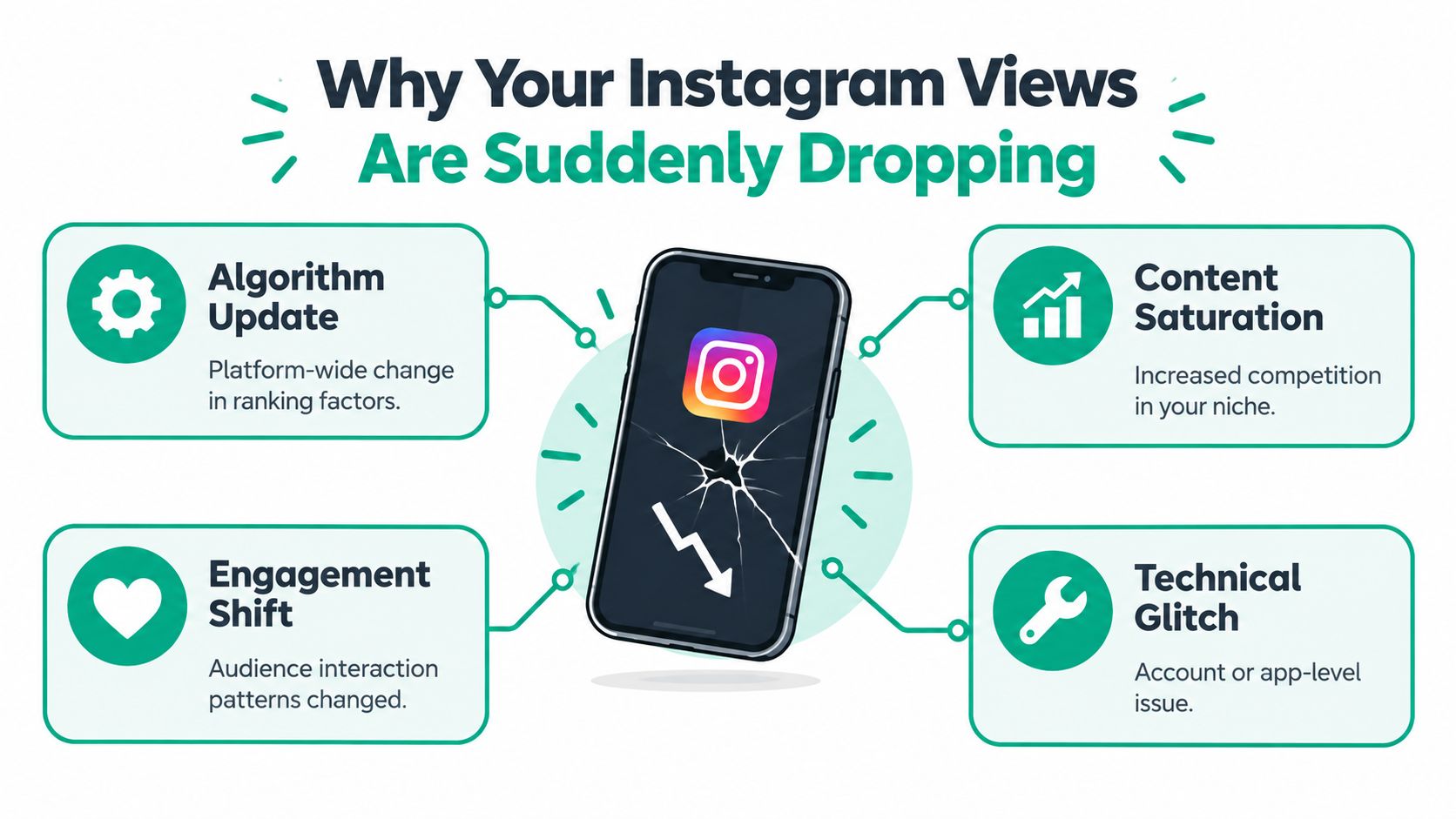
Why Your Instagram Views Are Suddenly Dropping
A sudden drop in views doesn't automatically mean Instagram has penalized your account. In many audits, the first explanation is broader: platform-wide engagement has weakened, organic reach has contracted, and the meaning of “views” has become less stable.
Instagram consolidated several reach-style metrics into a single Views field in 2026. Older measurements such as media impressions, Reel plays, Story impressions, and carousel impressions were folded into broader reporting, which makes some year-over-year comparisons less reliable. A lower number may reflect changed measurement, changed distribution, or both. The Instagram algorithm updates guide is useful context, but your own Insights data still needs to be interpreted carefully.
The platform-wide shift
Benchmark data supports the view that Instagram views down is often a systemic issue rather than an isolated account failure. Socialinsider's 2026 benchmark, based on 35 million Instagram posts, reported a platform-wide engagement rate of 0.48%, down 24% year over year. Buffer's separate 2026 analysis of more than 52 million posts found median engagement falling from about 7.3% in 2024 to 5.4% in 2025, a 26% decline. Both figures are documented in Socialinsider's Instagram benchmark study.
When fewer people interact with posts, distribution can weaken, especially in crowded feeds and short-form video environments. That doesn't prove every low-performing post was suppressed. It does show why an account can follow the same publishing routine and still receive less exposure than it once did.
Organic reach contracted across formats in 2025. Emplifi reporting summarized by Net Influencer described a 30% to 40% decline across Reels, images, and carousels, while other benchmark coverage reported Reels reach down by nearly 29% year over year for accounts under 50,000 followers between Q2 2024 and Q2 2025. Later reach datasets reported Reels reach down 35% year over year, with overall post reach down 31%, as covered by Net Influencer's report on Instagram reach and engagement.
Practical rule: Treat “shadowban” as a hypothesis to test, not your default explanation.
What distribution is rewarding now
The strongest diagnostic signals are not follower count or hashtag volume. They're watch time, saves, and sends or shares, because those actions indicate that people stayed with the content or found it valuable enough to pass along. If your views fell but saves, shares, profile visits, and inbound messages remain steady, the account may be reaching fewer people without losing content relevance.
That distinction matters. A platform-wide reset changes the baseline, while an account-level restriction usually creates a more specific pattern, such as recommendation ineligibility or a clear Account Status issue. Diagnose the pattern before you rewrite the entire strategy.
The Diagnostic Checklist for Declining Reach
Before changing your hooks, thumbnails, or posting schedule, rule out technical friction. A genuine account-level problem usually leaves clues in Instagram's Account Status, recommendation eligibility, or audience breakdown. A normal reach contraction often appears as a broad decline across multiple formats, with no policy warning attached.
Run the audit in this order
Check Account Status first. Open Instagram's Account Status area and review any content, recommendation, or community-guideline warnings. A restriction can affect discovery even when your content still appears to followers. Save screenshots of anything listed before you appeal or delete material.
Separate follower reach from non-follower reach. In Professional Dashboard or post-level Insights, compare who saw recent content. A fall in non-follower exposure points toward recommendation, topic relevance, saturation, or format performance. A fall concentrated among followers may indicate weaker audience activity, posting-time mismatch, or declining relationship signals.
Inspect recent content by format. Don't average Reels, carousels, images, and Stories together. Compare each format against your own recent baseline, then look at views alongside watch time, saves, shares, replies, and profile actions. Gainsty's Instagram analytics guide provides a practical route through the relevant Insights screens.
Review connected tools and behavior. Remove third-party apps you no longer use, especially tools that request broad account access or automate repetitive actions. Also check whether a scheduler, engagement tool, or old integration is still connected. If you suspect artificial activity or low-quality followers, use an independent Instagram bot checker guide from AI Image as part of the review.
Publish a controlled test. Use a topic your audience already understands, keep the format native, and avoid changing multiple variables at once. Record follower reach, non-follower reach, watch time, saves, shares, and profile visits. One clean test tells you more than a week of random posting.
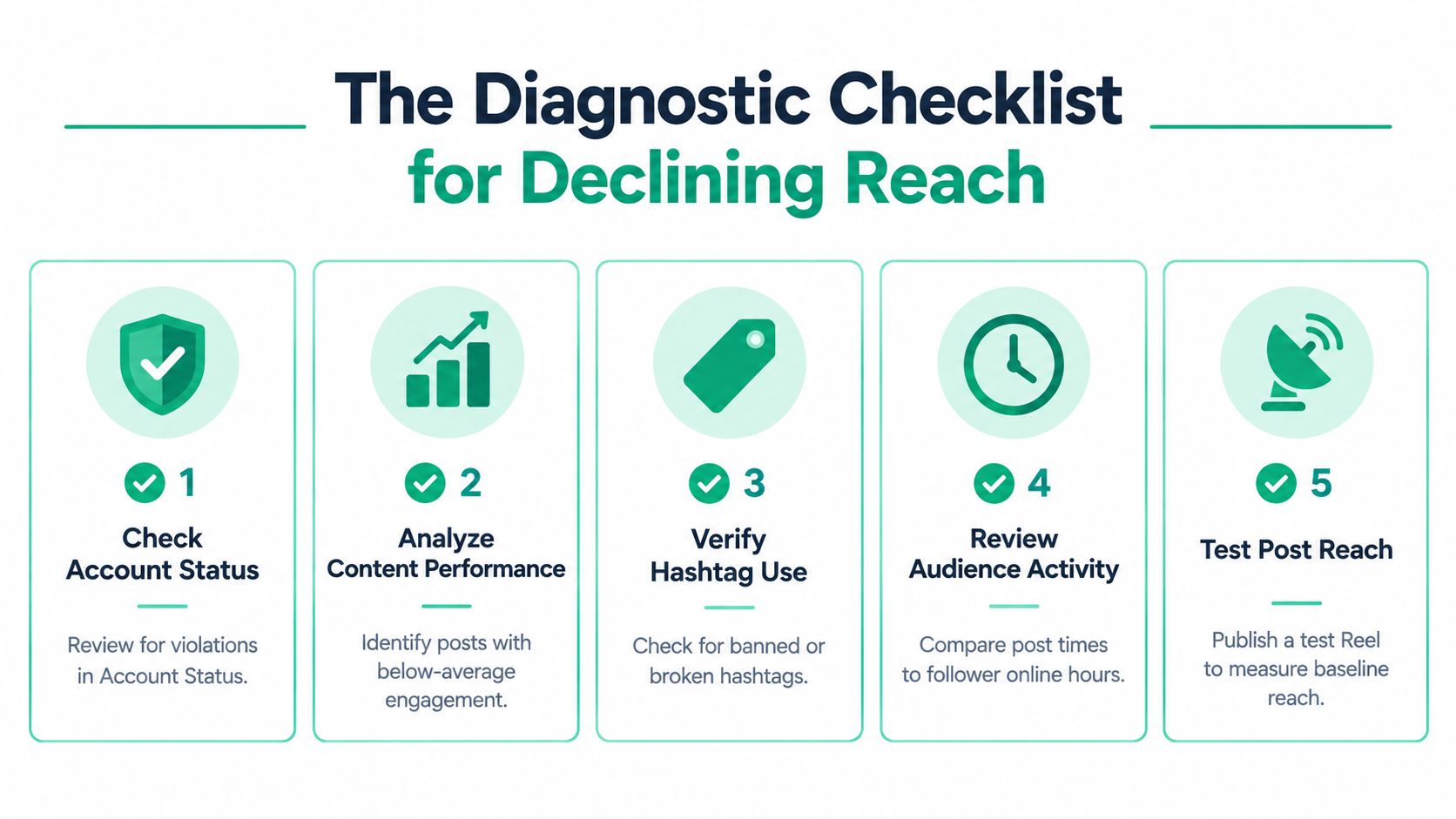
The purpose of this sequence is to prevent false conclusions. If Account Status is clean, follower access is stable, and every format has weakened, the evidence points toward a distribution environment rather than a hidden account penalty.
Use the video below as a visual walkthrough while you inspect your account. Don't treat any single screen as proof of suppression. Instagram's labels and reporting fields can change, so document what you see before making adjustments.
Content and Format Fixes to Reclaim Attention
“Post more Reels” is no longer a complete strategy. Reels remain a discovery format, but saturation and weaker retention can make a Reel-first plan less effective than a deliberate mix of Reels, carousels, images, and Stories.
The clearest technical lever for video is retention. A 2026 analysis of 346 Reels found median watch-time retention at 31.4% of video length. Reels under 15 seconds retained 66.0%, compared with 16.4% for Reels over 60 seconds, according to Highviz's Instagram Reels report. The lesson isn't that every Reel must be short. It's that your length should match the audience's demonstrated attention window.
Build the opening around the payoff
Remove logo animations, greetings, slow establishing shots, and vague introductions from the first frame. Put the outcome, tension, or visual proof immediately on screen. A viewer should understand the subject without sound and know why continuing is worthwhile.
Use a simple test structure:
Hook test: Keep the topic and footage consistent, but change the first spoken line or first-frame text.
Length test: Cut the same idea into a concise version and a fuller explanation.
Cover test: Compare a clear promise against a purely decorative thumbnail.
Quality test: Calculate engagement per view as total interactions divided by views, then compare that ratio across formats and topics.
In the cited sample, Reels under 15 seconds retained 66.0% of their length, while Reels over 60 seconds retained 16.4%. Reels overall showed 31.4% median retention, and recent benchmarks suggest their reach has contracted. The retention study did not provide equivalent retention figures for carousels or single images, but recent comparisons suggest carousels are increasingly competitive for saves and reach, while single images tend to underperform carousels.
This separates what is measured directly from what is observed in reach benchmarks. Don't invent a retention target for carousels or images. Evaluate them through saves, shares, completion behavior, profile actions, and the amount of meaningful attention they generate.
Give carousels a real job
Carousels work well when the audience needs a sequence, comparison, checklist, framework, or explanation. The first slide earns the swipe. The middle slides deliver usable detail. The final slide gives the reader a clear next action, such as saving the post, sending it to a colleague, or visiting the profile.
That doesn't make carousels universally superior. Reels can introduce a topic to non-followers, while carousels often create deeper consideration. A strong content system assigns each format a role instead of forcing every idea into video. For production guidance, ShipTeaser's resource on formatting promotional videos for Instagram can help when a video fits the message.
Before exporting assets, check Instagram post format sizing guidance. A cropped subject, unreadable cover, or text hidden beneath interface elements can reduce attention before the algorithm has any meaningful quality signal to evaluate.
Optimizing Metadata and Audience Re-engagement
Instagram can't recommend content effectively if the topic is unclear. Modern discovery depends less on stuffing captions with unrelated hashtags and more on making the subject legible through the caption, on-screen language, alt text, profile description, and the surrounding audience response.
Write the first caption sentence as a plain-language description of the post. If you sell tax planning to freelancers, say that directly. If you teach strength training for beginners, use those words naturally. Repeat the central topic where it helps comprehension, but don't turn the caption into a keyword list.
Make the topic easy to classify
Use one clear subject per post. A Reel about meal preparation shouldn't also try to target productivity, budgeting, wellness, and entrepreneurship unless those ideas belong together. Specificity helps both viewers and recommendation systems understand who should receive the content.
Hashtags can support categorization, but they can't rescue unclear content. Choose a small set that accurately describes the niche, audience, or subject. Avoid banned, irrelevant, or extremely broad tags, and don't assume adding more tags will compensate for weak retention or limited shares.
Your metadata checklist should include:
Caption language: Put the main topic in natural wording near the beginning. -
On-screen text: State the promise in a readable first frame. -
Alt text: Describe the image or carousel accurately for accessibility and context. -
Profile positioning: Make your niche and audience obvious before people decide whether to follow. -
Content consistency: Repeat related themes often enough that viewers associate your account with a clear problem or interest.
Rebuild signals from existing followers
Discovery isn't the only recovery lever. Re-engage people who already know your account through Stories, replies, and useful follow-up content. Ask a focused question instead of a generic “thoughts?” prompt. Use polls, question stickers, sliders, and direct replies when they fit the conversation, not as decorative additions.
Calls to action should match the value of the post. “Save this checklist for your next launch” gives a reason to save. “Send this to a teammate who manages Instagram” gives a reason to share. Avoid begging for every interaction, because repetitive engagement requests make the content feel transactional.
Audience signal: A useful save or send is more informative than a passive like, so design the post around a future need or a specific person who would benefit from it.
Review your audience activity before changing publishing times. If followers are less active at your usual slot, test a different window while keeping topic and format stable. Track replies, shares, saves, profile visits, and returning viewers rather than judging the experiment by views alone.
Safe Organic Growth Strategies and Expert Help
A view drop rarely justifies buying followers or automating engagement. Those tactics can make an account appear active while weakening audience quality. Inactive or fake followers do not reliably watch, save, reply, or share, and bot-driven activity creates noisy patterns that make a format-specific reach contraction harder to diagnose.
Consider outside help after completing the account audit and testing a clear content mix. A useful provider should help identify relevant audiences, improve content decisions, and attract people who have a reason to follow the subject. It should not promise instant virality or request unsafe credentials.
Vet a growth service before granting access
Ask how the provider identifies audiences, which actions it automates, whether bots or fake accounts are involved, and how results will be reviewed. Look for transparent targeting, account-level reporting, human oversight, and a clear explanation of the setup and ongoing work. Reject any service that guarantees a fixed follower outcome without discussing your niche, content, or audience fit.
Gainsty is an AI-powered social assistant platform designed to support Instagram follower and engagement growth through organic targeting. According to Gainsty's platform information, it focuses on authenticity and states that it does not use bots or fake followers. Its offering combines AI technology with Instagram expertise, targeting options, analytics, and account management.
The trade-off is control versus operating time. Managing growth internally preserves direct control over targeting and messaging, but requires consistent analysis. Managed assistance can reduce day-to-day work, yet you still need to inspect audience quality and connect new activity to views, saves, shares, profile visits, and business outcomes.
Use performance evidence to judge the service, not follower count alone. If the audience does not watch or return, the growth activity is not solving the discovery problem.
No provider can replace strong content. An outside partner may improve initial audience fit, but each post still needs a clear promise, sound retention, and a reason for viewers to return.
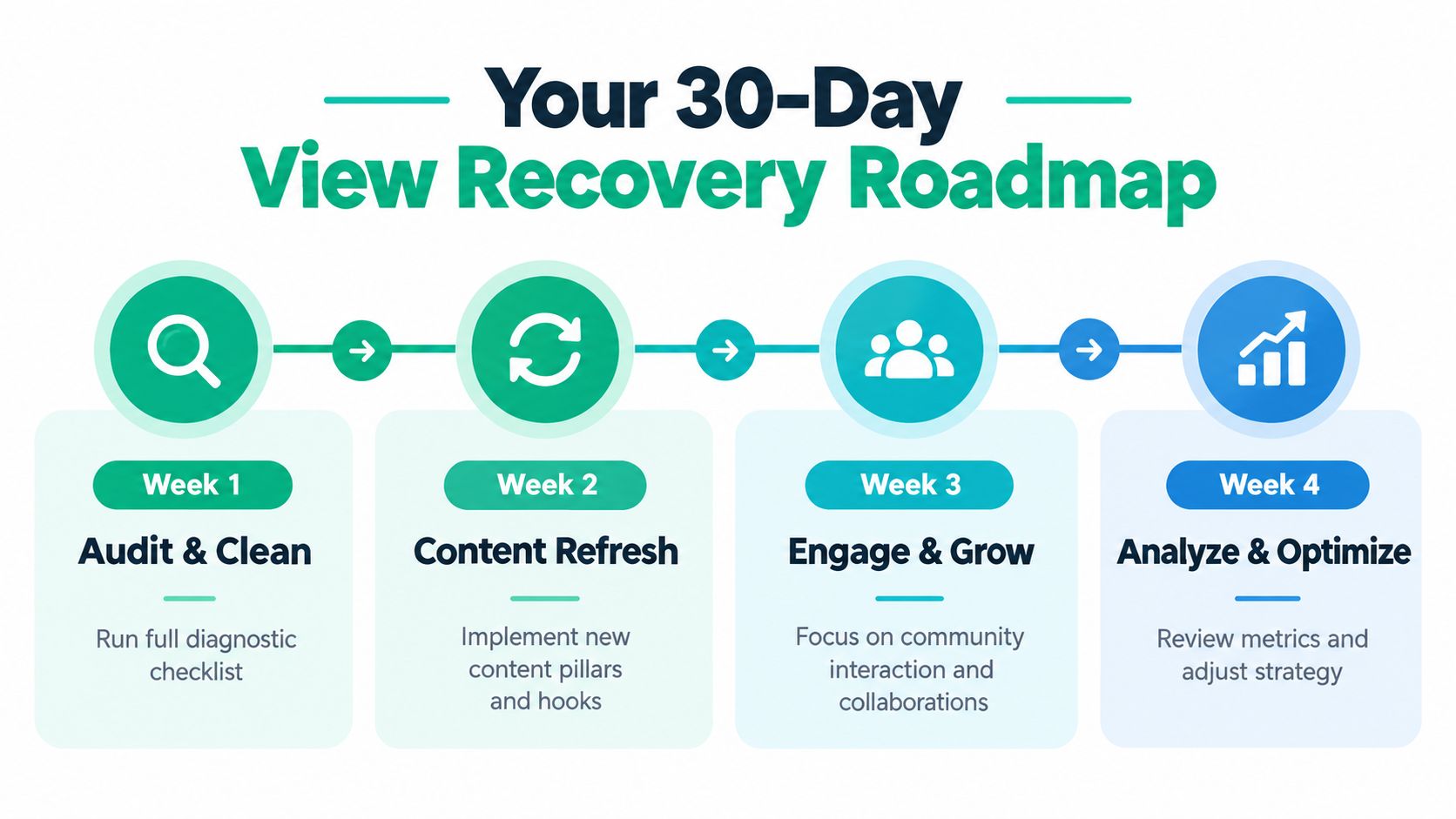
Your 30-Day View Recovery Roadmap
A recovery plan should reduce variables, not create more of them. Change everything at once, and you won't know whether the improvement came from a shorter Reel, clearer metadata, a better posting window, or simple variance. Use the month to establish a clean baseline, run controlled tests, and decide which signals deserve continued investment.
Week 1: audit and clean
Review Account Status, recommendation eligibility, connected apps, recent content, and follower versus non-follower reach. Export or record the available Insights for your latest Reels, carousels, images, and Stories. Mark each post's views, watch time where available, saves, shares, replies, profile visits, and follows.
Remove unused integrations and stop any questionable automation while you investigate. Don't delete large amounts of content impulsively. Preserve the evidence first, then address specific violations or technical issues.
Week 2: Refresh the content system
Choose a small group of recurring topics that match your audience's needs. Create a concise Reel with a direct first-frame promise, a carousel that teaches the same topic in steps, and a Story sequence that invites a response. Keep the core subject consistent so you can compare format behavior.
For Reels, test the hook and length separately. For carousels, test the first slide and the final call to action. Track engagement per view, saves, shares, watch time, and profile actions, not just total views.
Week 3: Engage and grow
Reply to comments with substance, answer Story responses, and start conversations with relevant accounts in your niche. Collaborate only when the audience overlap makes sense. A collaboration that attracts unrelated viewers may increase exposure without improving future engagement.
If you use growth assistance, confirm its targeting and safety practices before connecting the account. Keep your content tests running so you can see whether new followers become active viewers rather than just increasing the follower count.
Week 4: Analyze and optimize
Compare each test with your recorded baseline. Identify which topics retained attention, which formats generated saves and shares, and whether non-follower exposure improved. Don't declare recovery because one post performed well. Look for a repeatable pattern across multiple publications.
A realistic outcome is clearer diagnosis and stronger consistency, not a return to an earlier platform baseline. If views remain low but saves, shares, profile visits, and qualified messages improve, the account may be recovering in a more valuable way than headline reach alone suggests. Continue the formats and topics that produce meaningful actions, then retire tests that only generate empty exposure.
If your Instagram views are down and you want help building authentic audience activity, visit Gainsty to explore its AI-assisted targeting, analytics, and account management options. Use the diagnostic framework above to define your baseline first, then evaluate whether Gainsty's organic growth approach fits your niche and recovery plan.
.png&w=1920&q=75&dpl=dpl_34ZXCf12K5qjjdZjPn9snwDRADrB)



.png&w=750&q=75&dpl=dpl_34ZXCf12K5qjjdZjPn9snwDRADrB)