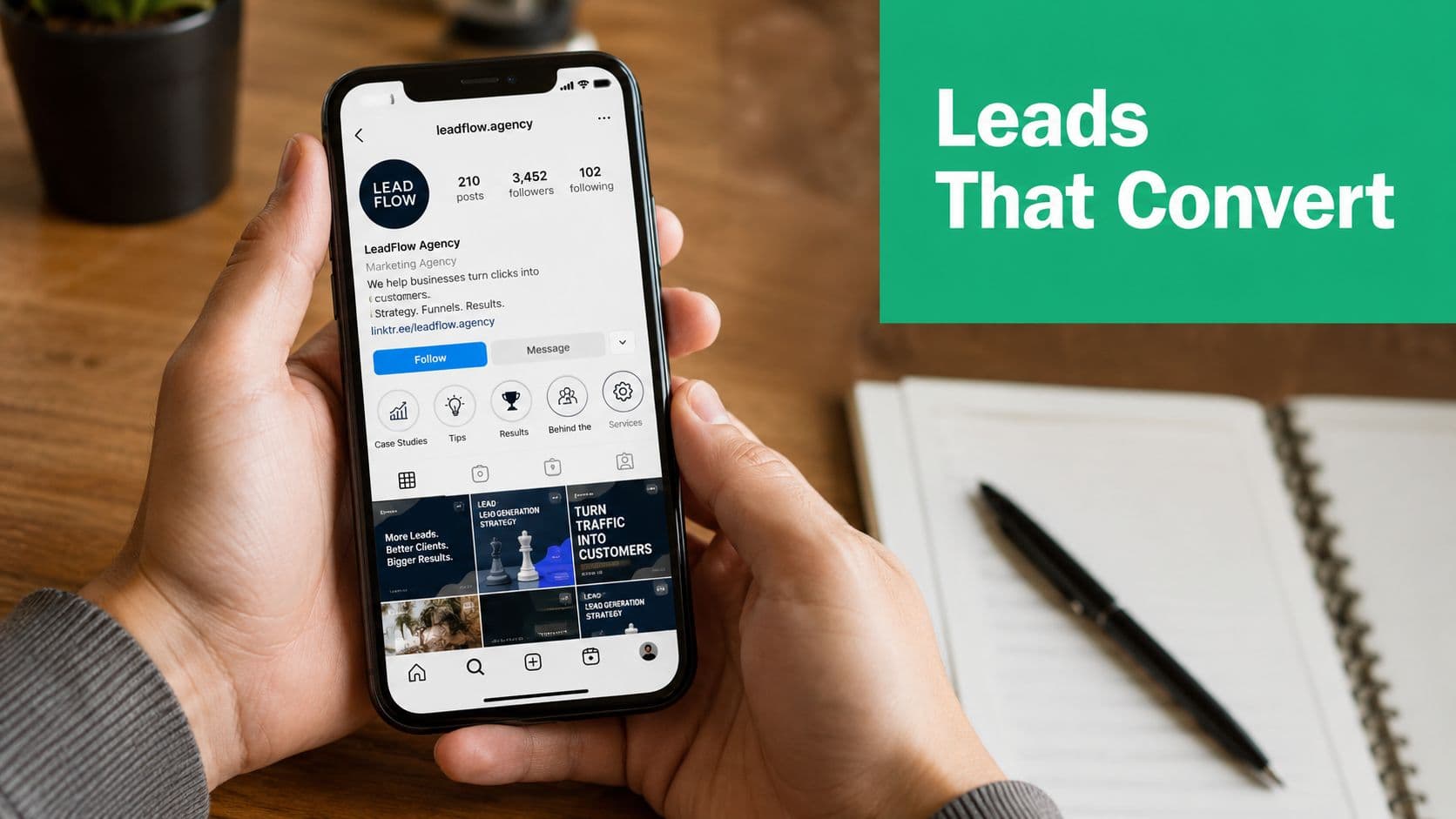
Why Most Instagram Accounts Struggle to Get Leads
A lot of small brands post like they're building awareness and then wonder why nothing turns into a pipeline. The feed gets likes, Story views, and a few “nice post” comments, but there's no clear step for a visitor to take next. That's the main reason Instagram feels busy without becoming profitable.
The platform also rewards more direct-response behavior than passive posting. In 2025, industry reporting tied Meta lead campaigns to an average conversion rate of 7.72% and an average cost per lead of $27.66 across industries, while another roundup put Instagram's paid-campaign conversion rate at 1.85% as a lead-gen and sales benchmark. At the same time, Socialinsider reported Instagram's average engagement rate at 0.48% in 2025, down about 24% year over year, which makes it obvious why “post more” isn't a lead strategy by itself.
The real issue is the missing handoff
Most accounts never define the handoff from attention to intent. Someone sees the content, but there's no keyword comment, no Story reply prompt, no DM trigger, and no routed form waiting on the other side. That means every response has to be interpreted manually, which kills consistency and follow-up speed.
Practical rule: if a post can't tell a visitor exactly how to raise their hand, it probably won't create leads.
The fix is structural. Build an entry point, qualify the person quickly, and send them somewhere usable. Without that path, even solid engagement just becomes a vanity metric.
Building a Profile That Converts Visitors Into Leads

Your profile is the landing page for everything else you post. If it's vague, overloaded, or hard to act on, you're paying the cost in lost clicks and half-formed interest. The fastest wins usually come from stripping the profile down to one clear promise and one next step.
The bio has one job, say who it's for and what happens next. A coach might say “Helping founders close higher-ticket clients through short DM funnels,” while an ecommerce brand could say “Natural skincare for sensitive skin, shop the starter set.” If the profile points people to a free guide, a discovery call, or a DM keyword, that action should be obvious without scrolling.
Make the profile feel like a mini funnel
Use one CTA in the bio, not three competing ones. If you need a hub, use a link-in-bio stack only when there are several equally relevant paths, such as a podcast, booking page, and lead magnet. If the offer is narrow, a single deep link usually converts with less friction.
The contact button and action buttons matter because some people want to email or call instead of clicking out. Highlights should answer the obvious objections fast, with proof, FAQs, offer snapshots, or behind-the-scenes context. Pinned posts should frame the offer, not just showcase the prettiest content.
For a quick profile audit, I like to check three things in order, clarity, friction, and proof. If the bio says everything and nothing, the link leads to a generic home page, and the highlights don't show what happens next, the profile is leaking leads before the DM flow even starts.
A good reference for tightening the bio itself is this practical breakdown of Instagram bio tips. Use it to clean up the top of the funnel before you spend time on the rest.
The Four-Stage Instagram Lead Funnel Explained

A working Instagram lead system has four stages, and each one has to hand off cleanly to the next. Attract attention, trigger intent, capture the lead, then route that lead into a follow-up path with context attached. That sequence matters because the funnel only works when the intent signal survives the transition.
The first stage is the content that gets seen, such as Reels, carousels, Stories, and creator content. The job here isn't to explain everything, it's to get the right person to take the next action. The second stage is where you create intent with a keyword comment, Story reply, or form submission.
Capture has to happen immediately
Once someone shows interest, the capture step should be friction-light. That can mean a native lead form, a DM automation handoff, or a landing page, depending on the offer. A free checklist can often live inside a DM trigger or a native form, while a webinar or high-consideration offer usually needs a dedicated page.
The fourth stage is where most accounts fall apart. If the lead doesn't move into a CRM, booking link, or nurture sequence, you've just built a nicer inbox, not a funnel. Context matters here, because the person's original reply, click, or keyword should still inform the next message.
Here's the anchor point worth remembering, the 2025 Meta leads benchmark cited in industry reporting put average conversion at 7.72% and average cost per lead at $27.66. Those numbers don't mean every account will hit them, but they do show that Instagram can function as a real acquisition channel when the sequence is tight instead of scattered.
The strongest funnels don't ask for more attention, they ask for a clear response and then move fast.
Turning DMs Into a Qualification Pipeline

DMs are where serious interest shows up, but most accounts treat them like a general inbox. That's a mistake. The DM should work like a qualification pipeline, where one entry point starts the conversation, one question checks fit, and one branch sends the lead to the right next step.
A simple workflow looks like this. Someone comments a keyword, taps a Story sticker, or clicks a trigger. They get an instant opener, then one qualifying question about timing, budget, or fit. If they qualify, they get a booking link or CRM handoff. If they don't, they can still enter nurture.
For example, a coach might use, “Want the client pipeline template? Reply with your niche, and I'll send the right version.” A SaaS founder might ask, “Are you looking for a demo this month or just comparing tools?” An ecommerce brand could say, “Want sizing help or the drop list?” Short prompts work because they're easy to answer and easy to route.
Automation helps, but it can sound robotic
Manual replies feel personal, but they don't scale. ManyChat-style automation can move people quickly, but generic language will make the conversation feel cold. The best setup is usually a hybrid, where the first response is instant, and the qualification step still sounds human.
Benchmark data from a 2026 funnel analysis reports that 30–70% of users who are triggered into a DM open it, and 22.9% of engaged leads qualify after the DM step. That tells you the biggest drop-off happens before qualification, not after, so your opener and first question matter more than fancy branching logic.
If you want a deeper breakdown of DM setup, this Instagram DM marketing guide is a useful companion. Use it alongside a clean routing system, not as a replacement for one.
Organic vs Paid Approaches to Leads on Instagram
Organic and paid Instagram lead generation solve different problems. Organic is slower but builds trust through repetition, while paid is better when you need controlled reach and faster testing. The wrong move is assuming one channel should do everything.
Organic performance has gotten tougher. Socialinsider reported Instagram's average engagement rate at 0.48% in 2025, down about 24% year over year, so broad posting alone is a weaker bet than it used to be. Paid lead campaigns, by contrast, can use targeting and forms to create a more predictable capture path.
The practical choice comes down to offer, budget, and speed. Founder-led brands with strong Story replies often do well organically because the conversation starts naturally. Broader offers, new launches, or time-sensitive campaigns usually need paid support to scale the first touch.
Organic: Organic growth is generally slower to learn from, but it can be valuable for testing messaging and understanding what resonates naturally with an audience. It can create a strong trust signal, especially when the founder or creator is visible. It works particularly well for niche audiences and warm communities, although the main weakness is that reach and results can be harder to predict.
Paid: Paid growth offers faster learning because you have more control over distribution and targeting. Trust depends heavily on the quality of the creative, messaging, and offer. It is best suited to broader targeting and scalable lead generation, but it can waste advertising spend when the underlying funnel or offer is weak.
For teams thinking about paid placements, a good external reference on Instagram Reels advertising in 2026 can help frame the ad format side without losing sight of the funnel. The decision isn't organic versus paid, it's which one gives you the cleaner path into a qualified conversation.
You can also compare this with the broader logic in organic versus paid social media if you're deciding how much to put into Instagram versus other channels. A hybrid model is often the sane middle ground, organic content warms the audience, then retargeting or lead ads capture the people who already showed intent.
Lead Magnets, Landing Pages, and CRM Routing
Once someone wants more, the capture step has to feel worth it. A weak lead magnet or mismatched landing page will choke the funnel even when the content and DM prompts are working. The offer needs to match the level of intent you asked for.
Native lead forms work well when the ask is simple and the next step is quick. DM handoffs work well when the first conversation matters more than the form fields. Landing pages make the most sense when the user needs more context, such as a webinar, an audit, or a high-ticket booking path.
Match the asset to the offer
A SaaS team can usually use a template, checklist, or demo invite as the magnet. Ecommerce brands often do better with lookbooks, size guides, or product quizzes. Agencies and consultants usually need an audit, assessment, or call-based path because the sale depends on fit.
Routing matters just as much as capture. A lead that lands in a spreadsheet with no context is hard to follow up on and easy to forget. A lead that lands in a CRM with the original keyword, source post, and stated need is much easier to qualify and nurture.
If the person had to explain their problem in a DM, don't strip that context away before the lead hits your CRM.
Here's a simple way to think about the capture layer.
Native lead form: Best for fast opt-ins and simple offers. It should collect contact details with as little friction as possible.
DM automation handoff: Best for qualification and conversation-led offers. It should ask a relevant question first, then route the person based on their response.
Landing page: Best for higher-consideration offers. It should match the Instagram creative, clearly explain the value, and make the next step obvious.
Common Mistakes, AI Risks, and Your 30-Day Action Plan
Most Instagram lead systems fail for boring reasons. The account chases followers instead of leads, uses content that gets attention but no action, or sends generic follow-up messages that sound like they were copied from a template. None of that is a platform problem, it's a funnel design problem.
AI and automation can help, but they also create new failure modes. Current coverage increasingly recommends DM automation and SEO-optimized captions, yet there's still limited neutral data on how those tools affect spam perception, response quality, or terms-of-service risk. That means the safe move is to use automation as a first-response layer, then keep a human eye on the quality of the conversation.
Guardrails that keep the system usable
Keep auto-replies short and on-brand. Don't over-automate mass outreach, don't bury the prospect in button choices, and don't pretend the bot is a person if your audience expects transparency. If the flow starts to feel like a trap instead of a conversation, people will back out fast.
The best 30-day plan is simple enough to finish. Week 1, clean up the profile and set one keyword trigger. Week 2, create one lead magnet and build the DM workflow. Week 3, drive traffic with targeted content or ads. Week 4, review the lead quality, the routing, and the follow-up.
A short checklist helps keep it real.
Obsessing over followers: Track leads, not just reach.
Ignoring DM leads: Treat every qualified reply as a sales signal.
Generic follow-up messages: Use the original context in the next message.
Spammy automation: Keep human oversight in the loop.
Over-promising: Match the lead magnet and the offer to what you can deliver.
The accounts that win on Instagram usually aren't the loudest. They're the ones that make it easy to raise a hand, quick to qualify the person, and disciplined about routing that interest into a real system.
If you want help turning Instagram attention into an actual pipeline, Gainsty builds organic growth systems that can support the top of that funnel while you handle the DM and CRM side properly. It's a practical fit when you need more of the right visitors, not just more noise, and you want a cleaner starting point for lead generation work.
.png&w=1920&q=75&dpl=dpl_D59Qa4oJ5cFQ7dZDLQ1JPQVnqHSs)




.png&w=750&q=75&dpl=dpl_D59Qa4oJ5cFQ7dZDLQ1JPQVnqHSs)