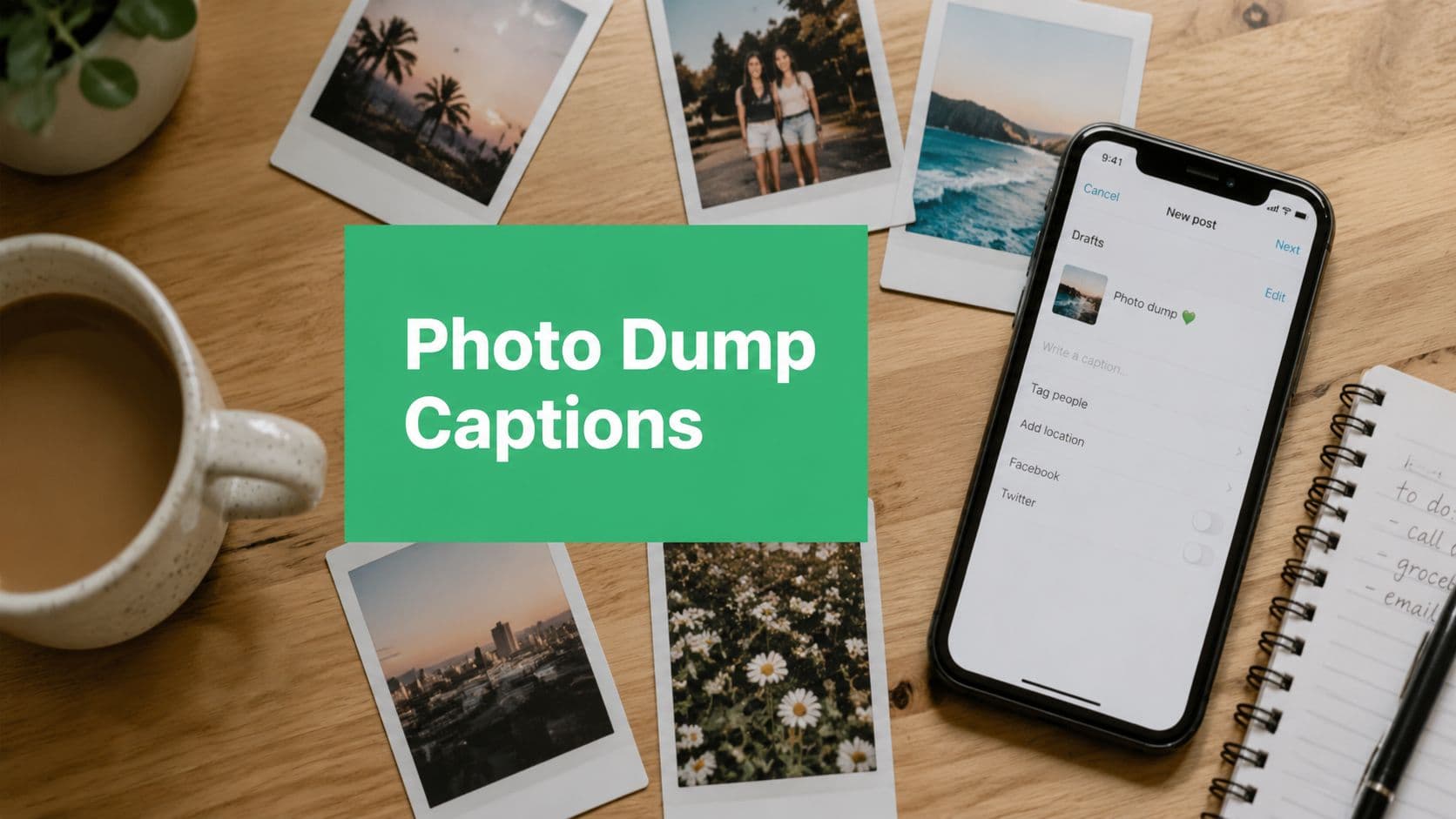
1. Authentic Moment Sharing
Authentic captions work when the photos already feel slightly imperfect. A blurry coffee shot, a half-finished desk, a weird selfie, a friend caught mid-laugh. If every image looks polished, the caption “just real life” won't land because the post and the words will contradict each other.

This style works because photo dumps are already framed across the web as casual, unfiltered mini summaries rather than polished storytelling. Major caption roundups consistently describe them as short, cohesive recaps of random moments, which is why simple, low-friction copy often performs better than a polished essay (The Knot's take on photo dump captions as mini summaries).
What this caption style builds
It builds trust first. People follow polished accounts for aspiration, but they stay when they can recognize a human being behind the grid.
A good, authentic caption gives context without over-narrating. Think lines like:
“A few things that made this week feel like mine.”
“Not my best angles, definitely my real life.”
“Messy camera roll, decent mood.”
“Tiny moments, solid week.”
Practical rule: If the caption sounds like it was written for any person on Instagram, it's too generic to build connection.
For creators and small brands, this style works especially well when you want to soften your image. If your feed is heavy on finished work, use a dump to show process, personality, or ordinary moments. That contrast makes the polished content more believable.
What works and what doesn't
Use one specific detail that makes the post yours. “This week” is weak. “This week looked like coffee, missed trains, and finally finishing that draft” is stronger.
Also, don't confuse authenticity with laziness. Random can feel real, but careless still looks careless. If you need ideas for recurring post formats that keep this style fresh, this list of social media post ideas is useful for turning everyday moments into repeatable content.
2. Witty and Humorous Captions
Humor is one of the fastest ways to turn a passive viewer into a commenter. Not because every joke goes viral, but because humor lowers the barrier to interaction. People may not know what to say to a pretty sunset, but they'll reply to a caption that pokes fun at the chaos in the slides.
The trick is matching the joke to the photo order. If slide one looks elegant and slide four is you holding a melting iced coffee with dead eyes, the caption should acknowledge the contrast.
Caption angles that get responses
Use humor when your dump includes visual tension: - polished and messy in the same carousel - confident first slide, chaotic middle slides - event recap with at least one obviously awkward frame
Captions that fit:
“Proof I was outside and occasionally thriving.”
“Some highlights, some evidence.”
“I had a week.”
“Camera roll looking like a personality test.”
This style works for creators with a self-aware voice, local businesses with personality, and personal brands that want to feel less rehearsed. It doesn't work when the joke sounds copied from a meme account. If people have seen the same punchline a hundred times, it stops feeling witty and starts feeling borrowed.
The trade-off
Funny captions are memorable, but they can flatten emotional depth if you use them on every dump. If every recap is irony, followers won't know what you care about.
Use humor when the photos are visually mixed and the energy is casual. Don't force jokes onto milestone posts, meaningful family moments, or content where sincerity would hit harder.
A good joke should sharpen the post's personality, not hide it.
3. Motivational and Inspirational Captions
Most inspirational captions fail because they jump straight to the lesson and skip the lived moment. People don't connect with generic encouragement. They connect with a specific struggle, a real shift, or a small win that feels earned.
That's why this category works best when your dump shows movement. It could be a work project, a training block, a healing season, or a better week after a rough one. The caption should sound grounded, not performatively wise.
How to make inspiration credible
Start with what changed, not with a slogan. These lines are stronger than vague motivation:
“A few reminders that progress usually looks ordinary while you're in it.”
“Still figuring it out, but this week felt steadier.”
“Some growth doesn't photograph well, but I know it's happening.”
“Not every win is loud.”
This style helps establish authority if you're a coach, founder, wellness creator, or service provider. It shows that you don't just post outcomes. You understand the process behind them.
Photo dumps have become closely tied to monthly and event-based storytelling through Instagram's multi-select posting flow, where users gather moments from their camera roll into one recap post (Picsart's overview of photo dump posting behavior). That format naturally suits reflective captions because the carousel already implies a timeline.
Where people get it wrong
The most common mistake is sounding like a poster. “Believe in yourself” doesn't give the audience much to hold onto. “Spent most of this month rebuilding my routine one boring day at a time.” does.
Use one concrete lesson, not five. Keep the emotional tone honest. Inspiration works when it feels observed, not manufactured.
4. Nostalgia and Throwback Captions
Throwback dumps do well when they don't just say “look how long ago this was.” They work when they create a contrast between then and now. That contrast gives followers a story to react to.

A nostalgia caption can build emotional connection, but it can also establish credibility. If you run a business, old product photos, early event images, rough first drafts, or old workspace shots can show how your work has evolved. If you're a creator, throwbacks help people see continuity in your identity.
Stronger than a simple throwback
Useful caption formulas:
“Same energy, better boundaries.”
“From that version of me to this one.”
“Found these and remembered how much can change subtly.”
“A little proof that growth rarely feels dramatic in real time.”
This style works best when you mix older photos with a few recent ones. That side-by-side effect makes the caption sharper. It gives the audience something to compare.
Editorial note: Nostalgia lands harder when you acknowledge both the charm and the discomfort of the past.
Avoid fake sentiment. Not every old photo needs a deep reflection. Sometimes a light line is enough, especially if the visuals already carry the emotion. A smart growth move is choosing a caption that matches the weight of the moment instead of forcing significance onto it.
5. Story-Driven Narrative Captions
Some photo dumps shouldn't feel random at all. They should feel sequenced. If the carousel covers a trip, launch day, moving week, event setup, or a weekend that had a clear arc, use the caption to turn the swipe into a story.
Narrative captions increase retention because they make each slide feel like part of a whole. People keep swiping to understand the progression. That's useful when your goal is deeper attention, not just a quick like.
Build a story, not a summary
The best narrative captions give a beginning, a middle, and a quiet payoff. They don't describe every image. They frame the sequence: -
“Started with one plan, ended with something better.”
“A weekend that moved from rushed to memorable.”
“These slides make more sense in order.”
“One of those days that kept getting better after the second photo.”
If you want to strengthen this style, reference the slide order directly. “The third photo explains the rest,” or “the last slide is the actual ending,” gives people a reason to stay with the carousel.
Narrative captions are especially useful for travel creators, event planners, wedding vendors, stylists, and founders documenting a rollout. They help the audience experience the post instead of just scanning it.
The trade-off
This approach needs intentional image order. If the sequence feels random, the caption can't save it. Choose a strong cover image, then arrange the rest so tension builds or the story unfolds cleanly.
This is one of the few photo dump Instagram captions styles where editing the image order matters almost as much as writing the copy.
6. Educational and Tips-Based Captions
Educational dumps are one of the cleanest ways to turn attention into authority. They work best when the carousel shows examples, and the caption sharpens the lesson. Think design mistakes, before-and-after workflow, client prep, ingredient swaps, styling decisions, or setup notes from a shoot.
The mistake here is trying to teach everything at once. One dump should answer one useful question.
Make the lesson easy to save
A strong educational caption usually opens with the takeaway:
“A few things that made this shoot easier.”
“What I'd do differently next time.”
“Small fixes that changed the final result.”
“If you're trying this yourself, start here.”
Then add brief supporting points in the caption itself.
Lead with the main takeaway: Put the most useful line first so people get value before they tap “more.”
Tie the advice to a slide: If slide three shows the lighting setup, mention it directly.
Write for saves: Clear, practical language beats cleverness when the post is meant to teach.
For creators building a niche, this style is one of the strongest ways to prove expertise without sounding promotional. If you want to tighten the structure of these posts, this guide on how to write Instagram captions is a good companion.
What not to do
Don't hide the tip behind a long personal intro. And don't make the caption so dense that it feels like homework. Educational posts still live in a mobile feed. Clarity wins.
7. Aesthetic and Mood-Based Captions
Mood captions aren't shallow. They just serve a different purpose. Instead of explaining or teaching, they create identity. When done well, they tell followers what kind of taste, atmosphere, or emotional register your account stands for.

This style works especially well for fashion, interiors, hospitality, cafes, beauty, and lifestyle creators. The photos carry most of the weight. The caption should reinforce the feeling without over-explaining it.
Keep the copy spare
Good aesthetic captions are usually short:
“Soft light, slow morning, no complaints.”
“Current palette.”
“A few quiet favorites.”
“More texture than storyline.”
“The week looked like this.”
Across the web, caption examples such as “Digital diary,” “Camera roll, wrapped,” “From the vault,” and “A week in the life” show how the photo dump has shifted toward identity signaling and storytelling, not just jokes (Dorm Therapy's caption roundup and framing of authenticity). That's why mood captions can still support growth. They attract people who want to belong to the same visual world.
Where this style fails
It fails when every dump says “just vibes.” That phrase has been drained of meaning. If your visual style is strong, the caption should add texture, not repeat the obvious.
Use sensory words, emotional cues, or framing language. Avoid abstract fluff. “Warm neutrals and a better headspace” says more than “vibes lately.”
8. Behind-the-Scenes and Process-Focused Captions
Behind-the-scenes captions are trust builders. They show the work, not just the result. That matters if you sell something, create professionally, or want followers to understand the effort behind what looks easy in the feed.
Lead with reality. A BTS dump should feel like access, not another polished campaign.
Here's the visual setup this kind of post supports best:

Show the messy middle
Strong BTS caption options: -
“What this looked like before it looked good.”
“A few unglamorous parts of the process.”
“Proof that the finished version skips a lot.”
“The part people don't usually post.”
This style is powerful for photographers, bakers, founders, stylists, event teams, social media managers, and creators filming from home. It gives your audience a reason to trust your finished work because they've seen how you approach the details.
What works is specificity. Mention the delay, the retake, the problem with lighting, the packaging mistake, and the last-minute swap. Those details humanize the post and make your skills visible.
Most audiences don't need perfection. They need proof that you know what you're doing when things get messy.
If the process includes motion or setup context, a short embedded clip can deepen the post without replacing the carousel:
Keep it transparent, not sloppy
There's a line between transparent and chaotic. Show friction, but frame it with competence. “This failed three times before we fixed the setup” is stronger than “everything went wrong lol” unless your brand voice is intentionally chaotic.
9. Question-Driven and Interactive Captions
If your comment section is quiet, stop ending photo dumps like diary entries and start ending them like invitations. Interactive captions give followers an easy next step. They turn the post from a recap into a prompt.
This style is especially useful when your audience likes to weigh in on choices, preferences, opinions, or small debates. Fashion creators can ask “first outfit or last?” Food accounts can ask “savory or sweet?” Service providers can ask, “Which version feels stronger?”
Make the question easy to answer
Better prompts:
“Which slide sums up your week?”
“Pick one. First photo energy or last photo energy?”
“Best part of this dump?”
“Which one would you have posted first?”
The strongest interactive captions avoid yes-or-no questions. They give people a simple lane to enter the conversation. Specificity matters more than cleverness.
You can also structure the post around choice:
This-or-that prompts: Great for style, design, menu items, and product variations.
Opinion prompts: Best when there's no single right answer.
Story prompts: Ask followers to share their own version of the moment.
If you want examples of prompts built for conversation, this roundup of Instagram engagement captions is a solid reference.
The catch
You have to respond. Interactive captions don't work if you disappear after posting. Replying early helps set the tone and turns comments into an actual community signal rather than a dead prompt.
10. Seasonal and Trending Topic Captions
Want your photo dump to feel current without sounding like everyone else's?
Seasonal and trend-based captions work best when they give the post a reason to exist now. That timing can raise reach because the context is already familiar to your audience. People are already in back-to-school mode, holiday mode, summer travel mode, or year-end recap mode. Your caption meets them there.
The strategic value is relevance. The trade-off is sameness. If the caption stops at “fall dump” or “summer vibes,” it may blend in with hundreds of similar posts. Good seasonal captions use timely context to earn attention, then add a specific point of view to build recognition.
Use the moment to frame the post
Try captions like:
“What this month looked like.”
“Current season, current camera roll.”
“Proof the weather changed, and so did my routine.”
“End-of-summer evidence.”
“December in fragments.”
These work because they do two jobs at once. They signal timeliness fast, and they leave room for the photos to carry emotion, humor, or personality. That makes them useful for creators who want light structure without over-explaining every slide.
Trend-based captions follow the same rule. Use the trend as an entry point, not the whole message. Instagram's own trend reports regularly show how quickly formats, audio, and cultural moments cycle, which is why broad trend references age badly unless they are tied to a real experience on your account (Instagram trend reports and creative insights).
Add one lived detail to make the caption memorable
Specificity is what turns a seasonal caption into a growth tool.
Instead of “fall vibes,” write “the season of earlier sunsets and too many coffee photos.” Instead of “summer dump,” write “all the proof I said yes to leaving the house.” Instead of “holiday recap,” write “the week my camera roll became cookies, wrapping paper, and missed texts.”
That one detail matters. It helps followers recognize your voice, gives them something concrete to react to, and keeps the post from reading like a template.
Seasonal captions are strong for visibility and cultural relevance. They are weaker for authority unless you attach a clear perspective. Use them when you want to stay timely, stay discoverable, and keep your content connected to what your audience is already noticing.
Photo Dump Caption Styles: 10-Point Comparison
Authentic Moment Sharing: Low implementation complexity and minimal production needs make this style easy to maintain. It tends to build trust and steady engagement, making it a strong fit for lifestyle, wellness, and creators focused on organic growth. Its biggest advantage is relatability and a deeper audience connection.
Witty and Humorous Captions: These require a consistent comedic voice but relatively little production effort. They often generate high engagement, shares, and even viral potential. They work especially well for comedy creators, playful brands, and Gen Z audiences because they are memorable and encourage comments.
Motivational and Inspirational Captions: This style takes more thoughtful storytelling and reflection. The payoff is stronger loyalty, emotional connection, and evergreen value. Coaches, entrepreneurs, and wellness leaders often use them to position themselves as trusted voices and thought leaders.
Nostalgia and Throwback Captions: Using past photos and memories requires little production because existing assets can be reused. These captions create emotional resonance and encourage sharing, making them ideal for anniversaries, milestones, and celebratory moments.
Story-Driven Narrative Captions: These are more demanding because they require planning, structure, and stronger writing. However, they often lead to deeper engagement, longer reading time, and more saves. They’re particularly effective for travel stories, product launches, and event recaps.
Educational and Tips-Based Captions: Medium-to-high effort goes into research, accuracy, and organization, but they frequently earn saves, establish credibility, and attract niche followers. Experts, educators, and service-based brands benefit because these captions build authority and support future monetization.
Aesthetic and Mood-Based Captions: This approach depends heavily on visual consistency and polished editing. It helps create a recognizable brand identity and steady niche growth, making it popular with fashion, interior design, and luxury lifestyle creators.
Behind-the-Scenes and Process-Focused Captions: These require only moderate effort and often rely on informal, real-time content. They strengthen trust by showing how things actually happen, making them valuable for creators, makers, and small businesses that want to humanize their brand.
Question-Driven and Interactive Captions: Crafting thoughtful prompts and responding to comments takes ongoing effort, but this style can dramatically increase conversations and engagement. It’s especially useful for community builders and brands seeking audience feedback because it generates both interaction and insights.
Seasonal and Trending Topic Captions: Success depends on timing and staying aware of trends. When executed well, they can deliver significant short-term reach and discoverability. Retail brands, holiday campaigns, and trend-focused creators often use them to capitalize on moments when audience interest is highest.
From Random Photos to Strategic Growth
A strong photo dump caption does one thing really well. It gives the carousel a job. Maybe that job is building trust through honesty. Maybe it's creating comments through a question. Maybe it's reinforcing your taste, your expertise, or your point of view. Once you start seeing photo dump Instagram captions that way, the writing gets easier because you're no longer trying to be clever for no reason.
The biggest shift is moving from filler to intention. “Lately” isn't wrong. It's just incomplete. It doesn't tell the audience why this post matters, what emotion they should carry through the slides, or how they should engage with it. A stronger caption creates a frame that helps the audience read the post the way you meant them to.
That matters even more now because photo dumps have become a distinct Instagram convention, not just a random album format. The web is full of caption libraries built specifically for this style, which means standing out won't come from posting a carousel alone. It will come from choosing the right caption strategy for the kind of relationship you want with your audience.
In practice, the best workflow is simple. Look at the photos first. Ask what they naturally support. If the images are candid and personal, go authentic. If they show contrast, use humor. If they reveal progress, lean reflective. If they teach something, write to be saved. If they invite opinion, end with a question. Matching the caption category to the content usually works better than trying to force one voice across every dump.
For teams and creators who want help refining that process, tools can help surface patterns in what style resonates most with a given audience. Gainsty is one option in that broader workflow, and its caption-related features can support ideation and consistency. If you also want outside tools for drafting sharper copy, this resource on how to enhance social media with AI captions adds another angle.
The goal isn't to make every caption longer. It's to make every caption more useful. When the words support the purpose of the post, the dump stops feeling random. It starts pulling its weight.
If you want help turning better captions into a consistent Instagram growth system, Gainsty offers AI-assisted support for content, targeting, and organic audience growth without relying on bots or fake followers.

.png&w=1920&q=75&dpl=dpl_D59Qa4oJ5cFQ7dZDLQ1JPQVnqHSs)








.png&w=750&q=75&dpl=dpl_D59Qa4oJ5cFQ7dZDLQ1JPQVnqHSs)