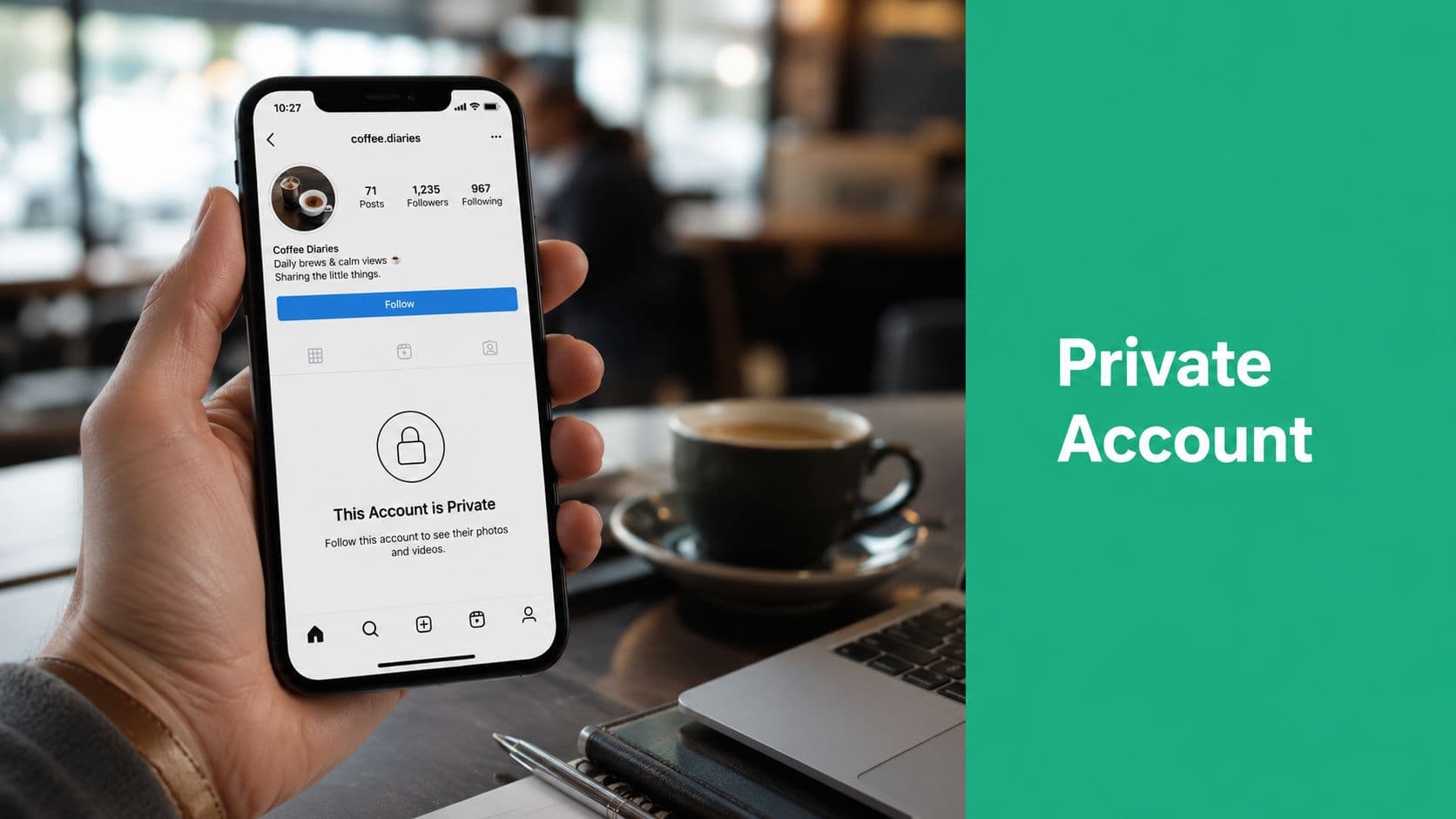
Rethinking the Private Instagram Account
The usual advice says growth requires maximum visibility. In practice, visibility without relevance often produces weak followers, low-intent viewers, and a feed full of people who never engage.
A private Instagram account changes that dynamic. It asks a simple question before someone sees your content: Are they interested enough to request access? That single step removes a lot of passive browsing. It also creates curiosity when the profile positioning is strong.
For creators, coaches, community-led brands, and niche curators, that can be useful. Privacy turns access into part of the offer. Followers don't just scroll in. They opt in. When handled well, that can make the audience smaller but sharper.
Practical rule: If your value depends on broad reach, stay public. If your value depends on trust, selectivity, or insider access, private deserves a serious look.
This isn't just a personal-versus-business choice. It's a positioning choice. A private account can signal exclusivity, stronger boundaries, or a more intentional community. That's different from hiding. It's closer to controlled distribution.
If you're still deciding what kind of profile strategy fits your goals, this breakdown of types of Instagram accounts is a useful starting point.
The mistake is assuming privacy works on its own. It doesn't. A private account with a vague bio, random content, and no off-platform discovery usually stalls. A private account with a clear promise and a reason to follow can attract exactly the people it wants.
How Instagram's Privacy Model Really Works
A private Instagram account works like a members-only club. The lobby is public. The main room isn't.
Instagram's own help guidance makes the core rule straightforward: only approved followers can view posts, Reels, and Stories, while your profile photo, name, username, and bio remain publicly visible through Instagram's privacy controls, which means privacy protects content rather than fully hiding identity (Instagram help on private account visibility).

What stays public
When people land on a private profile, they can still identify who the account belongs to. They can usually see enough to decide whether to request access.
That public layer includes:
Profile identity: Your profile photo, display name, username, and bio stay visible.
Positioning cues: Your category, tone, and call to action in the bio still shape first impressions.
Brand signals: Even with posts hidden, people can still infer your niche from your handle, photo, and profile copy.
This is why bio strategy matters more on a private account than on many public ones. The bio has to carry more of the conversion load.
What gets locked down
Once you switch to private, Instagram puts the content behind approval. New viewers can't freely inspect the feed and decide later. They have to request access first.
That approval-gated model changes several behaviors at once:
Content access: Posts, Stories, and Reels are limited to approved followers.
Audience inspection: Non-followers can't browse post content or inspect the account the same way they can with a public profile.
Discovery friction: Every interested viewer becomes a manual approval event rather than an instant follower.
A private profile doesn't erase your presence. It narrows access to your content.
There's an important nuance here. Private doesn't mean invulnerable. It means Instagram is expected to enforce access on the server side. If that enforcement fails, privacy can fail with it. That's one reason I don't advise people to treat private mode as full secrecy. Treat it as a meaningful access control, not a guarantee against every exposure scenario.
What marketers often misunderstand
A lot of people assume private means impossible to analyze or impossible to use strategically. That's not true. It means the strategy changes.
Third-party tools and social teams have adapted because they can't rely on unrestricted visibility into private content. The tactical consequence is simple: your account acts less like a billboard and more like a gated community. That changes how you write bios, review requests, and create reasons for people to join.
The Strategic Pros and Cons for Growth
A private Instagram account isn't universally smart or universally limiting. Its value depends on what you're trying to grow.
If you're chasing broad awareness, private works against you. If you're building a high-trust niche audience, private can help you qualify followers before they ever see the feed. That's a very different kind of growth.
Where private helps
The biggest advantage is audience quality. A person who requests access has already shown more intent than someone who casually taps Follow on a public account after seeing one Reel.
Private also changes the emotional feel of the account. It can make the content seem more selective, more personal, or more valuable. That's useful when your content relies on closeness, member identity, or behind-the-scenes access.
It can also help creators and brands that need boundaries. If you share sensitive personal content, client-adjacent material, limited-release drops, or community-specific updates, privacy gives you more control over who sees what.
Where private hurts
The downside is friction. Every growth action becomes harder because the feed can't sell itself instantly. A public profile lets people browse, binge, share, and decide. A private profile asks for commitment before proof.
That hurts discovery. It also slows down viral pathways. If your content model relies on being found through open profile visits and immediate content consumption, privacy gets in the way.
For businesses, especially, there are cases where a public or professional setup fits better. This guide to business vs personal Instagram helps frame that decision by use case.
Private vs. Public Account Trade-offs by User Type
Personal creator
Key advantage of going private: More control over who sees your content and a stronger community feel.
Key disadvantage of going private: Slower discovery and fewer opportunities for new viewers to find your content.
Aspiring influencer
Key advantage of going private: Can create a sense of exclusivity and attract followers who are genuinely interested.
Key disadvantage of going private: Potential followers cannot easily preview your content before deciding to follow.
Established niche expert
Key advantage of going private: Useful for member-style communities, premium positioning, or sensitive trust-based topics.
Key disadvantage of going private: Limits open distribution, sharing, and organic reach beyond existing followers.
Brand with broad awareness goals
Key advantage of going private: Can be used selectively for gated campaigns, VIP communities, or exclusive access initiatives.
Key disadvantage of going private: Generally a poor fit for top-of-funnel growth, awareness, and everyday discoverability.
Community-led business
Key advantage of going private: Helps maintain relevance by screening who joins the audience.
Key disadvantage of going private: Requires manual approval processes, adding operational effort and management time.
If people need to see your content before they trust you, public usually wins. If they trust you because access feels selective, private can work better.
The key is honesty about the job Instagram is doing for you. If the account exists to broadcast, keep it open. If it exists to gather and serve a qualified group, privacy can sharpen the audience instead of shrinking the opportunity.
Impact on Follower Growth and Engagement Metrics
The biggest shift isn't just reach. It's a measurement.
Instagram's own documentation shows that Insights are available after switching to a creator or business account, but those insights are limited to content posted since conversion and to the past 90 days of data for the selected timeframe through the app's analytics experience (Instagram Insights limitations). For a private account, that makes analytics less about broad public visibility and more about how a closed audience behaves once it's inside.

What changes first
Top-of-funnel growth usually gets tighter. Fewer people can sample your feed freely, so you should expect less passive conversion from profile visitors.
That sounds negative, but it also changes the quality mix. People who request access are often more deliberate. They came from a recommendation, another channel, a shared context, or a strong bio promise. That tends to produce a more qualified audience than random traffic.
What to watch instead
On a private account, vanity metrics become less useful on their own. Follower count still matters, but it stops telling the full story. I pay closer attention to the signs of depth inside the audience you already approved.
Useful signals include:
Comment quality: Are followers responding with specifics, not just emojis?
Story interaction: Do people reply, react, and continue the conversation in DMs?
Follower retention: Do approved followers stay because the content keeps its promise?
Content resonance: Which posts generate discussion, saves, or message-driven follow-up?
You can still use Instagram's native dashboard to evaluate performance. You just have to accept that the data reflects a closed system, not the open web. If you need a refresher on what Instagram shows inside the app, this guide on Instagram Insights explained is useful.
A private account changes the question from "How many people saw this?" to "Did the right people care enough to respond?"
The right benchmark mindset
Don't compare a private account to a public one as if they're trying to do the same job. They aren't.
A public account is built to maximize exposure. A private Instagram account is often better judged like a qualified pipeline. The audience may grow more slowly, but each accepted follower can hold more strategic value if they're better aligned with your niche, your offers, or your community standards.
That doesn't make private superior. It makes it different. The mistake is using public-account expectations to judge a private-account strategy.
A Practical Guide to Managing Your Private Account
Privacy only helps if the account is managed with intent. Otherwise, it becomes a locked door with no reason to knock.

Set the account up like access is part of the brand
Before you switch to private, fix the public-facing profile elements. Your bio, profile image, name field, and pinned context need to explain why following matters.
Use the bio to make one promise clear. What does someone get once they're approved? Insider commentary, niche education, product drops, community discussion, private portfolio work, and personal updates for a selected audience. If the answer is vague, requests will be weak.
Then switch the privacy setting inside Instagram and check the profile from a non-follower perspective. If the public layer doesn't create interest, the closed layer won't matter.
Review follow requests with criteria
Many users either approve everyone or become arbitrary. Both approaches create problems.
Use a simple screening lens:
Relevant profile signals: Does the person look connected to your niche, location, industry, or community?
Real-person indicators: Do they have a filled-out profile, profile photo, and some sign of genuine use?
Fit with your goal: Are you building a local client audience, a creator peer circle, or a members-only fan group?
If you're doing outreach beyond Instagram, clean targeting matters even more. Teams that build partnerships, creator lists, or campaign prospecting often benefit from structured workflows for building Instagram outreach lists, especially when they want to drive qualified people toward a gated account rather than chase broad visibility.
Reward people for getting in
A private account shouldn't feel like a public account with the blinds closed. Give followers a reason to value access.
That can include:
More specific posts that assume insider context.
Story conversations where replies matter more than impressions.
Early access content for launches, openings, or limited offers.
Community cues, such as polls, questions, and feedback loops, make followers feel recognized.
Approved followers should feel they've entered a better room, not just a smaller one.
Know when to switch temporarily
Some brands and creators don't need to stay private all year. They use privacy in phases.
You might go public during a campaign that depends on discovery, then return to private when the goal shifts back to community depth. You might also keep the main profile public and create a separate private account for premium updates, client education, or close-community content.
If you want operational help with audience targeting while keeping growth organic, tools such as Gainsty can support niche-based Instagram targeting and account management workflows. That's most useful when you already know who should be requesting access and why.
Driving Organic Growth with an Exclusive Account
The strongest private accounts don't rely on Instagram alone for discovery. They use public channels to drive high-intent requests.
That means your growth engine often sits outside the feed. Short-form video on other platforms, an email list, a podcast, a newsletter, a website, creator collaborations, or even a public secondary profile can all pre-sell the value of joining your private Instagram account.

A few tactics work consistently:
Use your bio as a gate invitation: Tell people what kind of insider value they'll get after approval.
Promote the account publicly elsewhere: Let TikTok, LinkedIn, YouTube, or your site do the top-of-funnel work.
Create a clear reason to request access: Private research notes, community commentary, limited product updates, or behind-the-scenes content all work better than generic "follow me" language.
Keep the audience aligned: Decline requests that don't fit if the point is quality, not volume.
The broader market has already adapted to this reality. As noted by tools such as Inflact, analytics around Instagram now focus more on aggregate metrics like engagement rate and follower growth tracking rather than direct visibility into private content because closed and authorized communities are a normal part of the platform environment (Inflact Profile Analyzer).
That shift matters. It means the right question isn't whether private limits growth. It does. The better question is whether it improves the type of growth you want.
If your goal is to attract the right followers instead of the most followers, Gainsty can fit that approach. It offers Instagram audience targeting and growth support built around organic follower acquisition, which is useful when you're trying to drive qualified follow requests to a private account rather than chase empty reach.
.png&w=1920&q=75&dpl=dpl_2si4hWs7xtpQVmrY6d8xhJ1wLJZL)



.png&w=750&q=75&dpl=dpl_2si4hWs7xtpQVmrY6d8xhJ1wLJZL)