Building Your Foundation Beyond Vanity Metrics
Let's get one thing straight: the 'post and pray' method doesn't work. It’s a fast track to burnout and wasted resources. If your entire social media strategy is built around chasing a higher follower count, you're missing the point and, frankly, leaving money on the table.
True success isn’t measured in vanity metrics like likes; it's measured in leads, sales, and a loyal customer base. Instead of getting distracted by those superficial numbers, it’s far more valuable to track social media engagement like a pro to find the data that actually matters.
This simple chart shows you exactly how to connect a business goal to a social media action and, ultimately, a business result.

Think of it this way: every post, story, or ad should be a deliberate step toward a concrete outcome, whether that's a new lead in your pipeline or a completed sale.
Define What Success Actually Looks Like
Vague goals like "get more followers" won't get you very far. The most effective plans I've seen all use SMART goals—that’s Specific, Measurable, Achievable, Relevant, and Time-bound. This framework is so powerful because it forces you to tie every social media activity back to a tangible business result.
Let’s look at a couple of real-world examples:
A local cafe: Their goal isn't just "more followers." A much better goal is "increase weekday foot traffic by 15% in Q3." To achieve this, their social media action is to run geo-targeted Instagram Story ads promoting a new lunch special. The result? More customers walking through the door, which they can track through coupon redemptions or by simply asking people how they heard about the special.
An e-commerce shop: Instead of a generic aim for "higher engagement," their goal is "generate 50 direct sales from social media per month." Their action plan involves creating compelling video ads that click through directly to a product page. The result is a clear, measurable bump in online revenue that they can attribute straight back to their social campaigns.
The most powerful shift you can make is from asking "How many likes did this get?" to "How many qualified leads did this generate?" This change in perspective is the cornerstone of a plan that delivers ROI.
Every single goal you set should answer one simple question: how does this help my business grow? By focusing on outcomes, you’ll start building a brand on social media that doesn't just look good but actually performs. The point isn't just to be online; it's to be there with a clear purpose.
Finding and Understanding Your Ideal Customer

If you’re trying to talk to everyone on social media, you’ll end up talking to no one. It’s a classic mistake. The most effective small business social media plan isn't about casting the widest net; it's about getting hyper-specific about the people who will actually become your customers.
This means digging much deeper than basic demographics like age and location. You need to understand what they care about, what frustrates them, and what truly makes them tick. The best part? You don’t need a huge market research budget. Your most valuable insights are often hiding in plain sight, starting with your existing customer list.
Digging for Audience Gold
To really get the full picture, you'll want to piece together clues from a few different sources. This isn't just about collecting data; it's about listening intently to validate your gut feelings and uncover those "aha!" moments you might otherwise miss.
Here’s how you can start today:
Social Listening: Go beyond just checking your mentions. Actively monitor conversations about your industry, your competitors, and the problems your product solves. Simple tools like Google Alerts or even just searching keywords on Instagram and TikTok can show you the exact language people use and what they're struggling with.
Analyze Your Competitors' Followers: Take a peek at who’s engaging with your competitors. What posts get the most comments? What questions are people asking? This isn’t about copying them. It’s about spotting gaps in their approach and finding opportunities for your brand to shine.
Dive into Platform Analytics: Your built-in analytics are a goldmine. Tools like Instagram Insights or Facebook Audience Insights provide a ready-made snapshot of who already follows you. This gives you a fantastic baseline to build from.
Your goal is to move from a vague idea of "customers" to a crystal-clear profile of a single person. This process is what turns audience research into actionable content ideas.
Crafting Your Buyer Persona
Once you've done your homework, it's time to bring all that research to life by creating a buyer persona. This is essentially a character sketch of your perfect customer. Give them a name, a job, and a story. What are their goals? What keeps them up at night?
Let's imagine a boutique fitness studio. They might develop a persona named "Busy Professional Brenda."
Who is she? A 34-year-old marketing manager who's strapped for time but wants to prioritize her health.
What are her pain points? She struggles to stay consistent with a fitness routine and feels intimidated by big, impersonal gyms.
What does she want? She's searching for efficient workouts she can squeeze into her day and a supportive community that makes fitness feel less like a chore.
With "Brenda" in mind, the studio's content strategy becomes clear. They can now create posts about quick 30-minute workouts or share testimonials from other busy professionals who found their community. This persona becomes the North Star for your entire small business social media plan, making sure every post lands with impact.
This deep understanding also shows you what types of content will hit home. For instance, featuring photos and videos from your actual customers is a proven winner. In fact, when small businesses showcase user-generated content, they can see 10.3 times higher conversion rates and a whopping 28% more engagement compared to standard brand content. You can explore more about this and other powerful strategies in these 2026 social media trends from Zoek.
Developing Your Core Content Pillars
That nagging, daily question—"What on earth should I post today?"—is something every business owner feels. A real small business social media plan gets rid of that panic by giving you a clear framework, not just a scramble for last-minute ideas. The foundation of this entire approach? Your content pillars.
Think of content pillars as the 3-5 core themes you’ll talk about, time and time again. These aren’t just random topics; they’re the sweet spot where your expertise, your business goals, and your audience’s genuine interests all meet. They give your feed a consistent feel and, more importantly, establish you as the authority in your space.
Brainstorming Your Pillar Ideas
The real magic begins when you stop thinking about what to post and start thinking about what your audience needs. Start by jotting down all the themes that connect directly to what you do. The best place to find these? The questions your customers are already asking you. Those are pure gold.
I once worked with a financial advisor for freelancers who was struggling with content. We realized their clients constantly asked about navigating taxes, saving for retirement, and smoothing out inconsistent income. Boom. Right there, we had three powerful, audience-first pillars to build their entire strategy around.
The most effective content pillars are never about what you want to sell. They’re about what your audience needs to learn. Deliver that value consistently, and the promotion will feel like a natural next step, not an interruption.
Once you’ve locked in your core themes, you can start breaking them down into an endless supply of actual post ideas. You can get creative with different formats—videos, carousels, quick tips—to keep things fresh. For a deeper look at this process, check out our complete guide on developing social media content pillars for your brand.
The 80/20 Rule for Your Content Mix
One of the quickest ways to lose followers is to turn your social media feed into a 24/7 sales pitch. Nobody logs onto Instagram hoping to see an endless stream of ads. That’s why the 80/20 rule is absolutely essential to your plan.
80% of your content should provide value. This means posts that educate, entertain, or inspire your audience. This is how you build trust and create a genuine community.
20% of your content can be promotional. This is where you talk about your services, announce a new product, or share a special offer.
When you spend the vast majority of your time giving, giving, giving, your audience will be far more receptive when it's time to ask. This balance is the key to turning followers into actual customers.
From Pillars to Posts: A Practical Example
Let’s put this all together and see what it looks like in the real world. A pillar system gives you clarity and makes sure every single post is working toward a larger goal.
The list below shows how a few different small businesses might turn their services into distinct content pillars and then brainstorm specific post ideas.
Example Content Pillars For Small Businesses
Local Bakery – For education, the bakery can post a Reel showing how to properly knead dough at home. For inspiration, it can share a behind-the-scenes story of developing a new seasonal pastry. For promotion, it can create a carousel post announcing a “buy one, get one free” croissant special.
Real Estate Agent – For education, the agent can post a carousel on the “Top 5 Mistakes First-Time Homebuyers Make.” For inspiration, they can share a video tour of a beautiful and aspirational home listing. For promotion, they can post a “Just Sold” success story featuring a client testimonial.
Fitness Coach – For education, the coach can share an infographic explaining the benefits of compound exercises. For inspiration, they can post a client transformation story with before-and-after photos. For promotion, they can use a Story slide with a link to book a free consultation call.
See how this works? You're no longer just throwing content at the wall and hoping something sticks. Instead, you're building a thoughtful library of content that serves your audience, defines your brand, and moves your business forward one post at a time.
Building a Content Calendar You Can Actually Stick With

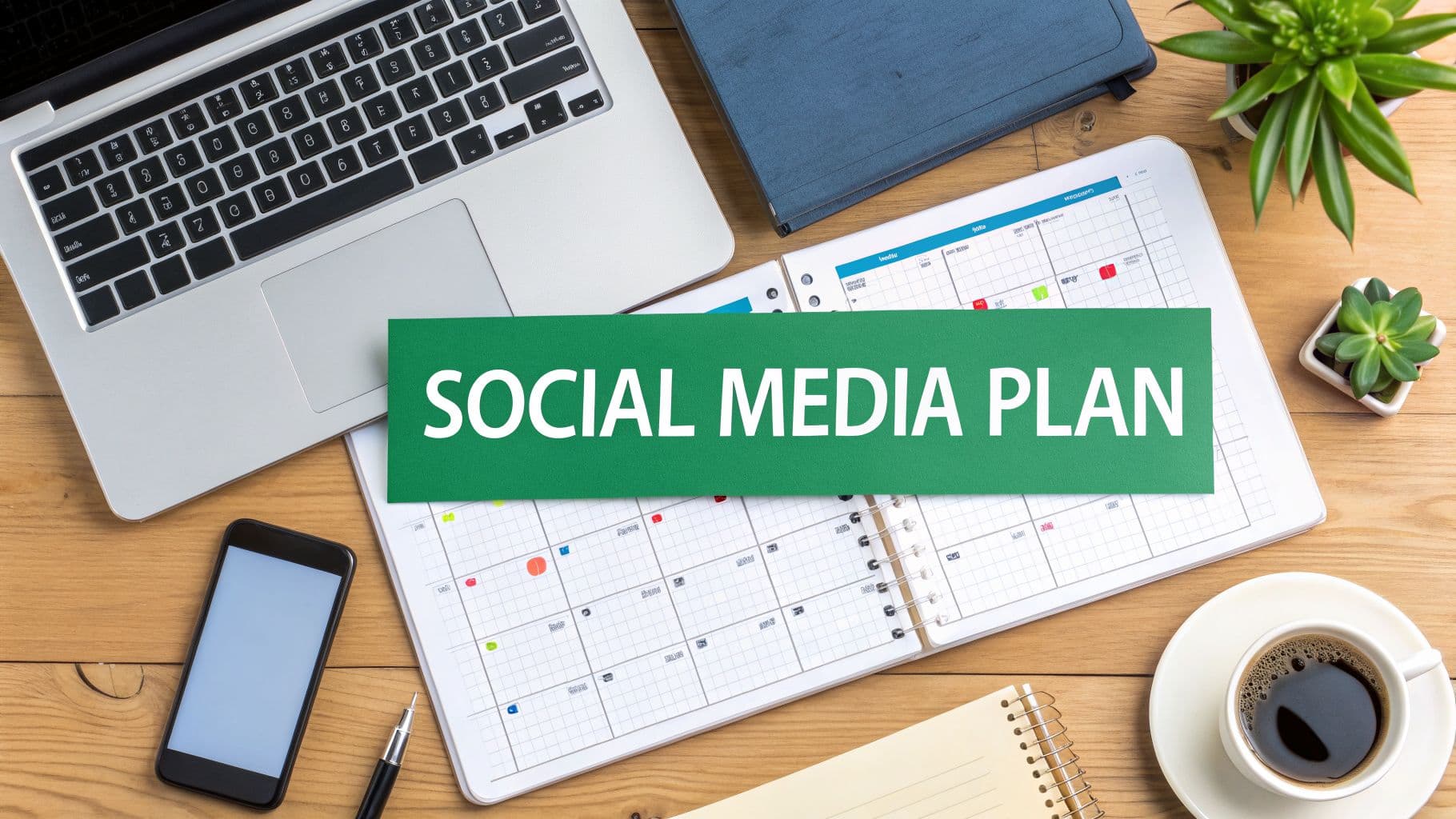
If you've ever felt like you're on a social media hamster wheel, you're not alone. That constant pressure to post fresh content every single day is a direct path to burnout. This is where a sustainable content calendar becomes the most valuable tool in your small business social media plan.
It’s about moving social media from a reactive, daily panic to a proactive, manageable part of your marketing. The goal here isn't to just fill a calendar with posts for the sake of it. It’s to build a system that works for you and your schedule, one you can realistically maintain without wanting to throw your phone out the window.
Finding Your Posting Rhythm
So, how often should you really be posting? There's no single magic number. The "right" frequency depends entirely on the platform and, more importantly, what you can sustain without sacrificing quality. Trust me, one thoughtful, high-quality post is infinitely better than three rushed ones.
Here are some starting points I've seen work well, but always listen to your audience and check your analytics to fine-tune your approach:
Instagram: Try for 1 in-feed post per day and 2-3 Stories. Stories are your best friend for sharing casual, behind-the-scenes moments that don’t need a ton of production value.
Facebook: A solid benchmark is 1-2 posts a day. The algorithm here loves genuine connection, so prioritize posts that get people talking.
TikTok: This platform definitely rewards more frequent posting, with many successful accounts posting 1-4 videos daily. The key here isn't perfection; it’s authenticity and hopping on trends.
LinkedIn: If you're in the B2B space, posting once per weekday is a great way to stay top-of-mind with a professional network.
Think of these as guidelines, not rigid rules. The most important thing is to use your platform's analytics to see when your followers are actually online and active, then adjust your schedule to match.
A content calendar isn't a prison; it's a framework. It gives you the structure to stay consistent while leaving you the creative freedom to jump on a trend or share something spontaneous when the moment strikes.
The Game-Changing Magic of Batch Creation
The real secret to staying consistent without going crazy is batch creation. Instead of scrambling every day to come up with a post, you set aside a dedicated chunk of time to create a whole week's—or even a month's—worth of content at once.
For me, this means dedicating a single block of time to getting into a creative headspace.
First, I’ll spend about an hour on ideation, looking at my content pillars and just brainstorming a long list of ideas. Then, I move into creation mode for a few hours—filming all my video clips, designing graphics in Canva, and pulling any user-generated content I want to share. Finally, I'll block out another hour or two for writing, where I draft all the captions, find relevant hashtags, and write my calls-to-action.
When you group these tasks together, you find a creative flow and stop the constant, draining task-switching between designer, writer, and strategist.
Then comes the final step: putting your plan on autopilot. Over 83% of small businesses are on social media, but the ones with a documented plan are the ones who truly see results. Using a scheduling tool like Buffer or CoSchedule is a non-negotiable part of a sustainable strategy. You can load in all that content you batched and schedule it to go live at the perfect times, freeing you up to actually run your business. This simple system is what makes a small business social media plan not just effective, but truly manageable.
Measuring ROI on a Small Business Budget

As a small business owner, you know every single dollar counts. That's why your small business social media plan needs to be more than just posting pretty pictures—it has to deliver a real return on your investment.
It's easy to get caught up in vanity metrics like likes and shares. While those are nice, they don't pay the bills. The numbers that truly move the needle are metrics like conversion rates, cost per lead, and customer acquisition cost. These are the data points that tell the real story of whether your social media efforts are actually making you money.
Getting Started with Paid Ads (Without Breaking the Bank)
You don't have to throw hundreds of dollars at ads to see what works. In fact, starting small is the smartest way to dip your toes into paid social media. It lets you test different ad styles, copy, and audiences without risking your whole marketing budget.
And the potential return is huge. In 2026, brands are seeing an average of $5.20 in revenue for every dollar spent on social campaigns. You can tap into this by starting with just $5 to $10 per day on a single, focused campaign. Pro tip: Video ads tend to work better, often generating 34% higher conversion rates than static images, as highlighted in recent social media marketing statistics from New Media.
This methodical approach lets you figure out what resonates with your audience before you commit more money. Once you find an ad that works, you can confidently reinvest your profits to scale up, creating a predictable growth engine for your business.
Forget trying to be everywhere at once. Focus your initial budget on the one platform where your ideal customer spends the most time. Master it, prove your ROI, and only then should you think about expanding.
Tracking What Truly Matters
How do you know which post led to a sale and which was just a shot in the dark? The answer is tracking. It’s the only way to draw a direct line from a specific social media post to a customer clicking "buy" on your website.
Here are two essential tools for tracking your ROI:
Platform Analytics: Every social network has a free analytics dashboard. These are great for seeing surface-level metrics like reach, but they also give you crucial insights into link clicks and profile visits—strong indicators of buying intent.
UTM Parameters: If you're serious about ROI, UTMs are non-negotiable. They are just tiny bits of text added to the end of your links that tell tools like Google Analytics exactly where your website traffic came from. You can see which platform, which campaign, and even which specific ad drove the visit.
Using these tracking methods stops the guesswork. It gives you the clarity you need to build a successful small business social media plan based on hard data. For a deeper dive into this topic, you can learn more about the essentials of social media ROI measurement in our dedicated guide.
Answering Your Social Media Plan Questions
Even with a solid small business social media plan in hand, questions are bound to pop up once you start putting it into practice. That’s completely normal. Let's tackle some of the most common hurdles I see small businesses face so you can keep your momentum going.
First up, the big one: money. How much should you really be spending? I’ve seen budgets range from a few hundred dollars a month to several thousand, so there’s no magic number.
My advice is always the same: start by nailing your organic strategy. Focus on creating genuinely valuable content that doesn't cost a dime to produce. Once you see what resonates with your audience, you can start putting a small budget behind your best-performing posts. Even a modest daily ad spend can make a huge difference in who you reach.
How Often Should I Post to See Results?
This is another question that trips a lot of people up. The answer is simpler than you think: focus on consistency over quantity. Your goal isn't just to show up; it's to make an impact. Posting rushed, low-quality content just to hit an arbitrary daily number can do more harm than good.
Remember, a great post grabs attention in a split second. Quality is everything.
While every audience is different, here are some reliable starting points you can test and tweak:
Instagram & Facebook: Aim for 1-2 high-quality posts per day. Use your Stories for the more frequent, behind-the-scenes updates.
TikTok: This platform loves fresh content. Try posting 1-4 videos daily. Authenticity trumps high production value here.
LinkedIn: For B2B businesses, posting one solid piece of content each weekday is a great way to stay top-of-mind.
Dive into your platform's analytics. They will tell you exactly when your audience is most active. Use that data to fine-tune your posting schedule for maximum impact.
What Is the Best Way to Track Social Media Leads?
If you can't measure it, you can't improve it. Guesswork has no place in a serious social media strategy. You need to be able to draw a direct line from your social media efforts to actual sales to understand your return on investment.
The most critical, non-negotiable tool for tracking leads from social media is the UTM parameter. It’s the only way to know with certainty which platforms, campaigns, and posts are driving traffic and sales on your website.
Think of UTMs as little breadcrumbs you add to your links. When someone clicks, these "breadcrumbs" feed data directly into your Google Analytics, showing you precisely which post, platform, or campaign sent them. It’s the difference between guessing what works and knowing. When you pair UTMs with platform-specific tools like the Facebook Pixel, you get a crystal-clear view of your customers’ entire journey.
To get a better handle on all the moving parts, checking out the best social media marketing tools for small businesses can give you the support you need to manage your plan efficiently.
Ready to stop guessing and start growing? Gainsty combines expert strategy with powerful AI to get you real, organic Instagram followers. Let us build an authentic audience that loves your brand. Start your organic growth journey with Gainsty today.

.png&w=1920&q=75&dpl=dpl_D59Qa4oJ5cFQ7dZDLQ1JPQVnqHSs)






.png&w=750&q=75&dpl=dpl_D59Qa4oJ5cFQ7dZDLQ1JPQVnqHSs)