Why Social Media Is a Must-Have for Your Nonprofit
Let's be clear: having a social media presence isn't just another box to check on your to-do list. For nonprofits, especially those running on tight budgets and lean teams, it's one of the most effective tools you have. It’s your digital community center, your 24/7 volunteer fair, and your most accessible fundraising gala all rolled into one.
These platforms cut through the noise, giving you a direct line to the people who care about your work. You can talk to supporters, share updates with beneficiaries, and connect with potential partners in a way that feels genuine and immediate.
The Real-World Benefits for Your Mission
A solid social media plan does so much more than send out announcements. It creates a living, breathing space where your mission can flourish. It’s the place you share the stories that hit home, the ones that connect with people on an emotional level and inspire them to do more than just hit "like."
Here’s what you stand to gain:
Build a Dedicated Community: Social media is where people gather. It lets you bring together a loyal group of followers who truly believe in your cause and are ready to help.
Fuel Your Fundraising: With built-in donation buttons and the incredible power of peer-to-peer sharing, social media becomes a direct pipeline for contributions. In fact, 32% of donors say social media is the very thing that inspires them most to give.
Massively Expand Your Reach: Your message is no longer stuck in your local area. A single, powerful story can be shared around the world, bringing in awareness and support you never thought possible.
Think of your social media channels as a constant, open-door event for your cause. Every post is an opportunity to engage, educate, and invite someone to join your mission.
This guide is your roadmap. We’re going to walk through practical, actionable strategies to make your mission impossible to ignore and show you how to get real results that prove your hard work is paying off.
2. Building Your Nonprofit Social Media Strategy From the Ground Up
A powerful social media identity is never an accident. It's built on purpose, with a clear plan guiding every post, share, and comment. Think of your strategy as the blueprint for a house—without one, you’re just nailing boards together hoping for the best. With a solid plan, every piece fits together to build something strong and lasting.
This foundational blueprint is what turns random posting into a focused effort that actually moves the needle for your mission. It’s how you make the most of your limited time and resources. Let's start building that blueprint, piece by piece.
Set Clear SMART Goals Aligned With Your Mission
Before you even think about what to post, you have to know why you're posting. A vague goal like "raise awareness" is impossible to track and feels like shouting into the wind. We need to get specific.
That's where the SMART framework comes in. It forces you to create goals that are specific, measurable, achievable, relevant, and time-bound. It’s the difference between saying, "We want more volunteers," and saying, "We will recruit 20% more volunteers through our website by the end of this quarter." Now that's a target you can work toward.
Specific: Who are you trying to reach and what do you want them to do? Instead of "get donations," try "Increase online donations from first-time donors in our local area."
Measurable: How will you know you succeeded? "Raise $5,000 through our holiday Instagram campaign."
Achievable: Is this goal realistic for your team and budget? A small nonprofit aiming for 100 new newsletter subscribers makes more sense than aiming for 10,000.
Relevant: Does this goal directly help your nonprofit’s core mission?
Time-Bound: When does the clock run out? "By the end of Q2."
Define and Understand Your Audience
You can’t talk to everyone at once, so you need to figure out who you really need to reach. Your audience isn’t one big, generic blob; it’s a collection of unique people with different reasons for caring about your cause. Creating simple "personas" for them can be a game-changer.
Think about who you're trying to connect with:
The Passionate Donor: What stories will truly move them? They want to see the human impact of their gift, so testimonials and clear reports on where their money goes will resonate deeply.
The Hands-On Volunteer: What do they need to know to get involved? They're looking for practical details—when, where, what to expect—and behind-the-scenes content that makes them feel like part of the team.
The Corporate Partner: What are their community outreach goals? They’re looking for professionalism, measurable results, and a clear vision for partnership.
When you understand these different mindsets, you can stop broadcasting generic messages and start having meaningful conversations.
Establish an Authentic Brand Voice
Your brand voice is your nonprofit's personality. It's the consistent feeling people get from your content, whether it's a heartfelt story, an urgent call to action, or a simple thank you. Is your voice compassionate and hopeful? Or is it bold, direct, and focused on creating change?
Your brand voice isn't just about what you say, but how you say it. It’s the consistent tone that builds trust and makes your nonprofit instantly recognizable and relatable to your followers.
A consistent voice helps your community know what to expect and feel a genuine connection. To make sure your strategy is on the right track from the start, it helps to ground it in proven nonprofit social media best practices.
This initial work—setting goals, knowing your audience, and finding your voice—is essential. For a more detailed breakdown of this process, check out our full guide on how to create a social media strategy.
It's no surprise that 93% of nonprofits are on Facebook. But with organic reach plummeting to an average of just 2.2%, simply posting and hoping for the best is a losing game. That's why 53% of nonprofits now set aside a budget for social media ads. And of that spending, a massive 98% goes to Facebook, where the average cost per lead is a manageable $3.20.
Choosing the Right Platforms to Amplify Your Mission
Trying to be everywhere at once on social media is a fast track to burnout, especially for a nonprofit team that's already stretched thin. It's like fishing—you don't just cast a net into an empty lake and hope for the best. You go where you know the fish are biting. The real secret to effective social media is picking your channels with purpose.
Instead of spreading your limited time and energy across a dozen platforms, the goal is to pinpoint exactly where your people—your donors, volunteers, and community partners—are already spending their time. When you match your mission’s goals to the unique strengths of each platform, you put your effort where it will actually make a difference.
Match the Platform to Your People and Purpose
Every social network has its own vibe, its own audience, and its own set of tools. Choosing the right one isn’t about chasing the latest trend; it’s about understanding where you can build genuine connections.
Facebook: Still the undisputed giant for community building. With an audience of 3.3 billion monthly users, it's a powerhouse for reaching a huge range of demographics, sharing detailed stories, and running targeted fundraising campaigns.
Instagram: This is your home for visual storytelling. It’s perfect for nonprofits whose work can be captured in powerful images and short videos, creating an instant emotional hook, especially with younger audiences.
LinkedIn: Your professional hub. This is where you connect with corporate sponsors, recruit skilled volunteers or board members, and share content that builds your organization's credibility as a leader in its field.
TikTok: The champion of authenticity and short-form video. It gives you a chance to show your organization's human side, reach a massive and engaged younger audience, and tell your story in a fun, creative way.
The infographic below drives home just how vital Facebook remains in the nonprofit sector. It highlights its near-universal adoption and its efficiency for generating leads.
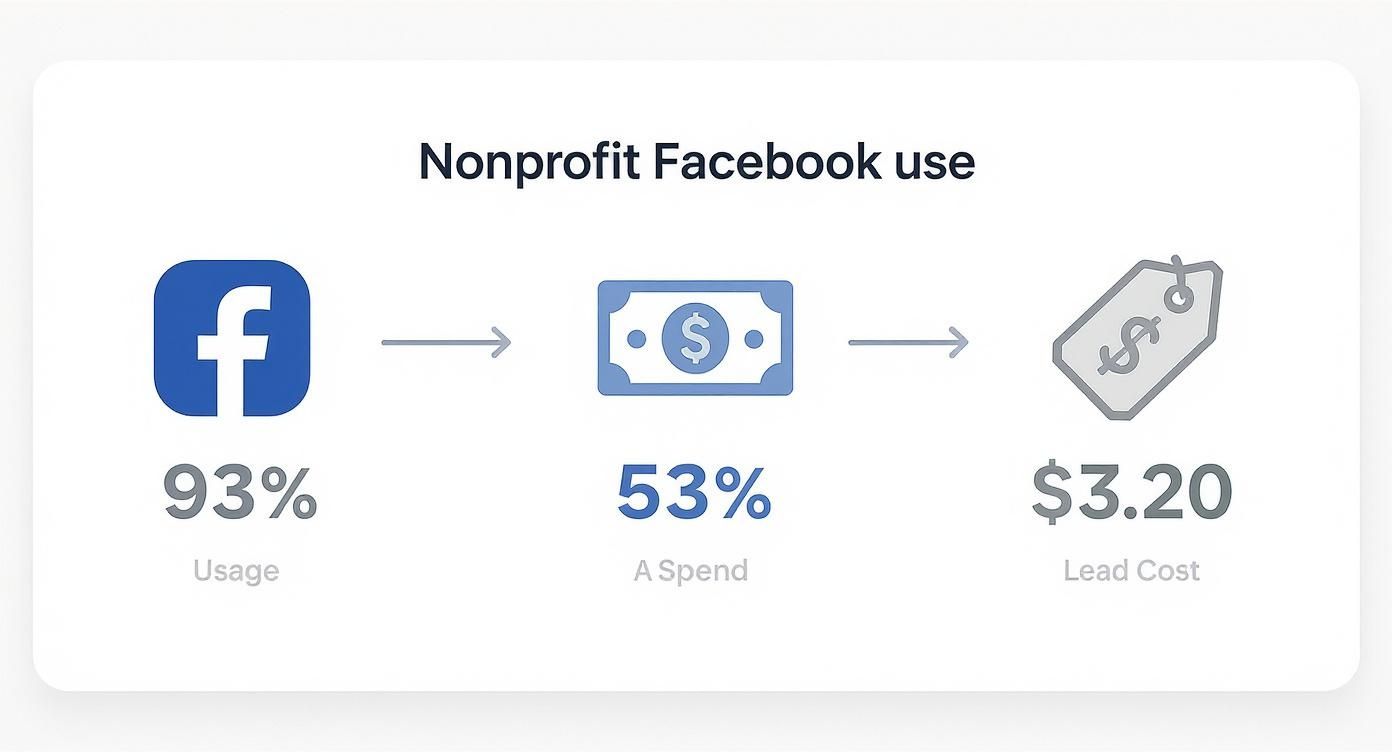
This data isn't just a number; it confirms that despite the buzz around newer platforms, Facebook's powerful tools and massive reach make it a non-negotiable part of most nonprofit social media strategies.
To help you decide where to focus, this table breaks down the core strengths of each major platform.
Platform Strengths for Nonprofit Goals
• Facebook primarily reaches Gen X, Millennials, and Baby Boomers, and is best used for community building, fundraising, detailed updates, and event promotion through long-form posts, live videos, photo albums, fundraisers, and Groups.
• Instagram targets Gen Z and Millennials and works best for visual storytelling, brand awareness, and building emotional connections using high-quality photos, Reels, Stories, and carousel posts.
• LinkedIn is ideal for professionals and corporate partners, supporting corporate fundraising, volunteer recruitment, and thought leadership through articles, impact reports, professional videos, and company updates.
• TikTok is most effective for Gen Z and younger Millennials and is best for reaching new audiences and showing authenticity through short-form videos, trends, and behind-the-scenes content.
This isn't about picking just one platform and ignoring the rest. It's about deciding where you'll plant your flag and invest the majority of your energy, while perhaps using one or two others for more specific, secondary goals.
Diving Deeper Into Platform Strengths
Let's get into the nitty-gritty of how you can put these platforms to work for your specific goals.
Facebook for Community and Fundraising
Think of Facebook as your digital town hall. It’s the place to create dedicated Groups for your most passionate supporters, host live Q&A sessions with your team, and share in-depth updates on your programs. Plus, its built-in fundraising tools are incredibly powerful, making it simple for people to donate right from a post or launch their own peer-to-peer campaigns for your cause.
If your main goals are to build a tight-knit community and drive donations directly through social media, Facebook needs to be your top priority. Its toolset is built for exactly that.
Instagram for Visual Impact
Instagram communicates through images and quick videos. If a picture is worth a thousand words, an Instagram Reel showing your work in action is worth ten thousand. Use it to share stunning photos from the field, candid behind-the-scenes moments with your team, and heartfelt video testimonials from the people you serve. The platform’s visual-first nature is unbeatable for grabbing attention and forging an emotional link to your mission.
LinkedIn for Professional Connections
Treat LinkedIn like your most important networking event. It's the perfect place to share impact reports, give a shout-out to your corporate partners, and post volunteer roles that require specific professional skills. In fact, more than 42% of US donors say they use LinkedIn to research nonprofits, making it a crucial platform for building trust and attracting high-value supporters.
TikTok for Authentic Storytelling
TikTok is all about showing, not just telling. The platform rewards raw authenticity and creativity. You can use it to create quick, engaging videos that show a "day in the life" at your organization, break down a complex issue in a simple and relatable way, or just share a moment of pure joy from your work. It’s a fantastic way to connect with a new generation of supporters by being real and human.
Creating Compelling Content That Inspires People to Act

If your social media strategy is the engine, then great content is the fuel that makes it run. Having a solid plan and picking the right platforms gets you on the road, but it’s the content itself that actually moves you forward. It’s what stops someone mid-scroll and turns a passive glance into a real connection with your cause.
This is where you move past simple announcements and start building actual relationships. It's the art of telling stories that stick, sharing impact that resonates, and creating posts that inspire people to do more than just double-tap—they inspire them to donate, volunteer, or become a champion for your mission.
The Core Pillars of Nonprofit Content
Think of your content as having different "recipes" designed for specific goals. A truly effective social media feed doesn't just ask for donations over and over again. It nurtures your community with a healthy mix of posts that educate, inspire, and entertain before you ever make a direct ask.
Here are the essential pillars to build your content around:
Educate: Share eye-opening facts, simple infographics, or quick videos that explain the problem you’re solving. This builds your credibility and positions you as a trusted voice in your field.
Inspire: This is where the magic happens. Post a heartfelt quote from someone you’ve helped, shine a spotlight on a dedicated volunteer, or share a powerful success story. This is the stuff that forges a deep, emotional connection.
Show Impact: Make donations feel tangible. A post saying, "Your $25 donation provides 10 warm meals," hits so much harder than a generic "thank you for your support." Always connect the dots between giving and the real-world outcome.
Go Behind the Scenes: Give your audience a peek at the day-to-day work. Show your team in action, setting up for an event, or sorting through donations. It makes your organization feel human, transparent, and accessible.
Your social media feed should feel like a conversation, not a constant sales pitch. By providing genuine value through varied and engaging content, you earn the right to ask for support when the time is right.
Planning Your Content for Maximum Impact
A content calendar is an absolute game-changer for social media marketing for nonprofits. It turns what can feel like a chaotic daily scramble into a manageable, strategic process. I always recommend starting by mapping out the big dates—awareness months, key holidays, and your own campaign launches.
Once you have that framework, you can slot in your content pillars. Maybe Mondays are for educational facts, Wednesdays are for volunteer spotlights, and Fridays are reserved for a big impact story. This kind of structure guarantees a balanced feed that keeps your audience engaged without burning them out. Plus, it lets you create high-quality content in batches, which is a lifesaver for busy teams.
For more hands-on advice about crafting these posts, our guide on visual storytelling techniques is packed with practical tips.
The Rise of Authentic and User-Generated Content
The social media landscape is always shifting, and right now, authenticity is king. We're seeing a huge move away from overly polished, corporate-style posts. Research shows that user-generated content (UGC) and collaborations with creators often blow traditional branded posts out of the water, especially with younger audiences.
What does this mean for you? It means encouraging your supporters to share their own stories, photos, and experiences with your mission can be one of the most powerful things you do.
The most successful nonprofits are also diversifying their channels, using a smart mix of Instagram Reels, YouTube Shorts, and even LinkedIn to stabilize their reach and connect with different segments of their audience. Keeping an eye on these marketing and fundraising trends is essential. The future is all about agility and focusing on genuine, community-driven content that feels real.
Turning Social Media Engagement Into Successful Fundraising
Likes, shares, and comments are fantastic. They show you've built a real community. But let's be honest—they don't pay the bills or move your mission forward. The real trick is to gently guide all that incredible energy and goodwill into tangible support. It's about creating a smooth, obvious path from a follower's newsfeed right to your donation page.
Think of engagement as the warm-up. You've already done the hard work of earning your audience's trust with powerful stories and honest updates. Now, it's time to make the ask. The key is to make it feel like the next logical step in their journey with you, not a sudden sales pitch.
Using Platform-Specific Fundraising Tools
The major social media platforms know how important they are to nonprofits, and they've built some fantastic tools to make donating incredibly simple. Your job is to make the process completely frictionless. Every single click you can remove from the donation process will boost your success rate.
Platforms like Facebook and Instagram have native donation buttons you can add directly to your posts, your Stories, and even your main profile. When someone is moved by what you've shared, they can act on that feeling instantly, without ever having to leave the app.
Facebook Fundraisers: These are perfect for letting your supporters run their own campaigns, like for a birthday or a special awareness day. It taps into their networks for you.
Instagram Donation Stickers: Drop these into your Stories for urgent, in-the-moment appeals. They capture that immediate emotional spark.
"Donate" Buttons: Make sure this is a permanent fixture on your profile pages. It gives anyone visiting your page a clear and easy way to give.
The Power of Peer-to-Peer Campaigns
Want to multiply your reach? Empower your most passionate followers to raise money on your behalf. A peer-to-peer campaign changes your community members from passive observers into active champions for your cause.
When a supporter shares a fundraiser with their own friends and family, it carries a ton of weight. A recommendation from a trusted friend is always more powerful than a post from an organization they might not know. This approach doesn't just bring in new donors; it builds massive awareness.
The most convincing fundraising appeals often don't come from the organization itself, but from a friend who truly believes in the work. Let your community tell your story for you.
To get people excited enough to donate or start their own fundraisers, you need to drive genuine interaction first. This practical guide to increasing social media engagement offers some great strategies to build that foundation.
Crafting a Compelling Call-to-Action
Your call-to-action (CTA) is the make-or-break moment of any fundraising post. It has to be clear, direct, and emotionally compelling. A vague or weak CTA will get scrolled past, even by your most dedicated followers.
A great CTA always has two ingredients:
Urgency: Why give right now? Use time-sensitive language like, "Help us hit our goal by midnight!" or "Your gift will be matched, but only for the next 24 hours."
Impact: What, exactly, will their money accomplish? Get specific. Instead of a generic "Donate now," try "$15 provides a week of clean water for a family."
This simple formula connects a dollar amount to a real-world result, which is incredibly motivating for donors. Social media is a huge driver for modern giving. In fact, 32% of donors say social media is what inspires them most to give, and Facebook alone influences 56% of those people. It’s clear that a strong social identity is no longer just an option—it’s essential.
How to Measure Your Social Media Success and Prove ROI
So, how do you actually prove your social media efforts are paying off? Without solid data, you're just guessing. That makes it incredibly difficult to justify your time and budget to the board or other stakeholders.
The secret is to stop chasing "vanity metrics" and start focusing on numbers that tell the real story of your impact. Things like follower counts and post likes feel good, but they don't really show if you're moving the needle on your mission.
Moving Beyond Vanity Metrics
To show a real return on investment (ROI), you need to draw a clear line from your social media activity to a real-world outcome. Did that campaign actually lead to more volunteer sign-ups? Did that powerful story on Instagram drive a spike in donations? These are the questions that matter.
Start by looking back at the SMART goals you set earlier and picking out the Key Performance Indicators (KPIs) that align with them. These are the specific, measurable data points that will prove your strategy is working.
Here are the main buckets of metrics you should be keeping an eye on:
Awareness Metrics: These tell you how many people are seeing your content. Look at Reach (the number of unique people who see a post) and Impressions (the total number of times your post was viewed).
Engagement Metrics: This is where you see who's actually interacting. Track Comments, Shares, and Saves. These actions show a much deeper level of interest than a simple "like."
Conversion Metrics: This is where the magic happens for proving ROI. Track things like Website Clicks, Donation Page Visits, Volunteer Application Submissions, and Newsletter Sign-ups that came directly from a social media channel.
Proving your ROI isn't about showing you're busy; it's about showing you're effective. The goal is to draw a straight line from a specific social media post to a completed donation or a new volunteer.
Key Performance Indicators That Matter to Nonprofits
Don't fall into the trap of tracking every single number available. It's overwhelming and unnecessary. Instead, focus on a handful of KPIs that tell a clear, powerful story about your nonprofit's growth and influence. A simple, focused report always beats a giant spreadsheet filled with confusing numbers.
To get started, consider tracking these mission-critical KPIs:
Click-Through Rate (CTR): This is the percentage of people who saw your post and actually clicked the link. A high CTR is a great sign that your call-to-action is compelling and your message is hitting home.
Conversion Rate: This tracks the percentage of people who clicked through from social media and then completed a specific action, like donating or signing up. This is the ultimate proof of ROI.
Cost Per Conversion: If you're running ads, this metric is gold. It tells you exactly how much money you spent to get one new donor or one volunteer application, helping you make smarter decisions with your ad budget.
Free and Low-Cost Tools for Tracking Success
The good news is you don't need an expensive, complicated analytics suite to do this well. Most social media platforms have powerful and free built-in tools that give you everything you need.
Meta Business Suite: This is your command center for Facebook and Instagram. It offers fantastic, detailed insights into your audience, post performance, and overall reach.
LinkedIn Analytics: For B2B or professional-focused nonprofits, LinkedIn's native analytics provide great data on follower demographics and how your company page updates are performing.
Google Analytics 4: This is a must-have. By setting up custom goals, you can see precisely how many visitors from your social channels are taking key actions on your website, like filling out a form or making a donation.
When you let data guide your strategy, you stop hoping for results and start creating them with intention. For a deeper dive, our complete guide to social media ROI measurement can walk you through building a powerful reporting system. These numbers won't just justify your work—they'll give you the insights you need to make an even bigger impact.
Answering Your Top Social Media Questions
Let's be honest, jumping into social media for your nonprofit can feel a bit overwhelming. You're juggling a dozen other priorities, and a lot of questions probably come to mind. Here are some straightforward answers to the questions we hear most often from organizations just like yours.
How Much Time Do We Really Need to Spend on This?
There's no single right answer, but forget the idea that you need to be online 24/7. It’s all about consistency, not sheer volume. For most smaller nonprofits, a dedicated 30-60 minutes per day is a solid, achievable goal.
Here’s what that could look like:
15 minutes: Jump into your comments and DMs. A quick, personal reply goes a long way in making your community feel heard.
30 minutes: Time to create! Use this block to "batch" your work—write and schedule out a few days' worth of posts at once. It's a huge time-saver.
15 minutes: Look outward. Like and comment on posts from your partners, supporters, and other organizations in your space. It’s all about building relationships.
The trick is to lean on your content calendar and a good scheduling tool. They’ll help you make every one of those minutes count.
What Do We Do About Negative Comments?
It’s bound to happen, and seeing criticism pop up can be jarring. But take a deep breath—how you handle it is a chance to show everyone what your organization is made of. The most important thing is to have a simple game plan ready before it happens.
A prompt, calm, and open response can turn a bad moment into a real opportunity to build trust. Whatever you do, don't just delete negative feedback (unless it’s clear spam or hate speech).
A great strategy is to respond publicly just once. Acknowledge their concern and politely invite them to continue the conversation in a direct message or over email. This shows you're taking it seriously without getting into a public back-and-forth.
We Have Zero Budget for Ads. Now What?
Don't sweat it. You can build an incredible and engaged following without spending a single dollar on ads. Organic social media marketing for nonprofits is a powerful game of creating genuine value and fostering community.
Pour your energy into these high-impact, no-cost tactics:
Make Content People Want to Share: Think about what makes you hit the "share" button. It's usually a compelling infographic, a powerful quote, or a short video that pulls at your heartstrings.
Partner Up: Team up with other local nonprofits, community businesses, or influential leaders for a joint post. It’s a fantastic way to get introduced to a whole new audience that already trusts your partner.
Embrace User-Generated Content (UGC): Your best marketers are often your own volunteers and supporters! Encourage them to post about their experiences and tag your nonprofit. When you reshare their photos and stories, it provides powerful, authentic proof of your impact.
Ready to grow your nonprofit's Instagram and connect with more people who care? Gainsty offers an AI-powered social assistant designed for safe, organic follower growth. It helps you find a larger community of potential donors and volunteers, so you can expand your impact.

.png&w=1920&q=75&dpl=dpl_D59Qa4oJ5cFQ7dZDLQ1JPQVnqHSs)





.png&w=750&q=75&dpl=dpl_D59Qa4oJ5cFQ7dZDLQ1JPQVnqHSs)