The True Cost of Unmanaged Social Media
We’ve all been there. You pop onto Instagram for a "quick check," and suddenly 45 minutes have vanished. But the real damage isn't just the lost time; it's the derailed focus, the inconsistent messaging, and the slow creep of burnout for very little reward. Without a plan, your social media brand becomes a series of random, scattered actions that leave your audience confused and you completely exhausted.
Think about it. You open the app to post one update, but a notification catches your eye. That leads you down a rabbit hole of comments and replies, and before you know it, you're deep into someone else's feed. Your original task is long forgotten, and your focus for the afternoon is shattered. This isn't just a personal failing; it’s a genuine business bottleneck.
The Hidden Costs of Reactive Habits
An unplanned, reactive approach to social media comes with a steep price, even if it doesn't show up on a balance sheet. These issues stack up over time, creating that frustrating feeling of being busy but not productive.
Fragmented Focus: Bouncing between deep work and social media notifications is a concentration killer. This "context switching" makes it incredibly hard to get back into a state of flow, and the quality of all your work suffers.
Inconsistent Brand Voice: When you’re just posting on the fly, your brand’s personality can get messy. One day, you're sharing insightful, professional advice, and the next, you're rushing to post a random meme just to have something up. This kind of inconsistency erodes trust.
Opportunity Cost: Every hour you spend scrolling aimlessly is an hour you could have invested in something with real ROI—like mapping out a content series, analyzing your performance data, or building relationships with key partners.
The real trap of unmanaged social media is that it forces you into a constant state of reaction. You're letting the algorithm and a stream of notifications dictate your day, instead of you controlling your brand's story and growth.
The Ripple Effect on Productivity
This cycle of distraction doesn't stay confined to your social media performance; it spills over into your entire workday. It’s no surprise that research shows the average employee spends about 45 minutes per day—or 10% of their workday—on social media. This is a huge factor in why overall employee productivity is estimated at just under three hours per day. Once you see the true cost, you can begin to tackle the common problems with time management and how to fix them.
Ultimately, getting a handle on your social media time isn't just a productivity hack. It’s a core business strategy that leads to sustainable growth, better mental clarity, and real results—all without burning yourself out.
Before we dive into the specific systems, let's summarize the key strategies you'll learn to implement. This list offers a quick overview of how to reclaim your time effectively.
Quick Guide to Effective Social Media Time Management
• Time & Content Audit helps you understand what’s working and what isn’t by analyzing your time use and content performance for 1–2 weeks to identify your highest-impact activities.
• Set Clear Priorities keeps your efforts focused by defining 1–2 main goals, such as lead generation or community building, to guide all your social media actions.
• Content Batching makes content creation more efficient by dedicating a single block of time each week or month to produce multiple posts at once.
• Schedule & Automate ensures consistent posting without being “always on” by using scheduling tools to plan posts and automate routine tasks.
• Time-Blocking protects your focus by assigning specific, non-negotiable time slots in your calendar for content creation and engagement.
• Delegate & Outsource frees up your time for higher-level strategy by handing repetitive tasks like comment moderation or graphic design to a team member or AI assistant.
This framework is your starting point for transforming social media from a time drain into a powerful, well-oiled machine. Now, let's get into how to put these ideas into practice.
Figure Out Where Your Time Goes
Before you can build a smarter social media workflow, you have to get painfully honest about your current one. We all think we know how we spend our time, but the reality is often surprising. This isn't about feeling bad for endlessly scrolling—it's about collecting the raw data you need to make better decisions.
You can't fix a problem you can't see. So, for one full week, I want you to track every single minute you spend on social media. A simple spreadsheet or even a dedicated notebook will do the trick. The key is to move beyond your phone's generic screen time report and get specific about your actions.
Break Down Your Social Media Activities
Every time you open an app, jot down what you're doing and for how long. The goal here is to separate the high-value, needle-moving tasks from the time-sucking black holes.
Your categories might look something like this:
Strategic Outreach: Deliberately engaging with potential clients, industry peers, or key accounts. This is pure growth activity.
Content Creation & Publishing: The actual work of writing captions, creating visuals, and scheduling your posts.
Community Management: Responding to comments, DMs, and messages from your followers. This is about nurturing your existing audience.
The Endless Scroll: Passively consuming content on your feed with no real purpose. Be honest—this is the biggest culprit for most of us.
The point of a time audit isn't to shame you into quitting social media. It’s to make your habits visible. When you see in black and white that 75% of your time is spent scrolling while only 10% goes to strategic outreach, the need for a change becomes undeniable.
This audit is your baseline. It's the "before" picture that makes the "after" so satisfying. It might feel like a chore at first, but the clarity you'll gain is the bedrock for everything else we're about to cover. If you want to go even deeper, our complete social media audit checklist can walk you through a more granular analysis.
When you don't manage your time, it’s easy to lose focus. That lack of focus directly translates to a confusing message for your audience, which ultimately kills your results.
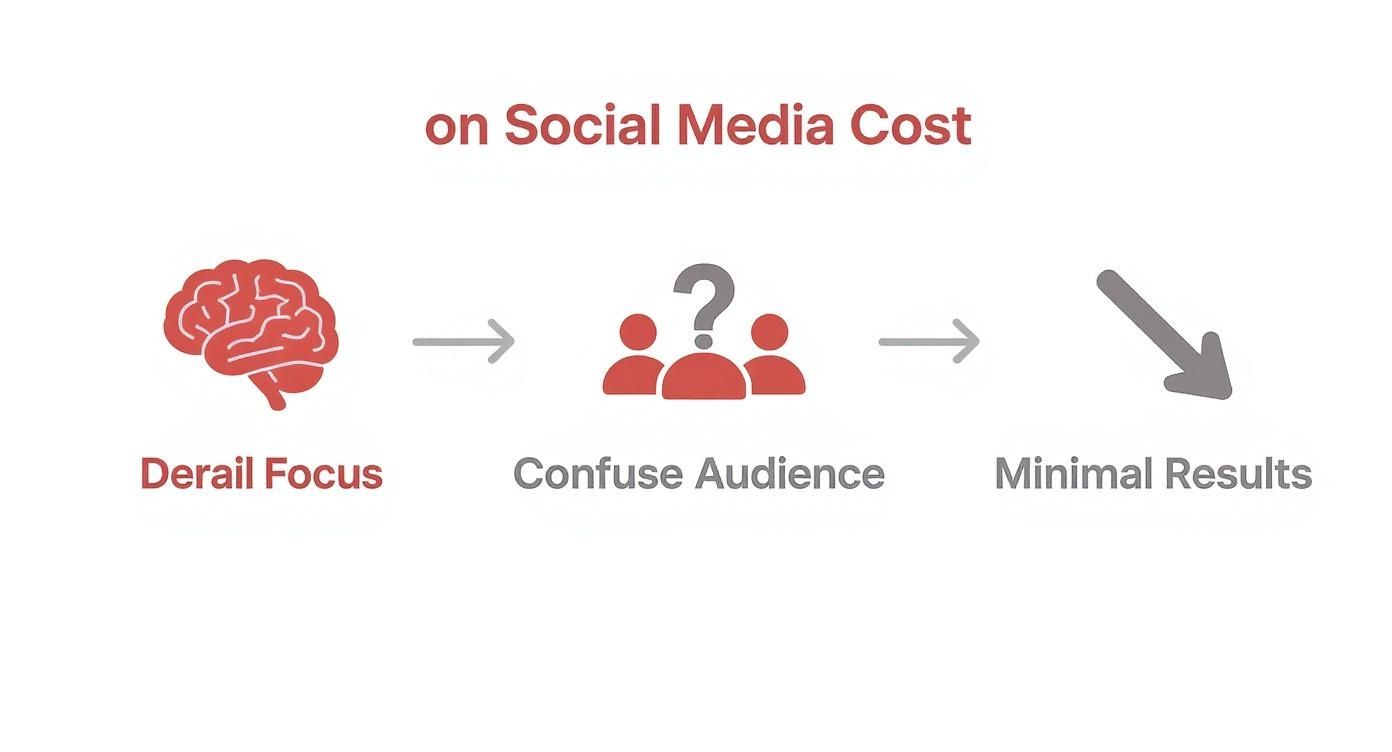
As you can see, that initial slip in focus creates a domino effect that can sabotage your entire social media strategy.
Consider this: the average person spends over 2 hours per day on social platforms. Across all of humanity, that adds up to a mind-boggling 500 million years every single year. This audit is your first step to taking back control of your slice of that time.
Building Your Content Batching Workflow

If you’ve ever stared at a blank screen wondering what to post today, you know the feeling. That daily scramble for content ideas is the fast track to social media burnout.
The antidote? Content batching. Instead of winging it every morning, you dedicate one focused block of time to create an entire week's—or even a month's—worth of content at once. It’s a complete shift from being reactive and stressed to proactive and in control.
The magic of batching is that it mimics an assembly line. You’re not trying to be a one-person band doing everything at once. Instead, you separate the creative phases, allowing you to get into a deep state of flow for each specific task.
The Four Stages of Effective Batching
The biggest mistake I see people make is trying to write, design, and schedule a post all in one go. That constant context-switching is a massive energy drain. To do this right, you have to break your workflow into four distinct stages and tackle them one at a time.
1. The Ideation Phase: This is all about brainstorming. Set a timer for an hour and just let the ideas fly. Don't censor yourself or worry about visuals yet. Just get the raw concepts down. I like to look at trending topics in my niche, see which of my old posts performed well, and list out the most common questions my audience asks.
2. The Writing Phase: With a list of ideas ready, now it’s time to write. Open a single document and just write all the captions, one after another. Getting all the words out first without distraction is incredibly efficient.
3. The Visuals Phase: Once the captions are done, move on to creating all your graphics, editing photos, or trimming video clips. By focusing only on the visual element, you stay in that "design" headspace and produce better, more consistent work, faster.
4. The Scheduling Phase: This is the final, satisfying step. With all your content written and designed, you simply plug it into a scheduling tool. You can load up an entire month of approved posts and set them to publish at the best times.
This assembly-line approach is the secret to producing a high volume of quality content in a fraction of the time. To map this all out, a solid social media content calendar is your best friend—it becomes the blueprint for your batching sessions.
A Real-World Batching Day
So what does this actually look like? Picture this: you block off Tuesday morning for social media.
9-10 AM: You brainstorm 20 solid post ideas.
10 AM-12 PM: You write all 20 captions and pair them with photos or video concepts.
1-2 PM: After a lunch break, you spend an hour scheduling everything.
By 2 PM, you're done. Your entire month of content is locked and loaded. Think about that.
This isn't just a time-saving hack; it's about reclaiming your mental energy. You eliminate the daily "what should I post?" anxiety, which frees you up for the strategic work that actually grows your business.
This kind of social media time management is non-negotiable when you consider the environment we're in. With over 5.24 billion people on social platforms and the average person spending around 2 hours and 20 minutes scrolling daily, the pressure to be "always on" is intense.
Batching lets you maintain a powerful, consistent identity without getting sucked into the vortex. For more on the numbers, Sprout Social has some eye-opening new social media demographics. The takeaway is clear: batching ensures your time is spent creating value, not just consuming it.
Putting Your Content on Autopilot with Smart Scheduling
Okay, so you've batched a ton of great content. That's a huge win, but content sitting in a Google Drive folder doesn't exactly build a business. The real magic happens when you get that content out into the world consistently, without it taking over your entire day.
This is where scheduling tools become your new best friend. I'm talking about platforms like Buffer, Hootsuite, or even the free scheduler inside Meta Business Suite. The idea isn't to be lazy; it's to be smart. Instead of getting sucked into the social media vortex multiple times a day to post manually, you can block off one chunk of time, load everything up for the week, and get back to work.
Know What to Automate (and What to Keep Human)
Automation is a game-changer, but it’s not a silver bullet. A smart social media strategy knows exactly which tasks to hand off to the robots and which ones absolutely need that human touch. If you get this balance wrong, you risk sounding like a corporate bot, and nobody wants to engage with that.
Here’s a simple rule of thumb I follow:
Automate This: Your primary content distribution. Think standard posts, sharing your latest blog, or re-sharing popular evergreen content. The goal here is pure consistency.
Don't Automate This: Anything that involves a direct conversation. Responding to comments, answering DMs, and jumping into relevant discussions should always be your responsibility. People can spot a canned, automated reply from a mile away, and it can kill your credibility.
The point of automation isn't to replace you; it's to free you. By automating the repetitive task of posting, you create more time and brain space for the stuff that actually builds a community—real conversations with real people.
If you want to go deeper, you can learn how to automate your content creation and never run out of time again. This is how you maintain momentum without the daily grind.
Let Data Tell You When to Post
Most good scheduling tools do more than just publish your content; they give you a treasure trove of data. This is where you can stop guessing and start making strategic decisions. Your platform's analytics will show you precisely when your audience is online and most likely to engage.
Dive into your insights and look for those peak activity windows. You might discover your Instagram audience is scrolling after work on weekdays, while your LinkedIn connections are most active Tuesday through Thursday during business hours.
Scheduling your best content to drop during these specific times means it gets in front of the most eyeballs possible. It's a simple tweak that amplifies the impact of your work without you having to do anything extra. This turns scheduling from a simple time-saver into a powerful growth tool.
Stop Reacting, Start Engaging: A Smarter Approach

Real connections happen in the comments and DMs—that’s where you build a community and signal to the algorithms that your content matters. But let's be honest, it’s also a massive time-suck.
The biggest mistake I see people make is letting notifications run their day. Every ping and pop-up pulls them away from what they should be doing. That’s a reactive strategy, and it’s a recipe for burnout and distraction.
The fix? Flip the script. Instead of being a slave to the app, you need to set the terms for engagement. This means carving out specific, focused blocks of time dedicated only to interaction. It's a cornerstone of effective social media time management.
Master Your Time with "Engagement Blocks"
I call these engagement blocks. They’re short, intense sessions—usually just 15-20 minutes—where your only job is to interact with people on social media.
Think of them like a meeting with your community and schedule them right into your calendar. When the time hits, close every other tab, put your phone on silent, and dive in with a purpose.
By fencing this activity into a tight window, you stop it from bleeding into your entire day. You'll find that two or three of these focused blocks are infinitely more productive than being "kind of online" for hours.
This simple shift turns engagement from a constant, low-grade distraction into a high-impact growth activity. You go from being a pinball, bouncing between notifications, to a strategist making intentional moves.
Your 15-Minute Engagement Playbook
So, what do you actually do in these quick sprints? The trick is to have a game plan before you open the app. Don't just show up and scroll.
Instead, work from a simple, high-value checklist. Here are a few ideas:
Connect with VIPs: Keep a private list of 10-15 industry peers, dream clients, or big players in your niche. Use your first block of the day to leave meaningful comments on their latest content.
Tend to Your Garden: Use your next block to reply to every comment and DM you’ve received in the last 24 hours. This tells your audience you're present and that you actually value what they have to say.
Go Find Your People: Spend a block searching relevant hashtags or popping into niche groups. Ask thoughtful questions, offer helpful advice, and connect with new accounts that fit your ideal audience profile.
This proactive system puts you firmly back in the driver's seat. The difference between this and the old reactive way is night and day.
Reactive vs. Proactive Engagement Strategies
The list below breaks down the practical difference between the time-wasting reactive habits and the focused, proactive approach.
• Responding to Comments: A reactive approach wastes time by replying to notifications all day and constantly breaking focus, while a proactive approach schedules a single 15-minute engagement block to handle all comments at once.
• Finding New People: A reactive approach involves endless scrolling in hopes of finding relevant accounts, while a proactive approach saves time by engaging with a pre-vetted list of key accounts and targeted hashtags.
• Answering DMs: A reactive approach treats DMs like instant chat, creating fragmented conversations throughout the day, while a proactive approach sets a dedicated time block to respond to all messages with full focus.
• Handling FAQs: A reactive approach wastes time by repeatedly typing the same answers, while a proactive approach uses saved replies or text expander tools to respond quickly and efficiently.
Making this shift won't just save you hours every single week; you'll also see the quality of your interactions skyrocket. Your engagement becomes more strategic, your relationships get stronger, and your growth picks up speed—all while spending less time glued to your screen.
Measuring Your Success and Knowing When to Delegate
It feels great to get a new system in place, but how do you really know it’s working? The whole point isn't just to feel less busy—it's to get better results without being chained to your phone. Measuring this shift is how you prove to yourself (and your boss) that your new habits are actually paying off.
It’s simpler than you might think. Just start by tracking the hours your new workflow gives back to you each week. Remember that initial time audit? Compare it to how you're spending your time now.
If content batching and focused engagement blocks have slashed your daily social media time from 90 minutes down to 45, that’s 3.75 hours saved every single week. That's nearly half a workday you just reclaimed.
Connecting Time Saved to Real Results
Getting time back is a massive win, but it’s only half the story. The real magic happens when you connect those saved hours back to your key performance indicators (KPIs). Are your new, efficient efforts still moving the needle?
Take a good look at your core metrics before and after you changed your routine.
Follower Growth: Is your audience still growing at the same pace, or maybe even faster?
Engagement Rate: Are those scheduled posts still getting the likes, comments, and shares you're aiming for?
Website Clicks or Leads: Is social media still a reliable source of traffic for your business goals?
If your results are holding strong—or even getting better—while your time commitment has plummeted, you’ve hit the jackpot. For a more detailed look at what to track, we've put together a full guide on measuring social media success that can help you zero in on the right metrics for your brand.
The ultimate proof of a successful time management system is achieving the same (or better) results in significantly less time. This isn't about doing less; it's about making every minute you do spend count for more.
Identifying Tasks Ready for Delegation
Once your system is a well-oiled machine, you'll start to notice which tasks are just purely mechanical. These are the prime candidates for delegation, freeing you up to focus on high-level strategy. And remember, "delegation" doesn't always mean hiring someone—it can also mean handing a task off to a smart tool.
Look for tasks that are:
Repetitive: Think about posting daily content that's already been created and signed off on.
Time-Consuming but Low-Skill: Things like creating simple graphics from templates or handling common FAQs.
Data-Driven: A prime example is utilizing an AI assistant to identify the most effective accounts to engage with or discover trending hashtags.
Whether you pass these tasks to a virtual assistant, a junior team member, or an AI tool, the goal is the same. You're offloading the tactical work so you can put your brainpower where it really matters: planning campaigns, building key partnerships, and steering the ship. This is how you truly master your social media workflow.
Ready to delegate your Instagram growth and save hours every week? Gainsty utilizes advanced AI and expert strategies to organically grow your followers, allowing you to focus on what you do best. Get started at Gainsty

.png&w=1920&q=75&dpl=dpl_34ZXCf12K5qjjdZjPn9snwDRADrB)







.png&w=750&q=75&dpl=dpl_34ZXCf12K5qjjdZjPn9snwDRADrB)