Going Beyond Transactions to Understand Customer Engagement
It helps to think of customer engagement less like a transaction and more like a friendship. A single purchase? That's just the first handshake. Real engagement is what happens after that—the inside jokes, the follow-up conversations, and the genuine support that builds a real bond.
For your business, this means a big mental shift. Stop asking, "What can we sell them?" and start asking, "How can we help them?" It’s the difference between a brand that just dumps product photos on its feed and one that starts conversations, shares genuinely useful tips, and even celebrates its customers' wins. This back-and-forth dialogue is what really powers modern marketing.
The Foundation of Modern Growth
This relationship-first mindset isn't just a "nice-to-have" anymore; it's essential for survival. In fact, a recent report found that a staggering 77% of marketers believe they need to completely rethink their customer engagement strategies by 2025 just to keep up. People expect more now. They want authentic connections and experiences that make them feel like you actually see them.
Customer engagement changes passive buyers into active supporters. It turns simple interactions like likes, comments, and reviews into the foundation of sustainable business growth and powerful word-of-mouth marketing.
When you nail this, you build incredible trust and loyalty. You turn one-time buyers into lifelong advocates who not only keep coming back but also tell all their friends about you. To build these kinds of relationships, you have to get your social profile right. Learning how to increase social media engagement is the first step toward growing an audience that truly cares. This commitment to connection is what separates the brands that fizzle out from the ones that last.
Why Customer Engagement Is Your Most Valuable Business Asset
It's easy to grasp the idea of an emotional connection, but the real magic happens when you see how that connection directly impacts your bottom line. Think about it this way: a business obsessed only with transactions is like a store clerk who only sees the cash register. But a business focused on engagement? That's like building a vibrant community center right around that same store.
One gets a single sale. The other gets a lifelong fan who brings all their friends along. That's the core difference, and it's why engagement isn't just some fluffy marketing term—it's the very engine of sustainable growth. It turns casual curiosity into real, measurable financial success.
From Relationships to Revenue
Every single positive interaction a customer has with your brand chips away at their indifference and builds a little more loyalty. This isn't just a warm, fuzzy feeling; it has a real-world effect on how they spend their money. Customers who feel connected to you are far more likely to buy again, try out your new products, and they're much less likely to jump ship for a competitor's discount.
This loyalty directly translates into a higher customer lifetime value (CLTV). In fact, a global study of over 15,700 consumers found that highly engaged customers have a 19% higher CLTV than those who barely interact with a brand. This data, detailed in Simon-Kucher's 2025 Global Telecommunications Study, proves that building relationships isn't just nice—it’s one of the smartest ways to boost long-term revenue.
Customer engagement isn't a cost. It's a strategic investment that pays you back through higher retention, bigger lifetime value, and organic brand advocacy. It turns your customer base from a simple list of buyers into your most powerful marketing channel.
The Power of Word-of-Mouth Marketing
What's better than paid ads? Free advertising, powered by your most passionate fans. When you truly invest in engaging your customers, you create a dedicated base of supporters who essentially become a volunteer marketing team for you. They're the ones leaving glowing reviews, tagging you in their Instagram stories, and telling their friends they have to check you out.
This kind of organic, word-of-mouth promotion is pure gold because it’s built on trust and authenticity. Here’s how that directly helps your business:
Lower Customer Acquisition Costs: When your happy customers are bringing in new ones, you can spend less on ads to find them yourself.
Stronger Brand Credibility: A recommendation from a friend will always be more powerful and convincing than a sponsored post.
A Priceless Feedback Loop: Engaged customers are often the most willing to give you honest feedback, offering incredible insights you can use to make your products even better.
At the end of the day, when you shift your mindset from chasing one-off sales to building lasting relationships, you create a business that doesn't just survive—it thrives.
The Four Levels of Customer Engagement Explained
Customer engagement isn't a one-and-done deal; it's a relationship that deepens over time. I like to think of it as a ladder. A customer can't just leap to the top rung and become a passionate brand advocate overnight—they have to climb the steps first. Breaking it down this way is a practical method for really understanding what customer engagement looks like in the real world.
As you can see, engagement isn't just a fuzzy metric. It's the foundation that supports your most critical business assets: customer lifetime value (CLTV), retention, and sustainable growth.
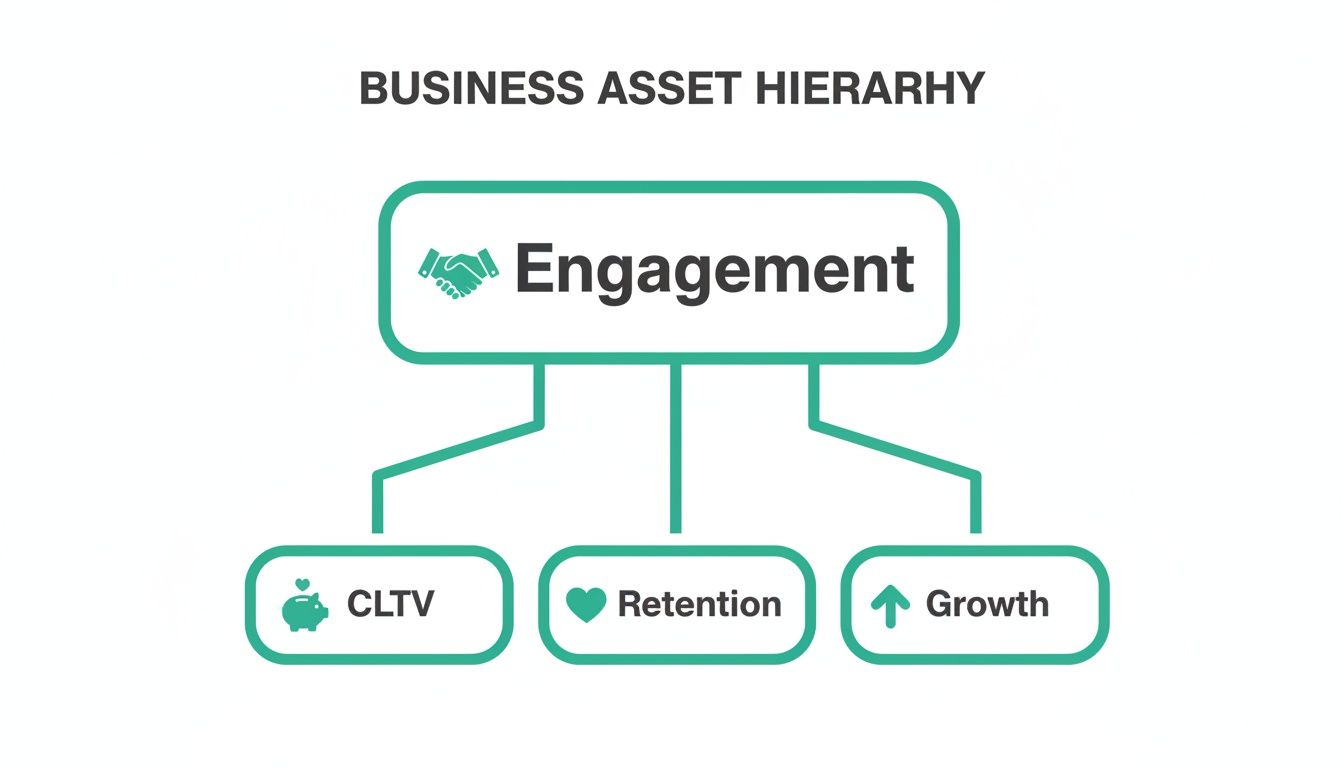
This really drives home the point that investing in engagement is the first, most crucial step toward achieving those big-picture business goals.
Level 1: Transactional Engagement
This is the ground floor, the very first handshake. It's when someone makes their first purchase, subscribes to your email list, or hits "Follow" on your Instagram profile. It’s a vital starting point, but let’s be honest—it’s purely functional.
The customer had a problem, and you offered a solution. At this stage, there's not much of an emotional bond or loyalty. They could have picked you for any number of reasons—price, convenience, or a well-placed ad—and they could just as easily jump to a competitor for their next purchase. Your only job here is to make that first experience so smooth and positive that they're curious enough to stick around.
Level 2: Relational Engagement
Alright, now we're talking. Relational engagement is all about building on that first interaction with consistent, positive touchpoints. This is the stage where a customer starts to recognize your brand and actively chooses you over others.
On social media, this might look like:
Consistent Likes: They're not just scrolling past; they regularly tap the heart on your posts because they genuinely enjoy what you're sharing.
Simple Comments: They start leaving quick comments or replying to your Instagram Stories.
Repeat Purchases: They come back for more, moving past that initial one-time transaction.
This level is all about building familiarity and trust. You’ve graduated from being just another option to becoming a reliable, go-to choice.
Level 3: Emotional Engagement
This is where the real magic begins. Emotional engagement is that pivotal shift where a customer goes from simply liking your brand to truly loving it. They start to feel a personal connection and might even see your brand as a small part of their own identity.
At this level, customers buy from you because of how you make them feel, not just what you sell. They trust your values, appreciate your mission, and feel like part of your community.
They're not just buying a product; they're buying into the story and the feeling that comes with it.
Level 4: Advocate Engagement
Finally, we reach the top of the ladder: advocacy. These customers are no longer just buyers; they're your most passionate, vocal supporters. They become your best marketing asset because their praise is authentic, organic, and incredibly persuasive.
An advocate on Instagram is someone who might:
Create user-generated content (UGC) featuring your product and tag you, completely unprompted.
Jump into the comments to defend your brand against criticism.
Actively recommend your products to their own friends and followers.
These are the true fans who fuel word-of-mouth growth and help you build a brand reputation that money just can't buy.
How to Measure Customer Engagement Effectively
You can talk about engagement all day, but if you aren't measuring it, you're just guessing. How do you know if your strategy is actually working? The trick is to stop thinking of engagement as one big, vague number. Instead, see it as a story told through a handful of specific, meaningful metrics.
It's easy to get distracted by flashy numbers. A post with thousands of likes looks great on the surface, but if nobody is commenting, sharing, or clicking through to your site, what did it really accomplish? That’s what we call a vanity metric. Real measurement digs deeper into the quality of the interactions, not just the quantity.
The goal isn’t to chase the biggest numbers. It’s to pick the key performance indicators (KPIs) that actually show you how healthy your customer relationships are and line up with your real business goals.
This way, you start to understand what truly clicks with your audience. For a much deeper look into the nuts and bolts of this, check out our complete guide on how to measure social media engagement.
Key Engagement Metrics on Instagram
When you're on a visual-first platform like Instagram, a few core metrics can give you a crystal-clear picture of how people are responding to what you share. Let's break down the most important ones.
Here's a quick look at the essential Instagram metrics, what they mean, and why they're so important for understanding your audience connection.
Key Instagram Engagement Metrics and What They Mean
1. Engagement Rate
How to Calculate: (Likes + Comments + Shares + Saves) ÷ Total Followers
Why It Matters: This is the classic metric. It tells you what percentage of your audience found your content interesting enough to physically interact with it.
2. Comments Per Post
How to Calculate: Total Comments on a Post
Why It Matters: Likes are easy and passive. A comment is an active investment of time and thought. It’s a clear sign you’ve sparked a real conversation.
3. Story Interactions
How to Calculate: Poll Votes, Quiz Answers, Sticker Taps, DMs
Why It Matters: This shows people aren’t just swiping past your Stories. They’re participating. It’s a direct signal of an active, tuned-in audience.
4. Shares
How to Calculate: Total “Send to” Actions on a Post
Why It Matters: Shares are the digital equivalent of word-of-mouth. When someone shares your post, they’re vouching for your content to their own network.
5. Saves
How to Calculate: Total “Bookmark” Actions on a Post
Why It Matters: A save is a powerful indicator of high-value content. It means someone found your post so useful they want to come back to it later.
By tracking these, you get a much richer story than just looking at your follower count. You start to see what content people truly value.
Choosing KPIs That Actually Matter for Your Goals
The right metrics for you depend entirely on what you're trying to achieve. There’s no one-size-fits-all dashboard. A brand trying to build a loyal community will care about very different numbers than a brand whose main goal is just getting its name out there.
Here’s a simple way to connect your goals to the right numbers:
If Your Goal Is to Build a Community...
Track these KPIs: Comments per post, replies to DMs, and tags in user-generated content. These metrics are all about conversation and creating a sense of belonging.
If Your Goal Is to Drive Website Traffic...
Track these KPIs: Link clicks from your bio or Stories and website referral traffic in your analytics. This is where you connect social media activity directly to business results.
If Your Goal Is to Increase Brand Awareness...
Track these KPIs: Reach, impressions, and shares. These numbers show you how far and wide your content is traveling, well beyond your existing followers.
Once you tie your KPIs directly to your strategy, you can finally stop guessing. You'll start making smart, informed decisions that actually move the needle on your customer relationships.
Getting Practical: How to Boost Your Instagram Engagement
Knowing your metrics is one thing, but actually moving the needle is a completely different ballgame. To really fire up your customer engagement, you need a solid playbook of hands-on tactics. These are the strategies that turn passive scrollers into active community members—the kind of people who power genuine growth on Instagram.
The trick is to stop thinking about just posting content. Your real goal is to start conversations, invite people to join in, and create stuff so good your audience can't help but share and save it. This is how you build a following that actually sticks around.
Spark Conversations with Interactive Content
The fastest way to get people talking? Ask them something. Instagram's built-in features are a goldmine for this because they make it ridiculously easy for your audience to participate.
Polls and Quizzes: Jump into Instagram Stories and ask fun, simple questions. A skincare brand might run a poll asking, "Morning or night routine?" A local coffee shop could quiz followers on different brewing methods.
"Ask Me Anything" (AMA) Sessions: Hosting an AMA in your Stories is a fantastic way to pull back the curtain and let your audience connect with the real people behind the brand. It’s a huge trust-builder.
Question Stickers: Use these to get direct feedback and content ideas. A simple "What do you want to see more of?" can fill your content calendar for weeks.
These features aren't just for show. They make your followers feel seen and heard, which tightens their bond with your brand.
The best engagement strategies don’t just shout messages into the void—they open the door for a two-way dialogue. When you invite your audience to help shape the experience, your profile stops being a monologue and starts becoming a community.
Write Captions That Beg for a Reply
Think of your caption as the opening line in a conversation. Don't just describe the photo—that's a missed opportunity. Your job is to write captions that pull people in and invite a response.
A killer caption often ends with a question. Instead of just posting a picture of a new product with its features, try asking, "What’s the one feature you're most excited to try?" That simple tweak turns a flat announcement into a lively discussion. If you want to dive deeper, learning how to increase engagement on Instagram can give you even more powerful tactics.
Put User-Generated Content to Work
User-Generated Content (UGC) is the holy grail of social proof and a massive driver of engagement. When a customer loves your product enough to post about it, sharing their content on your profile is a huge win for everyone involved.
Here’s why UGC is pure magic:
It Screams Authenticity: A post from a real, happy customer feels far more trustworthy than anything a brand can create.
It Builds Community: Featuring a customer’s post makes them feel like a VIP and encourages others to share their own experiences, creating a positive feedback loop.
It's Effortless Social Proof: UGC is basically a visual testimonial, showing potential new followers that real people are already loving what you do.
Get the ball rolling by creating a branded hashtag and making a habit of featuring your favorite customer posts. This strategy doesn't just give you great content; it builds a vibrant community around your brand. For even more ideas, check out our guide on how to increase Instagram engagement organically.
Using AI to Power Authentic Organic Engagement
As your audience grows, a tough question comes up: How do you keep the personal, one-on-one connections going when you have thousands of followers? The sheer volume of comments and DMs can feel like a tidal wave, making it nearly impossible to keep up that genuine human touch.
This is where smart AI comes in. I'm not talking about replacing you with a robot, but giving you a powerful partner to help you scale your authenticity.
Think of it like having a super-powered assistant. This assistant can sift through mountains of data to pinpoint the perfect times to post, brainstorm content ideas that will actually land with your audience, and help you understand your community on a much deeper level. The point isn't to automate replies with soulless bots; it’s about using technology to make your human interactions smarter and more impactful.
Amplifying Human Connection with Technology
Tools like Gainsty really show what this human-AI partnership can look like. By blending sophisticated AI with actual human expertise, you can build a growth strategy that feels completely natural and organic. The AI handles the heavy lifting with data-driven insights, while human experts make sure the execution is authentic and perfectly matches your brand's unique voice.
The real goal here is to free you up to do what you do best: build real relationships. AI takes care of the analytical grunt work, which in turn amplifies your ability to create meaningful customer engagement at scale.
This kind of collaboration is quickly becoming the norm. By 2025, it's predicted that AI will be involved in a massive 95% of all customer interactions. We're seeing machine learning tackle complex questions and even analyze sentiment to deliver hyper-personalized responses.
This isn't just some passing tech trend. With 86% of customers willing to pay more for a fantastic experience, it’s a core business strategy. You can see more data on this in these customer engagement statistics from involve.me.
Ultimately, the focus is still on growing a real community—no bots, no fake followers. By using technology to deepen your connections, you can build a thriving, engaged audience safely and effectively. You can learn more about how to use AI for Instagram growth without sacrificing your authentic approach.
Your Top Customer Engagement Questions, Answered
Even with the best strategy in place, some questions always pop up. Let's dig into a few of the most common ones to clear up any confusion and nail down the core ideas of building great customer relationships.
Customer Engagement vs. Customer Satisfaction
So, what's the real difference between customer engagement and customer satisfaction? Here’s a simple way to think about it: satisfaction is a snapshot, while engagement is the entire photo album.
Customer satisfaction is all about a single moment. It measures how happy someone was with one purchase or one interaction. It's a metric that looks backward. A customer can be perfectly satisfied with their purchase but have zero emotional connection to your brand, ready to jump ship the second a competitor offers a better price.
Customer engagement, on the other hand, is the ongoing relationship and emotional bond a customer develops with you. It’s a powerful predictor of future loyalty and advocacy. A satisfied customer is great, but an engaged customer is a true long-term asset who will stick with you.
How Long Until I Actually See Results?
This is the big one. Building genuine engagement is a marathon, not a sprint. You might see some quick wins—a spike in likes or a few more comments—within weeks of trying new tactics. But the real rewards take time.
True engagement, the kind you measure in loyalty, retention, and higher customer lifetime value, comes from consistent effort over several months. You're building relationships, and those simply don't happen overnight.
Can Small Businesses Really Compete on Engagement?
Absolutely. In fact, small businesses often have a secret weapon: authenticity. They can offer a personal touch and a direct connection that massive corporations can only dream of.
By focusing on a tight-knit community, replying personally to every single comment, and showing the real faces behind the brand, small businesses can cultivate fiercely loyal followings. It’s not about having the biggest budget; it’s about making a real connection.
Ready to build those authentic connections at scale and see real growth? Gainsty uses a smart mix of AI and human expertise to grow your Instagram with real, engaged followers. Start building your community today.

.png&w=1920&q=75&dpl=dpl_34ZXCf12K5qjjdZjPn9snwDRADrB)






.png&w=750&q=75&dpl=dpl_34ZXCf12K5qjjdZjPn9snwDRADrB)