Your Quick Guide to Peak Instagram Posting Times
Cracking the Code of General Posting Patterns
Let's cut through the noise. Most studies boil down to a simple truth: post when people are taking a break. Obvious, right? But the consistency in the data is what's powerful.
Across the board, engagement climbs during the workweek, especially from Tuesday through Thursday. These are the days when people are in a routine and looking for a mental escape. The sweet spot generally falls between 11 a.m. and 6 p.m., capturing both the lunchtime crowd and the after-work wind-down.
In particular, that mid-morning window from 11 a.m. to 1 p.m. is prime time. It’s when you can catch people right as they're breaking for lunch, scrolling through their phones before they grab a bite. If you want to dig deeper into the numbers, Sprout Social’s annual social media data for 2025 is a fantastic resource that confirms these trends.
The goal isn’t just to post at a popular time; it's to post right before your specific audience opens the app. These general timeframes are simply the most statistically likely moments for that to happen.
General Best Times to Post on Instagram at a Glance
To give you an immediate, actionable starting point, we've compiled the most effective days and time slots based on aggregated industry data. Use this table as your initial guide for scheduling your next few posts.
Tuesday (11 AM – 2 PM): Engagement is strong because people check social media during lunch breaks, and midweek focus is high.
Wednesday (11 AM – 1 PM): Typically the highest engagement day of the week, especially during midday hours.
Thursday (10 AM – 2 PM): Users are more active as they plan for the weekend and browse more content.
Think of these times as well-lit highways for your content. While they don't guarantee you'll avoid all traffic, they give you a much better chance of getting seen than a deserted back road at 3 a.m.
Look, we’ve all seen those infographics. "The Absolute Best Times to Post on Instagram!" They’re everywhere, promising a magic bullet for engagement. But here’s the hard truth: relying on those universal times is like using a national weather forecast to plan a backyard BBQ. It might give you a general idea, but you could still get caught in the rain.
Those big studies are a decent starting point, don't get me wrong. They aggregate data from millions of accounts to find broad patterns. But that’s all they are—an average. Your brand, your followers, your community? You're not average.
Think about it. A generic study screams that 1 PM is prime time. But what if your audience is full of nurses just starting a 12-hour shift? Or college students stuck in a lecture hall? Your brilliant post lands to the sound of crickets. By the time they actually log on, it’s buried under a mountain of newer content.
Your Audience Doesn't Follow a Generic Clock
Every niche, every community, every fan base has its own unique rhythm. The very things that make your audience special are what make one-size-fits-all advice so useless.
You're Dealing with Multiple Time Zones: If your followers are waking up in New York, taking a lunch break in London, and heading to bed in Sydney, a single "best time" is a myth. Posting at 9 AM EST is great for your East Coast crowd, but it's 2 PM in London and a ghostly 1 AM in Sydney. A global strategy needs an international mindset.
Your Industry Dictates the Schedule: It's just common sense. A B2B software company will find its audience scrolling during the 9-to-5 workday. But a brand selling hiking gear? Their engagement is going to explode on Saturday mornings when people are planning their weekend escape, not during a Wednesday morning meeting.
Demographics Drive Daily Habits: A stay-at-home parent's online time looks completely different from a grad student's. One might be scrolling while the kids nap in the afternoon, while the other is deep-diving into memes at 2 AM. Their lifestyles directly shape their Instagram habits.
The Algorithm Cares About the First Hour
Here's the part that really matters. The Instagram algorithm is hungry for immediate feedback. When you hit "Share," it doesn't blast your post to everyone at once. It shows it to a small test group of your followers first.
If that initial group bites—if they like, comment, share, and save right away—Instagram’s algorithm sees it as a sign of high-quality content. It's a green light to push your post out to a much wider audience, boosting its reach exponentially.
This is the whole game, right here: Posting when your specific followers are most active and ready to engage gives your content its best shot at getting that critical early traction. It’s not about when people are online; it’s about when your people are online.
So, treat those industry-wide statistics as a hypothesis, not a conclusion. They give you an educated guess to start your testing, but the real answers—the ones that will actually move the needle—are buried in your own Instagram Insights. Thinking of generic times as the final word is a rookie mistake. Instead, let's use them as the first step to discovering what truly works for you.
Understanding the Rhythm of the Week on Instagram
Forget those generic, one-size-fits-all posting schedules. To really get traction on Instagram, you need to understand the natural ebb and flow of the week. Think about it—the way you feel on a Monday morning is completely different from a Friday afternoon, right? The same goes for your audience.
Each day has its own energy, a collective mindset driven by the routines of millions of people. Monday kicks off with a flurry of activity as everyone dives back into their workweek, maybe scrolling Instagram for a gentle start. By Wednesday, they're looking for inspiration or a quick mental break. And as Friday rolls around, the vibe shifts entirely to weekend plans and winding down.
Tuning into this weekly rhythm allows you to post content that lands at the perfect moment, resonating with your audience's mood, not just their available screen time.
This is where the magic really happens: at the intersection of broad, data-backed trends and your own unique audience insights.
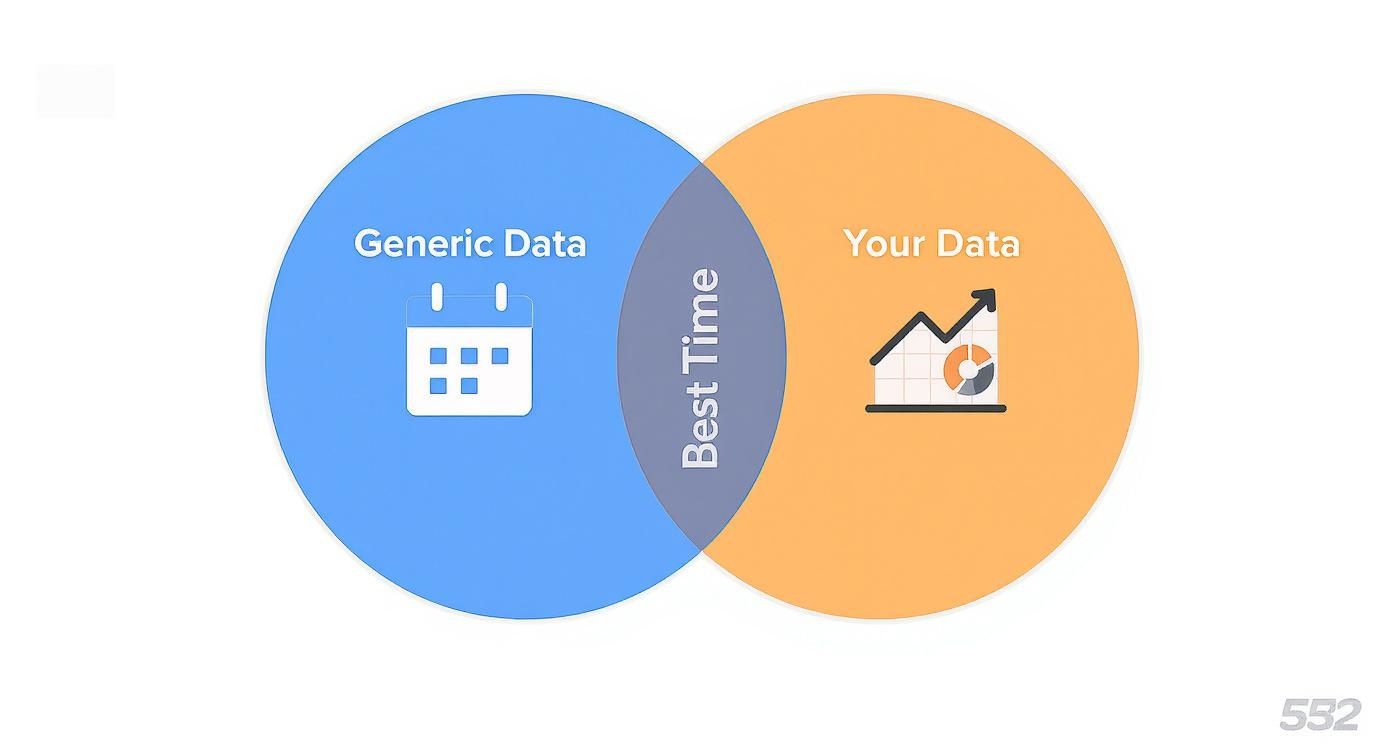
The sweet spot—your personal best time to post—is found right in that overlap. It's about using general patterns as a starting point, then refining them with what you know about your people.
Aligning Content with Daily User Mindsets
Once you grasp the typical mindset for each day, you can make your content feel incredibly relevant and timely. This is less about hitting a specific time slot and more about connecting with your audience on their level.
Monday Motivation: Start the week strong. This is the time for uplifting, goal-oriented, or productive content. People are in planning mode and are wide open to a positive kickstart.
Midweek Engagement: Tuesdays and Wednesdays are your prime time for deeper content. Think tutorials, educational carousels, or asking thoughtful questions to get a conversation going. Your followers are settled into their weekly routine and are much more likely to engage with something that offers real value.
Weekend Wind-Down: As soon as Thursday afternoon hits, you can feel the collective mood start to lighten. Through Friday, it's all about that pre-weekend buzz. This is the perfect window for entertaining Reels, behind-the-scenes glimpses, or fun, community-focused posts.
Understanding these daily nuances helps you answer a much more powerful question than "When is my audience online?" Instead, you start asking, "When is my audience most receptive to the type of content I'm sharing?" That's a game-changer.
The data backs this up. A deep dive by Hootsuite, for example, shows that Mondays get a big engagement spike between 7 a.m. and 11 a.m. as people get their week started. Contrast that with Fridays, which have two hot windows: 6 a.m. to 10 a.m. for the early risers and 5 p.m. to 9 p.m. as everyone officially clocks out for the weekend.
These patterns are a direct reflection of human behaviour. To truly nail this, you have to know who's on the other side of the screen. Our guide on Instagram audience demographics is the perfect place to start digging into who your community really is. When you combine that specific knowledge with the general rhythm of the week, you'll be able to build a posting schedule that feels both strategic and completely intuitive.
How to Find Your Personal Best Time to Post
Industry-wide data gives you a map, but your own analytics? That's the turn-by-turn GPS leading you straight to your audience. It's time to stop guessing and start using the powerful tool Instagram gives every professional account for free: Instagram Insights.
Think of Insights as a direct conversation with your followers. It tells you exactly when they’re scrolling, liking, and ready to engage with what you post. This is where you get to play data detective for your own brand, and it's the single best way to figure out a posting schedule that actually works.
The best part is, you don’t need a degree in data science to make sense of it. A few minutes is all it takes to tap into the numbers your account is already generating for you.
Unlocking Your Audience's Schedule with Instagram Insights
To find your personalised peak hours, you’ll need to head over to your account's analytics dashboard. This data is the key to creating a schedule built around your audience's real-life habits, not just some generic average.
Here’s how to get there:
Head to your Profile: Open the Instagram app and tap your profile picture in the bottom-right corner.
Access the Professional Dashboard: Right under your bio, you'll see a link for the "Professional Dashboard." Tap it.
Open Account Insights: On this screen, tap on "Account Insights" to pull up your analytics.
Find Your Follower Data: Navigate to the "Total followers" section. Scroll down until you see the "Most Active Times" module.
This little chart is your goldmine. It shows you a complete breakdown of when your followers were online over the last week, organised by both day and hour.
The darker blue bars represent the busiest times—when more of your followers are active. Lighter bars show you the quieter periods.
Here’s a look at what you can expect to see in the "Most Active Times" chart.
This visual data immediately points out the high-traffic windows for your specific audience. You can tap on each day to get an hourly breakdown and pinpoint the exact times engagement is most likely to happen. For a deeper dive into all the numbers, our complete guide to understanding Instagram Insights will help you master every metric.
Turning Data into a Posting Strategy
So, you’ve got the data. Now what? Start by identifying the top 2-3 most active hours for each day of the week. These are your new prime-time posting slots.
The goal isn’t to post at the absolute peak minute. Instead, aim to post slightly before it. Dropping your content 30-60 minutes ahead of the busiest time lets the algorithm start working its magic, ensuring your post is waiting for your followers right as they log on.
Let's say your data shows that Wednesdays are busiest at 6 PM. Try scheduling your post for 5:30 PM. This gives it a running start and maximises its chance of being seen.
Once you’ve got this basic rhythm down, you can start fine-tuning your approach. Digging into these 8 Tips to Find the Best Time to Post to Instagram in 2025 can give you even more ideas to sharpen your strategy.
Remember, this data is your personalised roadmap. Use it to build an initial schedule, then get ready to test, learn, and optimise your way to better engagement.
Testing and Optimising Your Instagram Schedule
Let's get one thing straight: finding your perfect posting time isn't a one-and-done task. Your audience’s habits will shift, new trends will pop up, and your strategy needs to keep pace. Think of your schedule as a living, breathing thing that needs regular check-ups to stay healthy.
This is where you graduate from having a good schedule to a great one. The simplest, most effective way to do this? A/B testing.
Don’t let the term intimidate you. All it means is pitting two options against each other to see which one performs better. Say your Insights show a lot of your followers are online on Tuesdays at both 1 PM and 5 PM. Which slot will give your post the best launchpad? Time to run a little experiment.
The key is to compare apples to apples. You'd post similar content—maybe two different carousels with the same theme, or two Reels using the same trending audio—at those two different times and see which one gets more traction.
Building Your Testing Framework
To get results you can actually trust, you need a system. Tossing content out randomly and checking the numbers later is just guessing. We want clean, actionable data, and that requires a bit of structure.
First, look at your Instagram Insights to find your potential test windows. Let's imagine Thursdays are hot for your audience, with a peak between 4 PM and 7 PM. You could set up a simple test like this:
Week 1: Post a Reel on Thursday at 4:30 PM.
Week 2: Post a similar Reel on Thursday at 6:30 PM.
Once each post has been live for at least 24 hours, pop back in and compare how they did. This methodical process is how you'll truly dial in the best times for your audience, not just rely on generic advice.
Remember, the point of testing isn't to find one single "magic" minute to post. It's about identifying broader windows of opportunity where your content consistently has the best shot at success. You're building a flexible, data-driven rhythm.
What Metrics to Track for Success
When you’re comparing posts, likes are only part of the story. You need to focus on the metrics that signal to the Instagram algorithm that your content is a hit, especially in that critical first hour after posting.
Here are the big three to watch:
Reach: How many unique eyeballs saw your post? A higher initial reach is a fantastic sign.
Engagement Rate: This is the percentage of your followers (or reach) that actually interacted with your post. It’s a measure of how compelling your content was.
Shares & Saves: These are gold. A share or a save tells the algorithm that your content was so good, someone wanted to either show it to a friend or come back to it later.
As you test different times, you'll need a benchmark for what "good" looks like. Getting a handle on your engagement rate is crucial for tracking your progress. If you're looking for ways to improve this number across the board, you can find proven tips to Boost Your Engagement Rate on Instagram.
Trying to juggle all these tests in your head or a messy spreadsheet is a recipe for confusion. Using an ultimate Instagram content calendar template makes it a hundred times easier. It helps you map out your experiments, record the results, and gradually turn that raw data into a smarter, more agile posting strategy. That kind of system is what separates the pros from the amateurs.
Putting It All Together: Your Strategic Instagram Posting Plan
Alright, you've got all the pieces of the puzzle. You understand the "why" behind audience activity, time zones, and even the sneaky Instagram algorithm. Now, it's time to assemble those pieces into a smart, effective posting schedule.
The goal here isn't to find one single "magic hour" and call it a day. That's not how this works. Instead, we're building a repeatable, data-backed system that gets your content seen by the right people, every time. This is how you move from just guessing to actually having a strategy.
The Three-Step Success Cycle
Think of this as a simple, powerful loop. You start with a solid foundation, refine it with your own data, and keep optimising. It's a cycle that gets smarter and more effective over time.
1. Start with Benchmarks: Don't just throw content at the wall and see what sticks. Begin by posting during those widely-accepted peak windows we talked about, like weekday lunchtimes and late afternoons. This gives you a data-backed starting line.
2. Pivot to Your Data: After you've been posting consistently for a few weeks, it's time to become a detective. Dive straight into your Instagram Insights. Find out when your specific audience is most active and start shifting your schedule to match what the numbers are telling you.
3. Test and Refine: Your posting schedule should be a living, breathing thing. Once you know your peak windows, start experimenting. Try posting at the beginning of that window one day, and at the end the next. Keep a close eye on your engagement and tweak your plan based on what actually works.
Here's the bottom line: The "best time to post" isn't just about timing. It's a powerful combination of data, a real understanding of your audience, and consistently great content. You can't have one without the others.
By following this loop, you leave the generic advice behind. You're building an intelligent posting strategy that drives real-world results—more likes, more comments, and more followers. You're no longer just hoping for the best; you're strategically placing your content exactly where it has the best chance to connect and grow your account.
Got Questions About Posting Times? We've Got Answers
Once you start diving into your Instagram Insights and fine-tuning your schedule, a few questions always seem to surface. Let's tackle the most common ones head-on, so you can move forward with a clear strategy.
Should I Post Reels and Stories at Different Times?
You bet. Think of it this way: different content formats are consumed in different ways. Feed posts and Reels are like primetime TV shows, competing for attention during peak scrolling hours like lunchtime and the evening wind-down. You want to drop them right before your audience's activity really kicks into high gear.
Stories, on the other hand, are more like casual check-ins. They’re quick, snackable, and disappear after 24 hours. Because of this, they do well when you post them more often throughout the day, keeping your account bubble right at the front of the line. Sure, you can align a big Story announcement with a peak time, but don't be afraid to post during the quieter "shoulder hours" to catch people when the main feed is less chaotic.
Okay, So How Often Should I Really Be Posting on Instagram?
This is a big one, but the answer is simpler than you think: consistency always wins over frequency.
Seriously. It's far better to post three genuinely great, engaging posts per week at your optimal times than it is to churn out seven mediocre ones at random. The real goal is to get your audience used to seeing awesome content from you on a predictable schedule.
A solid starting point for most creators and businesses is 3-5 times per week for feed posts and Reels. This pace is usually manageable enough to prevent burnout, but active enough to keep your audience hooked and signal to the Instagram algorithm that you're a consistent player.
What Do I Do If My Audience Is All Over the World?
When you have a global following, the idea of a single "best time" goes right out the window. It's a myth. Your mission is to cater to your biggest audience pockets.
First, pop open your Instagram Insights and see which countries or cities most of your followers call home. If you've got big groups in both North America and Europe, for example, you have a few smart ways to play it:
Find the Sweet Spot: Post when one major audience is just starting their day, and the other is wrapping up their workday (think morning in the US, which is late afternoon/early evening in Europe).
Alternate Your Focus: You could dedicate Mondays and Wednesdays to your European followers' peak times, and Tuesdays and Thursdays to your North American audience.
Double Down: If you have the content, post twice. Share something different for each of your main audience's peak engagement windows.
Ready to stop guessing and start growing? Gainsty uses advanced AI and expert strategies to find your perfect audience and boost your organic growth. Get more followers and engagement on Instagram today!

.png&w=1920&q=75&dpl=dpl_34ZXCf12K5qjjdZjPn9snwDRADrB)





.png&w=750&q=75&dpl=dpl_34ZXCf12K5qjjdZjPn9snwDRADrB)