Find the Stage Where Your Hashtags Fail
A reach drop isn't proof of a shadowban. First, identify what Instagram accepted, what people can search for, and where visibility stopped.
The Instagram Help Center explains that hashtag visibility depends on factors including account privacy and whether a hashtag remains searchable under its policies. Instagram also reviews hashtag availability, so a restricted tag isn't necessarily unavailable permanently. Those are specific visibility conditions, not evidence that every disappointing post faces an account-wide penalty.
Separate acceptance from exposure
Think of hashtags as passing through distinct stages:
Publishing: Instagram accepts the caption or comment containing the tag.
Indexing: The hashtag is valid and searchable. A working tag page confirms the tag exists, not that every tagged post has been indexed.
Search visibility: An eligible public post can appear in relevant hashtag results. Eligibility doesn't guarantee prominent placement.
Distribution: Instagram shows the post to viewers, including people who don't follow the account.
This distinction stops you from applying a distribution remedy to a publishing error. Rewriting your opening frame won't fix a rejected comment, and correcting a hashtag typo won't necessarily improve viewer retention.
Match the symptom to the first check. If a post publishes but shows no hashtag impressions, indexing or search visibility may be the issue. Search each tag in Instagram and confirm the account is public, then work through the publishing and visibility checks below. If a caption or comment fails to post, the problem is at the publishing stage. Count the hashtags and look for stray characters.
If the post appears on tag pages but views stay flat, look at distribution instead. Compare hashtag-origin impressions across comparable posts using the 12-post test below. If reach has fallen across carousels, Reels, and Stories, check performance across all three formats before attributing the decline to tags; distribution or account health may be involved. If hashtag impressions remain near zero after repeated tests, review the opening hook and watch time to see whether content relevance is the larger problem.
Investigate restrictions without guessing
If Instagram displays an eligibility warning in Account Status, address that warning directly. If it doesn't, avoid labeling low reach a shadowban because a post performed poorly. Use the Instagram shadowban troubleshooting guide to investigate account-level concerns separately from individual hashtag problems.
Diagnostic rule: A post appearing on a hashtag page proves visibility at that moment. It doesn't prove Instagram will distribute it widely.
Can you identify whether your post fails at publishing, disappears during search checks, or appears on a tag page without attracting viewers? That answer determines the useful fix.
Publishing Errors That Block Hashtags
Start with the hashtag count when a caption or comment won't publish. Instagram's official Help Center allows up to 30 hashtags per post, and going past that can stop the caption or comment from going through at all. A copied block from an old template can push you over the ceiling before audience relevance even matters, so count the full set before retrying. Don't assume moving the excess into a comment solves the problem; the limit applies wherever the tags sit.
Check the exact text Instagram receives
Inspect each tag in the published caption, not just in your scheduling document. A space splits one intended tag into pieces, while punctuation or an unsupported character ends the hashtag at that point. An emoji pasted next to a word can also change which tag Instagram registers.
For example, #sourdough bread doesn't function as a single hashtag for sourdough bread. Use a continuous, correctly spelled tag, then tap it after publication to verify the destination.
If a short, clean caption still fails, publish a test version without the copied hashtag block. That isolates the block from a broader app or connection problem. Keep the error message in your notes rather than resubmitting identical text; repeated submissions of the same string rarely produce a different result.
Confirm visibility and tag status
Check account privacy next. Posts from private accounts don't appear on public hashtag pages, so decide whether public discovery fits your business before expecting any tag traffic.
Search prospective tags inside Instagram before reusing them. If a tag is unavailable or shows a restriction notice, leave it out of the active set. Search results full of unrelated material are also a reason to reconsider, even when the tag technically works.
Keep unavailable tags in a separate review column rather than treating every restriction as permanent. Recheck their status during routine maintenance, but don't build a campaign around a tag that currently returns no usable results.
Use this pre-publishing checklist:
Count: Remove excess tags and old pasted blocks, and stay under the platform's limit.
Spelling: Check the complete word, spaces, punctuation, and stray characters.
Account visibility: Confirm the account is public if hashtag discovery is the goal.
Tag status: Open each hashtag and inspect its current results.
A clean tag set clears the publishing stage. Whether it attracts the right viewers is a separate test.
Audit Your Current Hashtags Before Changing Them
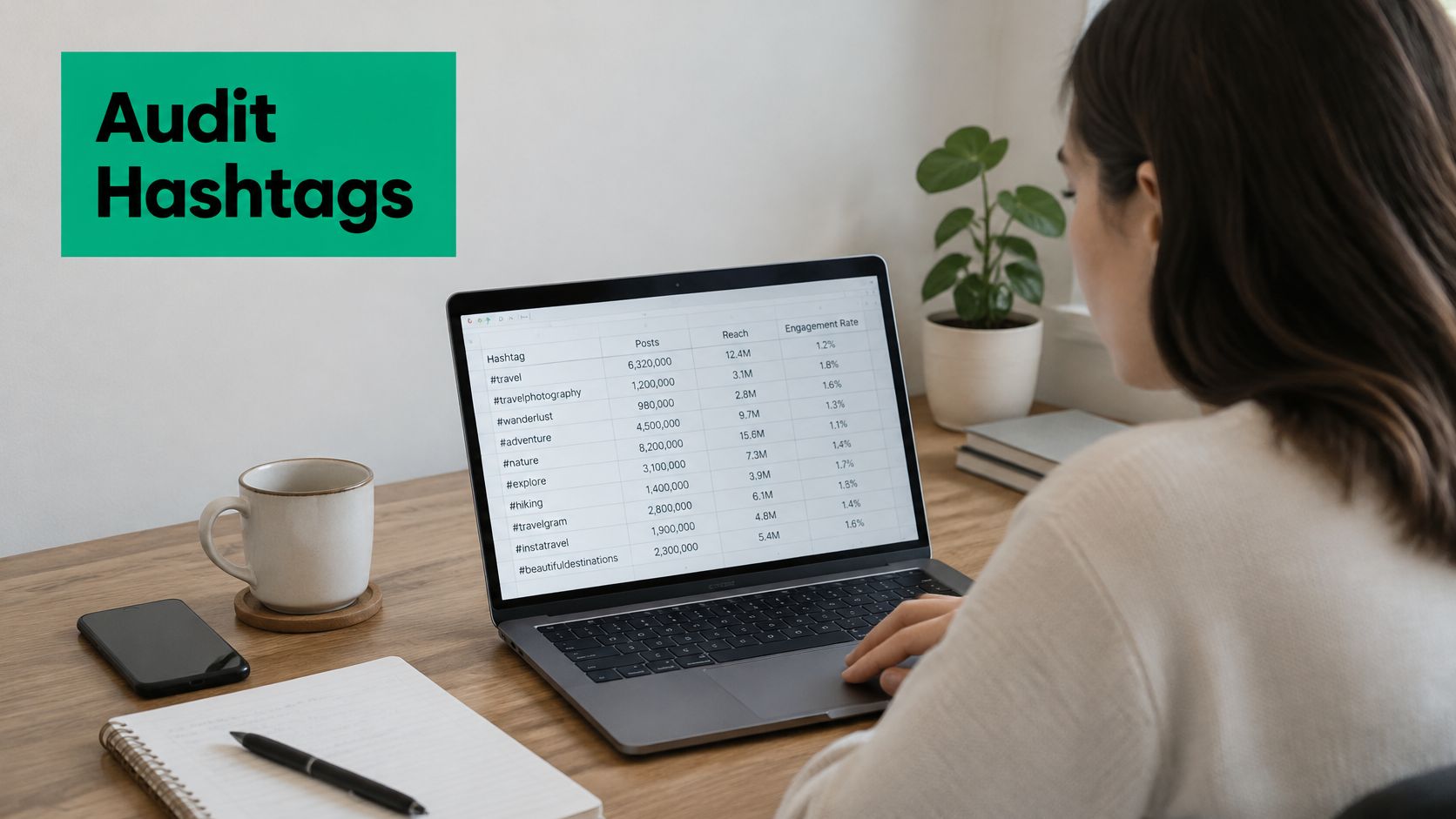
Open a spreadsheet before opening a hashtag generator. Gather a recent batch of comparable posts and place the caption, hashtag set, format, reach, non-follower reach, and available discovery metrics beside each other.
Add a column for the actual subject of each post. This exposes a common mismatch: the tags describe the account's general identity, while the post answers a much narrower question.
Use a worksheet to compare the label with the content, not just the reach total.
Mark the reason each tag belongs
Buffer's Instagram reach guidance recommends three to five relevant hashtags rather than a long generic list. Build that relevance check around these failure modes:
Irrelevance: The hashtag doesn't describe what the viewer sees or learns. A bakery account's equipment-cleaning tutorial needs different labels from its wedding-cake portfolio.
Excessive competition: A huge general category places the post among loosely related content. Its size isn't evidence that it attracts suitable customers.
Ambiguous meaning: The term means something different to another community. Inspect the results rather than trusting your interpretation.
Restriction or spam association: The tag is unavailable, limited, or populated with material you don't want associated with your business.
Use the guide to banned Instagram hashtags as a checking aid, then verify the tag's live status inside Instagram. Don't treat a static list as a permanent ruling.
Replace labels with a clear purpose
Say a Lisbon home baker posts a sourdough shaping demonstration. Replacing #food with #sourdoughathome makes the label more specific; adding a relevant local tag can express location. Neither choice guarantees discovery, but both describe the intended audience more accurately.
Compare weak posts with strong ones, but don't delete a tag solely because it appears on a poor performer. The hook, subject, or format may explain the difference. Mark the tag as a candidate for testing rather than declaring it harmful.
Check the asset too. If a video was exported incorrectly or a crop hides the demonstration, hashtag analysis won't isolate the problem. PostPulse's option to check media before publishing can support that preflight workflow without replacing your review of readability and relevance.
Finish with small sets grouped by content topic. Rotate them because the posts differ, not because repetition alone proves a penalty.
How to Run a 12-Post Hashtag Test
Treat this as a screening experiment, not a promise of statistical certainty. You're looking for a repeatable difference large enough to justify keeping a hashtag workflow.
A Socialinsider analysis summarized by Social Media Today examined more than 75 million posts published from March 2021 to March 2022 and found that hashtag count didn't materially influence distribution; posts using three to four hashtags had the highest average engagement rate by impressions, approximately 3.41%. That historical association offers a starting hypothesis, not a current reach guarantee or a universal target.
Use this workflow to keep the experiment organized.
Build comparable groups
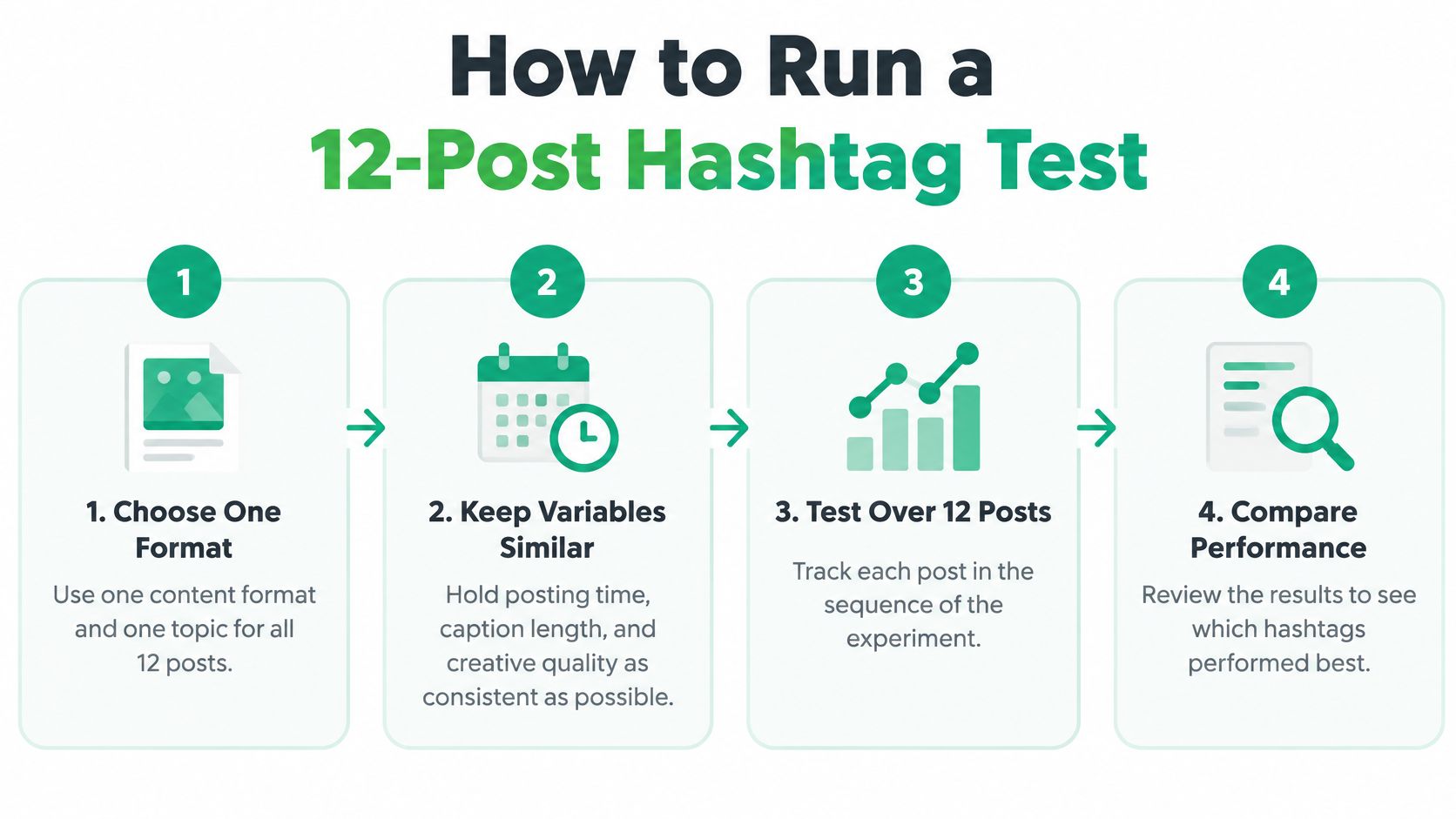
Choose one format and topic. Use a narrow content pillar, such as beginner sourdough tutorials, rather than mixing tutorials, offers, and personal updates. Otherwise, audience interest can overwhelm any tag effect.
Assign the treatments before publishing. For the twelve-post pilot, alternate between no hashtags, a small, highly specific set, and a mixed-intent set within the current publishing cap. Don't reproduce older experiments that require more tags than Instagram now accepts.
Keep other variables similar. Use comparable publishing windows, caption lengths, production standards, and hook structures. Publish distinct posts rather than identical duplicates, and record unavoidable differences such as a collaboration or unusual promotion.
Record meaningful outcomes. Open Instagram Insights and capture non-follower reach, profile visits, saves, shares, and follows where available. Record hashtag-origin impressions only when Instagram exposes that breakdown; a missing field isn't a measured zero.
Use the same observation window. Compare posts at the same age, then calculate each group's median rather than allowing a viral outlier to dominate an average. The Instagram hashtag analytics guide can help organize the measurements.
Retest promising results. A short pilot can identify candidates, but a single standout post can't establish a dependable treatment effect. Extend the comparison with more comparable posts before standardizing a set.
Decide what would change your workflow
Set your decision rule before reviewing the results: keep a treatment only when it shows a consistent advantage in the outcome you care about, without an obvious creative or promotional explanation. For a local service business, qualified profile visits may matter more than extra impressions.
A hashtag set earns its place through repeatable, useful outcomes, not because its best post won the experiment.
If discovery remains negligible across repeated rounds, stop increasing tag volume. Check content relevance and early retention instead. If the groups overlap substantially, use the simplest relevant set and spend less time maintaining it.
When Your Content, Not Your Tags, Is the Problem
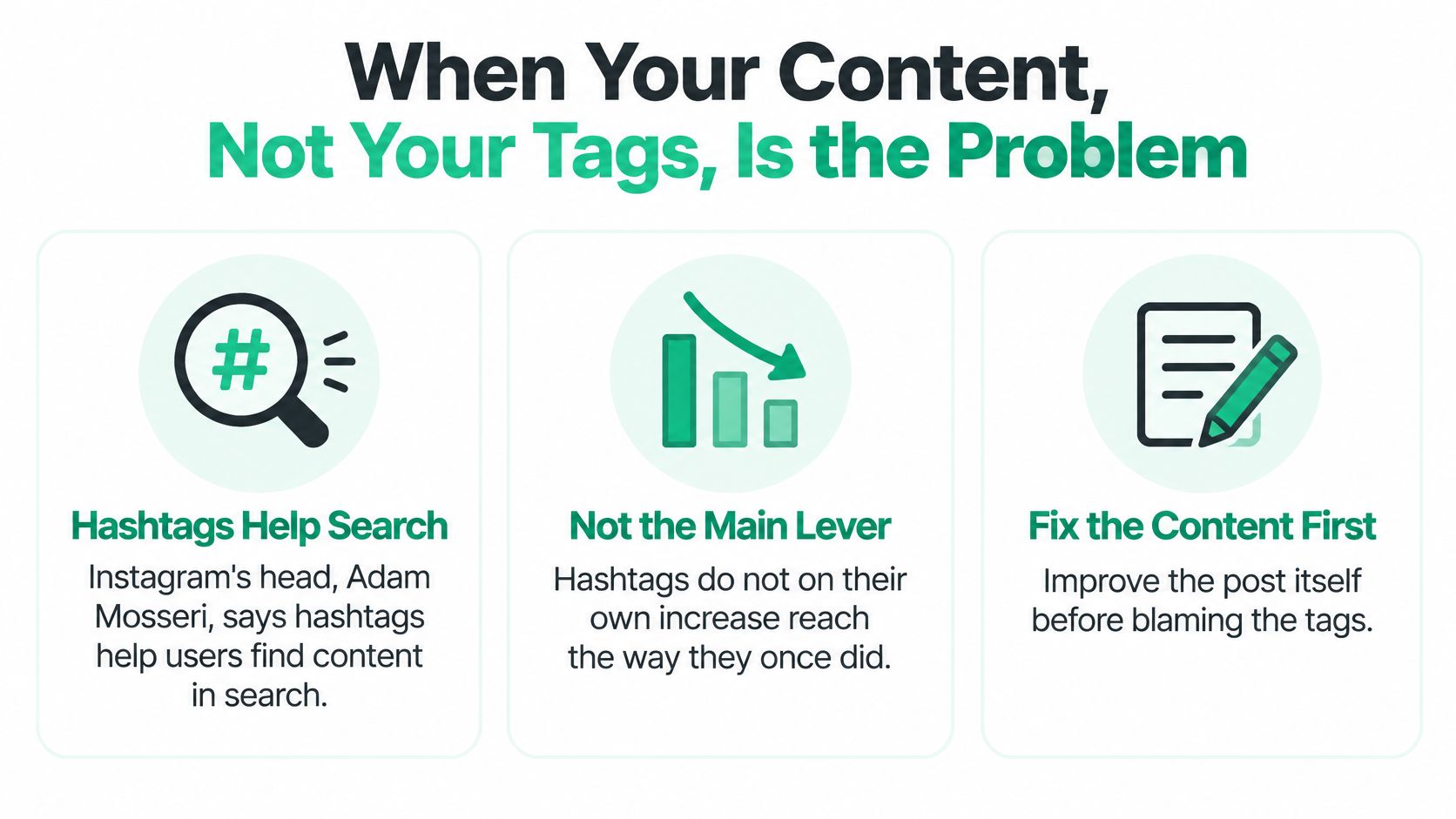
Hashtags can help people find content in search without independently increasing overall reach. Shapeless AI's overview of Instagram hashtags summarizes that distinction from Instagram head Adam Mosseri and cites an analysis of 10.4 million Reels in which hashtags changed views by 7% or less, while collaborations and shorter videos showed stronger effects.
A wider reach decline also doesn't isolate hashtags as the cause. Statista's Instagram reach figures show average reach declining across carousels, Reels, and Stories between 2023 and 2024. That historical pattern doesn't diagnose your account, but it does undermine the assumption that a single format or hashtag choice explains every decline.
Use this distinction when deciding where to spend production time.
Make the benefit visible before asking for attention
Say a baker publishes a carousel with a cover that says “Something exciting.” The useful material, how to prevent a dense sourdough loaf, appears later. A relevant hashtag can describe the subject, but it can't make that vague opening persuasive.
Replace the opening with a clear problem and payoff. For Reels, show the result or mistake immediately, then inspect watch time alongside shares and saves. Use readable on-screen wording and natural spoken keywords that match the actual demonstration.
If the product disappears against a cluttered background, simplify the image. ImagesArt AI's guide can help you find accurate background removal tools for that editing task. A cleaner cutout may improve legibility, but it isn't a substitute for a compelling idea.
Change creative variables separately
Work through the creative in a deliberate order:
First line: State the viewer's problem or the practical result.
Opening frame: Show evidence of that result instead of a long introduction.
Cover: Make the topic understandable when someone encounters the post outside the feed.
Keep the hashtag treatment stable during these comparisons. Otherwise, you won't know whether the stronger opening or the new tags explained the change.
When repeated hashtag tests show no useful movement, schedule a creative-testing block. Spend it making posts easier to understand, worth finishing, and useful enough to share.
A Hashtag Set You Can Keep Using
A standing set should save time without making every post look topically identical. Store tags by content pillar, then choose the subset that accurately labels the asset you're publishing.
For a home baker, sourdough teaching, celebration cakes, and collection-day announcements need different sets. A tag that fits the business isn't automatically appropriate for every post the business publishes.
Give every tag a defined job
The following is a hypothetical working set for a home baker. Search the examples before using them; they illustrate selection logic, not verified popularity or availability.
Tag groups for a standing set. Start with one broad category tag, such as #homebaking, to label the general topic. Add two niche tags that match the exact post, such as #sourdoughathome and #weekendbaking. If local or ready-to-buy viewers matter, add one intent or location tag, such as #bakerylisbon. Together, those four tags form a hypothetical set within the three-to-five range: #homebaking, #sourdoughathome, #weekendbaking, and #bakerylisbon.
Don't keep a location tag merely to fill a slot. It makes sense when local discovery matters, but a globally relevant technique tutorial may deserve another precise topic label instead. Likewise, replace the weekend label when the content has nothing to do with weekend baking.
Maintain the set without overinterpreting it
Record the set name, included tags, content pillar, date tested, and reason for retaining it. Keep alternatives for distinct topics rather than randomly swapping words to make the block look fresh.
Use the available measurements to support different decisions:
Hashtag-impression share: Where available, this indicates how much measured discovery came through hashtags.
Non-follower reach: This shows whether the post reached beyond the existing audience, though it doesn't attribute that exposure to tags.
Profile visits and follows relative to impressions: These help compare audience quality when posts receive different levels of exposure.
A set with less exposure but more relevant profile activity may be more useful than a broad set attracting casual viewers. Judge that trade-off against your goal, whether that's local enquiries, newsletter interest, or audience growth.
Review sets in batches rather than after every disappointing post. If a set repeatedly contributes no observable discovery, replace its weakest candidate or retain only its useful classification labels. When individual-tag attribution isn't available, record conclusions at the set level, not as unsupported claims about a particular hashtag.
Pick the First Fix to Try This Week
Choose the first intervention from the symptom, not from whichever tactic feels most productive. Rebuilding a hashtag library is busywork when Instagram won't accept the comment, and changing account settings won't solve an unclear tutorial.
If publishing fails, inspect the text and remove the blocker. If search checks fail, investigate the tag's status and the account's visibility. If the post is visible but underperforms, preserve a clean baseline before changing creative.
Use the week to establish a reliable baseline
A practical schedule might look like this:
Opening audit day: Gather recent comparable posts, record their tags and outcomes, and label the likely failure stage. Save screenshots of any publishing errors or eligibility notices.
Technical cleanup days: Correct malformed tags, remove unavailable candidates, and verify account visibility. Record each change so you don't later attribute a technical fix to a content experiment.
Experiment setup days: Assign hashtag treatments, prepare comparable posts, and create the tracking sheet. Start publishing at your normal sustainable cadence, then continue beyond the week rather than rushing the entire test.
Don't compress the experiment into an unusually heavy posting schedule just to finish quickly. That changes the conditions you're trying to hold steady. Agencies should also note paid promotion, collaborations, and campaign launches, since those can make apparently comparable posts behave differently.
Make the next action small enough to complete
Before your next post, write down the suspected failure stage and the evidence supporting it. Then choose a single change that could resolve that specific problem.
If you can't identify evidence of a tag problem, don't buy a larger list of supposedly high-reach hashtags. Put that effort into a clearer opening and a measurable comparison.
Hashtags can help classify a post, but they cannot rescue content that viewers skip.
Gainsty offers a free Instagram Hashtag Generator and a free Instagram analysis tool that works with a public username, without a login. Visit Gainsty to prepare relevant tag candidates and review your account before starting a controlled test, rather than treating another hashtag list as a guaranteed reach fix.