Instagram Marketing Agency Pricing Models at a Glance
Most Instagram work is sold as a monthly retainer, a fixed fee for a defined package. It works like a gym membership: you pay whether or not you use every included deliverable, so unused scope is wasted money. Hourly billing is paying per session, which suits a short, tightly scoped job. A percentage fee works like a commission: the agency earns more as your ad budget grows.
There is no single market rate. The 2024 agency and freelancer survey data reported an average proposed monthly fee of approximately $2,107 among more than 100 agencies and freelancers, with an average labor rate of $66.96 per hour. A separate survey of agency owners put the average contract value somewhat higher. Both figures cover broader social media services rather than Instagram alone, so treat them as anchors, not as a price you should automatically accept.
Agency pricing models compared
Hourly billing charges for staff time, with a 2024 average labor-rate benchmark of $66.96 per hour. It suits audits, one-off strategy, and small, tightly scoped tasks, but revisions and scope creep can push the hours up.
Monthly retainers charge a fixed fee for an agreed package. Basic packages start around $750, while mid-market programs commonly cost $2,000-$5,000 a month. They fit ongoing publishing and community management, though you can end up paying for deliverables you do not use.
Project fees cover a defined deliverable, such as an audit, launch campaign, or content library. The price depends on scope, so get the deliverables and revision rounds in writing; changes to that scope can reopen the quote.
Performance-based fees often charge 10%-25% of managed ad spend, sometimes with a minimum such as the greater of $975 or 15% of spend. They can fit paid campaigns with a stable budget, but the fee rises with spend even when the agency's workload does not.
Published U.S. price lists show why scope matters more than the label. One agency lists monthly packages of $750, $1,350, and $1,550, plus a $300 setup fee. A basic tier may cover scheduling, captions, and limited community management. A higher retainer may add strategy, original Reels, photography or video, influencer coordination, ad optimization, and detailed analytics.
No headline price means anything until you know exactly what it covers, what it excludes, and how many approved assets you get.
Compare scope before price: posting frequency, revision limits, contract term, onboarding charges, and account-management time. Then run one calculation. Divide each agency's total monthly cost by the number of approved assets it commits to deliver. Two quotes that describe different work are not comparable, and the cheaper retainer often turns out to be the more expensive buy once you do that math.
What Drives the Price of an Instagram Program
You're not paying for access to an Instagram account. You're paying for labor and production scope. Ranked from largest to smallest, the first driver is original Reels. Each one needs scripting, filming, editing, revisions, captions, and platform adaptation. Ten Reels will always cost far more than ten static posts using existing photos.
Second is community management. Daily replies, comment moderation, and direct messages create recurring labor tied to message volume and your response-time promise. Weekend coverage and fast response windows cost more because someone has to be available. If your team can handle routine replies, remove that work from the agency scope instead of paying twice.
The middle cost drivers
Third is paid campaign management. The work grows with creative variants, audiences, placements, tests, optimization decisions, and reporting needs. A simple campaign with one audience isn't the same job as several offers tested across multiple creative concepts. The tools behind that work matter too, and this overview of essential social media agency tools for client success shows the kind of stack that supports planning, publishing, and reporting.
Fourth is creator coordination. Outreach, briefs, contracts, approvals, and posting checks take staff time. Creator fees and usage rights commonly sit outside the retainer, so don't assume the people appearing in content are included. Photography and video production often sit outside it too, especially location shoots, talent, props, and editing beyond the agreed format.
The quieter costs buyers miss
Static posts and captions: Copywriting, design, hashtag work, and scheduling cost less than video, but volume still adds hours.
Analytics depth: A standard monthly report costs less than custom dashboards, attribution checks, and weekly recommendations.
Revision rounds: Edits beyond the agreed limit add billable work, and slow approvals can create rush production later.
Approval workflow: Every extra approver adds waiting, comments, version control, and account-management time.
You have three levers that lower price without automatically lowering quality: posting frequency, format mix, and response coverage. Say you swap four Reels for four carousels in an eight-post month. Your post count stays at eight, but scripting, filming, and editing hours drop. That's a smarter cut than asking the agency to produce the same video scope for less.
My recommendation is simple. Protect original creative and reporting first. Cut low-value posting volume before you cut testing, because weak creative wastes both production money and ad spend.
Monthly Budget Ranges by Business Stage
Budget ranges are only useful if you price the whole program, not the retainer. A solo creator buying scheduling help and an enterprise brand buying multi-market paid acquisition are shopping in different markets, even if both say they want Instagram marketing.
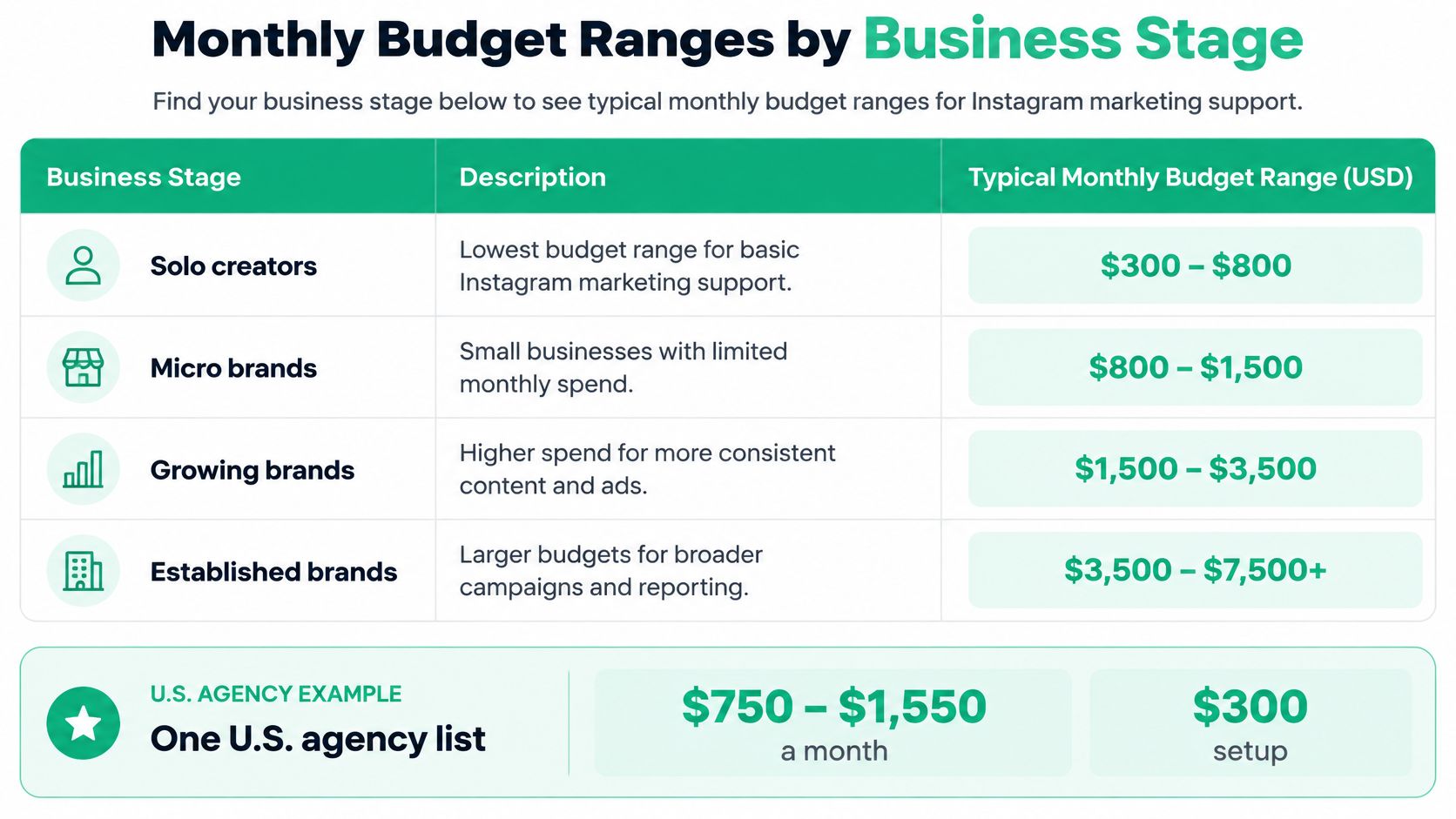
Typical monthly fees by business stage
A solo creator or micro brand can expect to pay $750-$1,550 a month for scheduling, captions, and limited community management, often plus a setup fee. One agency price list shows a $300 setup fee.
A small business buying strategy, Reels, community management, and reporting typically pays $1,500-$5,000 a month. A mid-market brand buying content, community management, analytics, and limited paid-social work typically pays $2,000-$5,000 a month.
An enterprise program covering multi-market content, paid acquisition, and creator programs may cost $5,000-$20,000 a month. At every stage, ad spend is billed separately in most quotes.
The Digital Applied social media marketing costs guide gives a practical benchmark of approximately $2,000-$5,000 per month for a mid-market program combining content publishing, community management, analytics, and limited paid-social execution, with enterprise programs exceeding $5,000-$20,000 monthly. The same source cites a 2024 survey benchmark for managing LinkedIn, Instagram, and Facebook, with three posts per platform weekly, 5-10 hours of community management, and reporting, at a $2,107.14 average monthly retainer.
These benchmarks don't always agree, and they aren't regulated rates. Different surveys count different platforms, deliverables, and business sizes. Don't treat disagreement as a reason to pick the lowest number. Treat it as a reason to demand a scope you can count.
The mistake to avoid is approving the retainer and forgetting everything around it. Say a small business pays a $1,500 retainer plus $1,000 in ads. That's a $2,500 monthly program, not a $1,500 one. If photography, creators, or software are extra, the total rises again. Judge that $2,500 by the approved assets it ships, because two agencies at the same fee can deliver very different volumes of finished work.
Budgeting rule: Approve the full monthly program cost, not just the amount invoiced by the agency.
Place your business in one row, then write down the ad budget and production money you can add to it. If the total doesn't work, reduce scope before you talk to agencies. A clear smaller brief beats a vague larger one.
How to Check Whether a Quote Is Good Value
A good quote is one whose total cost you can explain per approved asset. If the agency can't tell you how many finished assets, campaigns, reports, and management hours the fee buys, you don't have a quote yet. You have a monthly number.
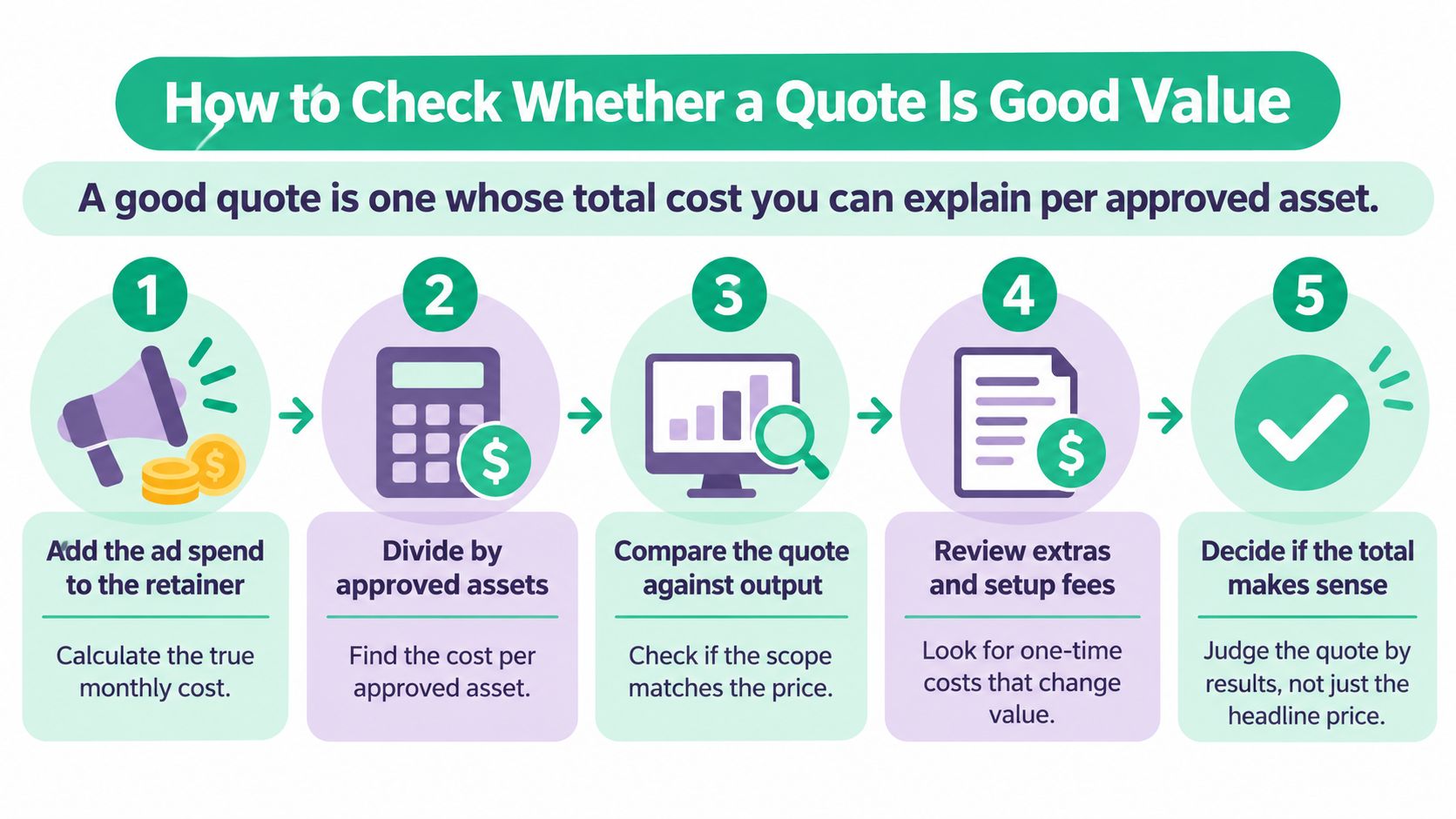
Run this six-step check
Add ad spend to the retainer. A $2,000 retainer with $5,000 in ads is a $7,000 monthly program. This is the only number your budget should approve. Paid management is separate because effort scales with creative variants, audiences, optimization events, and reporting, and the BusyLike guide to advertising agencies on Instagram describes a common structure of a minimum retainer beginning around $1,000 per month or roughly 10%-25% of ad spend, with ad spend billed separately.
Divide the total by approved assets. Say the $7,000 program produces 8 Reels and 8 posts. That's 16 assets, or about $437.50 per asset. Count only assets that pass approval and get published or used in ads, not drafts, raw clips, or unused concepts.
Count management hours and limits. Ask how many hours cover strategy, production, community replies, ad optimization, meetings, and reporting. Check the revision limit and response coverage in writing. A low fee with almost no revisions can become expensive once normal feedback begins.
List every exclusion. Put photography, video production, creator fees, usage rights, onboarding, software, travel, and taxes on separate lines. If an item is excluded, estimate it now. Don't discover after signing that the retainer buys coordination while you still have to fund the shoot.
Confirm ownership and reporting. You should own the ad account, audience data, creative files, and performance history. Agree on reporting cadence before launch. This guide to Instagram analytics for business growth is useful for deciding which metrics belong in that report.
Set attributable success metrics. Use cost per landing-page view, cost per qualified lead, conversion rate, and incremental revenue where they fit your offer. Follower growth alone doesn't prove the program created customers. Agree on the decision rule too, such as which result triggers more budget, a creative change, or cancellation.
A cheap quote with few assets, no testing, and thin reporting often costs more per result than a higher quote with clear output. You're not buying activity. You're buying finished assets, useful learning, and attributable outcomes.
If an agency resists itemizing deliverables, walk away. Good agencies can explain their price. Weak agencies hide behind words like strategy, growth, and full service.
Retainer or Percentage Fee at Different Ad Budgets
Percentage-of-spend pricing typically runs between 10% and 25% of ad spend, and agencies that quote it usually add a monthly minimum, commonly around $1,000. To see what that does to your bill, run one worked example: a fee of 15% of spend with a $1,000 floor, compared against a flat $2,000 retainer. The flat retainer starts winning once spend passes roughly $13,333 a month.
Percentage fee versus flat retainer by ad spend
At $3,000 or $5,000 in monthly ad spend, a fee of 15% with a $1,000 minimum costs $1,000, making it $1,000 cheaper than a flat $2,000 retainer in either case. At $10,000 in spend, the percentage fee rises to $1,500 and remains $500 cheaper.
The two fees break even at approximately $13,333 in monthly spend, when each costs about $2,000. At $20,000 in spend, the percentage fee is $3,000, making the flat retainer $1,000 cheaper. At $50,000 in spend, the percentage fee reaches $7,500, and the flat retainer is $5,500 cheaper.
Always separate the management fee from the media budget before you compare quotes. At $10,000 in monthly spend, the fee in this example costs $1,500, so the program really costs $11,500 before a single asset is produced. That distinction matters at scale: the Statista social media advertising outlook projects worldwide social media advertising expenditure at roughly $338.8 billion for 2026, and every percentage point of fee attached to spend like that is real money.
A fixed retainer fits a stable workload. If campaign count, creative testing, and reporting stay similar while spend rises, the agency has not earned more just because Meta bills you more. A percentage fee can be fair when higher spend creates more testing and optimization work. Ask what extra work the extra fee buys. If the answer is vague, cap it.
My preferred structure for growing budgets is hybrid pricing. Set a base fee covering account structure, tracking, reporting, and a named number of campaigns. Add a variable component only when agreed thresholds are crossed, such as more creative tests, more audiences, or a higher spend band. The agency gets paid fairly for added work, and you avoid handing them a raise every time you increase spend.
The cheapest management fee can cost the most when underfunded creative testing sends a large media budget behind weak ads.
Judge both models by cost per approved asset rather than the headline fee. Divide your total monthly program cost (management fee, media spend, and production) by the number of finished, tested creatives the agency ships. A $2,000 retainer delivering eight tested assets beats a $1,000 fee delivering two.
Below the break-even point, the percentage model wins on cash cost. Above it, negotiate a flat retainer or a capped hybrid.
In-House, Agency or AI-Assisted Platform Compared
This decision is a trade-off among control, speed, and cost. There's no universally right answer. The wrong answer is choosing the cheapest format for work it was never built to do.
The comparison below sets the three operating models against the same criteria.

In-house, agency and AI-assisted platform options
An in-house specialist costs a salary, benefits, and tools, so estimate the full cost using local hiring rates before comparing it with an agency. You control priorities directly, but hiring and training take time, and the work may depend heavily on one person.
A full-service agency typically charges a mid-market retainer of $2,000-$5,000 a month plus ad spend. You set expectations through the contract, and an agency can often get started quickly, though timing varies. The main risk is paying for deliverables you do not use.
An AI-assisted platform such as Gainsty is listed here at $177 for four months on Upgrade or $237 for four months on Turbo. You set targets and review progress; the stated growth start times are 24 hours for Upgrade and 2 hours for Turbo. Growth remains subject to Instagram's account limits, and results are not guaranteed if Instagram changes.
An in-house specialist gives you direct control over brand voice and priorities. It also creates hiring time, management work, tool costs, and key-person risk. Before you compare it with an agency, price the fully loaded role from local hiring rates. Salary alone understates the cost.
A full-service agency is the better fit when you need strategy, original creative, paid campaigns, and reporting as one coordinated program. If creators are part of that program, remember to budget for influencer platform fees separately from the agency retainer. Our guide to outsourcing social media management helps you decide which tasks should leave your team at all.
Our Upgrade plan costs $177 for four months, with growth starting in 24 hours. Our Turbo plan costs $237 for four months (25% off from $316), with growth starting in 2 hours. Turbo includes everything in Upgrade plus 700-1,700+ real followers per month, advanced AI features, Explore page growth support, DM automations, competitor and language targeting, and a dedicated account manager.
State the limits plainly. Our growth system works within the limits set by Instagram for each specific account, affected by account history, Trust Score, and posting and browsing habits. We have no control over Instagram and can't guarantee results if Instagram changes its platform.
One customer put the trade-off candidly.
"Growth is a bit slow compared to running ads, honestly, but the follower quality is high. People actually engage and book calls, and retention is solid over several months.", Johannes B., Gainsty reviews
Here's my verdict by situation. A creator testing growth on a tight budget should start with a platform trial. A brand needing strategy and original creative should hire an agency. A company with steady content volume and budget for a strong hire should build in-house.
Negotiate the Quote and Confirm Your Next Step
Do one thing now. Get the total three-month program cost in writing, including the retainer, ad spend, setup, production, creator fees, usage rights, and taxes. Don't negotiate the monthly fee until you can see the full commitment.
Ask for these terms before you sign
Itemized quote: Require the setup fee on its own line, then ask whether it can be waived or spread across the first months.
Revision limit: Get the number of included rounds and the price for extra edits in writing.
Response coverage: Confirm which days and hours the agency monitors comments and messages, and who covers gaps.
Approval workflow: Name the approver, turnaround time, and what happens when feedback arrives late.
Ownership: Confirm you own the ad account, audience data, source files, and reports if the contract ends.
Exit terms: Ask for cancellation notice, the initial commitment length, and any fee for leaving early.
Pilot option: Propose a shorter first term with agreed success metrics before a longer commitment.
Relevant references: Ask for examples tied to approved assets and measurable outcomes, not follower counts alone.
Then compare two or three serious options using the same formula. Total program cost divided by approved assets, plus the management hours and exclusions behind that number. If the scopes still differ, ask each provider to quote the same deliverable list.
If an AI-assisted platform is on your shortlist, use our free trial before committing to a multi-month plan. You can also chat with an Instagram specialist and book a call over email before you decide. Keep the order strict. Quote, math, pilot, then sign.
If a full agency retainer is more than your current Instagram program needs, Gainsty gives you a lower fixed-cost way to test targeted organic growth, review progress, and keep control of your targets. Start with the free trial, compare the results against the cost-per-asset and outcome targets in your agency quotes, then put your larger budget only behind the option that proves its value.