That "Great Post!" Comment You Just Got Is Probably a Bot
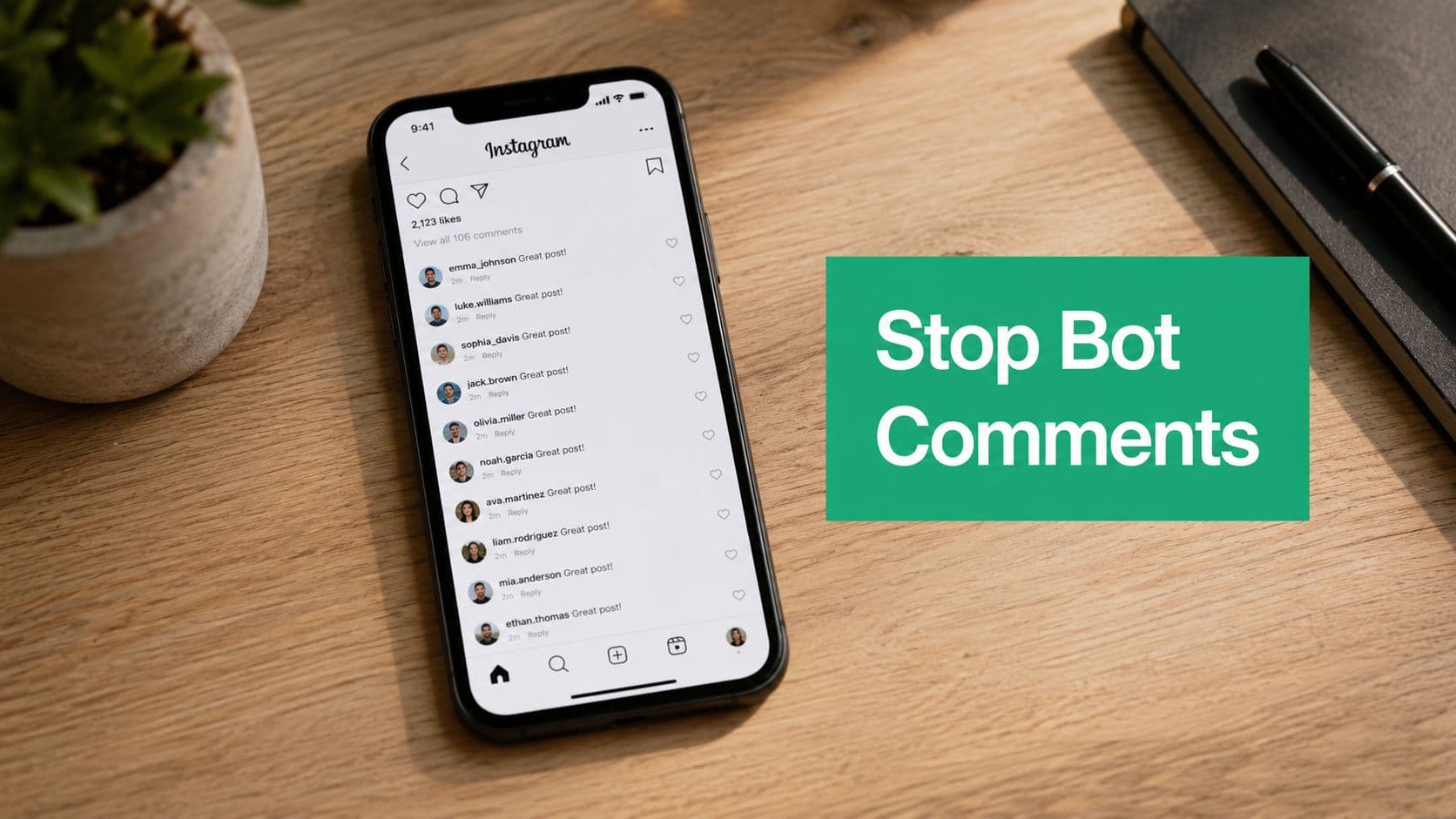
A local business owner once showed me a post that got a burst of comments within minutes. On paper, it looked active. In reality, the comments read like they were copied from a worn-out script.
“Awesome.” “So good.” “Love this.” A row of fire emojis on a post about store hours.
None of those comments referred to the image, the caption, or the question in the post. Not one person seemed to be having a real conversation. The owner's frustration wasn't about vanity. It was about trust. Customers were seeing spam before they saw the actual brand voice.
That's the part many people miss. Bot comments on Instagram don't just clutter your notifications. They change how your account feels to real people. If someone lands on your page and sees obvious junk under every post, they start making quiet judgments. Is this brand buying attention? Is this account safe to engage with? Is anyone managing this page?
A spam-filled comment section doesn't look popular. It looks unmanaged.
For personal brands, that hurts authority. For e-commerce, it hurts confidence. For agencies and service businesses, it can make you look careless right when a prospect is deciding whether to trust you.
There's also a second layer to this problem. Some users seek out comment bots as a cheap growth trick. Others are getting hit by them without asking for it. Those are different situations, but they lead to the same place: lower-quality interactions, less clarity about who your real audience is, and more work cleaning up the mess.
What Instagram Bot Comments Are in 2026
Bot comments used to be easier to spot. They were blunt, repetitive, and attached to obviously fake profiles. Think of the old version like a telemarketer reading one line to everyone on the call list.
Today's version is more polished.
A major shift happened in 2018 to 2021, when the ecosystem moved from mostly fake-profile spam toward tools built to generate comments from real people or AI-assisted replies, as described in this breakdown of Instagram comment bot evolution. In that same example, one platform said users got 3x to 5x more engagement on average when they asked for a simple comment. That change matters because the focus moved from obvious spam to engagement-driven automation.

Old bots versus modern bots
The old model was easy to understand. Fake account. Generic compliment. Maybe a spammy link. Move on.
The newer model is trickier because it often tries to look context-aware. Instead of “Nice pic,” a modern automated comment might mention a keyword from your caption, react to a visible topic in the post, or ask a vague follow-up question that feels almost human.
Here's a simple comparison:
Old spam bot
What it looks like: Generic praise, repeated phrases, or obviously incomplete/fake-looking profiles
Main giveaway: Often easy to spot because the comment ignores the actual content of the post and could be copied anywhere
AI-assisted comment bot
What it looks like: Semi-relevant comments with cleaner grammar and more natural wording
Main giveaway: May still feel overly broad, shallow, or strangely similar across multiple posts
Human engagement
What it looks like: Specific reactions, personal tone, and real back-and-forth interaction
Main giveaway: Directly connects to the post itself and naturally supports an ongoing conversation
Why did this get harder to detect
Modern bot comments often aim to blend in, not stand out. They don't always push a scam link right away. They often try to create the appearance of interest first.
That's why simple assumptions don't hold up anymore. A polished sentence isn't proof of a real person. A relevant keyword isn't proof either. Automation can now mimic surface-level conversation well enough to fool a rushed account owner.
If you want a broader primer on the kinds of accounts behind this behavior, Taap.bio's guide on spam accounts is a useful reference. It helps separate low-effort spam profiles from the more convincing versions that slip through casual moderation.
The core definition that matters
For practical purposes, Instagram bot comments are comments created or triggered by automation rather than genuine user intent. Some are built for spam. Some are built to fake engagement. Some are designed to warm up a target before sending a sales pitch or scam.
That distinction matters because not every bot comment looks ridiculous anymore. But the underlying problem hasn't changed. The interaction still isn't real, and your audience can feel that.
How to Spot Bot Comments on Your Profile
You don't need forensic tools to catch most bot activity. You need a repeatable way to review comments and profiles without overthinking every notification.
The fastest method is to inspect the comment first, then inspect the account behind it.

Five signals that show up again and again
The comment says almost nothing
“Great post!” “Awesome content!” “Love this!” These comments aren't automatically fake, but they become suspicious when they appear repeatedly, especially across unrelated posts.The reply is slightly off-topic
You post a detailed caption about a product update and get a comment that sounds positive but doesn't connect to the topic. That mismatch is one of the most common clues.The account looks thin or strange
Check the profile. Does it have very few posts, no profile photo, unrelated images, or a bio that feels empty or spammy? Those patterns matter more than any single comment.You get a burst of comments in a short window
One bot builder's documentation says a comment bot should be limited to 15 to 20 comments per hour and should take breaks between runs, according to this Instagram comment bot documentation. That's useful because it explains why automated comments often show up in suspicious clusters instead of a natural flow.The same style repeats across multiple accounts
Different usernames. Same tone. Same emoji pattern. Same generic enthusiasm. That kind of uniformity usually points to automation, not coincidence.
Practical rule: Don't judge a comment in isolation. Judge the comment, the profile, and the timing together.
A quick audit method
When you're reviewing your own posts, use this short checklist:
Read for specificity. Does the comment mention the image, caption, question, or topic?
Check the account history. Real followers usually leave traces of a real identity.
Look for repetition. If several comments feel interchangeable, that's your clue.
Watch the timing. Bursts often reveal automated workflows.
See whether the person responds. Bots rarely handle natural back-and-forth well.
If you want an extra reference point, this guide on how to spot Instagram bots gives a useful outside checklist. And if you suspect the issue goes beyond comments, Gainsty's article on checking fake followers on Instagram can help you assess whether low-quality accounts are affecting your audience quality more broadly.
What confuses most people
The hardest part is that some real people also leave short comments. Not every brief reply is fake.
A primary test is pattern recognition. A genuine follower might say “Love this” once. A bot network says the same thing at scale, from weak profiles, with no actual conversation behind it. That's the difference you're looking for.
The Real Risks to Your Brand and Reach
Many users treat bot comments like a housekeeping issue. Delete a few. Ignore a few. Move on.
That's too casual.

Instagram's policy explicitly forbids artificial interactions, including automatically generated comments, likes, or follows, as noted in this explanation of Instagram bot comment policy. Once you understand that, the issue stops being a minor annoyance and takes on its true form: a compliance, reputation, and brand safety problem.
Reputation damage happens first
Your comment section is public proof of what kind of community you've built. When it fills with generic praise, irrelevant replies, or obvious spam, people notice.
A prospect may not know the technical details of automation. They don't need to. They just need to feel that something is off. That feeling can be enough to weaken trust before they ever click your website or send an inquiry.
For founders, consultants, and public-facing leaders, reputation risk deserves the same seriousness online that it gets anywhere else. This guide on digital reputation protection for executives is useful because it frames public-facing digital clutter as a strategic issue, not just an inconvenience.
The quality gets distorted
Even without getting into technical speculation, one practical issue is obvious. If your comments are crowded with fake or shallow interactions, you lose a clear read on what your real audience cares about.
That hurts decision-making.
You can't easily tell which topics are sparking genuine interest. You can't tell whether a question resonated. You can't tell whether a launch created a real conversation or just triggered low-quality noise. When your signals are dirty, your content strategy gets worse.
The damage isn't just visible. It also clouds your judgment about what's working.
Security risk is the part that people ignore
Some bot comments aren't trying to flatter you. They're trying to exploit your audience.
That can mean suspicious offers, bait to push people into DMs, or comments that steer followers toward sketchy accounts. Even if the attack isn't directed at you personally, it's sitting under your post, beside your brand, in front of your customers.
A lot of account owners only take this seriously after a follower messages them to ask whether a weird comment is legit.
If your audience has to wonder whether your comment section is safe, you've already lost something important. Not reach. Credibility.
A Proactive Guide to Removing and Preventing Bots
Cleaning up bot comments on Instagram works best when you split the job into two. First, remove what's already there. Then reduce what gets through next time.
Trying to do only one of those usually fails. Deleting without prevention turns moderation into a treadmill. Prevention without cleanup leaves old spam sitting under posts where people can still see it.
Remove what's already hurting the page
Start with the obvious offenders. Delete comments that are generic, unrelated, spammy, or trying to pull people into suspicious offers. Then block the accounts that keep returning.
If an account looks malicious or repeatedly targets your posts, report it through Instagram's in-app tools. That doesn't guarantee instant action, but it helps create a documented pattern.

A simple removal routine looks like this:
Delete visible spam quickly so new visitors don't assume it reflects your normal engagement.
Block repeat offenders when the same profiles or networks keep showing up.
Report suspicious accounts if the behavior looks coordinated, scammy, or abusive.
Review older high-traffic posts because bots often pile onto content that already gets attention.
Prevention needs more than keyword filters
Modern automated comment systems often simulate browser actions, pull text from the post, clean that text with JavaScript, send it to an LLM through an API, then generate a context-specific reply before inserting it into the comment field in-browser, as shown in this technical walkthrough of automated Instagram comment generation. That matters because simple keyword blocking isn't enough anymore.
If a bot can generate a comment based on your actual caption, basic filters will miss a lot of it.
Build a layered defense
Use Instagram's comment controls, but don't rely on one setting to solve everything.
A stronger setup usually includes:
Hidden words and custom filters for repeated spam phrases, known bait terms, and recurring emoji patterns
Manual review habits on posts that tend to attract junk activity
Comment limits for situations where a post is drawing too much low-quality traffic
Fast moderation after publishing because early comment windows often shape how the thread develops
If you need help using Instagram's native controls more aggressively, Gainsty's article on how to limit comments on Instagram is a practical next step.
Clean comments aren't just a moderation win. They make it easier for real followers to speak up.
One habit that pays off
Reply to real people quickly.
That does two things. It rewards authentic engagement, and it makes fake engagement look more out of place. A thread with genuine back-and-forth is much harder for generic spam to blend into than a silent post where any comment looks equally valid.
The Authentic Growth Alternative That Works
If this all sounds like a reason to avoid shortcuts, that's because it is.
Bot comments promise the appearance of momentum. What they usually create is clutter, risk, and confusion. They don't build trust. They don't create loyal followers. They don't produce the kind of engagement that turns into customers, referrals, or a real community.
The alternative is less flashy, but it's stronger.
What authentic engagement actually looks like
Real growth comes from content that gives people a reason to respond and a reason to return. That usually means:
Asking better questions instead of posting captions that end with nothing
Replying with intent so followers feel there's a person behind the account
Publishing with consistency so your audience learns what to expect from you
Creating posts with a clear point of view rather than generic content that attracts generic reactions
This approach doesn't just improve your comment quality. It improves your audience quality. The people who stay are the people who care.
Why sustainable growth protects the brand
When your growth strategy is clean, moderation gets easier. Your analytics make more sense. Your comment section starts reflecting your positioning instead of fighting against it.
That's why organic growth matters. It protects your reputation while building the one thing fake engagement never can: real trust. If you want a practical foundation for that approach, Gainsty's guide on how to grow Instagram followers organically is worth reading.
A healthy Instagram account doesn't look busy for the sake of looking busy. It feels credible. The comments sound human. The audience fits the brand. The conversation moves somewhere useful.
That's the standard to aim for.
If you want help growing on Instagram without bots, fake followers, or risky shortcuts, Gainsty offers a safer path focused on authentic engagement and organic audience growth. It's built for creators, businesses, and brands that want real momentum without sacrificing credibility.

.png&w=1920&q=75&dpl=dpl_34ZXCf12K5qjjdZjPn9snwDRADrB)





.png&w=750&q=75&dpl=dpl_34ZXCf12K5qjjdZjPn9snwDRADrB)