What the Instagram Explore Page Really Rewards in 2026
The Explore page isn't a single leaderboard where every user sees the same winning posts. Instagram ranks content for each person based on signals such as what they've liked, saved, and commented on previously. Its official ranking explanation also identifies likes, saves, and shares among the important actions Instagram predicts when selecting Explore content.
That changes the question you should ask. Don't ask, “How do I make this post go viral?” Ask, “Which specific people would find this useful, entertaining, or worth sending to someone else?” Relevance comes before scale. A post may begin with a small group of followers and closely related viewers, then reach wider pools when those viewers respond strongly.
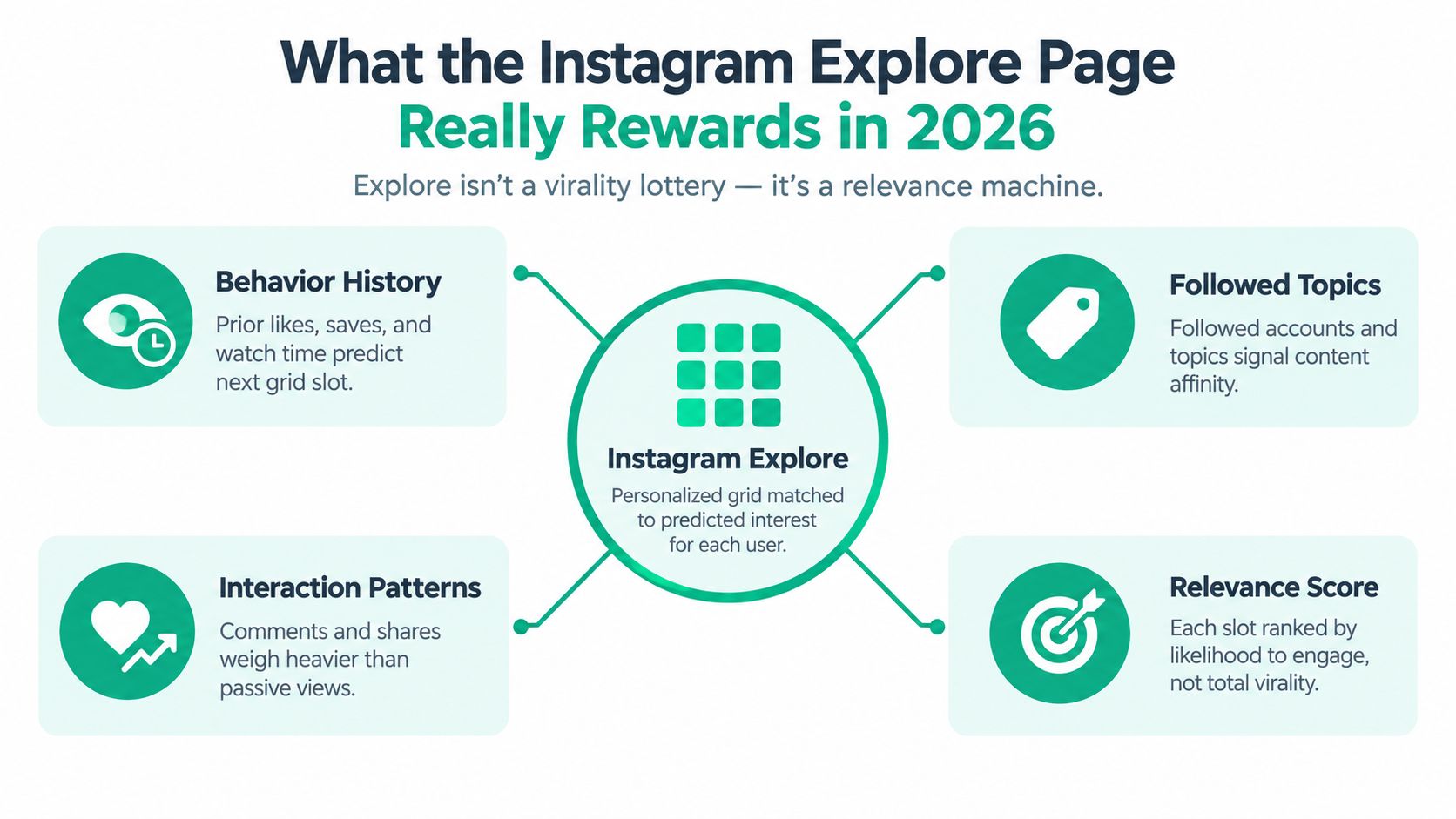
Explore works through staged distribution
A creator with a modest follower base can still reach a large non-follower audience when the content earns the right behavior early. The important mechanism isn't follower count. It's whether the post performs with people who are likely to care about that topic.
Explore is also a substantial discovery surface. An industry roundup reports that about 50% of Instagram users visit Explore each month (Later's social media statistics roundup). Secondary industry sources also estimate that Explore represents 13–18% of platform views and that roughly 47% of Reel views come directly from Explore, although those figures aren't published by Instagram itself and should be treated as directional rather than official.
Build for behavior, not a lucky break
The signals worth engineering are clear:
Watch time, especially on Reels, shows whether the opening earns attention.
Completion rate reveals whether the payoff justifies staying.
Saves indicate future reference value.
Shares expose the post to someone else's network.
Engagement velocity shows whether the post creates meaningful response soon after publication.
Dwell time and swipe depth help explain whether carousels and static posts hold attention.
Creators who need stronger footage, editing, or visual packaging can also work with short-form video production specialists when production quality is the bottleneck. But better production won't rescue a vague idea. The concept still needs a clear audience, a strong opening, and a reason to act.
The Ranking Signals That Move Posts Into Explore
Instagram's Explore ranking uses information about the post, the creator, the viewer's activity, and the relationship between viewer and creator. The platform's own explanation places likes, saves, and shares among its important predicted actions, while independent breakdowns of the system emphasize retention and engagement depth. That means a post with fewer passive likes can be more useful for discovery than one that attracts quick, shallow approval.
The signals to prioritize
Saves represent delayed value. Someone saves a tutorial, checklist, recipe, reference graphic, or framework because they expect to use it again. Design posts that remain useful after the first viewing, then make the value obvious enough that saving feels natural.
Shares create a stronger discovery loop. A viewer who sends a post to a friend is effectively identifying another person who may care about the same subject. Shareable content often solves a specific problem, expresses a recognizable opinion, or describes a situation people want to discuss together.
Watch time and completion rate matter most for Reels. Instagram's ranking guidance, as summarized in Hootsuite's Instagram algorithm breakdown, includes whether viewers are likely to spend more than five seconds with a post and whether they'll watch at least 95% of a video. Use completion as a quality test, not as a vanity score.
Engagement velocity captures the early concentration of likes, comments, saves, and shares. A post that produces meaningful interaction quickly gives Instagram stronger evidence that the content fits a nearby audience. The response must be relevant, though. Artificial activity or engagement from people outside your topic can create noisy signals.
Saves measure future reference value and help identify useful, repeatable content. Shares measure person-to-person relevance and can extend discovery into adjacent audiences. Watch time measures how well a video holds attention and indicates whether a Reel earns continued viewing. Completion rate reflects the percentage of a video watched and shows whether the payoff satisfies the opening promise. Engagement velocity measures the speed and quality of early response and helps Instagram decide whether to test the post more broadly. Carousel dwell time tracks how long people spend reading and swiping, which signals depth of interest in multi-slide content. Profile visits show curiosity after exposure and support topical and creator relevance.
Likes still matter, but they're a weak standalone target. The same principle appears in other recommendation systems, including the X algorithm explained by Xholic AI. Don't chase the visible action while ignoring the behavior that shows intent.
Each format gives you a different way to earn these signals. Reels are built around retention and replay behavior. Carousels are designed for swipe depth and saves. Static posts need enough visual and informational value to earn sharing or a profile visit despite having less built-in interaction.
Engineering Reels for Watch Time and Completion
A strong Reel makes the viewer understand the promise before they have a reason to scroll. Start with a pattern interrupt, a specific outcome, or a curiosity gap in the opening moment. Avoid intro slates, logos, and greetings that delay the useful part.
Use a retention-first structure
Open with the problem or result. Put bold text directly on the first frame, such as “Fix your weak Reel hook” or “Three edits that improve retention.” The viewer should know what they'll gain without turning on sound.
Make the promise specific. Replace “Tips for better content” with a defined result or a clear tension. Specificity gives people a reason to keep watching instead of making them decode the subject.
Reintroduce progress throughout the Reel. Use cuts, on-screen text, visual changes, open loops, and small payoffs. Every beat should answer part of the question while creating a reason to see the next beat.
Deliver the strongest proof before the ending. Don't hide all value until the final frame. Give viewers enough substance to trust the content, then reserve a concise conclusion, checklist, example, or reveal for completion.
Create a clean loop. End on a frame, motion, or sentence that connects naturally to the opening. Replays can increase total viewing time without requiring a separate idea.
For creators who need help turning concepts into repeatable drafts, a tool such as Hooked AI Reels maker can support ideation and production. Use it to speed up execution, not to publish generic scripts without adapting the hook to your audience.
Retention rule: A shorter Reel that viewers finish can be more valuable than a longer Reel that loses them before the payoff.
Add save triggers through steps, templates, mistakes, or compact processes. Add share triggers through a sharp opinion, a relatable scenario, or a line that describes a friend's problem accurately. Then review completion, average watch behavior, saves, and shares in Insights. For more format-specific planning, use this guide to Instagram Reels in 2026.
Designing Carousels and Posts That Earn Saves and Shares
Carousels don't need a dramatic video hook to earn Explore distribution. They need a reason to swipe, a reason to continue, and a reason to return later. Treat every slide as a standalone piece of value, while making the sequence feel incomplete until the viewer reaches the end.
Build the carousel as a reference tool
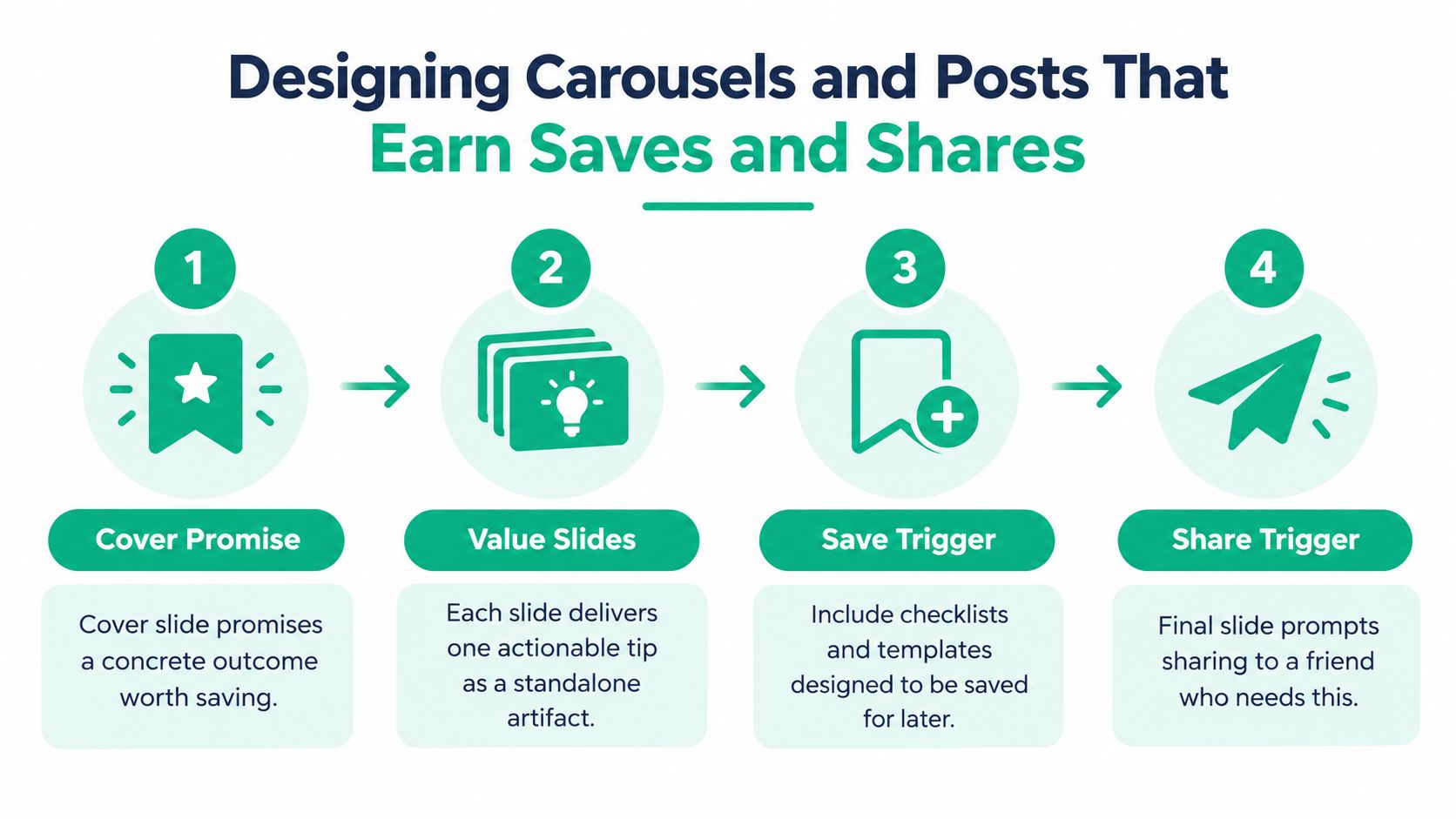
Start with a cover that promises a concrete outcome in a few words. “Instagram Bio Fixes” is clearer than “Thoughts on Branding.” The second slide should contain a strong, useful point because a weak opening sequence gives viewers no reason to continue.
Use a simple progression:
Cover promise: State the outcome clearly.
Early value: Give the strongest actionable insight near the beginning.
One idea per slide: Keep the text scannable and visually distinct.
Open loop: Create a logical reason to see the next frame.
Final reference point: End with a checklist, template, summary, or framework.
Share prompt: Ask the viewer to send it to someone who needs the information.
Carousel depth is useful because each swipe demonstrates active attention. Avoid packing several unrelated lessons into one slide. A reader should be able to save a single frame and understand its practical use later.
Captions should add context rather than repeat every slide. Lead with the value in the opening lines, use short paragraphs, and include natural keywords that describe the subject. A specific prompt such as “Save this before your next content session” gives the viewer a clear action, while “What do you think?” often produces low-effort comments without improving reference value.
Generic hashtags won't compensate for a carousel that no one finishes. Use a small set of highly relevant topic labels if they help classification, but invest more time in the cover, slide two, visual hierarchy, and final save trigger. For examples of formats worth adapting, review these Instagram carousel post examples.
Why Niche Consistency Beats Broad Posting for Explore
Instagram can recommend content more confidently when it understands what the account consistently publishes and which viewers respond to it. A creator who alternates between travel clips, motivational quotes, product reviews, and workout advice may attract engagement, but that activity doesn't give the system a stable topic pattern.
The practical alternative is a narrow content cluster. Choose one primary lane, two adjacent subjects, and a recognizable format. A fitness creator might focus on postpartum running, with adjacent topics around recovery and training plans. That account gives Instagram a clearer audience match than a broad fitness page that speaks to everyone.
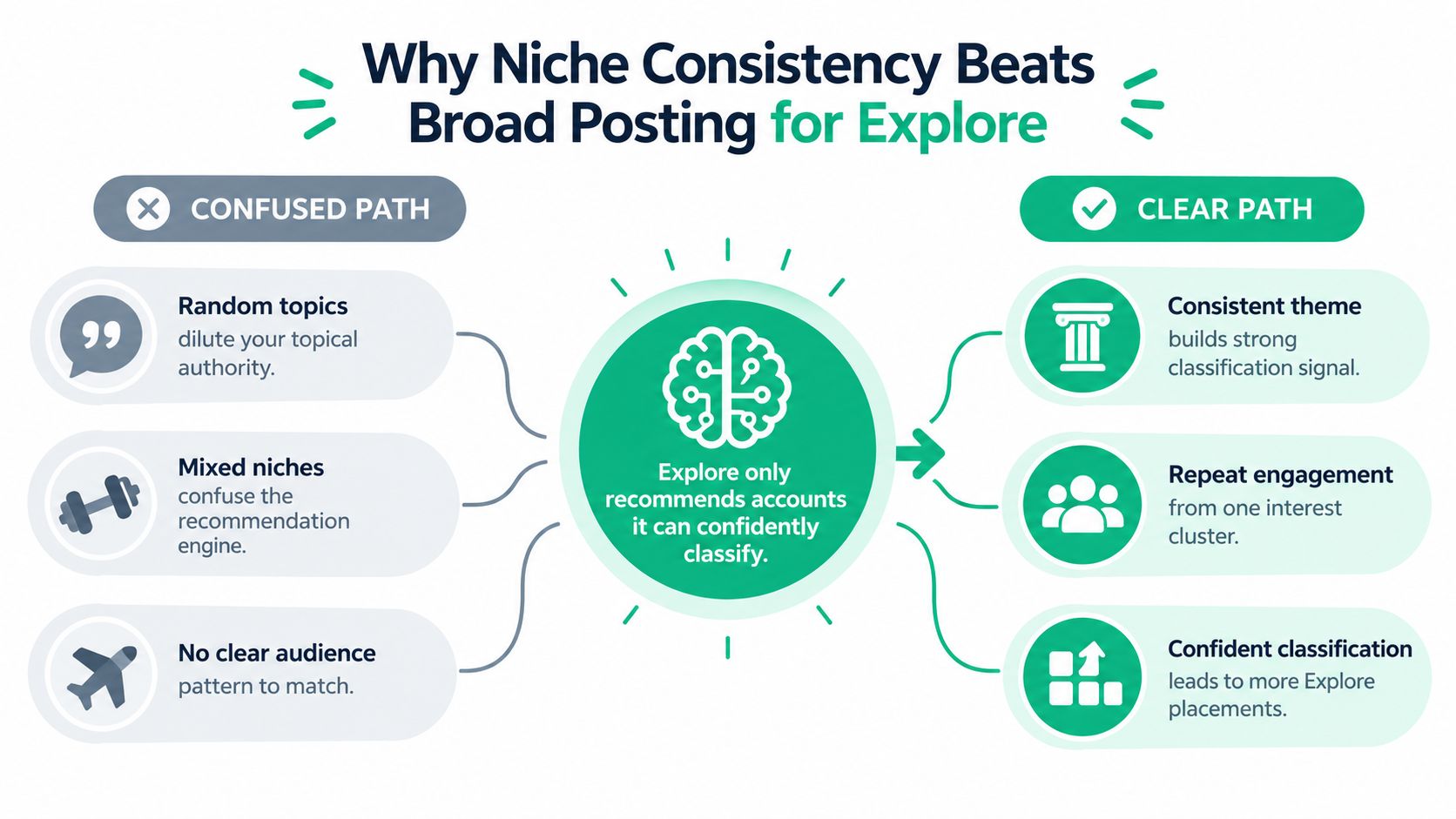
Topic density builds recommendation confidence
Repeat the same subject through different angles:
Explain a common mistake.
Demonstrate a process.
Compare two approaches.
Answer a recurring question.
Turn a successful idea into a series.
Consistent visual cues and semantic language help viewers recognize your content, while repeated saves and shares from the same interest cluster give Instagram stronger evidence about who should see the next post. You're not limiting growth by becoming specific. You're making the first audience match easier, which creates a better foundation for expansion.
Give the lane enough time to produce a meaningful pattern before changing direction. If a post underperforms, adjust the hook, packaging, or payoff before abandoning the topic. Broad posting feels creatively flexible, but it often forces every new post to rebuild audience context from scratch.
Your First 60 Minutes After Posting
The first hour should be a focused distribution and conversation window, not a frantic refresh session. Instagram's ranking system looks at predicted actions and early response, so your job is to help the post reach relevant people and then deepen the interaction naturally.
Use the launch window deliberately
Before publishing, check that the cover, caption, topic, and call to action all point to the same audience. Share the post to Stories with a question that invites a real answer, rather than telling followers to “check this out.”
During the first 30 minutes, reply to comments with useful follow-up questions. A response such as “Which part causes the most trouble for you?” creates a better conversation than a string of emojis. Don't manufacture debate. Continue the subject introduced by the post.
During the remaining window, send the post to highly engaged followers who have a genuine reason to care, using a personal note. Then participate thoughtfully in recent posts from accounts in your niche. Leave comments that add information or perspective, not repeated promotional phrases.
Track saves per reach, shares per reach, watch time, and completion behavior. Likes can tell you whether the idea attracted quick approval, but they won't explain whether viewers found the post useful enough to recommend privately or revisit.
Posting time still has a role because an active, relevant audience can provide faster feedback. Use your own Insights rather than copying a universal schedule, and compare windows with the best times to post on Instagram for engagement. Timing should support a strong post, not substitute for one.
Mistakes That Quietly Kill Explore Reach
Explore reach rarely fails because a creator used the wrong hashtag or missed an ideal posting minute. It usually fails because the post generates activity without proving that viewers found it worth watching, finishing, saving, or sharing. Those behaviors give Instagram stronger evidence than a burst of superficial engagement.
Stop optimizing the wrong inputs
Hashtag dumping adds noise without fixing weak relevance. A large block of generic tags cannot make an unrelated post useful to the right audience. Use a small set of niche-specific labels when they accurately describe the content, then put more effort into clear keywords, a focused topic, saves, shares, and retention.
Obsessing over posting time turns testing into superstition. A stronger publication window may help a post collect early responses, but low completion and weak shareability will still restrict distribution. Test timing only after the Reel, carousel, or static post has a clear promise and a worthwhile payoff.
Engagement pods and follow-back circles create activity without dependable audience fit. People interacting because of a reciprocal arrangement may not behave like the viewers Instagram should reach next. Their likes and comments can make a post look active while leaving watch time, saves, shares, and genuine profile interest unchanged.
Thin captions waste space that could clarify the post. Short copy works when the visual carries the complete idea. Vague text gives viewers little reason to save, share, comment, or visit the profile. Add context, one useful takeaway, and a specific action that matches the content.
Reposted or watermarked content can make the account feel less original and weaken the viewing experience. Create an Instagram-native version, remove distracting marks, and edit the footage so the opening, pacing, and payoff look deliberate.
Unclear Reel covers reduce profile visits after discovery. Someone arriving from Explore should understand the subject immediately when they reach your grid. Use readable cover text, consistent visual cues, and a profile layout that confirms the topic instead of forcing visitors to decode it.
Vanity reporting hides the reason reach stopped. Review the behaviors that support the recommendation:
Retention: Where do viewers leave the Reel?
Completion: Does the payoff justify watching to the end?
Saves: Is the post useful after the current session?
Shares: Does it help viewers send something relevant to another person?
Explore referrals: Which topics and formats attract non-followers?
A single weak post does not define an account. Repeated low retention, unclear topics, and weak shareability do.
A one-week execution plan
Audit your last ten posts for saves, shares, completion, and Explore referrals.
Choose one core content lane and remove unrelated ideas from the next batch.
Draft three Reels with the hook visible in the opening moment.
Build two carousels with a clear cover and a useful second slide.
Publish, then respond thoughtfully during the first hour.
Review Insights and identify the topic, format, and opening that produced the strongest qualified behavior.
Repeat the winning structure with a new idea instead of reposting the same content.
This process turns Explore testing into a repeatable creative system. Keep the signal that worked, then change the subject, example, or angle so the audience has a reason to watch again.
Explore questions creators ask
How long does it take for a post to appear on Explore? There is no fixed timeline. Instagram may test a post with relevant viewers and expand distribution when predicted engagement is strong. Focus on the quality of the response rather than waiting for a guaranteed timestamp.
Can Explore reach hurt follower growth? No. Discovery introduces your content to people who do not follow you, but conversion depends on your profile, topic consistency, and the next action you give visitors. Reach alone does not create a loyal audience.
Do Reels still beat carousels? Reels have an advantage when watch time and completion are strong. Carousels can compete when they earn deeper swiping, saves, and shares. Choose the format based on the behavior your idea can generate, not on a universal format rule.
What save rate should you target? There is no verified universal benchmark to copy. Compare saves per reach across your own posts and improve against your account's baseline.
Does switching to a professional account help? Account type is not a shortcut. Professional tools can make Insights and Account Status easier to review, but recommendation eligibility and content performance still depend on the post and audience response.
Explore is a compounding system, not a slot machine. Each strong post teaches you more about the audience, topic, hook, and format that Instagram can confidently recommend.
Gainsty helps creators and businesses organize Instagram growth around relevant audiences, engagement, targeting, analytics, and account support without relying on bots or fake followers. If you want a structured growth partner while testing Explore-focused content, visit Gainsty and review the Instagram growth options for your niche.
.png&w=1920&q=75&dpl=dpl_34ZXCf12K5qjjdZjPn9snwDRADrB)




.png&w=750&q=75&dpl=dpl_34ZXCf12K5qjjdZjPn9snwDRADrB)