Your Instagram Engagement Is Down, But Your Account Is Not Dead
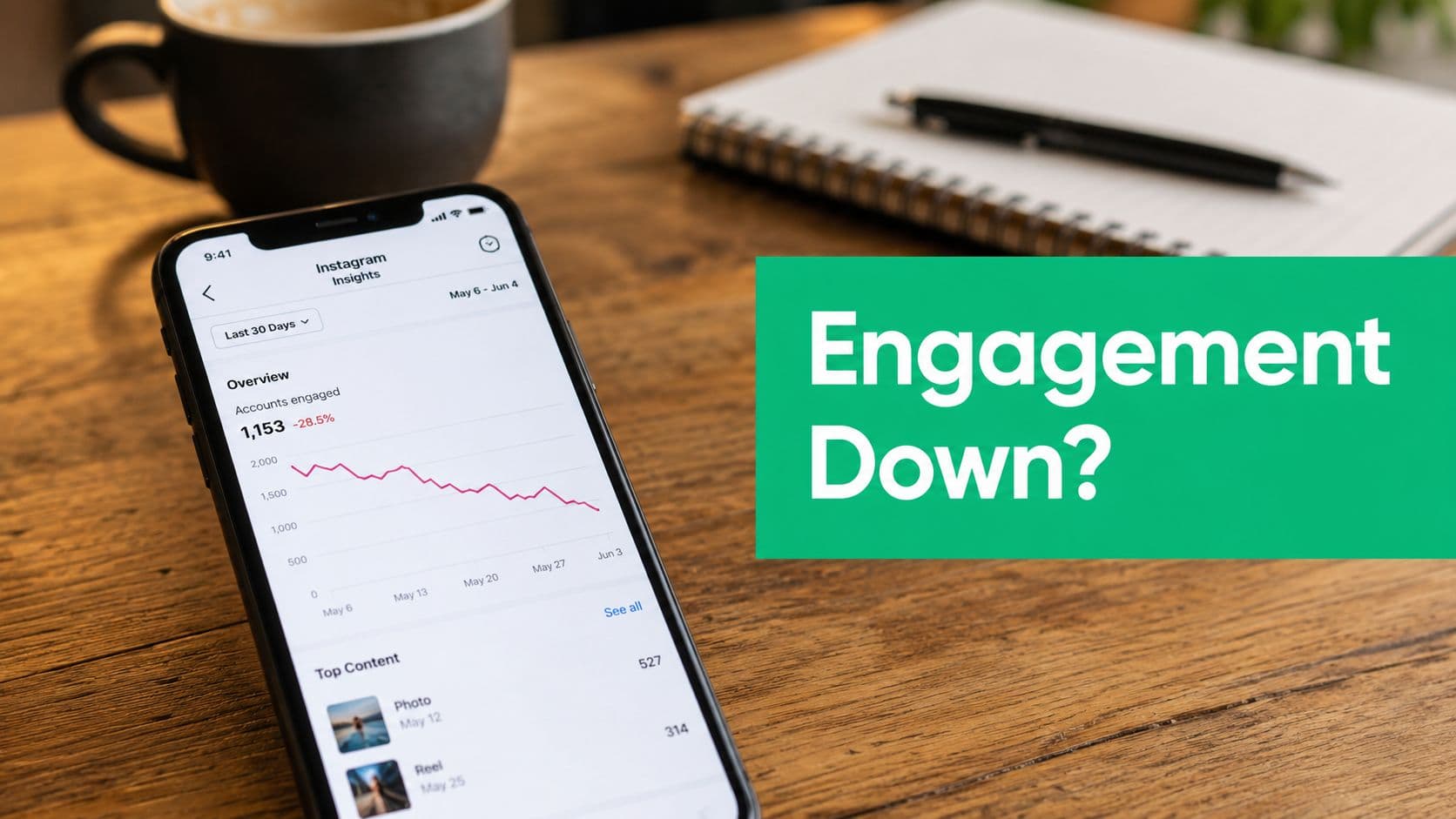
The most common reaction to falling engagement is personalizing it. People assume the content got worse, the audience lost interest, or the account was somehow punished. In many cases, none of those are the actual cause.
According to Buffer's 2026 analysis of over 52 million posts, Instagram's median engagement rate dropped from approximately 7.3% in 2024 to 5.4% in 2025, a 26% decline. That moved Instagram from first to third place among major social platforms. The same analysis points to a user behavior shift toward saves and shares, which the algorithm now prioritizes more than older public signals like likes and comments.
That changes the diagnosis.
A client can show me a post with fewer likes than last year and still have a healthy account if that post drove saves, profile visits, replies, or DMs. Another account can look “active” on the surface and still be weak because the engagement is shallow and never turns into conversations or actions.
Practical rule: If your old benchmark was “Did people like this post?” your new benchmark is “Did this post make people keep it, send it, or respond to it?”
That doesn't mean public engagement is irrelevant. It means it's incomplete. Silent consumption is now normal behavior. People watch, save, share, revisit, and message later.
If you need a broader framework for building from there, this guide on Instagram growth for businesses is useful because it looks at growth as a system, not just a posting schedule.
What usually hurts accounts now isn't one bad reel or a slow week. It's repeating an outdated playbook long after user behavior changed.
The Engagement Audit: How to Diagnose the Real Problem
Before changing your content calendar, audit the account like a strategist, not like a frustrated creator. Most engagement recovery starts with identifying which part of the system is weak. Content, audience fit, distribution, or conversion.

Start with your last 30 posts
Pull up Instagram Insights and review your recent posts as a batch, not one by one in isolation. You're looking for patterns.
Check these first:
Reach trend: Are fewer non-followers seeing your content, or is the drop mostly from followers?
Saves and shares: Which posts triggered private intent, even if likes were mediocre?
Profile activity: Which posts led to profile visits, website taps, or DMs?
Format split: Are Reels, carousels, Stories, and feed posts serving different jobs?
Hook strength: Which posts lost attention immediately, and which held it long enough to trigger action?
A lot of teams skip this and jump straight into “more Reels.” That usually makes the problem noisier, not better.
For a deeper measurement framework, this Instagram analytics business complete guide for driving growth is worth keeping open while you audit.
Separate a content problem from an audience problem
If saves are healthy but comments are weak, your content may still be useful. If reach is fine but profile actions are flat, the issue may be your CTA or offer positioning. If Stories get views but no replies, your audience may be passive because you're broadcasting instead of prompting.
Use this quick diagnosis list:
Low reach across formats: If your posts consistently reach fewer people regardless of whether they’re Reels, carousels, or photos, you may have a distribution problem. This often means your content is too broad, repetitive, or posted when your audience is less active, making it harder for Instagram to recommend.
Good reach, low saves and shares: When lots of people see your content but few save or share it, the issue is usually weak value density. The content attracted attention but didn’t provide enough useful, memorable, or actionable information for people to keep or pass along.
Good views, low profile actions: If a post receives plenty of views but few profile visits, follows, or link clicks, you likely have a poor conversion path. While the content captured attention, it didn’t give viewers a compelling reason to learn more about your account or take the next step.
Strong Story views, low replies: High Story views with very few responses usually indicate weak interaction design. You’re informing your audience rather than inviting them to participate. Adding polls, questions, quizzes, or clear prompts can encourage more conversations.
Reels underperform, carousels perform well: If your carousels consistently outperform your Reels, there may be a format mismatch. Your audience may prefer educational, detailed content over short-form entertainment, suggesting you should prioritize formats that align with how they like to consume information.
Review audience fit inside Insights
Don't just glance at demographics. Ask whether your content matches that audience's current intent.
A mismatch often looks like this:
You post for peers instead of buyers.
You educate at the wrong level.
You entertain without a clear niche signal.
You ask for action before trust is built.
If your audience changed over time but your content voice didn't, engagement drops even when your content quality is still good.
Audit your calls to action
Many weak accounts don't have a content problem. They have a vague next step problem.
Review your captions and Stories. Are you asking people to do something specific?
Weak CTA: “What do you think?”
Better CTA: “Reply ‘audit' and I'll send the checklist.”
Weak CTA: “Link in bio.”
Better CTA: “DM me ‘pricing' if you want the exact service breakdown.”
That difference matters because Instagram now rewards content ecosystems, not isolated posts. A post should lead to a response, a profile visit, a save, a share, or a DM. If it doesn't, the post may be attractive but strategically empty.
Revamp Your Content Strategy for the 2026 Algorithm
A lot of advice about Instagram is still stuck on one idea: publish more Reels and reach will come back. That's too simplistic now.
Format still matters, but format choice without timing and originality won't rescue a tired strategy.

Use formats for different jobs
In 2024, Reels averaged 2.08% engagement, carousels 1.7%, and photo posts 1.17%. That same source notes that all formats have declined, while carousels have shown the strongest resilience and posts using hashtags saw 31.70% fewer views in June 2026. It also notes that the 2025 algorithm emphasizes original, fresh content.
Those details matter because they break two habits that still drag accounts down:
relying on hashtags as a growth lever
assuming video automatically wins
Carousels are often stronger when you need saves and shares. Reels are useful when you need broader discovery. Static posts still work when the idea is strong, and the visual is specific. The mistake is expecting one format to do every job.
A practical split looks like this:
Reels for discovery: Fast hook, clear point, native-feeling delivery
Carousels for retention: Teach, compare, break down, or reframe
Stories for trust: Show context, answer objections, continue the conversation
Static posts for authority: Use when the image itself carries proof or taste
If you're refining your short-form video plan, this Instagram Reels in 2026 guide is a solid reference for current format expectations.
The 48-hour trend window is real
This is one of the biggest reasons Instagram engagement is down for accounts that still post “consistently” yet feel invisible. They are consistent, but they are slow.
According to Instagram creators and algorithm experts discussing the current trend cycle, trends now expire in 48 hours or less, and creators describe them as effectively “here on Tuesday, gone by Friday.” If your team spots a format, writes it into next week's content calendar, and publishes five or six days later, you're often posting after the market has moved on.
That means trend response needs a different workflow:
Spot the format early. Save examples the same day you notice repeat patterns.
Extract the structure. Don't copy the post. Copy the mechanism. Hook, pacing, framing, reveal.
Adapt to your niche fast. Rewrite it in your voice within a day.
Publish while it still feels current. Not next week. Now.
Follow with a depth piece. Use a carousel or Story sequence to turn attention into trust.
The old model was batch content first, trend adaptation second. The current model works better in reverse.
What to stop doing
There are a few tactics I would cut immediately if engagement is already slipping:
Recycled clips with obvious watermarking
Caption-heavy posts with weak first-line hooks
Hashtag stuffing - AI-looking content with generic phrasing
Trend participation that arrives late and adds nothing
If you want a good breakdown of why high-quality video still gets algorithmic preference when it feels native and watchable, this piece on cinematic video's algorithm advantage is worth reading.
Freshness isn't optional now. Neither is speed.
Master Modern Engagement Tactics Beyond Likes and Comments
The biggest mindset shift in 2026 is this. Engagement isn't mainly a public performance anymore. It's a private conversation system.

If your Instagram engagement is down and you're still judging success by comment count, you're measuring the wrong room. A lot of buyer intent has moved into DMs, Story replies, and quiet back-and-forth.
According to Funnel.io's 2025 guide on Instagram trends, the “link in bio” approach is waning as DMs take over as the main conversion channel. The same guide says users want “branded content that feels like advice from a friend,” and that replying within 24 hours is now a key engagement driver.
Treat comments as doorways, not endpoints
Many brands still answer comments like a customer service inbox. Functional, polite, dead.
That wastes momentum.
A better response style keeps the thread alive and moves the right people into a DM when needed.
Examples:
Comment says: “How much is this?” Better reply: “I'll DM you the breakdown so I can keep it clear.”
Comment says: “I needed this.” Better reply: “Glad it helped. Which part are you dealing with right now?”
Comment says: “Can you share the template?” Better reply: “Yes. DM me ‘template' and I'll send it over.”
The goal isn't to force every interaction private. The goal is to create momentum and let interested people keep moving.
Build DM entry points into content
A post should give people a reason to message you. Stories should make replying feel easy, not formal.
Try prompts like these:
Story prompt: “Want the checklist? Reply ‘checklist."
Carousel CTA: “DM me ‘guide' if you want the full version.”
Reel CTA: “If this is your situation, send me ‘help' and I'll point you to the right next step.”
Story poll follow-up: Message people who voted and ask a simple question tied to their choice
That's one reason Story stickers still matter. Polls, question boxes, sliders, and quizzes are not decorative features. They're conversation starters.
Reply speed is part of engagement now
If someone replies to a Story and you answer two days later, the interaction often dies. The account might still be posting great content, but the social part of social media is missing.
Use a lightweight response system:
Story reply: When someone replies to your Story, respond directly to their message and ask one short follow-up question to keep the conversation natural. Only move the discussion into a longer DM conversation if they show genuine interest.
Comment asking for help: Reply publicly so others can benefit from the answer, then invite the person to continue the conversation in direct messages if more detailed assistance is needed. Once they move to DM, send a concise and relevant next step instead of overwhelming them with information.
Poll vote: Treat poll responses as an indication of interest and follow up manually with people who seem like qualified prospects. Ask a specific question related to the option they selected to better understand their needs.
Keyword DM: If someone sends a keyword to receive a resource, deliver the promised guide, checklist, or link immediately. After they’ve received it, continue the conversation only if they engage further, rather than sending a long sequence of unsolicited messages.
If your volume is high and you need structure, a powerful Instagram DM automation solution can help you manage first-touch responses without letting conversations go cold.
Public engagement gets attention. Private engagement gets action.
That's why some accounts look quieter than they used to but still produce more qualified conversations than before.
Track What Matters: Monitoring Your Recovery
Once you change the strategy, don't go back to checking likes every morning. Recovery gets easier to manage when you watch a small set of signals every week and interpret them together.

Build a simple weekly scorecard
You don't need a complicated dashboard. You need consistency.
Track these every week:
Saves
Shares
Story replies
Profile visits from content
DMs started
Profile visits from non-followers
This guide to track Instagram growth is a helpful reference if you want a cleaner reporting workflow.
Read the pattern, not one isolated number
A post with fewer likes can still be a win if it drives more saves and profile visits. A Reel with decent reach but no follow-up actions may be useful for awareness, but weak for conversion. A Story series with lower views but more replies can outperform a high-view passive sequence.
Use this interpretation model:
Saves rising: Your content is getting more useful.
Shares rising: Your positioning is resonating enough to pass along.
Story replies rising: Your audience trusts you enough to talk back.
Non-follower profile visits rising: Discovery is improving.
DM starts rising: Content and CTA are working together.
Review over weeks, not moods
A lot of creators sabotage good strategy by changing direction too fast. One slow post means very little. A repeating pattern over several weeks means something.
Check your data weekly, but make decisions on a broader window. If saves and replies are improving while likes stay soft, stay the course. If reach is flat and no private actions are increasing, adjust hooks, timing, or CTA structure first. Don't rebuild the whole account because one post disappointed you.
Track behavior that signals intent. Ignore vanity unless it aligns with action.
That one shift makes your recovery plan much more stable.
Instagram Engagement FAQs
Is it a shadowban or just lower engagement
Usually it's lower engagement, weaker content-market fit, slower trend response, or poor follow-through after people interact. Most accounts that suspect a shadowban are dealing with normal distribution changes plus outdated expectations. Audit reach across formats, inspect originality, and look for whether people are saving, sharing, or replying.
Should I delete old posts that underperformed
Usually no. Old posts can still support credibility, topical relevance, and profile depth. Delete only when the content is off-brand, misleading, visibly low quality, or no longer represents the business well. Low likes alone are not a good reason.
Should I buy followers to make the account look stronger
No. Bought followers poison your data. They distort engagement rates, confuse your content signals, and make your Insights less useful. You end up optimizing for an audience that doesn't care and often isn't real. That makes every strategic decision worse.
How often should I post if my Instagram engagement is down
Post at a pace you can sustain while staying relevant and responsive. A smaller volume of original, timely, conversation-driven content is better than a larger volume of stale filler. If you can't adapt to trends, reply to DMs, and maintain quality, your posting frequency is already too high.
What matters more right now: Reels or carousels
Neither wins by default. Reels are often better for discovery. Carousels are often better for depth, saves, and follow-through. Strong accounts use both with different jobs in mind. If you force everything into one format, you usually weaken the overall system.
If you want help turning falling engagement into a structured growth plan, Gainsty is built for that. It supports organic Instagram growth with AI-assisted strategy, analytics, and account guidance designed around real engagement, not fake followers or bot activity.