
Why Follower Count No Longer Defines Real Instagram Growth
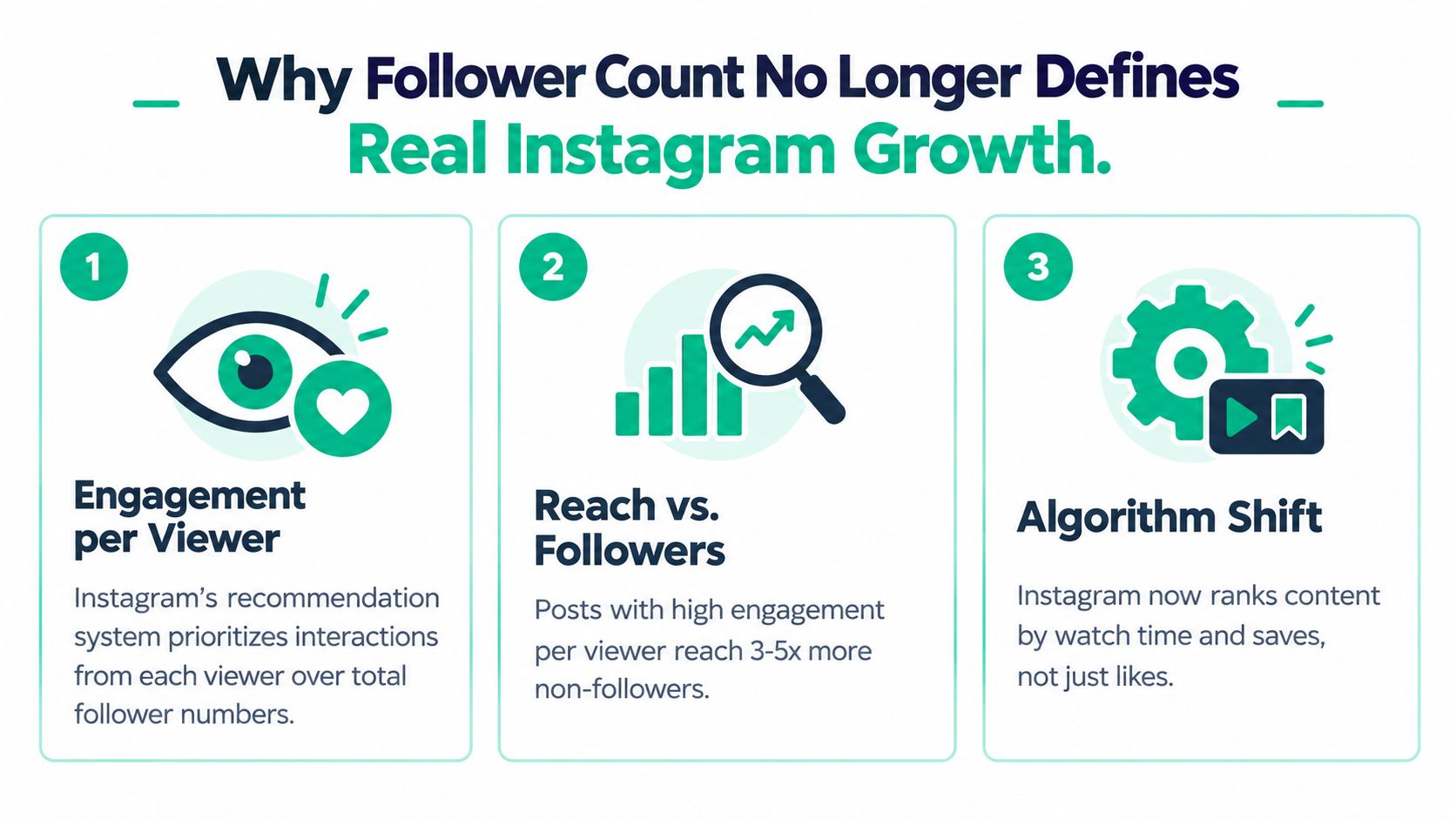
Instagram used to reward simple accumulation. That mindset is obsolete. Today, the platform's own creator guidance points buyers toward engagement per viewer, along with watch time, shares, follows, likes, comments, and profile visits, not just audience size (Instagram creator FAQ).
The metric that actually matters
A larger follower count can hide weak performance. If the new audience doesn't watch, save, share, or visit the profile, the account can look bigger while becoming less efficient. That's why an instagram engagement growth service should be judged by whether it improves the quality of distribution, not whether it inflates a number on the profile page.
For a smart buyer, the core test is simple. Does the service help the account earn more meaningful interactions from people likely to care about the content, or does it just push the account toward superficial activity from low-value profiles?
Buyer rule: If the provider cannot explain how it improves reach, saves, shares, and qualified profile visits, it's probably optimizing the wrong thing.
That's the lens to use across every pitch. You're not buying a crowd. You're buying a system for better discovery, better retention, and better interaction quality.
The four pillars that matter in practice
The strongest services tend to organize around four things.
Targeting decides who sees the content and who engages with it.
Safety decides whether the account stays recommendation-eligible and clean.
Measurement decides whether you can tell if the work is helping.
Support decides whether problems get fixed before they hurt reach.
If you want a simple starting point, compare the service against a practical educational roadmap like Yelly Nelly's Instagram growth plan. Any provider that contradicts that kind of audience-first thinking is already behind.
The Measurement Framework You Should Demand From Any Service
A provider worth paying starts with measurement, not slogans. The dashboard should show engagement rate by format, reach, saves and shares, and follower growth against your own baseline. Follower totals alone hide the core question, whether the account is earning attention from the right viewers or just collecting empty activity.
Start with format, not vanity
Benchmark data from a large 2025 analysis of 35 million Instagram posts across 447,613 active pages found an overall engagement rate of 0.48%, with carousels at 0.55%, Reels at 0.52%, and single-image posts at 0.37% (Socialinsider benchmark). A separate benchmark summary notes that median engagement fell from 0.36% in 2024 to 0.30% in 2025, while another cited average for brand posts was 0.48% (SocialPilot summary). Those numbers matter because they show why a single “average engagement rate” can mislead buyers.
Different account sizes should emphasize different measurements. A new account should focus first on Reel view rate, with follows from profile visits as a secondary signal, because fast reach can be mistaken for loyal attention. A growing account should pay closer attention to carousel engagement rate, then saves and shares, while remembering that one viral post can hide weak consistency. A mature account should judge engagement against its own baseline and watch comments per post, because high reach does not always mean strong audience quality. A brand account should care most about viewer-qualified interaction and follower conversion per reach, since raw follower growth can increase even while practical usefulness declines.
Ask for a rolling baseline
The right comparison is your own recent history, measured the same way every week. A service that reports improvement without stating the calculation method makes weak outcomes easy to hide.
If you want to connect social performance to business impact, use the logic in how to connect marketing spend to revenue. Social growth only matters when it can be read alongside outcomes, not isolated as a pretty chart.
Practical rule: If the provider only reports follower growth, you are missing the signal that decides whether Instagram keeps distributing your content.
I also recommend a closer look at the Instagram analytics business guide. The point is not to admire metrics. It is to force the service to prove what it changed.
Four Service Models and Where Each One Breaks
Most buyers end up in one of four buckets. The first is the fully managed human team, where real people choose targets, monitor quality, and adjust tactics manually. The second is the AI-assisted targeting platform, which uses software to narrow the audience but still claims to stay within organic behavior.
The third is the old follow/unfollow automation tool. It looks efficient because it churns through accounts fast, but it's usually built on behavior Instagram doesn't want. The fourth is the bot-driven follower farm, which is the most obvious trap because it sells counts with almost no concern for relevance.
The breakpoints are structural
Human-managed services usually break on cost and discipline. If the provider doesn't define success clearly, you can pay for “activity” without seeing meaningful gains. AI-assisted platforms break when they overpromise on precision and underdeliver on reporting.
The lesson is simple. The more a tool relies on shortcuts, the more likely it is to optimize for a metric that Instagram doesn't really care about.
Side-by-Side Comparison of Reputable Growth Services
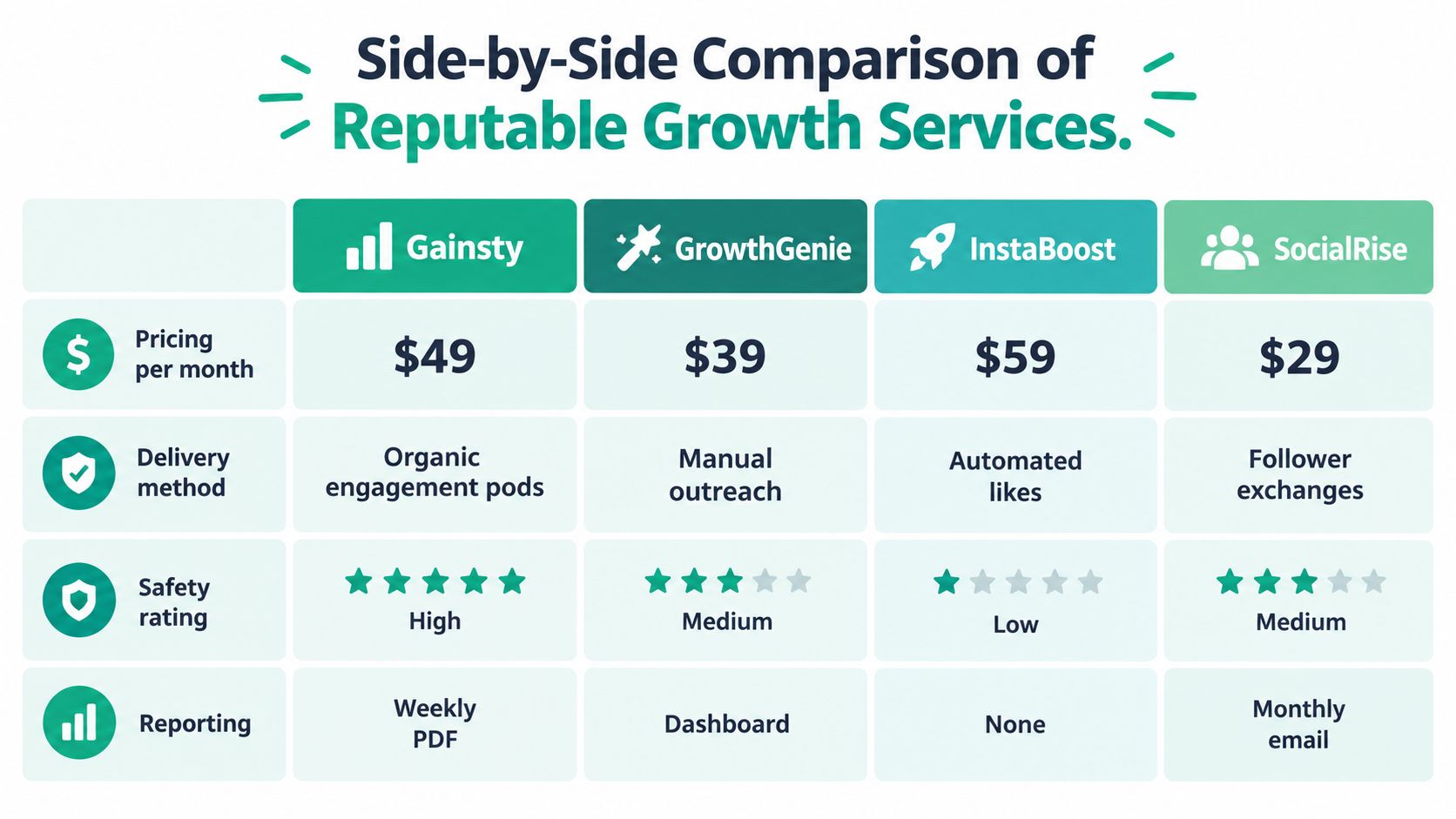
The comparison that matters is narrow. Ignore follower totals and look at who improves engagement per viewer, protects account quality, and explains results clearly.
When comparing service types, Gainsty stands out for its AI-assisted targeting, which uses niche, competitor, hashtag, and demographic inputs. It presents itself as organic-focused, with no bots or fake followers, and offers a live dashboard, account management, and engagement reporting. That makes it a fit for creators, startups, agencies, and brands that want managed growth. A human-managed growth service relies more on manual audience engagement. Its safety depends heavily on the discipline of the operator, and reporting is often monthly or periodic, which suits buyers who want a person actively involved. A general AI-targeting platform uses software-assisted audience selection, but safety and reporting depth vary by provider, so it usually works best for teams that can manage decisions themselves. An automation-heavy tool tends to depend on scripted actions and mass interaction, offers weak or risky safety standards, and often provides minimal reporting, which is why it is not a serious long-term option.
Gainsty, the AI-assisted managed option in the comparison, pairs targeting inputs with live reporting and account management.
A pure manual service can still be legitimate, but it gets expensive fast, especially when reporting is vague. AI-assisted platforms are useful only if they stay honest about what they can control. The problem starts when a tool promises precision but will not show its work.
Watch the reporting model closely. If a provider cannot separate format performance, audience quality, and change against your baseline, you are not buying a growth system. You are buying a story.
Key takeaway: The strongest provider is the one that can show its work, not the one that shouts the loudest about follower totals.
Safety Signals That Separate Organic Services From Risky Shortcuts
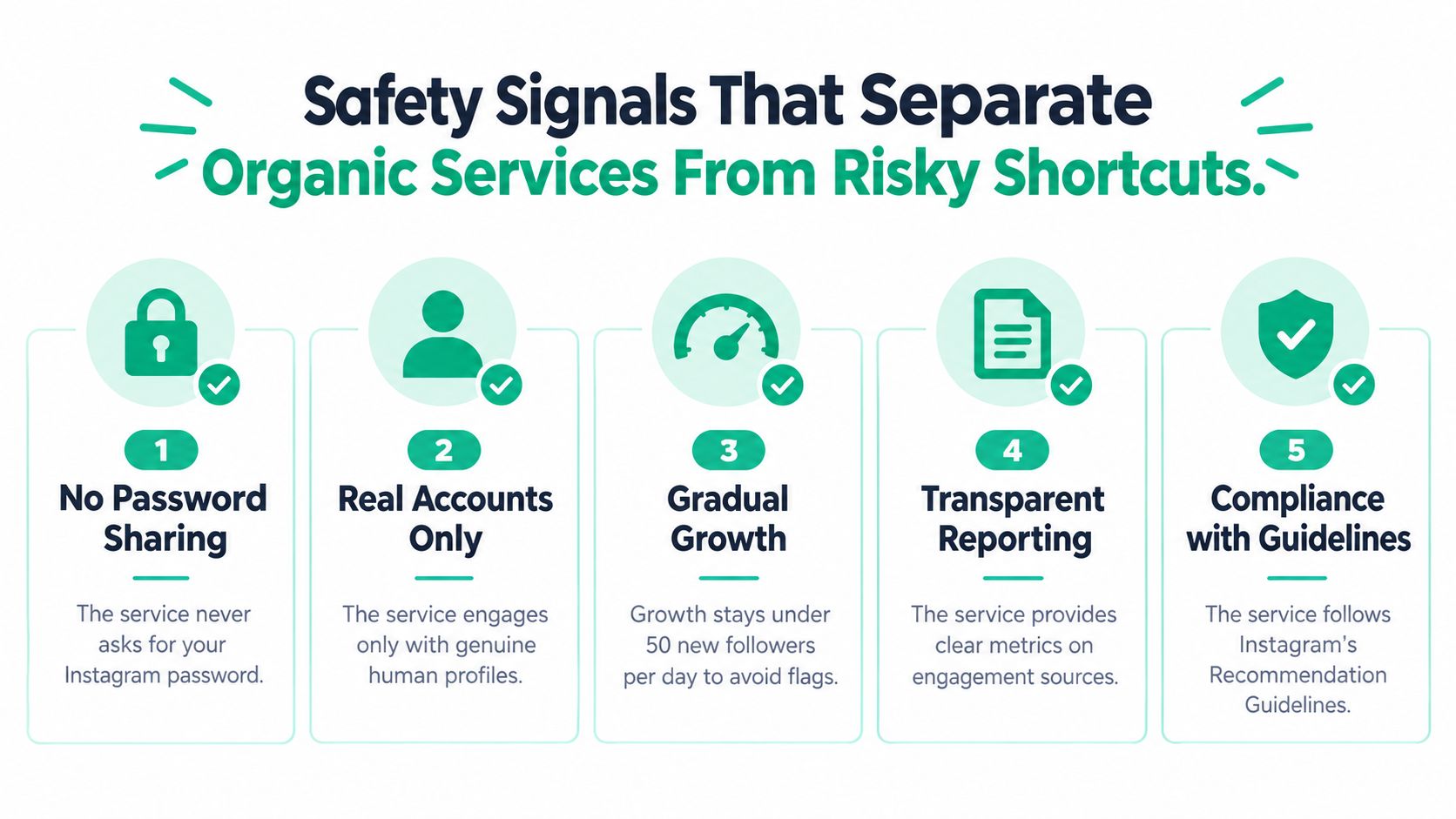
Safety isn't a branding word. It's an operational standard. Instagram uses ranking systems and Recommendation Guidelines, which means the question is whether a service helps content stay eligible for discovery while improving audience quality, not whether it says “organic” on a sales page (Instagram ranking explained).
What safe really looks like
A reliable growth provider should be transparent about how its platform works and what users can expect. Key questions to consider include how growth strategies are developed, how AI-assisted tools are used, what role human oversight plays, and how performance is monitored over time. It's also worth understanding how the platform identifies relevant audiences and helps users reach people who are genuinely interested in their content.
Transparency is key when evaluating any growth solution. Rather than focusing solely on whether a service uses automation or AI, look at how these technologies are applied, what safeguards are in place, and how the platform approaches audience relevance, engagement quality, and long-term growth.
Look for relevant audience targeting, sustainable growth strategies, transparent reporting, and a clear explanation of how the platform supports your social media goals. These indicators can help you assess whether a provider takes a thoughtful, responsible approach to growth.
Before choosing a provider, take time to understand how it approaches audience quality and identify potential fake follower warning signs. Doing your due diligence upfront can help you make a more informed decision and invest in a solution that aligns with your expectations.
Ultimately, an effective growth platform combines thoughtful strategy, appropriate technology, and ongoing performance insights to help creators and businesses build a more relevant and engaged audience.
Matching the Right Service to Your Stage and Niche
A new creator under 5,000 followers should care about discovery first, not prestige. At that stage, Reels matter because the account still needs new eyeballs, and smaller accounts can benefit from stronger Reel view rates as noted in the benchmark summary above (Instagram benchmarks). The right service profile here is one that can aim attention at the right niche without stuffing the account full of irrelevant followers.
A startup founder should think differently. The goal is category authority, not just reach, so the service should emphasize targeted saves, meaningful comments, and audience fit. That means tighter demographic and competitor targeting, plus reporting that shows whether discovery is turning into memory and return visits.
An established brand usually needs repeat engagement and conversion support. For that buyer, a service that tracks performance by format and audience quality is more valuable than one that sells speed. The account already has enough scale to make poor targeting expensive.
Match the tool to the job
If you're a new influencer, prioritize discovery, Reels, and a service that stays tightly focused on niche audience selection. If you're a startup founder, prioritize saves, profile visits, and targeting that reaches category-relevant people. If you're an established brand, prioritize repeat engagement, reporting depth, and audience quality over raw follower growth.
The same service can feel excellent for one stage and wrong for another. That's why brand recognition matters less than fit.
Onboarding, First 30 Days, and How to Measure Success

Start with clean access and a clean brief. The provider should know your audience, your content themes, your geographic priorities, and what success means before any work begins. If you skip that step, the service will improvise on your behalf, and improvisation is where bad targeting usually starts.
Use the first stretch to test structure, not just output. Keep the targeting stable while varying hooks, formats, and calls to action so you can see whether improvement comes from creative quality or from distribution changes. That distinction matters, because a bigger audience with weaker response is not progress.
After that, lock in what earned saves and shares. Likes are easy to collect, but they don't tell you whether the content was worth saving, sharing, or revisiting. Good reports show where the lift came from and where the account is still underperforming.
I'd also compare every update against a simple operating scorecard, not gut feel. If the numbers don't line up with what the provider claims, pause early instead of waiting for the month to end. The first 30 days should reveal whether the service has a repeatable method or just a noisy dashboard.
A deeper operating guide like how to measure Instagram success is useful here because it forces the account owner to read metrics the way a real operator would.
The first month should move through four practical phases. During setup, usually days 1 through 5, the main job is defining the audience, goals, access, and baseline, while tracking the starting engagement rate. During the test phase, typically days 6 through 15, the goal is to vary hooks, formats, and CTA language, while watching saves, shares, and comments. In the refine phase, often days 16 through 25, the focus shifts to keeping winning formats and cutting weak ones, with engagement by format as the main metric. In the decide phase, around days 26 through 30, you judge provider fit and reporting quality by looking at lift relative to your baseline.
Operational rule: If the provider can't explain the source of the gains, the gains probably aren't durable.
Decision Filters and Trust-Signal FAQ
Use four filters, every time.
Targeting. Is the audience specific and relevant?
Safety. Does the service protect recommendation eligibility?
Measurement. Does it report against your baseline with clear methods?
Support. Can a real person answer questions fast and fix problems?
Save this rule: Buy the service that improves qualified engagement, not the one that makes the follower number move fastest.
FAQ
Do these services work for regulated niches? They can, but only if the provider is careful with targeting and content eligibility. The safer the niche, the more important documentation and account-level controls become.
How should I compare pricing? Compare the method, reporting depth, and support, not just the monthly fee. Cheap automation is expensive when it harms reach.
For teams that want a practical operating layer, the how to guides from Trupeer Inc. are a useful reference point for process discipline. The same logic applies here, method first, claims second.
If you want organic growth with managed targeting, transparent reporting, and support that doesn't vanish after signup, look at a provider built around those priorities. Gainsty is a solid example of the AI-assisted, fully managed model this category should be moving toward.
If you want a cleaner way to grow Instagram without gambling on bots, fake followers, or shallow engagement, visit Gainsty and see how its organic targeting and account management fit your stage. The right service should help you build better reach, better retention, and better engagement quality. That's the standard worth paying for.
.png&w=1920&q=75&dpl=dpl_2si4hWs7xtpQVmrY6d8xhJ1wLJZL)




.png&w=750&q=75&dpl=dpl_2si4hWs7xtpQVmrY6d8xhJ1wLJZL)