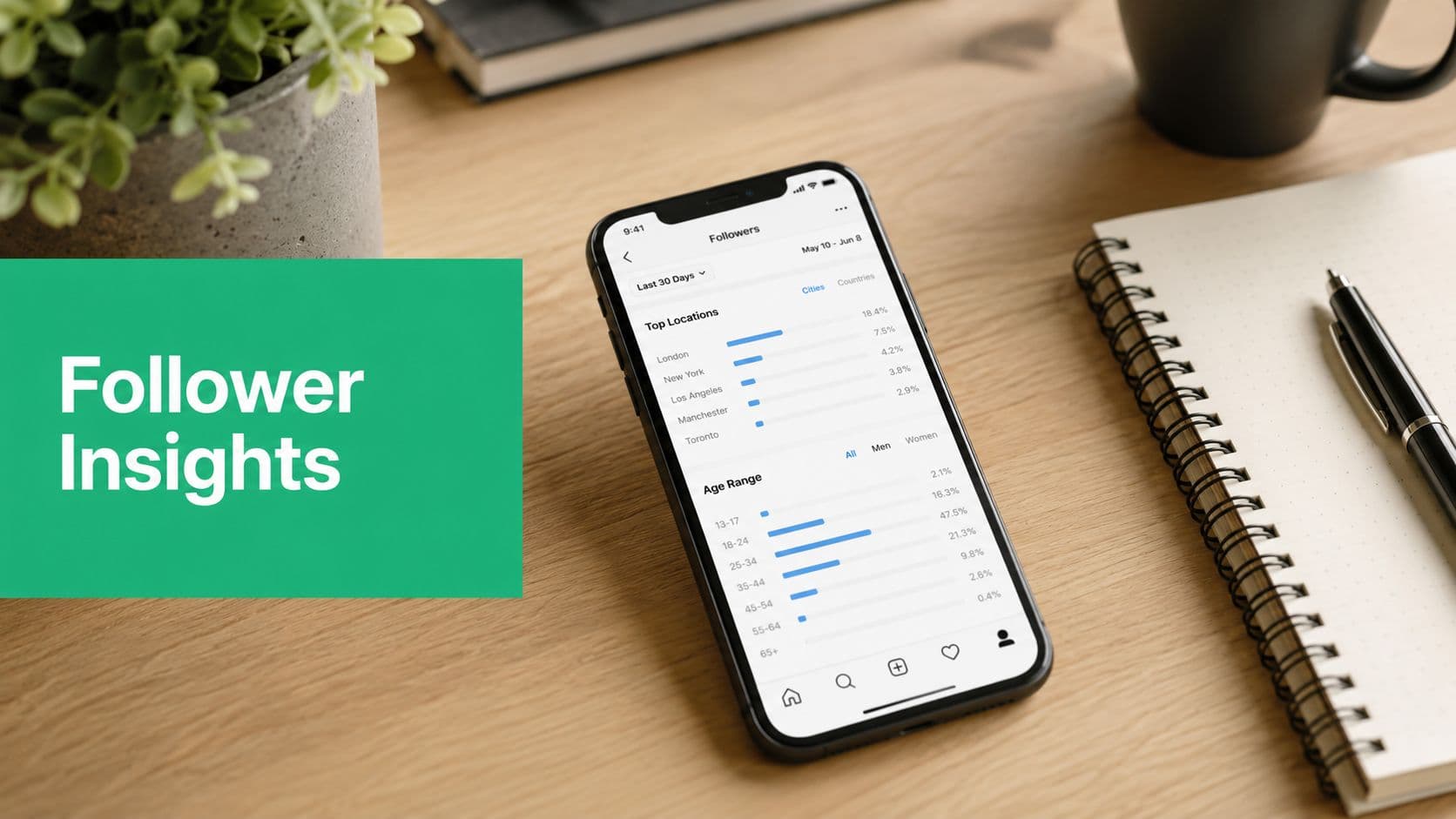
Why Your Follower Count Is Only Half the Story
A lot of creators treat Instagram like a scoreboard. More followers must mean better performance. But that's only part of the picture.
Picture a stand-up comic walking on stage without knowing who's in the room. A joke for college students lands differently with young parents. A niche business joke might crush at a founder meetup and fall flat at a wedding reception. Content works the same way. If you don't know who's watching, every post is part strategy and part guess.
That matters even more because most Instagram accounts aren't giant celebrity profiles. About 26.43% of Instagram users have fewer than 1,000 followers, and 49.94% have between 1,000 and 10,000, according to Backlinko's Instagram user analysis. That tells you something important. The majority of users are building in the nano and micro range, where audience fit matters more than broad popularity.
Small audiences can be strong audiences
If you're in that range, you don't need to panic about not being massive. You need to get clear about whether the right people are paying attention.
A local photographer with a smaller but highly aligned audience can outperform a larger account full of passive followers. A fitness coach can have steady inquiries from a focused group, while another account with more followers struggles to get replies. This is also why cleaning up audience quality matters. If you suspect your number looks better than your engagement feels, it helps to understand what ghost followers are and how they affect your account.
Practical rule: A follower who cares about your topic is more valuable than a follower who only liked one viral post.
Demographics turn vague advice like “know your audience” into something usable. Age changes your tone. Location affects timing and references. Gender balance can reveal whether your visual style or messaging is pulling in a different audience than you expected.
And if your immediate goal is visibility, not just vanity, it also helps to understand the mechanics behind reach. These SupaBird tips for boosting impressions are useful because impressions show whether your content is even getting enough chances to connect with the right people.
What the numbers actually help you do
Once you know who's in the room, you can make sharper choices:
Adjust your voice so captions sound natural for the people following you
Choose better examples that fit your audience's stage of life
Post with more intention based on where your audience lives and when they tend to engage
Spot a mismatch early if your account attracts attention from people outside your business goals
Follower count tells you how many seats are filled. Demographics tell you who bought the tickets.
Decoding Your Audience DNA
Instagram follower demographics can sound technical, but the main categories are simple. Think of them as your audience's profile card. Each one tells you something different about how your content should look, sound, and publish.

Age range
Age is usually the first useful lens because it affects taste, references, and decision-making.
If your audience skews younger, your content may need faster pacing, clearer hooks, and more trend awareness. If your audience is older, they may respond better to practical breakdowns, detailed captions, and content that saves them time or helps them make a decision.
This doesn't mean people only like content “for their age.” It means the way you package an idea often changes by age group.
Gender split
Gender data doesn't tell you everything, but it can reveal patterns in what's resonating. Sometimes a brand thinks it's speaking to one group and finds that another group engages more often.
That can affect visual choices, examples, and topic framing. A pet brand, for example, may think it's selling product performance while its audience responds more to care routines and emotional storytelling.
Your audience demographics don't tell you what to post word for word. They tell you what lens your audience is using when they interpret the post.
Top locations
Location data is one of the most practical metrics because it changes both content and logistics. If your top audience is local, neighborhood references, local events, and city-specific tags become more useful. If your audience is spread across countries, timing and language become more important.
A creator with followers in one metro area can lean into community familiarity. A creator with a wider spread may need cleaner phrasing, fewer local references, and captions that travel well across regions.
Interests and segments
Instagram doesn't hand you a neat personality summary, so you often infer interests from post performance. Which topics spark comments? Which posts get shared with friends? Which content attracts profile visits?
That's where audience segmentation for Instagram growth becomes useful. Instead of treating your followers like one group, you break them into clusters. New followers may want introductions. Loyal followers may want deeper advice. Local followers may care about different details than international ones.
Most active times
Many people stop too early. They see a chart of active hours and think they're done.
But active time isn't just a scheduling note. It's context. If people engage during work breaks, educational carousels may work better than long story-heavy captions. If they engage later at night, more personal, entertaining, or aspirational content may land better.
A demographic report is less like a biography and more like a map. It doesn't tell you the whole trip. It shows you where to steer.
Benchmarking Your Follower Demographics
A benchmark gives your followers data context. Without context, a skew can look like a problem when it is normal for your niche, or look harmless when it is pulling your content toward the wrong crowd.

What the global baseline looks like
Instagram tends to skew toward younger adult users, with especially strong representation among people in their late teens through early thirties. That broad pattern gives you a reference point, not a target. If your account roughly follows it, your audience may be growing along familiar platform lines. If it does not, your niche may attract a different mix of people.
That difference matters because averages can hide intent.
A fashion creator, a real estate agent, and a software consultant can all have healthy accounts with very different age and gender patterns. The benchmark is useful for one reason. It helps you ask whether your audience makeup fits the kind of attention your business needs.
When your audience should look different
Some accounts should look different from Instagram overall.
A local restaurant may draw nearby diners who care about atmosphere, price, and whether the place feels worth visiting this weekend. A B2B consultant may attract working professionals who respond better to clear education than trend-based entertainment. A wedding photographer may pull couples, planners, and venue partners, which can create a mixed audience that does not resemble the platform average at all.
Here is a simple way to read a demographic skew:
Minor typo in a casual DM: If you make a small mistake in an informal message, unsend it and resend a corrected version. This keeps the conversation clear with minimal disruption.
Wrong file or link sent to a client: If you send the wrong attachment or link, unsend the message, send the correct file or link, and acknowledge the correction so the client knows which version to use.
Sensitive information sent to the wrong person: If confidential or sensitive information is sent by mistake, unsend it immediately, notify the account lead or appropriate team member, and document what happened so the incident can be handled properly.
Message sent in frustration: If you send an emotional or impulsive message, unsend it if possible, avoid replying further, and have someone else review any follow-up before you send it. This helps prevent the situation from escalating.
Benchmarking without overreacting
The key question is not whether your audience matches Instagram. The key question is whether your audience matches your goal.
If the answer is yes, use that clarity to make sharper content decisions. If your audience is mostly women in one city, your posts can use local references, location tags, and examples tied to real routines in that area. If your audience is older than expected for your niche, your content may need fewer trends and more direct explanations, stronger proof, or clearer outcomes.
If the answer is only partly, choose which segment you want to serve more intentionally. If the answer is no, your content may be attracting attention without attracting fit.
Don't use benchmarks to grade your account. Use them to diagnose whether your content is pulling in the people you can actually help, sell to, or grow with.
Say you sell a premium home service, but your audience is packed with very young followers outside your service area. That does not automatically mean your reels are weak. It may mean your content is interesting in a broad way but not specific enough to attract likely buyers. In practice, that could lead you to post fewer generic before-and-after clips and more neighborhood-specific jobs, pricing context, homeowner FAQs, and service-area proof.
Benchmarks work like a fitting room mirror. They do not change the outfit. They show whether what you are wearing matches where you are trying to go.
Accessing Your Audience Insights
You don't need expensive software to start reading instagram follower demographics. Instagram already gives you a native dashboard. You just need to know what it shows, what it hides, and how to interpret the limits.

What you need before demographics appear
Instagram's native Insights tool requires a Professional Account, either Creator or Business. It also only shows audience data after you've reached over 100 accounts, and the demographic data is based on Accounts Reached, not total followers. Instagram also limits Top Locations to just five cities or countries, which can blur the picture for accounts with a broader audience, as explained in this guide to Instagram audience insights and reporting.
That last point confuses people all the time.
If your demographic panel says a certain city dominates your audience, that doesn't always mean most of your followers live there. It means your recent reach was concentrated there. Reach and follower base overlap, but they aren't identical.
How to find the data inside Instagram
On a Professional account, the path is usually straightforward:
Open your profile and tap the professional dashboard or insights area.
Look for audience or reached account data rather than only post-level metrics.
Review age, gender, and top locations together, not as isolated charts.
Check date ranges so you don't base strategy on a weird short-term spike.
If one Reel got broad traction in a city you don't normally reach, your location chart may temporarily lean that way. That's useful, but it needs context.
What Instagram doesn't tell you well
The native dashboard is fine for quick checks. It's weaker for pattern spotting over time.
Some common limitations:
Top locations are capped, so international nuance gets flattened
Follower quality isn't obvious from the default demographic view
Reach-based reporting can distort assumptions if one post breaks out
Segment comparisons are limited, so it's harder to compare clusters of followers over longer periods
That's why some creators pair Instagram's built-in data with a separate analytics view. Platforms like Sprout Social, Later, or Gainsty can help organize demographics and engagement patterns into something easier to act on, especially if you're trying to attract a more specific audience mix rather than monitor what already happened.
A simple reading habit
Don't check demographics only when growth stalls. Check them on a rhythm.
Try a lightweight routine:
Weekly: Look for sudden shifts in reach locations or active times
Monthly: Review whether age and gender patterns still match your content goals
Quarterly: Ask whether the audience you've built is the audience you want next
That turns analytics into feedback, not just a report card.
Applying Demographic Data to Your Content
You post a Reel that gets solid views, then a carousel that barely moves, even though both cover the same topic. Demographic data helps explain why. It shows who is in the room, what kind of content fits their habits, and how to shape your posts so they feel timely instead of generic.

Match the message to the audience
Follower demographics work like a casting sheet for your content. The same idea can be framed in very different ways depending on who is watching.
If your audience skews toward young professionals, short, useful posts usually fit better. They are often scrolling between meetings, commuting, or clearing a few minutes in line somewhere. That changes the job of your content. Lead fast. Solve one problem. Make the takeaway easy to save.
If your audience includes older followers or people making higher-stakes decisions, they often need more context before they act. A quick hook still matters, but trust matters more. Posts that explain the process, compare options, answer objections, or show proof tend to carry more weight.
Here's how those patterns often translate into creative choices:
Younger audience: faster openings, tighter edits, stronger visual contrast, practical tips in small pieces
More deliberate buyers: clearer teaching, case examples, FAQs, before-and-after context, stronger captions
Local-heavy audience: neighborhood references, city-specific details, local events, familiar landmarks
Mixed audience: recurring content series, so each group recognizes what is meant for them
That last point matters. A mixed audience does not mean every post should try to please everyone. It usually means your content calendar needs lanes.
Use active times as a creative clue
Posting times are not only about distribution. They also hint at the audience's mindset.
A late-night audience may be in discovery mode. They are more likely to respond to entertaining Reels, relatable stories, identity-driven posts, or aspirational content. A morning audience often wants something they can use right away, such as a checklist, tip carousel, short tutorial, or planning prompt.
The hour gives context to the format.
If your followers are most active before work, write captions that get to the point quickly. If they show up more in the evening, you may have more room for story, personality, or a slightly slower build. The goal is not to chase a perfect posting slot. The goal is to match the content to the mental state your audience is likely to be in when they see it.
Build audience profiles you can actually create for
A chart says “34% are ages 25 to 34.” That is accurate, but it does not help much when you sit down to plan next week's posts. A simple audience profile is easier to use.
The busy professional
This person checks Instagram between tasks and wants value quickly. Carousels, short Reels, and concise captions usually work well here. Good topics include workflow shortcuts, common mistakes, and practical advice worth saving.
The local explorer
This person cares about what is happening nearby and what feels relevant to real life in their city. Posts tied to neighborhoods, weekend plans, seasonal events, or community references tend to feel more personal. Restaurants, fitness brands, service businesses, and city creators often have more of this audience than they realize.
The careful buyer
This person is interested, but not ready to act on hype alone. They want clarity and reassurance. Educational posts, myth-busting content, walkthroughs, and comparison posts reduce hesitation. If you work in property, a useful example set is this guide to Instagram content for real estate agents, which shows how local relevance and trust-building can work together.
These profiles do not need to be perfect. They just need to be specific enough to guide creative decisions.
Let demographics shape promotion choices, too
Demographic patterns can improve organic strategy and paid support at the same time. If one age group consistently saves your educational posts, that is a clue about what to make more often and who might be worth targeting with ad support. If one city responds better to offer-driven content, that is useful for local promotions and retargeting.
Use your reports to ask sharper questions:
Which audience segment saves and shares the most
Which locations respond to local references
Who comments with intent, not just quick reactions
Which followers look like future customers, not casual viewers
That is where demographic data becomes practical. It stops being a static report and starts acting like a content planning tool.
Start Growing with the Right Audience
A bigger audience isn't always a better one. The more useful goal is an audience that fits your offer, your style, and your long-term direction.
That's why instagram follower demographics matter so much. They help you stop posting for “everyone” and start creating for the people most likely to care, respond, and stay. When you know the age patterns, location clues, behavior windows, and audience mismatch points, your strategy gets simpler. You write better hooks. You choose better posting windows. You stop chasing random reach.
What smart growth looks like
Smart growth usually has three signs:
Your content attracts the same kind of people you want more of
Your engagement feels relevant, not just active
Your analytics help you make decisions instead of creating noise
This same logic shows up in paid media, too. If you want a broader look at how data and automation shape audience targeting, this piece on transforming advertising with AI is a useful companion read.
The right audience creates a healthy loop. Better-fit followers engage more clearly, which gives you better signals, which helps you make better content.
That's the value of demographic analysis. It's not about turning Instagram into a spreadsheet. It's about removing guesswork so your creativity has direction.
If you want help turning audience data into action, Gainsty gives you a practical way to understand who you're attracting and shape your Instagram growth around the followers that fit your niche.
.png&w=1920&q=75&dpl=dpl_34ZXCf12K5qjjdZjPn9snwDRADrB)





.png&w=750&q=75&dpl=dpl_34ZXCf12K5qjjdZjPn9snwDRADrB)